|     |
|
| |

 Reflection of Tradition in Innovation- Chandra Anande-mail: chandra6267@yahoo.co.in December 4, 2025 Indian dance forms, particularly classical dance styles, are a symbol of our nation's rich traditions. They represent our cultural heritage, bond a connection to Indian philosophy of life and imply spiritual takeaways. Due to worldwide connection through internet, exposure to different cultures is enabled, to the effect, there is change in the Indian dance scenario too. To keep up with the change, there is a constant pressure to contemporize work to the likes of the present society. Contemporary innovations in dance has to provide content that suggest the country's culture and values of life. The traditions of classical dance styles of India provides a safety net for this purpose. And, when traditions echo through innovative works it gives a confident outlook, merging past and present maintaining a continuity in dance forms. ECHOES OF TRADITIONS - INNOVATION IN INDIAN DANCE FORMS Photo credits: Sanket Balapurkar and Girish Nambiar On 15th and 16th November 2025, Kaishiki Nrityabhasha in collaboration with Sangit Mahabharati's 'The Rasa Experience' series held a seminar on the topic 'Echoes of traditions - Innovation in Indian dance forms'. On 15th evening, dance presentations by senior artistes and gurus Uma Dogra, Aruna Mohanty, Mandakini Trivedi, Madhavi Mudgal, Vaibhav Arekar and Ratikant Mohapatra, was organized at Kalangan, Sangit Mahabharati Pandit Nikhil Ghosh Centre for Performing Arts, Mumbai. These artistes also were panel members with Gauri Sharma Tripathi and Ashish Mohan Khokar as moderators in a panel discussion held on the topic of 'Echoes of tradition - Innovation in Indian dance forms' on the 16th morning at the P. L. Deshpande Mini Auditorium, Mumbai. A perpetually changing physical environment, which brought forth new culture and lifestyle, changed the scenario of the dance landscape too. In this ethos, how did practitioners of Indian dance forms innovate upholding traditions. These were the lines on which the panel discussion was oriented. Surely, it is a topic that needs to be analyzed and evaluated repeatedly. 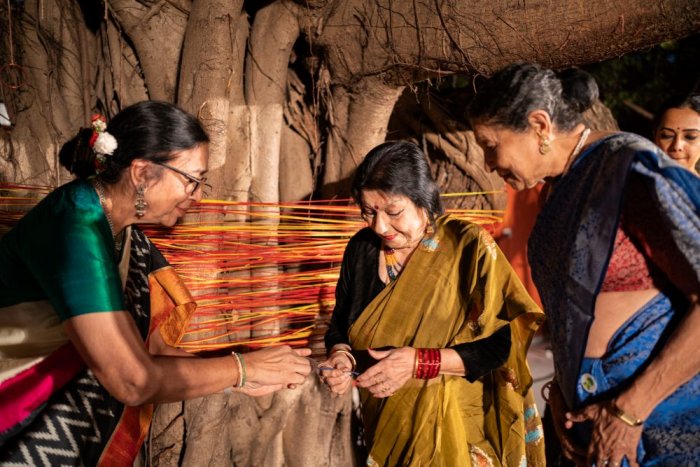 Daksha Mashruwalla, Padma Sharma, Darshana Jhaveri The event on 15th evening, commenced with a ritual ceremony of tying gungroos to the stump of a banyan tree by doyens Guru Darshana Jhaveri, a senior Manipuri artiste and Guru Padma Sharma, a senior Kathak artiste aided by Daksha Mashruwalla, a senior Odissi artiste and artistic director of Kaishiki Nrityabhasha. 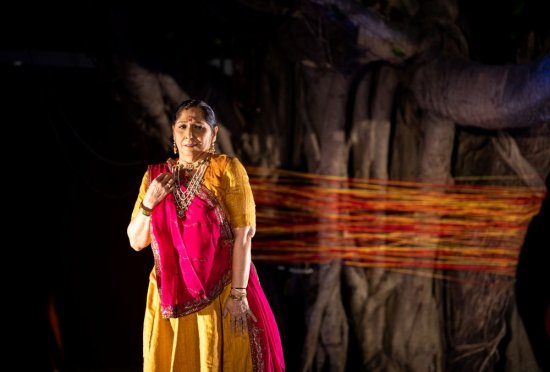 Uma Dogra Uma Dogra, a Kathak exponent, showcased her innovation that included some movements which she had learnt during her tryst with dance forms of Kathakali and modern dance. She performed a dance piece on the shloka "Daridra dukh dahnaye" in Chautaal, composition of Rishi Vashisht which described the magnificence of Lord Shiva. She adapted those movements in an electrifying sequence displaying icons of Shiva. This innovative part of mixing genres was done more with an awareness for indicating innovation, though it has been noticed that these nuances were already artistically ingrained in her earlier performances. Another addition or contribution of hers is to have included Ashtapadi of Jayadeva's Geeta Govindam to the repertoire of the Kathak style. She performed to "Dheera sameere Yamuna teere". 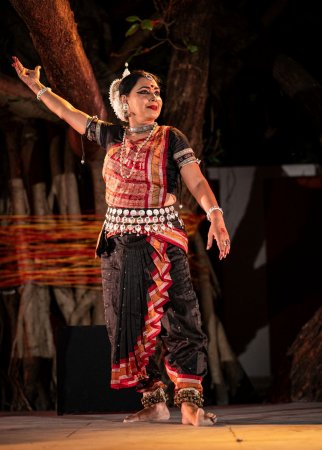 Aruna Mohanty Aruna Mohanty performed 'Pratinayaka' in chaste artistic Odissi. The innovation was a case study that validated the villain as equal to the hero. The title stressed that because of the availability of pratinayaka, the nayaka is able to deliver his divine benevolences. "I am, therefore you are". Yes, true, but does it express the important moral of "good over evil" and "triumph of truth" for healthy sustenance of the universe? In the era of Kali Yuga, the Nayaka and Pratinayaka do not exist as separate entities but coexist within every human being. When the man in Kaliyuga has to fight with conflicts within one's inner self, what feelings should he validate? Nayaka's or Pratinayaka's? The text for content was sourced from Bhagavata Mahapurana, the presentation was conceptualized by Kedar Mishra who also composed the lyrics for the production. 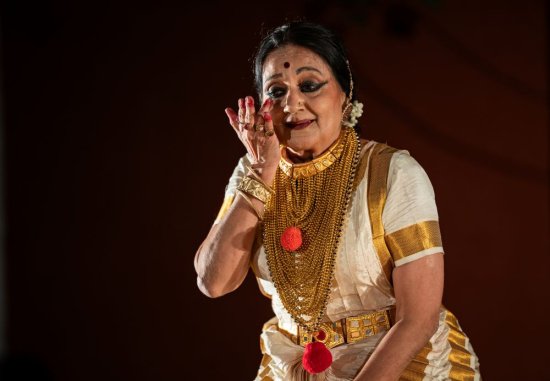 Mandakini Trivedi Mandakini Trivedi presented excerpt from the production 'Prathama Kaunteya' in Mohiniattam. She captivated the audience with her perfect Mohiniattam, delineating the story of young Kunti - her mischief of calling out Sun God, giving birth to Karna, her fears due to which she sets little Karna in the flowing waters and stood before him trying to salvage her relationship with him. Her innovation was embracing Hindi language for the script of lyrics and dialogues, which surely would help the narrative to reach out to a larger number of people. The lyrics was a creative translation of Rabindranath Tagore's "Karna-Kunti Sambad" by Late Veena Alase, music by Late Guru C. V. Chandrashekar. In the panel discussion, she explained that innovations are like seeds that are sown and when those innovations blossom and flourish well, they become part of traditions and thus the dynamic flow of the tradition is visible. Best innovations are those that unconsciously portrayed universal emotions and had a non-personal outlook. 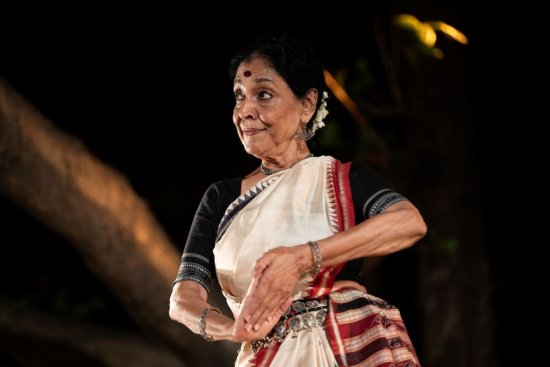 Madhavi Mudgal Madhavi Mudgal, an Odissi exponent, presented a Pallavi (raag Dhyan of Jaijaiwanti, drawn from an ancient musical text), and music composition was by Madhup Mudgal. For innovation, she had interspersed some footwork for which rhythmic syllables were very much Odissi oriented, but footwork patterns were based on tatkar and tihais of the Kathak style. She performed "Kshanamadhuna," an Ashtapadi, with great flair, for it was the right ambience for this composition to be explored through dance. During panel discussion, she spoke about her choreographies showing audio visuals of group choreography pieces where she explained her innovative choreography with emphasis on group dynamics, variation of gatis and importance of pauses. 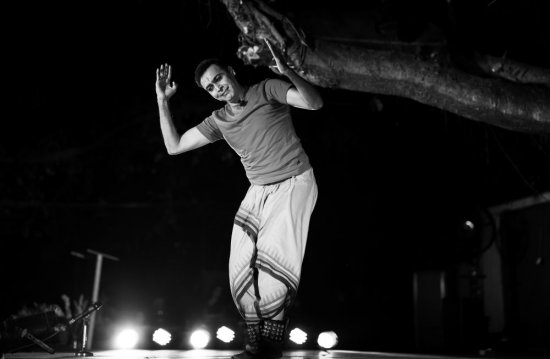 Vaibhav Arekar Vaibhav Arekar was perhaps the most innovative with his idiom of Bharatanatyam. In his production of 'Debotar Grash', a prose poem from Rabindranath Tagore poems, he depicts the story of mother and her son. The writer having seen the full production would rate it as a classic as it had a gripping performance. Sculpting of the stage with appropriate positioning and movements, a technique that got perfected when he learnt theatre, were of epic grandeur. Instances used to show the relationship of mother and son were totally soul stirring. It extensively made use of vachika abhinaya and the performance covered all four kinds of "vrittis" too. The innovation could be classified as classical dance of "Bharatanatyam-theatre style". He also presented "Greeshma", from his production titled "Seasons" which portrayed how seasons are experienced within selves. The element of angika abhinaya was explored to express the intensity of heat as an analogy to the inner turbulence of mind and yearning of the heart. Good emotional support was provided by evocative music. Tripataka hasta adavu that was interlaced in all korvais seemed like a motif for summer. Angasuddam of the group that performed was impeccable, perfect coordination was visible when they moved and the vibrant energy emanating from their limbs held audience's rapt attention. 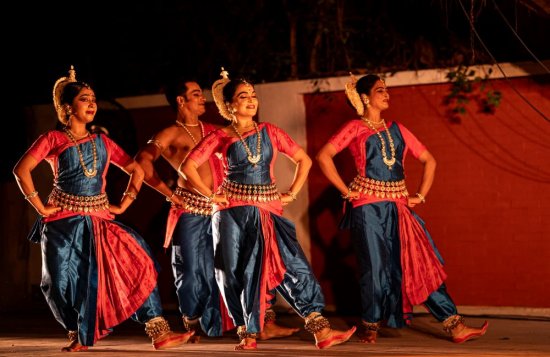 Srjan ensemble Ratikant Mohapatra, artistic director of Srjan, though adhering to the traditional art of Odissi, as taught to him by his father Guru Kelucharan Mohapatra, his innovation was to have included western instruments to the normal music ensemble of Odissi. Though the dance pieces, "Synthesis" and "Namami Gange", performed by his students was elegant with varied rhythmic patterns and usage of karanas, it was only in the panel discussion that one understood his idea of innovation. Before setting music, he had gauged the amount of speed at which the dance steps or patterns that he has choreographed could be adapted to. Then he set the music. 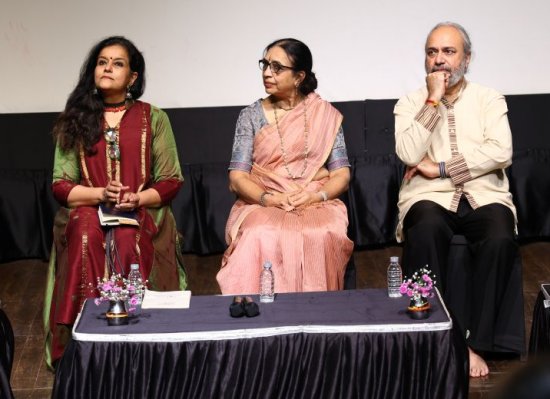 Gauri Sharma Tripathi, Daksha Mashruwalla, Ashish Khokar During panel discussion, the moderators were Gauri Sharma Tripathi, a Kathak artiste who introduced panelists (artistes) and asked relevant questions to be answered by them and Ashish Khokar who summarized key takeaways of panelists' response. Panelists were asked to speak about what aspect of the dance processes initiated them to get an idea to convey through art form of dance. How other factors like presentation method, music composition, dance choreography fall in place to convey their concept. How traditions could enhance or retard the processes of bringing originality to the presentation. How to balance tradition and modernity and discuss whether technology works as a boon or bane to carry forward innovative ventures. Final outcome of panel discussion was that, one had to learn and master the original art form they have chosen to follow, before stepping into innovations. By learning the art form from one guru, one learns the tradition. Then they can innovate with adherence to the norms the traditional dogma dictate. Thus, tradition is carried forward and sustained even in innovations. AESTHETIC INNOVATION ECHOING TRADITION AND SPIRITUAL QUEST: SANNIDHIM Photos courtesy: NCPA 'Sannidhim', a presentation conceptualized by Guru Sucheta Bhide Chapekar and the dance directed by Arundhati Patwardhan, was an aesthetic innovation echoing tradition and spiritual quest; where three classical styles - each complete in its own language, flavor and spirit were brought together. The three classical styles of Kathak, Bharatanatyam and Sattriya Nritya were led by Ameera Patankar, Arundhati Patwardhan and Devika Borthakur respectively. It was performed at the Experimental Theatre, NCPA, Mumbai on 20th September 2025. The performance was a tribute to the enchanting presence of Lord Krishna. By relating, through appropriate gestures and stances, all the virtuous deeds of Lord Krishna to protect mankind, the audience was pulled to the core of the presentation. Further, a verse from Shree Bala Mukundashtakam composed by Rishi Markandeya, was presented in Sattriya Nritya (Devika) evoking the image of beautiful baby Krishna lying on the vata patra sucking his toe. Through Kathak, Ameera invoked the loving image of Radha;Krishna; and through Bharatanatyam, Arundhati depicted the essence of Krishna as protector of mankind by relating the birth and his immediate deeds as protector of his father Vasudeva. Thus having introduced the audience to the multi-faceted forms of Krishna and idioms of dance forms, the journey of further experiencing his divine presence was carried forward by delineating varied stories of Lord Krishna. 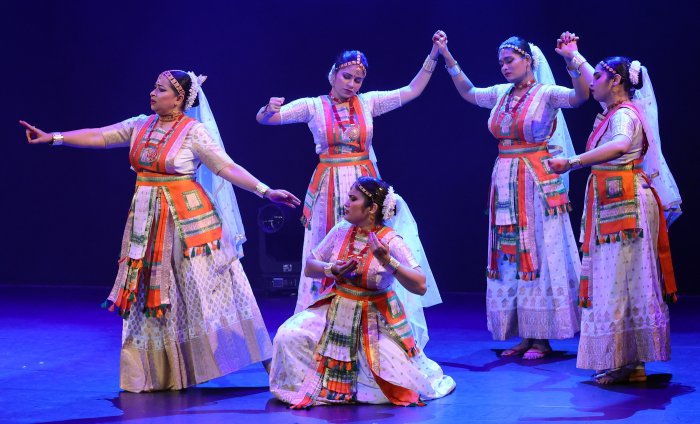 Vasudeva Sutam Krishnam Using verses from Krishnashtakam by Adi Shankaracharya, "Vasudeva Sutam Krishnam" Sattriya Nritya depicted events around birth of Krishna and killing of his evil Uncle Kamsa. This verse is also included in "Kirtan Ghox" by Mahapurush Sankaradeva who organized the ritual dances of Sattriya Nritya, to present stories from mythology to educate normal people about Vaishnava philosophy with stories of Lord Krishna. Sattriya Nritya presented small nritta pieces with good number of group formations done with great coordination and élan. These pieces were interspersed with descriptions of Krishna and gestures denoting his graces. The dance pieces were set to rhythms of Suta taal and Thukani taal, by Guru Naren Chandra Baruah and shlokas were choreographed by Devika Borthakur. They concluded this segment of Sattriya Nritya with a traditional offering to Lord Krishna set to the soothing rhythm of Kharman taal. This piece is a compulsory item that ends all dramatic performances of Sattriya Nritya. It also encompasses a request for forgiveness for mistakes done unknowingly. 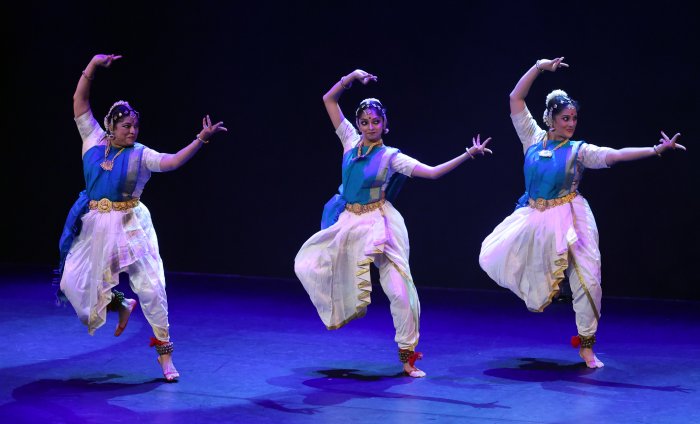 Kalinga Nartana Thillana Bharatanatyam celebrated Krishna's valour in subduing the venomous serpent that was poisoning the Yamuna river, showing triumph of good over evil. Also the five heads of Kaliya, also known as Kalinga, symbolized the five senses, the control of which was a requisite for stepping into the spiritual path. Sloka "Kasturi tilakam" was performed by Arundhati where she beautifully described Krishna's appearance and gopis' devotion towards him and followed it with Kalinga Nartana Tillana, (Gambeeranattai, adi), composed by Oothukadu Venkata Kavi. This piece was choreographed by Dr. Sucheta Bhide Chapekar and adapted for group choreography by Arundhati Patwardan. The song was well handled with apt step patterns for swaras. Gestures with apt pada bheda were used to express the padharta bhava which described Krishna in various ways. A crisp and brisk jati was interspersed to introduce the game of ball among Krishna and gopas and the fight between Kaliya and Krishna. 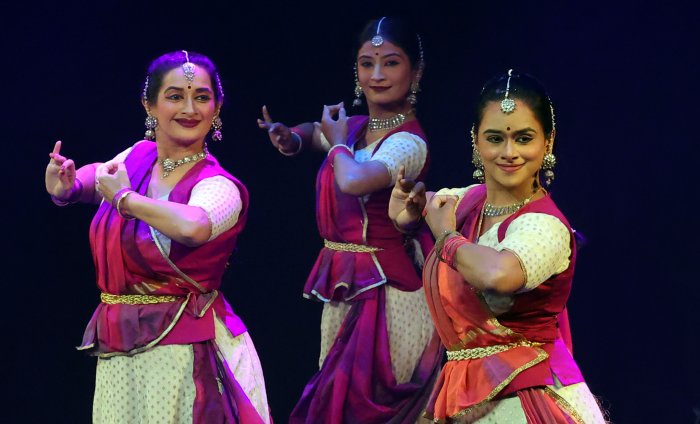 Chaturang Chaturang, an item in Kathak repertoire was performed, on "Niratata kaanha Chatarang sakhi", a traditional composition composed by Pt Mohanrao Kallianpurkar and choreographed by Guru Shama Bhate. Chaturang is structured with four antaras and each antara masterfully explores elements of tarana, sargam, sahitya and dance syllables, showcasing Kathak's elegance and rhythmic brilliance and dynamic features. Through this item the beauty of Krishna's persona wearing makar kundala, mora mukut, pitambara, vanamala, having dark hair tresses like rain bearing clouds, as Ultimate Soul among gopis and gwalas and his dance steps to rhythm of mridanga was celebrated. 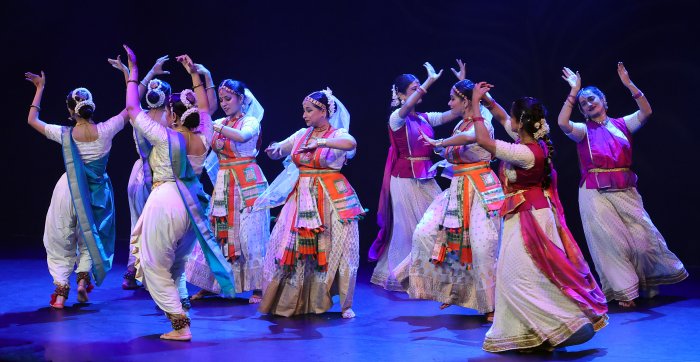 Govindashtakam Govindashtakam is an eight-verse hymn praising Lord Krishna, attributed to the 8th-century philosopher Adi Shankaracharya. It describes Krishna's eternal nature, his life as a cowherd, and his divine pastimes. Chanting these slokas is believed to please Lord Govinda and grant the devotee blessings and liberation, "pranamatha govindam paramanandam". Choosing the 2nd, 4th and 7th verses, dancers' subtlety related episodes of Yashoda being shown vishwaroopam, gopika vastraharanam, reverence of cows and Gajendra moksham. These pieces were interspersed with dance movements of namasankeertan activities like playing of cymbals and dancing in unison by all three styles to chants that hailed Krishna as the saviour and Ultimate being. A beautiful piece of dance presentation in classical genre that brought together story, rhythm, movement and devotion, thoroughly was a joyful journey ride on bhakti yoga. Co-artistes for Bharatanatyam were Sagarika Patwardhan and Rucha Khade, for Kathak were Shreya Kulkarni and Shraddha Mukhade and the Pune Sattriya team consisted of Akshata Mane, Anuradha Nalaware, Yosha Roy, and Sakshi Gaikwad. All three groups were equally strong, so the presentation made good viewing. Response * I read this review by Ms. Chandra Anand. And as I attended the event, these are just my humble observations. 1. The report accurately captures parts about what happened at the event. 2. Maybe it could go a bit deeper in terms of insights or reflections beyond the factual content, so the larger essence comes through more vividly. 3. The introduction reads somewhat generic, so a bit more detail could strengthen its purpose and vision. This would help all of us to use this as a reference for learning and for future adaptations. - Piyali Dasgupta Satish (Dec 7, 2025) 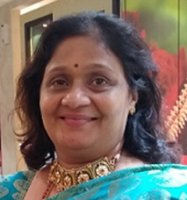 Chandra Anand is a Bharatanatyam artiste and teacher. She has an MA in Bharatanatyam from Tilak Maharashtra Vidyapeeth, and her series on 'Education in spiritual values through Bharatanatyam' is featured in narthaki.com. |
