|     |
|
| |

 Nadamrutham and 31st Chaube Maharaj Mahotsav- Vijay Shankere-mail: vijaydance@gmail.com December 3, 2025 Nadamrutham was a visual prayer addressed to her legendary Guru T.S. Kadirvelu Pillai by Dr Lata Surendra, the city's senior Bharatanatyam dancer for over six and half decades at the Cube of Nita Mukesh Ambani Cultural Centre, in Mumbai on 24th October. Known for establishing a one to one connect with the audience, Dr Lata Surendra in her signature style laced with humour led rasikas to the pulsating romance of rhythm, poetry of love in union and separation through the times. "The Nadamrutham cosmos within the Cube has two 'suns' today," she said, drawing attention to crisp nattuvangam by Kaliswaran Pillai and mridangam by Mumbai K Dakshinamurthy - the two talented suns creating waves in the rhythmic world of dance today - the Sangeetamrutham by mellifluous vocalist N.N. Shivaprasad, the stirring violin by Satish Seshadri and mesmerising flute by Bharat Raj. 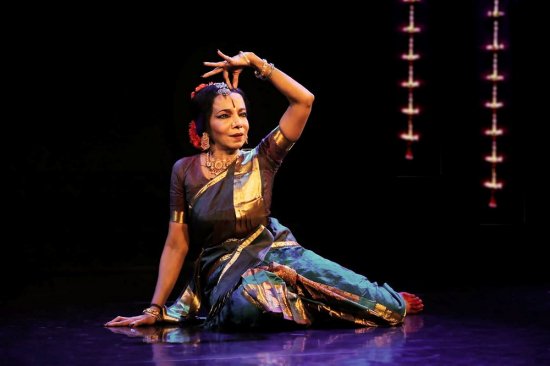 Lata Surendra The performance commenced in a unique way through a choreography highlighting the eloquent poetry of silence and sound. One could hear Lata's meticulous and strong footwork resonate all around the Cube through an intricate calculation of her distinguished mentor, which then unfolded the supreme effulgence of the Guru who awakened in her the truth of unity and the universe as an unfragmented reality embracing the one life force in all through an ongoing cyclic order 'Akhanda mandalakaram'. Vivid sancharis brought out the deep truth cushioned in timeless lines by Adi Sankaracharya. One often sees dancers only touching on the superficial padartham of the lines but the artiste drew attention to every word in the lines, culminating in the greatness of the Guru - leading her from light to light through lighting of the lamp within the temple of her heart. It opened out the pathways to notes embracing the ragam Vasanta and a visually arresting Jathiswaram item not done by any of the senior artistes today. The Jathiswaram by Tanjore Quartet was a visual delight and intriguing by virtue of its obvious cross rhythmic patterns in rupaka talam woven by Guru Kadirvelu Pillai. The nattuvangam by Kaliswaran and mridangam by Dakshinamurthy with the complimenting vocals had all senses engulfed in the bliss of Nadamrutham. What one marvelled at was Lata's unflagging stamina. Post each item, she simply walked over to the mike to reach out with eloquent details about the ensuing item. With a sense of humour that went well with the receptive audience, she recounted the cyclic drama of life replayed over and over in age-old chronicles of love. The padam, "Netrandi nerathile" in Huseini by Subbarama Iyer, a prolific composer of Tamil padams in the late 19th century, was a visual delight. Lata explained to the audience how, be it the realm of the Gods or humans, the age-old lover's tiffs show 'shy sweetness of that first meeting or distressful tears of farewell,' the plot embracing all navarasa continuing to engage life all around. She highlighted how the ragam Huseini was just ideal for gentle roasting by the "uttama nayika" confronting her Lord Karthikeya. She beautifully brought out through a variety of ways the question that the Nayika gently kept nudging her beloved with as a refrain - "in that golden twilight hour as women were bathing and as all nature sought to settle for the oncoming night, who was she who kept seeking your attention and beckoning you towards her?" Lata took up another composition in Saveri by the same composer to underline how a proper Khandita nayika, irate with the endless deception of her Lord, confronts him with packed levels of sarcasm through evocative sancharis. 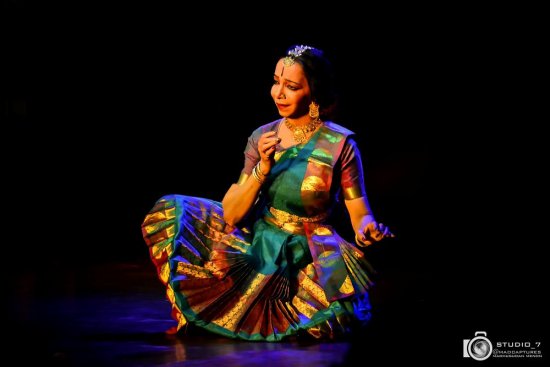 Lata Surendra The varnam in Anandabhairavi, adi talam by Sivanandam of the Tanjore Quartet was the highlight of the evening. The mathematical patterns in the nritta sequences of varnam was unique with mridangam moras that were created by her Guru instead of jathis. The flourish and ease with which Lata tackled these merited an ongoing applause from the audience that was totally captivated by the chemistry between the orchestral support and the dancer. With expressions and movements, the artiste brought to life the Nayika's longing for her Lord Rajagopala. Persuasion on one side, reluctance on the other, longing on the one side and indifference on the other... there were fresh analogies drawn in the description of her Lord. In the highlighting of lyrics, Lata mentioned how reading enriched and enhanced the depth vital to explore the content in the lyrics. It was interesting to see her apply Surdas's etching of how futile it was to compare Krishna to the world created by him alone. The lotus and fish escaping to waters shying away from the beauty of his eyes, the moon hiding in dark clouds seeing his effulgent face, the snakes slithering away to dark holes seeing the sinuous strength of his hands. The dilemma of Arjuna too 'To be or not to be' was very poignantly brought out in a command performance. The12th century poet Jayadeva's Ashtapadi "Priye Charusheele" in ragam Vasanthi was deeply stirring and performed with intensity and sung with feeling by the vocalist, wherein Krishna, after causing Radha pain, pleads for her forgiveness with deep love and humility, culminating in his earnest request to place her feet on his head. This act represented his complete surrender unto Radha. The sublime union of Krishnamayi Radha and Radhamayi Krishna, unfolded to a Thillana in Behaag by Ponniah Pillai. Nadamrutham truly impacted one and all present. What stayed long after the performance was the deceptive ease with which Dr Lata Surendra navigated the most demanding sequences all through the performance. Witnessing her sustain that intensity was a lesson in dedication, a visual testament to the sentiment that, 'True artistry isn't just about what is seen, but about the unseen strength that makes the impossible look inevitable.' 31ST CHAUBE MAHARAJ MAHOTSAV Kala Kriti Kendra and Mahaan Nrityangana Sitara Devi Gurukul organised the 31st Chaube Maharaj Mahotsav to celebrate 105th birth anniversary of Kathak queen Sitara Devi to project the traditional lineage of Pt Sukhdev Maharaj, father of Sitara Devi and also to pay reverence to great mentors like Pt Chaube Maharaj, Sitara Devi and Pt Sukhdev Maharaj of the Banaras Gharana in the Kathak style with Kathak performance by veteran dancer Jayantimala and her disciples at the Rangshila Theatre, Andheri, Mumbai on 9th November. 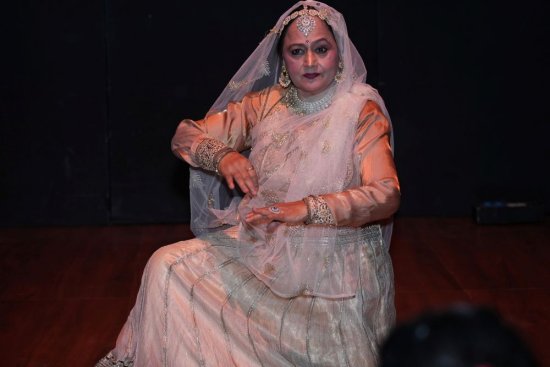 Jayantimala Sitara Devi was the daughter of Acharya Sukhdev Maharaj, who was a Sanskrit scholar and priest and was particularly credited for his poetic renditions which was transformed into interpretative dance pieces known as 'kavits'. While Sitara's father hailed from Benares, her mother belonged to the royal family of Nepal. Sitara was called "Dhanno" in her formative years as she was born on the auspicious day of Dhanteras pertaining to the festival of lights - Deepavali. Along with sisters Tara and Alaknanda, her father encouraged them to learn classical Kathak and music at a tender age, in spite of the stigma that was attached to classical dance but the turning point in her career came when she was still a teenager and danced in the presence of poet laureate Rabindranath Tagore, who was completely mesmerised by the devotion and the confidence of the young dancer and bestowed her with the title "Kathak Queen". After arriving in Mumbai, Sitara danced and acted in Mehboob Khan films that enhanced her popularity. Thereafter, Sitara Devi performed extensively both in India and overseas, winning national awards and international acclaim. The lineage passes on to her daughter Jayantimala and Rishika Mishra. 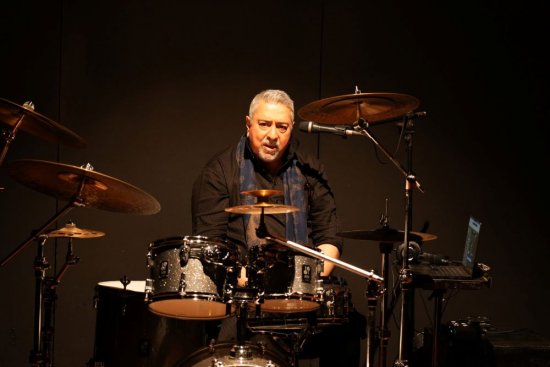 Ranjit Barot The program commenced with Ganesh Vandana presented with percussion music by well known music composer and drummer Ranjit Barot, son of Sitara Devi and associate of the famous music composer AR Rahman, followed by Kathak performance by Jayantimala, Nupur Bhargav and other students. Besides Durga Stuti and Chaturanga, Jayantimala and her disciples revealed their command over the technique of Kathak and intricate rhythmic patterns pertaining to tatkaar, tukde and expressional numbers like 'paran' and 'kavits' in teentaal and other rhythmic cycles. "Kanhaiya ye kya jadu" dealt with the magical persona of Krishna as he dances with Radha and the Gopis. It was quite an enjoyable performance, witnessed by a packed gathering. The dancers received fine musical support with Amit Mishra on tabla, Somnath Mishra on vocal and Abhishek Verma on padant and pakhawaj. It was a pleasant musical evening, organised by Rajesh Mishra on behalf of Kala Kriti Kendra. 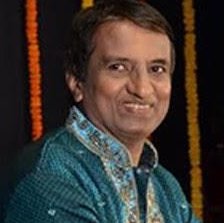 Vijay Shankar is a Kuchipudi and Kathakali exponent, teacher, bilingual journalist, arts critic and actor. |
