
|     |
|
| |

 Samyog: A divine confluence of Manipuri and Odissi at NCPA- Dr. Rohini Dandavatee-mail: dandavate2@gmail.com November 24, 2025 The National Centre for the Performing Arts (NCPA) in Mumbai has launched the Umang Series, a bi-monthly initiative curated by Swapnokalpa Dasgupta to offer year-round performance opportunities for promising young dancers. On November 20, 2025, four emerging artists took the stage, each illuminating their individual dance traditions in a vivid tapestry of rhythm, grace, and emotion. The evening opened with Abahani, a Rang Puja performed by Krishnendu Saha from Udaipur. A solemn invocation of the divine spirit within, the ritual unfolded through the lighting of the yagna, followed by arati and pushpanjali, transporting the audience to the tranquil temple landscapes of rural Odisha. Chants by Sangeeta Gosain - rooted in the liturgical traditions of Odishan priests - merged seamlessly with the resonant mardal of Bijay Kumar Barik and the delicate shimmer of the manjira. The result was an atmosphere steeped in devotion and meditative stillness. Conceptualized and choreographed by Guru Sharmila Biswas, the piece bore the imprint of her engagement with Odisha's ritual performance vocabulary. 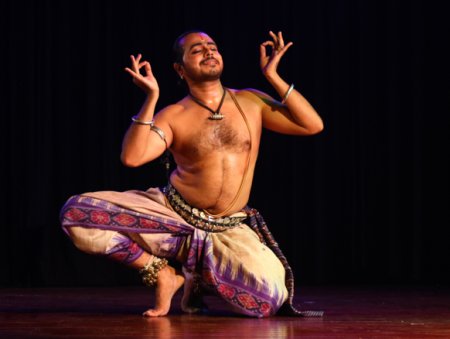 Krishnendu Saha (Photo: R.N. Sudhi) Building on this spiritual beginning, dancers Thingom Brojen Kumar Singha and Krishnendu Saha, guided by Sharmila Biswas's ideation unfolded a vibrant rhythmic dialogue between Manipuri and Odissi. Through mukhobols in the Manipuri idiom and banis in the Odissi style, the two artists revealed an intricate sense of order. Here, "order" echoes Christopher Alexander, Austrian-born British-American architect, design theorist, and emeritus professor at the University of California, Berkeley, known for his work on The Pattern Language Movement wherein he discusses The Nature of Order as not a rigid geometry but a living, breathing quality that awakens feeling and well-being. In this piece, the interplay of pung, vocal recitation, and manjira shimmer embodied that principle: strong centers, resonant boundaries, and subtle rhythmic gradations animated their exchange with palpable vitality. With the stage thus attuned, Krishnendu next presented the Meera bhajan Hari tuma haro jana ki peer. Set to the soulful composition of the late Debashish Sarkar and sung by Lalita Sharma, the choreography by Sharmila Biswas wove together mythic narratives - the fateful dice game of the Mahabharata, Prahlad's unwavering devotion, and Gajendra Moksha. Krishnendu's expressive clarity made each transformation fluid, illuminating the triumph of divine intervention over human suffering. 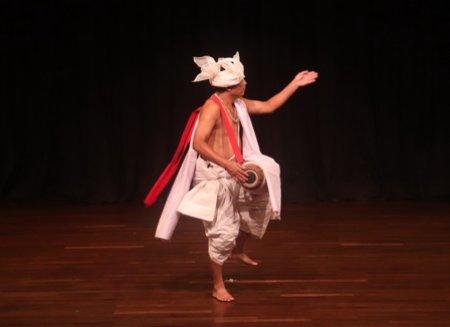 Thingom Brojen Kumar Singha (Photo: R.N. Sudhi) Thingom Brojen Kumar Singha then shifted the mood with a spirited celebration of Manipur's Yaoshang festival. His performance, at once ritualistic and exuberant, carried the audience into the heart of the festival's devotional joy. Through buoyant leaps, swift turns, and agile flips, he embodied both its sacred vigor and festive radiance. The finale of the first segment burst forth in a joyous confluence of Odissi's kinetic dynamism with the pulsating rhythms of the Manipuri pung. In this celebratory crescendo, the two traditions fused into a whirlwind of rhythm and movement, bringing Samyog to its thematic culmination: the beauty of union, the harmony of tradition, and the enduring power of Indian classical dance. Throughout this segment, Krishnendu animated his Guru's choreography with sensitivity and finesse, each movement echoing her artistic vision. Sharmila Biswas's research into Odisha's rural traditions, her attention to nuance, and her uncompromising training methodology were evident in every gesture. Thingom Brojen's presence enriched the dialogue, transforming the stage into a living weave of devotion and rhythm. Together, the dancers and audience entered a shared contemplative space - where rhythm became prayer, movement became meditation, and art became a bridge to the sacred. SAHACHAARI: DEVOTION, RHYTHM, AND THE ART OF TOGETHERNESS The second half of the evening sustained this artistic momentum as Archana Basu and Monaswini Mohanty opened with an invocation from the Jagannatha Ashtakam. The mellifluous verses blossomed through their gestures, each movement imbued with devotional clarity. The synthesis of voice, rhythm, and choreography fostered a serene yet powerful atmosphere, guiding the audience toward the spiritual core of the composition. 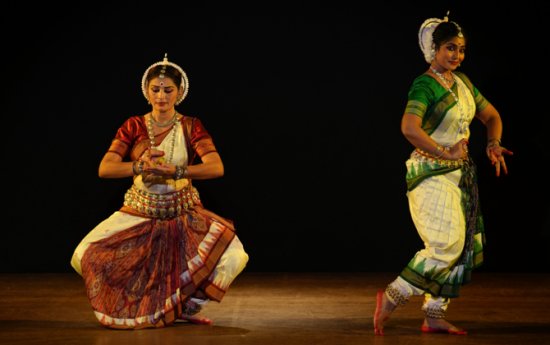 Archana Basu and Monaswini Mohanty (Photo: Praful Ghatvisavi) The dancers then presented the Gatibhed Pallavi, a dazzling exploration of rhythmic architecture. Guru Kelucharan Mohapatra's choreography navigates all five gatis - tisra, chaturasra, khanda, misra, and sankeerna - interlacing them with precision and lyrical intelligence. Set to raga Bageshri and tala Ektali with music by Pandit Bhubaneswar Mishra, the piece remains a benchmark of rhythmic ingenuity. Basu and Mohanty brought remarkable control to the shifting patterns, making the mathematical elegance of the work deeply engaging. Their performance was beautifully supported by Rohan Dahale's energetic mardal, Jateen Kumar Sahu's evocative vocals, and Vijay Tambe's lyrical flute. The program continued with a Janana performed by Manoswini - an intimate prayer by poet Dinakrushna Das. The verse "Jagabandhu he samanta nahi nahi ta" expresses boundless devotion to Lord Jagannath. Manoswini's choreography translated the poet's imagery into delicate gesture and expressive storytelling: Yashoda's vision of the cosmos in the divine child, Krishna subduing Kaliya, and the poet's surrender at the Lord's lotus feet. Set to raag Jhinnjoti and taal Addatali, with music by Jateen Kumar Sahu and rhythm by Rohan Dahale, the piece exuded devotion and poetic depth. This was followed by an Ashtapadi, "Yahi Madhava Yahi Keshava" from Jayadeva's Gita Govind, performed by Archana Basu. Guru Kelucharan Mohapatra's choreography and Pandit Bhubaneswar Mishra's musical composition have long been cherished, and Archana rose to them with elegance and emotional sensitivity. The evening concluded on a jubilant note with Ananda Tandav, a duet celebrating the blissful union of Radha and Krishna. Trained under the watchful eyes of Guru Debi Basu, Archana and Manoswini danced with harmonious synchrony, their movements suffused with joy, devotion, and playful charm. In its entirety, the evening offered a thoughtfully curated encounter between two classical traditions - Manipuri and Odissi - each deeply rooted in Vaishnava philosophy. The program not only highlighted their distinct aesthetics and rhythmic vocabularies but also illuminated their shared spiritual ethos. Through layered choreography, expressive musicality, and refined performance, the four artists created an immersive experience in which devotion, artistry, and narrative beauty converged. For the audience, rhythm became prayer, movement became meditation, and the timeless radiance of Indian classical dance revealed itself in full splendor. 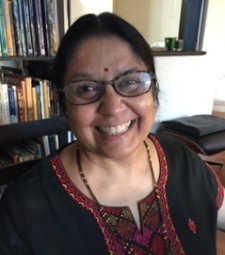 Dr. Rohini Dandavate is an Odissi dance practitioner with a Ph.D. in Cultural Policy and Arts Administration from The Ohio State University. Born in Cuttack, Odisha, she trained at Kala Vikash Kendra under renowned gurus, including Dr. Menaka Thakkar, Guru Raghunath Dutta, Guru Ramani Ranjan Jena, and Guru Kelucharan Mohapatra. She develops workshops and curricula that use traditional arts to promote cultural understanding and has created multimedia resources for Odissi students and teachers. Her publications explore topics in Odissi dance, arts administration, cultural policy, and dance education. Through her work, Dr. Dandavate fosters meaningful engagement with Odissi and world cultures. |
