
|     |
|
| |

 Naman Festival celebrates Odissi- V.V. Ramanie-mail: ramanigaru@gmail.com Photos: Srivatsa Shandilya November 22, 2025 The two-day annual festival 'Naman' presented by Madhulita Mohapatra at ADA Rangamandira, has become an important annual event that people look forward to in Bangalore. With strong support of her students, she ensures that the presentations are packaged and presented in a very professional manner. 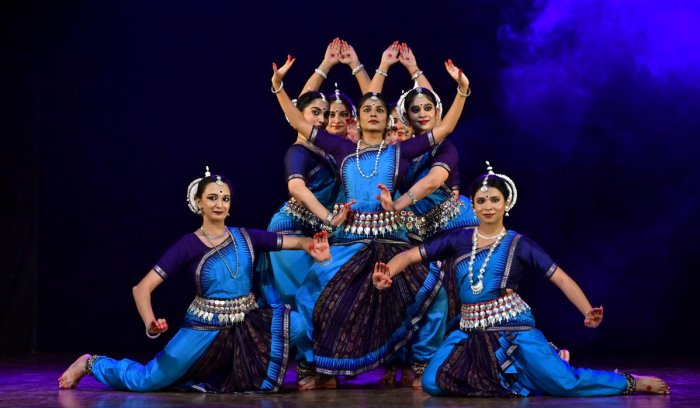 Shivam Dhimahi As always, this year's presentation also began with performances by students of her school Nrityantar', where the viewers were treated to an array of solo, duet and group presentations, showcasing the beauty of Odissi art form. Opening with a vibrant composition "Shivam Dhimahi" the varied attributes of lord Shiva and the Gangavataran and Neelkanth sequence were interwoven into the narration, and the dancers did a commendable presentation marked by good coordination and rhythm. The Pallavi, a pure dance number marked by rhythmic bols and sculpturesque stances is an important part of the Odissi dance repertoire. The Malhar, and Darbari raga pallavis choreographed by Madhulita Mohapatra, were interspersed between Abhinaya and thematic songs for rhythmic fervour in an engrossing manner. The beautiful movements and finesse of nritta highlighted the sincerity and commitment of the dancers. The story of Radha-Krishna, their deep love, the varied emotions like deep passion, jealousy, anger, remorse that go with it, have been a popular theme for many of the dance compositions in this style. There were a few solo abhinaya pieces on this theme, that were performed by the senior dancers of the school. The emotions expressed by the sakhi who sighted the Image of Radha Krishna in the Chandan Jatra processions was portrayed with conviction by Saanvi Sahoo for the Odiya song "Dekhago Radha Madhava Chaal" by Banamali Das. 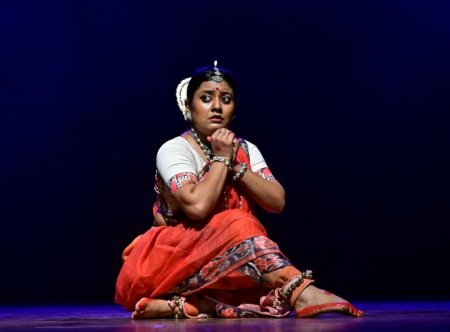 Anjali Raj Urs Anjali Raj Urs's portrayal of the emotion of Radha who is all decked up and waiting in the Kunja, frustrated and annoyed by Krishna's failure to keep up his promise of meeting, was a sensitive depiction of rejection in love. The transition from hope to despair, culminating with Radha tearing off her garland and throwing it in the river Yamuna was a memorable moment of visualisation. This Odiya song "Basi mo hoila phula seja" was choreographed by Aruna Mohanty. A counterpart to this was the song "Sajani" performed by Dr Sreemanthini Das, where it is Krishna who is pining and grief-stricken in separation. The depiction of Krishna and Sakhi was danced with clarity bringing out the masculine and feminine shades in a fine manner. Equally engrossing was Amrita Sharma's portrayal of the scenario of love moods in "Dheera Sameere". Debarati Dutta in her rendition of Radha's s reminiscence of her tryst with Krishna for the song "Sakhi hey" was appealing. 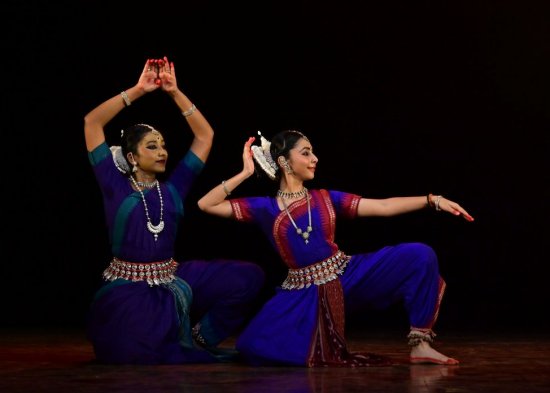 Angeleena Avnee & Aditi Das The Talamalika - Ragamalika presentation 'Colours of Krishna' detailing episodes from the life of Krishna like stealing butter, mischievous pranks being played, listening to the lively melody and getting enchanted by the enchanting melody on flute and finally the Tandava dance on Kaliya's head, was danced by two talented girls Angeleena Avnee and Aditi Das, with fine graceful movements and expressive communication through their abhinaya. A nice performance by young kids Maya and Mrida narrated the story of Narasimha avatar. From the depiction of dark clouds to the raindrops falling like the pearls disentangled due to the love making action of the apsaras, the gushing waterfall, dancing peacocks, the entire sequence of this performance capturing the mood of the season was choreographed and danced in a poetic manner. A fine blend of music and movement, this song was choreographed by Madhulita Mohapatra. Yet another presentation that impressed was 'Panchabhuta' highlighting the power of the five elements through interesting group formations and friezes choreographed in a creative manner by Aruna Mohanty. Day 2 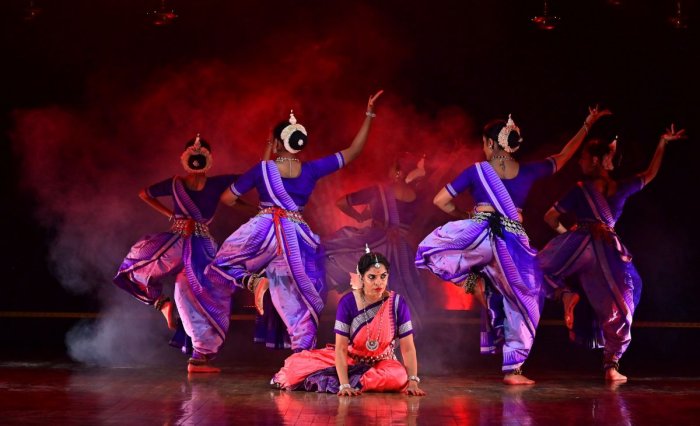 Draupadi's Mahabharata The second day of this festival focuses on showcasing performances by professional practitioners of Odissi, either as solo or group performance. The first performance of the evening was the group presentation by Nrityantar ensemble of 'Draupadi's Mahabharata.' Beginning with an introduction of Draupadi as a woman of great strength entering the battlefield, the sequence moved on to the storyline - Swayamvara, Game of Dice, humiliation and finally Kurukshetra war. Combining Sanskrit verses and Odiya verses by Kedar Mishra, musical score by Rupak Kumar Parida, rhythm composition by Dhaneshwar Swain, the choreography was by Madhulita Mohapatra. The sequences were visualised in an engrossing manner, marked by well knit group movements, geometric formations, powerful nritta and excellent coordination. Besides Madhulita as Draupadi, characters of Arjuna, Krishna, Shakuni, Duryodhana, Dushasana, Karna, Abhimanyu were danced by artistes whose abhinaya brought these characters to life through their dramatic portrayal. Finally, the moment of Draupadi's introspection and question - What remains after the bow and arrows are lowered and the sounds of war drums fall silent? This was a powerful soliloquy stating about the futility of hatred and war and the emotional turmoil ranging from rage, grief to reflection and stillness was visualised with great sensitivity and dignity by Madhulita. 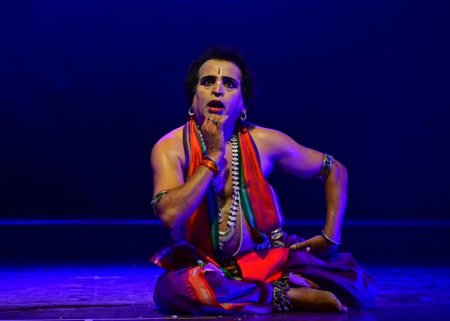 Guru Gajendra Panda Guru Gajendra Panda, a celebrated artiste from Bhubaneshwar, began his solo performance with ' Lakshmi Narasimha Dhyana'. His movements with a distinct folk flavour,,moved between moments of quietude to vibrant dramatic accents. The rhythmic footwork, quick transitions differentiating the main characters of Hiranyakashipu and Prahalada, made it a dramatic portrayal. "Manavadharana" by Upendra Bhanja was an intense abhinaya oriented composition, highlighting popular episodes of divine rescue like Krishna as saviour for Draupadi, and Gajendra moksha. The stories were explored with clarity of movements and emotion. 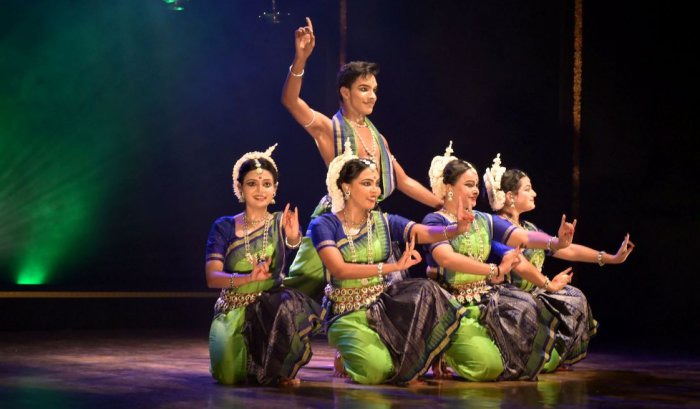 Soor Mandir ensemble The beauty of group dancing marked by aesthetic choreography and synchrony of movements in the presentation of three items by students of Dr Jyotsana Sahoo made a strong impression. Beginning with "Ganapathyam" a well knit narrative offering as a prayer to Ganesha, the beauty of tribhangas, choukas of the Odissi style of dancing came alive in the Kalavati pallavi that followed. The young dancers with well-coordinated movements and poses, were impressive. The grand finale "Ranga Charana" was an interesting composition ideating on the idea of total surrender to the lotus feet of the lord, where devotees seek his help to be freed from the bondage of worldly pleasures. Episodes of Ahalya, Guha the boatman in Ramayana and Krishna-Kaliya episodes were woven into the narrative. The festival concluded with Alliance University Performing Arts Colloquium, where ideas related to the world of dance and its practitioners, and practices were discussed in the panel consisting of V Kaladharan, Tapati Chowdhurie, Kedar Mishra, V. V. Ramani, Ashish Khokar and Romal Singh. Naman is indeed a festival that celebrates Odissi with great zeal and passion. 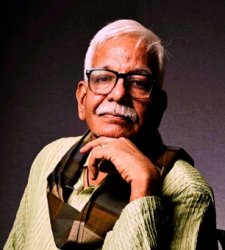 V.V. Ramani is a Chennai based multi-dimensional artist working in diverse fields ranging from collages and painting, teaching art, textile and costume designing, stage sets designing and wedding decor, to writing on visual and performing arts. |
