
|     |
|
| |

 Samarpanam - A dance tribute for a beloved father- Dr. Varsha Shridhare-mail: varshaishere@gmail.com November 21, 2025 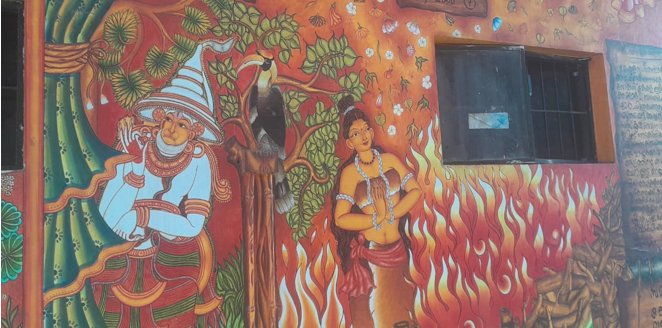 Mural of a scene from Ramayana on one of the walls at the Kerala Sangeetha Nataka Akademi On a balmy evening in November, I found myself in Thrissur's Kerala Sangeetha Nataka Akademi watching the annual performance of the Aatmalaya Dance Academy based in Bangalore. The chairperson of the academy, Dr. Padmaja Suresh, had conceived of a very special performance in Thrissur as a tribute to her father Chakyar Rajan, a passionate proponent and artiste of the Chakyar koothu, a classical Kerala style narration of stories in the form of song, dance and drama. It has been 10 years since the Chakyar Rajan Memorial Award, awarded to extraordinary music and dance artistes, albeit unsung in the mainstream, and often supporting senior artistes with economic duress. The award was instituted in his memory by the Aatmalaya Academy and Dr. Padmaja wanted to mark this anniversary with a tribute to him in his hometown, a first for the Academy, which has thus far held 8 of the anniversaries in various avenues in Bangalore and the one last year at Narada Gana Sabha in Chennai. The two and a half hours or so that we the audience spent in the welcoming environs of the Akademi were truly illuminating and humbling. In addition to talks by Retd Chief Justice Sriram, Dr. Padmaja's brother, in which he outlined his father's ofttimes challenging but always inspiring journey into the Chakyar koothu traditions and his father's impact on his life, there were also talks by the chief guest of the program, The Honorable Shri Devan, Justice of the High Court of Kerala and the 3 awardees of the Aatmalaya annual awards: Pottayil Narayana Chakyar, a renowned exponent of the Chakyar koothu art form for over five decades, who was bestowed with the Devika and Chakyar Rajan Memorial Award; Kunjaru, a musician and instrumentalist who was bestowed with the Kokilam and Shankari Award; and P.S.Krishnamoorthy, a vocalist who was bestowed with the Aatmalaya Vaggeyakara Award. One of the reasons this event was exciting was the opportunity to watch 3 artforms in one session: Bharatanatyam, Odissi and Mohiniattam. 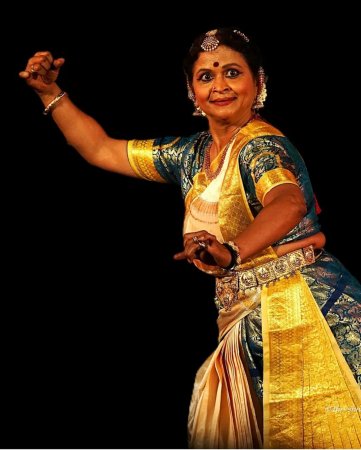 Dr. Padmaja Suresh The first dance of the evening (before the award ceremony) was Dr. Padmaja's solo to Mahakavi Subramanya Bharatiyar's paean to Goddess Kali. This is a fairly short and sweet song hailing Kali as being in everything. But the dancer's ability to imbibe the song with so many layers of meaning - Kali in nature, in the trees, in the flowers, in animals, as a mother, as a child, as the energy that flows through everything and everyone was captivating. A mark of any great dance is a renewed and deeper understanding of the song in the watcher and this was definitely true in this case through the richness of the detail she evoked in her performance. After the awards was the first group performance with the senior and junior students of Aatmalaya Academy, to a song on Lord Ganesha. It was riveting to see the individual personalities emerge from within the group dynamics. It is heartening to see that even in this day of social media and relentless phone usage, there is still interest among young girls in learning a traditional art form. There were 8 kids of varying ages and dance experience on the stage and Dr. Padmaja is to be commended on her energy and ability to give a chance on the stage to all these kids with such diverse skills and experience without losing the seams of or fragmenting the overall dance movement. Other than some placement issues between the dancers, the synchronization, the rhythm and the beat were kept meticulously by all and it was a joy to watch them perform the Ganesha Kautvam. 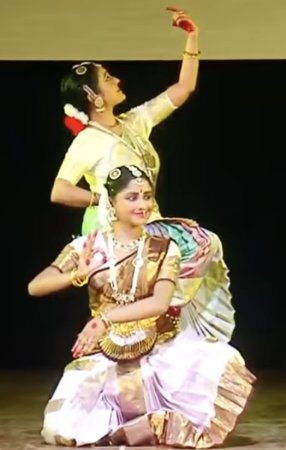 Aarya and Sreya performing to Natesha Kautvam This was immediately followed by a short performance by two of the senior students. Both were more experienced than the younger ones that performed earlier, with very distinct individual styles of performance, both imminently capable. The performances were very strong. 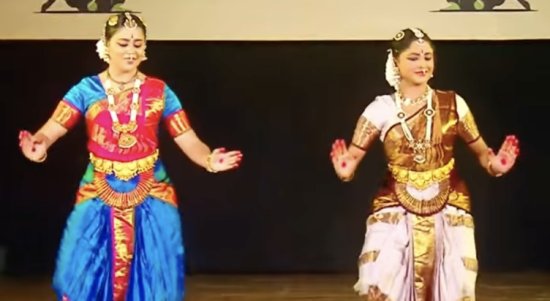 Aparna Doddamallur and Sreya S dance to Durga Devi stuti The 3rd performance was also a duet, between an even more senior and highly experienced student and one from the previous performance, on Kali and Kamakshi Kautvam, the music for which was composed by one of the awardees, Krishnamoorthy and after that, on Narayani Stuti (also called Durga Devi Stuti). Personally, this duet was probably the most memorable and transfixing performance: the individual strong performances, the dramatic energy of one countered by the serene and more gentle energy of the other were the perfect combination to describe the Mother Goddess. This dance evoked a lot of feelings and reminded me of a woman's journey in life: the early innocence, a gentle expectation of nurture and tenderness, then adulthood with real world injustice and the righteous anger that burns inside, and finally, a hope for wisdom through resolution of internal angst. The innocence, the tenderness and gentleness were captured beautifully in the younger dancer's depiction while the older dancer's emotions and eyes showed that depth of suppressed feelings, of righteous anger born out of unjust treatment. The musical climax and the dance highlighted the resolution experienced when the Goddess kills the demon Mahisha (the source of injustice, angst, anger and negativity). The heightened emotions after the Kali - Kamakshi Kauthvam and Devi Stuti were counterbalanced by the performance by the younger kids on Krishna's antics through a Krishna Shabdam. This marked the end of the Bharatanatyam performances. 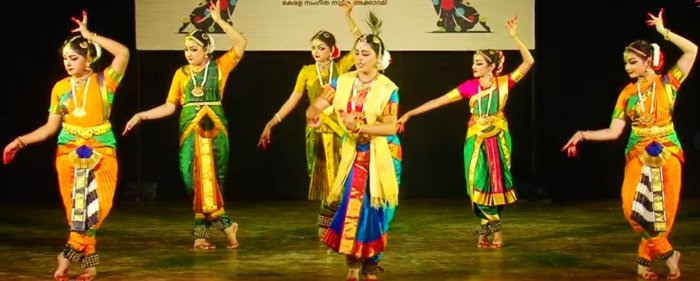 Divya, Ayra, Dyuti, Durga, Pranathi and Aarya dance in Krishna shabdam Sarita Mishra, noted Odissi performer, mentor and scholar, transfixed us with a rendition of the story of Ganga from the time of her descent from heaven to earth: from Bhagiratha's penance, Shiva's trapping and controlling of her powerful and uncontrollable fall, her flow on earth, her nurturing of our people and her recent pollution from human greed and negligence. Once a river of purity and grace, she cries for her own revival, pleading for humanity's compassion and respect. The melodious tune and composition by Prof Ramahari Das and K Ramarao Patra were a perfect accompaniment to this slow, reflective, and profoundly moving dance performance. As someone who has traveled to the Himalayas to see the Ganga and observed its pollution at places like Kanpur, this particular performance struck a chord. Sarita's expressions and movements were extremely heart-rending. 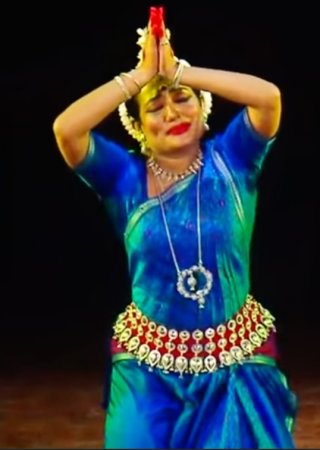 Sarita Mishra 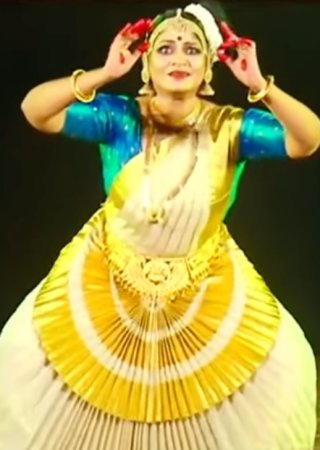 Swapna Rajendrakumar The final dance performance of the day was by Swapna Rajendrakumar, a noted Mohiniattam artiste. She danced to a varnam choreographed by her guru Kalamandalam Kshemavathi on Manjula, an ardent devotee of Lord Guruvayoorappan, and the glory of the banyan tree Manjulal named after her. Upon seeing the temple doors closed, Manjula feels sad that she cannot offer the garland she has made to Guruvayoorappan, and upon a venerable sage's advice, places it with devotion around a banyan tree, which she then finds around the Lord's neck the next time the door opens. In the light of the previous performances, I couldn't help but notice the thread depicting nature as divinity that ran through all the dances: be it trees or water or flowers or animals, each performance in this event highlighted the oneness between divinity and nature. This thought is integral to our culture and is a constant underlying theme in our ancient thought. Thus, this event underscored another reason for the enduring legacy of our ancient traditional dance forms - they remind us of our connectedness to Mother Earth, the Shakthi within, to Nature and to each other. 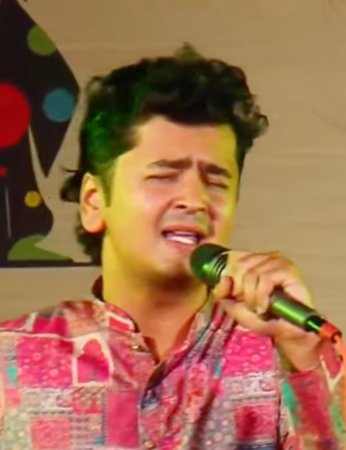 Sarvesh The event was brought to its fitting conclusion by a music performance by Dr. Padmaja's son, Sarvesh. His choice of music was, appropriately, "You Raise Me Up" by Josh Groban, a song in praise of supportive family and friends. With this, the event was brought to a close and we left it feeling energized and fulfilled. Dr. Varsha Shridhar is a public health practitioner and molecular biologist with an ardent interest in the fine arts. |
