
|     |
|
| |

 Mahakali - When time takes a breath- Pasumarthi Kumara Dattae-mail: datta.pasumarthy@gmail.com November 21, 2025 (Performed at Bangalore International Centre (BIC), Bengaluru, on 31st October 2025.) In a compelling confluence of myth, movement, and music, Mahakali emerged as one of the most evocative dance productions in recent times. Rooted in the classical vocabulary of Kuchipudi and enriched with the dramatic narrative essence of Kuchipudi Yakshagana, the production achieved a rare balance of tradition and contemporary imagination - a work where Time itself seemed to assume corporeal form and dance. 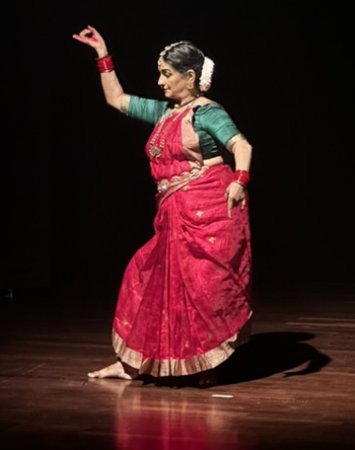 Dr. Anuradha Tadakamalla Conceptualised and choreographed by Dr. Anuradha (Jonnalagadda) Tadakamalla, produced by Art India Foundation, Mahakali bore her characteristic depth - spiritual, aesthetic, and philosophical. D. S. V. Sastry's music served not merely as accompaniment but as the inner pulse of the performance, weaving rhythm and melody into every gesture. Together, they shaped an experience that transcended the frame of performance and entered the space of rasotpatti - that refined aesthetic state where art and emotion coalesce. The production opened with verses from the Devibhagavatam, introducing the audience to the concept of Kala - Time - through hasta mudras drawn from the Bharatarnavam, a text rarely referenced in contemporary choreography. "She is Time. She is Kali. She is Mahakali." This central idea reverberated through the work, connecting cosmic cycles from the Surya Siddhanta, Mahayuga, and Manvantara, suggesting that even the blink of the Goddess's eye encapsulates aeons of creation and dissolution. Visually, the performance unfolded as a kinetic tapestry. The pancha bhutas - the five elements - were personified through precise and layered movement motifs. The Navagraha sequence stood out for its synthesis of ancient cosmology and contemporary stagecraft. Keerti Kumar's lighting transformed the stage into a celestial map, while Sastry's orchestration carried the narrative from primordial sound to the evolution of life - tracing, through rhythm and silence, the journey from the amoeba to the human. 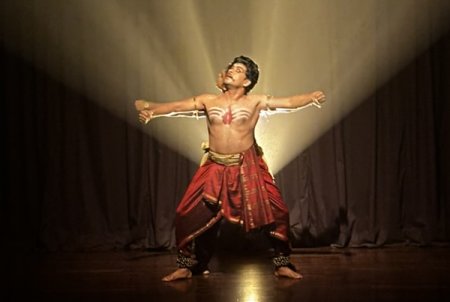 Praveen Voggu and Sreenaih Bakki The appearance of Sumbha and Nishumbha, portrayed by Praveen Voggu and Sreenaih Bakki, infused the performance with kinetic intensity. Their portrayal balanced dramatic vigour with classical control, drawing from the expressive traditions of angika abhinaya. Throughout, Mahakali retained an unmistakable Telugu sensibility, echoing the expansive storytelling mode of Kuchipudi Yakshagana while remaining anchored in Kuchipudi's aesthetic framework. 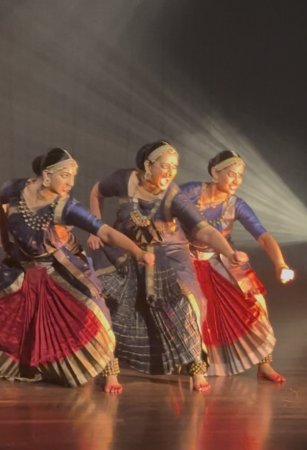 L to R: Anusha, Katyayani, Vaishnavi 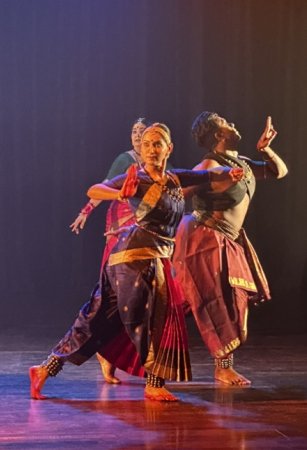 Anusha & Gowtham The presentation of the Saptamatrikas was radiant, culminating in the awe-inspiring arrival of Kali. Katyayani Kanak, as Mahakali, commanded the stage with fierce composure - her performance an embodiment of divine energy (shakti). She was ably supported by P.B. Vaishnavi, Anusha Srinivas, and Gowtham Maheswar, whose ensemble synergy sustained the energy of the scene. The presence of Aparna, sharing the stage with her Guru, lent an emotional continuity that deepened the performance's resonance. The climax - where Devi's hasta evolved, the hands of Mahakali transforming into Raktabeejakshi - became a striking visual metaphor for creation, destruction, and renewal. The imagery lingered long after the curtain fell. The final combat between Sumbha and Nishumbha was rendered with precision and force, culminating in the haunting image of Raktabeejakshi consuming each drop of the demons' blood - a moment that was at once terrifying, symbolic, and transcendental. 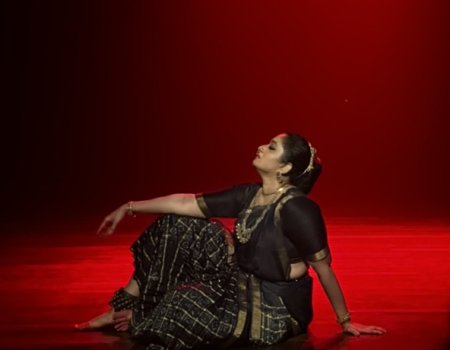 Katyayani Kanak Then came the final blink - Kali's blink - a moment so charged that time itself seemed to hold its breath. As the chant "Kala... Kala... Kala..." reverberated through the hall, the audience rose in spontaneous applause. In that instant, an hour dissolved into a heartbeat - Mahakali's eternal blink marking the seamless union of time, art, and divinity. Mahakali was not merely witnessed; it was experienced - a journey through time, devotion, and transcendence, where the choreography itself became a meditation on the cyclical rhythm of existence.  Pasumarthi Kumara Datta hails from a traditional Kuchipudi family and holds a Masters in Performing Arts from the University of Hyderabad. Trained under esteemed Gurus such as Pasumarthi Srinivasa Sarma, Vempati Ravishankar, Pasumarthi Rattaiah Sarma, and Prof. Anuradha Jonnalagadda, he is a recipient of the Sangeet Natak Akademi Young Artist Scholarship (2019). He is currently pursuing his Ph.D. in Dance and serves as Assistant Professor of Kuchipudi Dance at Alliance University, Bengaluru. |
