|     |
|
| |

 Natyakalavardini series of FAS for cultural excellence- Chandra Anande-mail: chandra6267@yahoo.co.in November 20, 2025 With the motto "Kalavaibhavam Sukhanubhavam", The Fine Arts Society, Mumbai (FAS) presents its Natyakalavardini series every month, which is their special initiative for encouraging classical dances of India and promoting cultural excellence for 6 decades. This is a platform that mainly gives space for solo performance and for traditional repertoire eg. Margam format in Bharatanatyam. 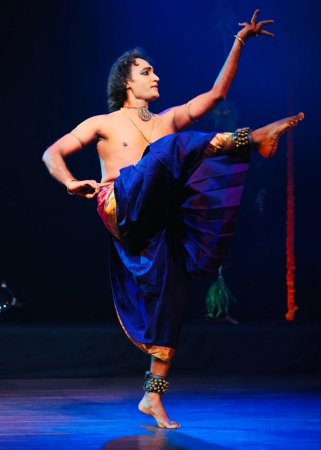 N Gururaju (Photo: Universal Rasika) Gururaju N, student of Guru Vyjayanthi Kashi, presented Kuchipudi performance on 7th November 2025, at FAS RCF Academy Hall, Mumbai. He regaled the audience with a traditional Kuchipudi repertoire in a solo performance, all items choreographed by his guru. He performed with a sober and calm demeanour, with restraint and mindful awareness. Poorvaranga Veedi (Revati, Talamalika) that took inspiration from the opening section of the Natyasastra, complete with Vedic chants and symbolic purifying of the stage with water and then offer lamps, flowers and incense sticks, was performed along with Brahmanjali, where he offered homage to the Trinity Gods. "Jaya jaya jithavairi" (Hamsadvani, adi) composed by poet Narayanateertha, was an invocation to Lord Ganesha, where the elephant god's praises and graces were duly expressed with bhakti and awe. "Vande vande vani bhavani" (Abhogi, chatusra ekam) was a salutation to Goddess Saraswathi, also known as Balatripurasundari, who is the presiding deity of the Kuchipudi village and the seat of knowledge of sixteen art forms. In his composition, Guru Vedantam Parvateesam has heaped praise on her as Kuchupudi Vani and on the richness of the art form. Gururaju performed this piece elegantly and paid salutation to her who is the personification of beauty, grace, benevolence, mellifluous vocals, chatur-vidha abhinaya and navarasa with great reverence. Shabdams in Kuchipudi style are choreographed using rhythmic passages in-between the sahitya which makes the item lively and brisk. In Ramayana Shabdam (Mohanam, adi), Gururaju portrayed the episodes from the birth of Sri Rama to his coronation with appropriate histrionics. Before performing "Entha chakkani vadi naa sami" (Abhogi, adi), a Kshetrayya padam on shringara rasa, Gururaju spoke to the audience and said that it is a challenge for a male to do a female role. He asked for forgiveness if he couldn't do the necessary justice to the item. But there was no reason or cause for doubting his talent. He did it with great confidence. He described Muvvagopala just like a girl would see and appreciate a beautiful handsome man, to a friend. 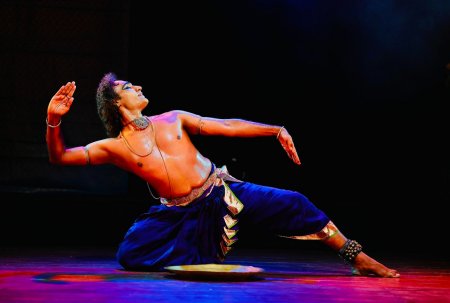 N Gururaju (Photo: Universal Rasika) Shiva sthuti "Shivudu tandava madenu" (Ragamalika, adi), composed by Purva Veda, was preluded by a shloka "trinetram chaturbhujam" and Gururaju went on to present all the icons of Lord Shiva and Lord Shiva's dance on Mount Kailas surrounded by all gods and goddesses. The orchestra for Lord Nataraja's dance was Saraswathi playing the veena, Indira playing the flute, Lakshmi singing in her golden voice, Lord Vishnu playing the mridangam and Brahma playing the cymbals. The stage was well sculpted giving splendid visuals of dancing and playing instruments. Gururaju concluded with Tarangam, "Neela megha sharira" (Mohana, adi), the special number in traditional Kuchipudi repertoire danced to the Krishnaleela Tarangini, a text that recounts the life and charming looks of Lord Krishna. The skill involving dancing on the rim of a brass plate indicates the mind body coordination with control over the senses that abets the human possibilities to reach beyond the limits. Gururaju, though continuing his restrained form, seemed livelier in this item. He danced to recorded musical pieces and much of his announcements was also recorded. He shared a little detail about the history of how gurus like Vedantam Lakshmi Narayana Sastry introduced dancing on brass plate to create a unique factor to this art form of Kuchipudi. Only flaw perhaps was he had limited the eye movements required for embellishment of the nritta portion and audience connect. In the month of September 2025, During the Navaratri festival, this series was included to be part of the FAS arrangements for its Navaratri celebrations, where they held Bharatanatyam performances of Sharmada Vishwanath and Jayanti Srivatsan. 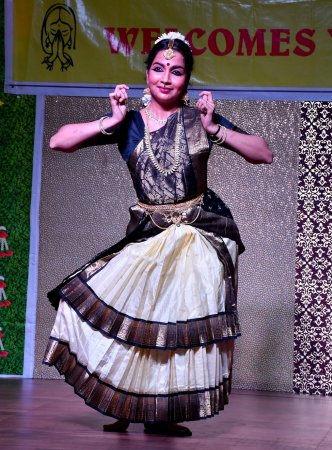 Sharmada Vishwanath (Photo courtesy FAS) When a distinctive style in art form is acquired, it forms from the likes and dislikes and direct experiences of the artiste. Then these experiences become unique features of the artistic choreography and so it is said that the expression of the art becomes organically shaped. One such style is of Guru Chitra Visweswaran, which is now famously called as Vichitra bani (Visweswaran+Chitra). A Bani is like a banyan tree where its branches grow downward and becomes roots of the tree supporting the main trunk. Thus Vichitra bani has gathered roots for she has trained a number of students though her school Chidambaram Academy of Performing Arts, Chennai, (CAPA) which is celebrating its 50th year; and in turn they have produced many branches of her style of performance evolving out a new parampara on the edifice of guru-shishya tradition, mainly as it is distinct from the Tanjavur and Pandanallur banis in which she was trained. Besides this, it is a matter for celebration that the doyen completed three quarters of a century this year on 12th October 2025, and that is being celebrated by one and all. These celebrations are being watched out for by dance connoisseurs and enthusiasts through the social media, throughout the globe. Naturally, in this scenario, it was a treat to see a solo Bharatanatyam performance by Sharmada Vishwanath, a student from CAPA, on 29th September 2025 at the Smt. Jayalakshmi Ramachandran Hall, the Fine Arts Society, Mumbai. Sharmada has been trained by Chitra Visweswaran herself and also by Sukanya Ravindhar, the present principal of CAPA. She performed pieces from the margam over the given hour. Shlokam and Pushpanjali (Gambeeranattai, adi) set the ambience for a promising evening of viewing of nritta and nritya in Vichitra bani known for its light and graceful demeanour through the lithe limbs of Sharmada. Shloka performed had an evoking appeal pointing towards the spiritual intent in the presentation. 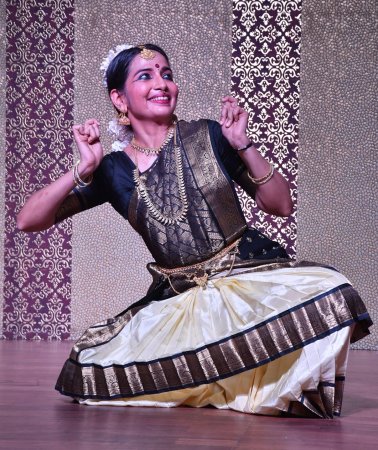 Sharmada Vishwanath (Photo courtesy FAS) The 95th birthday of Lalgudi Jayaraman was also being commemorated in the month of September 2025. So, a tribute was paid to him by performing "Angayar kanni" (Ragamalika, adi) varnam which extolled Goddess Meenakshi of Madurai, by relating her story through the medium of navarasas as imagined to be experienced by the goddess in stages of her life. The rhythm control and histrionics ability of Sharmada played well throughout the varnam. In the trikala jathi theermanam, the first three avartanas were in chowka kalam, and nritta patterns for each avartanam displayed different hue of soft, medium, and hard variety respectively. The nritta for the korvais was in sangfroid with the swara patterns of all ragams. In the second half of the varnam, inspite of doing padhartha bhava only, the characters were well enhanced with appropriate stances and expression. "Chikkavane" (Ragamalika, adi), a Dasar kriti was performed where the gopi seeks to hold little Krishna and play with him. He embarrasses her, plays pranks on her and teases her and runs away but finally she finds herself sleeping next to him and wakes up to find him holding her hand, giving her a vision of his true divine self, implying in our spiritual ignorance one tries to catch him and hold him in these human hands. But he is there in the spirit of each one of us. Her abhinaya came alive, fully encompassed in Vichitra bani. Sharmada concluded with 4 verses of Sri Balakrishna Mangalam (Madhyamavati, adi). Dancing to beautifully recorded music, Sharmada was in her best of elements that day. All pieces were choreographed by Guru Chitra Visweswaran. Music credits to Sukanya Ravindhar on the nattuvangam, Dr Murali Parthasarathy on the vocals, K. Venkatasubramanian on the mridangam, Mudikondan SN Ramesh on the veena, and R Thyagarajan on the flute. 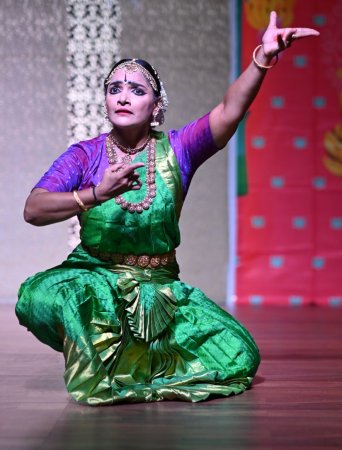 Jayanti Srivatsan (Photo: Suraj Uchil, Uchil Clicks) Jayanti Srivatsan, student of Roja Kannan and Bragha Bessell, performed Bharatanatyam on 30th September. She presented an 'Ode to Goddess Parvati', a beautiful devotional presentation, highlighting the universal motherly aspect of the goddess and her power to protect the devotees from evil. Jayanti began her offerings to the Navarati goddess with the sabdam (Ragamalika, Mishra chapu) "Devi thaye karunai puriya iduve samayam" by Madurai N Krishnan, choreographed by Roja Kannan. In this, she enacted the story of Devi's incarnation as Goddess Durga to destroy the demon Mahishasura, then hailed her as the Primordial Power who gave birth to Lord Karthikeya, and the story of Muruga giving upadesham of the pranava mantra 'Om' to his father Lord Shiva himself, displaying pure abhinaya. Varnam "Nithyakalyani" (Ragamalika, rupakam) composed by Seetharama Dasar and choreographed by Guru Adyar K.Lakshman was performed with aplomb bringing more variegated forms of the goddesses and their related tales, like Goddess Lakshmi rising from the ocean during Amrut mantan, Parvati rushing to hold Lord Shiva's throat while consuming the poison, and the fish-eyed Madurai Meenakshi; all the while emphasizing the goddess's omnipresence and power, and absolute faith of her devotees in her protection. She highlighted the story of the ardent devotee of Goddess Abhirami named Abhirami Bhattar who was born as Subramania Iyer (18th century). Bhattar was a fervent devotee whose intense devotion famously led to a miraculous event where the moon appeared full during a new moon night. Thus, he wrote "Abhirami Andadhi" in praise of Goddess Abhirami at the Thirukkadaiyur temple. 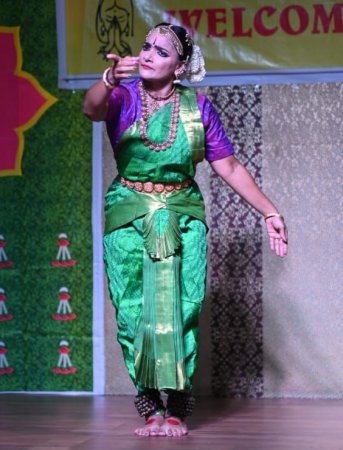 Jayanti Srivatsan (Photo: Suraj Uchil, Uchil Clicks) Jayanti concluded with a fast-paced thillana (Mand) in praise of Goddess Kamakshi of Kanchi Peetam, composed by Lalgudi Jayaraman and choreographed by Roja Kannan. She danced to a well supporting recorded music where nattuvangam was by Guru Roja Kannan, vocals by Radha Badri, violin by Kalaiarasan, on the flute was Sasidhar and Nellai D. Kannan on mridangam.  Chandra Anand is a Bharatanatyam artiste and teacher. She has an MA in Bharatanatyam from Tilak Maharashtra Vidyapeeth, and her series on 'Education in spiritual values through Bharatanatyam' is featured in narthaki.com. |
