|     |
|
| |

 Dance, Tagore and Gaudiya Nritya- Debolina Ghoshe-mail: debolina.2009@rediffmail.com November 18, 2025 Indian traditional dance is like a banyan tree which has flourished beautifully with many leaves, blossoms and fruits. It filled the air with pure oxygen. At the same time, it has weathered many storms. With onslaught of time, many of the traditional dance forms had gone into oblivion and with the advent of colonial power, society was highly influenced with foreign culture. Dance could not escape that phenomenon. Some of the forms got amalgamated and some of the forms were revived and restored by some art lovers like Rukmini Devi Arundale. In this context, we can discuss about two Bengalis of two different centuries. One, who has planted the sapling (containing the seed of ancient Indian dance form) in the soil of early 19th century society when dance was not looked upon respectfully. And the later one clasped in her hands a flying feather which was going into oblivion. The flying feather was Gaudiya Nritya - the sole classical dance form of Bengal. The former I am talking about is Gurudev Rabindranath Tagore. And the latter is Dr, Mahua Mukherjee, exponent of Gaudiya Nritya. On 3rd of November at the iconic Victoria Memorial of Kolkata, Dr. Mahua Mukherjee delivered a lecture-demonstration to celebrate the Nobel prize winning month of Rabindranath Tagore. The event was named as Dance and Tagore. 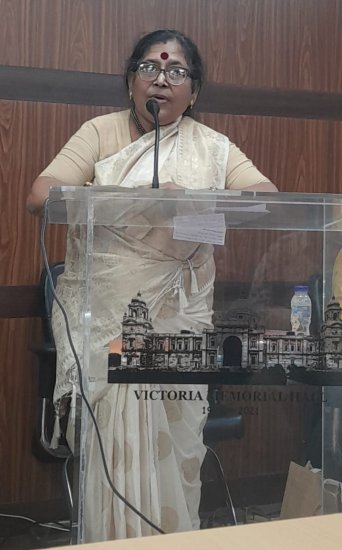 Dr. Mahua Mukherjee Dr. Mukherjee researched and showed how diversified and sincere was Tagore's observation and thinking on the field of dance. Rabindranath Tagore is known for his literary works but he was also a genius in dance and music. Tagore was a dance revivalist. When dance was in a degenerated condition due to social immoralities, Tagore by his creativity and intelligentsia shaped his own dance form 'Rabindra Nritya' where he inspired women of respectable families to perform on stage. He realised the importance of dance in education and society. He established Vishwa Bharati in 1921. He showed the path of establishing institution for art and culture. "Our body carries the weight of major and minor limbs and is directed by their momentum. Momentum gives the mass beautiful postures and movements When these mass and velocity fuse together, a beautiful artform appears. This creation is not for livelihood but for the happiness of creation. This is called dance." Such observations show his respect for dance forms. Tagore had interest in and was influenced by various kinds of Indian classical and folk dance forms. At the same time, he was also influenced by many foreign dance forms like Kandyan, Lancer Gallop and Hungarian style. He applied all these forms in his 'Rabindra Nritya'. He was also open to changing ideas and concepts. He wrote many dance dramas where dance and music were nicely used. In 1938, Mrinalini Sarabhai visited Shantiniketan and performed Bajrasen (a character in Tagore's dance drama 'Shyama') in Bharatanatyam style. Later Kelu Nair came and performed it in Kathakali style. In 1934, at the request of Rabindranath Tagore, king of Cochin sent O. Kalyani Amma to Shantiniketan. She taught Kaikottikali and Kalamuli in the style of folk dances of Kerala which has become classical Mohiniattam. 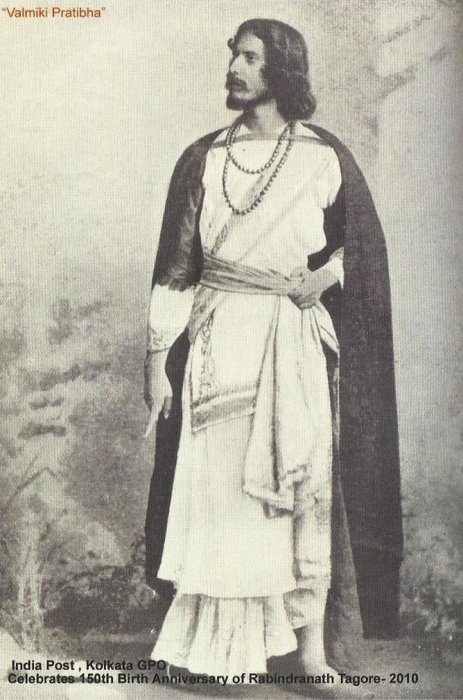 Tagore in Valmiki Prathiba 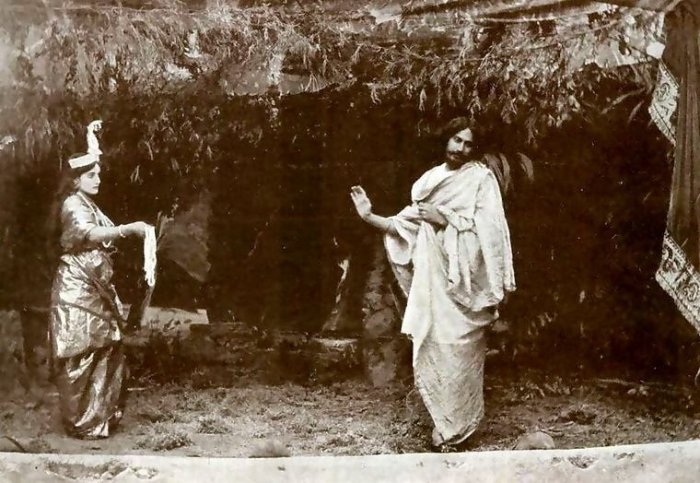 Tagore and Indira Devi in Valmiki Prathiba, 1881 Tagore applied Mohiniattam in his song "Ogo Bodhu Sundori" choreographed by Shantideb Ghosh. In 1923, he observed a folk dance of rural Sourashtra (now Gujarat). There he saw a family singing with cymbals and dhols and the girls dancing with that. He applied that to his song, "Dui haate kaler mondira je sodai baje...". The song is in praise of Nataraja, the time keeper. Raibeshe and Jari are folk dance styles of Bengal among many others. He used these forms in his song "Ebela dak porechhe". When Rabindranath Tagore was 17 years old, he went to England. He was influenced by the Lancer Gallop dance. He applied it in his song "Aye tobe sahachari". Hungarian style was used in the choreography of the song "Sharat tomar arun alor Anjali..." Kandyan style of Ceylon was applied for the choreography of Prahari's character in Shyama. Even Judo was used in his song "Sankochero bihwalata nijere apoman". Bengal's famous folk style Baul was used in his song "Fagun howay howay..." This is just a glimpse of Rabindranath Tagore's contribution to dance as an art revivalist. Coming to Dr. Mahua Mukherjee's contribution to Indian classical dance, even the Bengalis were unaware that we have our own classical dance form. Gaudiya Nritya which is encompassed under the Oudhra - Magadhi pravritti is the sole treasured classical dance of Bengal. It is not only a classical dance form which abides by the tenets of Natyasastra but it is also a platform which exhibits history, literature, temple architecture, sculpture, folk music and dance of ancient Bengal. As Rukmini Devi's name is associated with Bharatanatyam, in the same way, Dr. Mahua Mukherjee's name is associated with Gaudiya Nritya. Her strong willpower and intense research have helped to shape the form. Dr. Mukherjee has tirelessly travelled all over Bengal to collect documents, scripts, fragments of sculptures, observed architecture, sculpture on the temple walls. She learnt and practiced various folk dances of Bengal like Baul, Nachni, Raybenshe and Chhau. All these are the building blocks of Gaudiya Nritya. Keertan is the heart of Bengal's spiritual music and also the base of Gaudiya Nritya repertoire. Gaudiya - the name is derived from Gaur which was the capital of Bengal. The dance bears the glory of Bengal. Once Dr. Mahua Mukherjee visited Ananta Basudeb Mandir, located at Bansberia of Hoogly in West Bengal. There she saw beautiful dancing sculptures on the temple wall. That ignited her curiosity to know what influenced the sculptor to make such beautiful dancing sculptures. Afterward she intensively researched, collected fragments of sculptures, learnt Sanskrit and learnt to read inscriptions to find the root of such sculptures. Evidence of Gaudiya Nritya is also present in the aharya abhinaya chapter of Natyasastra. 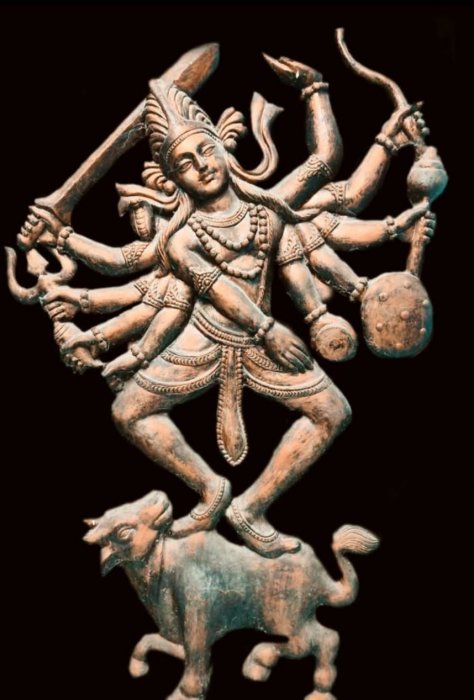 Narteswara Shiva of 10th century Bengal. 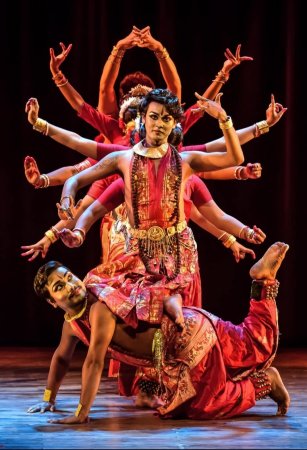 Narteswara in Gaudiya Nritya She found the Narteswara murti of 10th century in Bengal. Narteswara is dancing Shiva in Lalita Ananda Tandava posture. Narteswara have 10 arms depicting 10 corners. Instead of apasmara in Chola period Nataraja murti, Narteswara is dancing on Nandi bull - symbol of knowledge. This Narteswara murti is preserved in Delhi National Museum. There is another dancing Shiva murti preserved in Rajsahi Varendra Research Museum in Bangladesh. This dancing Shiva murti is also dancing on Nandi bull. This murti has cymbals in his two hands _ showing that he is the timekeeper. The repertoire of Gaudiya Nritya goes like Bandana Nritya, Mangalacharan, Alapchari, Mahajanapada Nritya, Leela Keertan, Pala Nritya and Naishkramikee Nritya. Bandana Nritya: The repertoire starts with Bandana. It is generally sung in ancient Bengali or Sanskrit language. This is danced in praise of Lord Krishna, Shiva, Saraswati and Ganesha. Mangalacharan: Different rasas are generally performed. It at least takes 8 to 10 minutes. Dhak, pakhawaj and mridanga are used as percussion. Alapchari: It is generally based on nritta - pure dance. Mahajanapada Nritya: Padas written by renowned literary artistes of Bengal like Jayadeva, Bidyapati, Dwija Chandidas is called Mahajanapada. Dances based on this is called Mahajanapada Nritya. Leela Keertan: Keertan means praising someone. This is based on praises of Gods and Goddesses. Pala Nritya: This is enactment of mythological stories. It is rich in both nritta and nritya. In ancient Bengal, it used to continue for 7-8 days. Naishkramikee Nritya: It is the last part of the repertoire. Here the dancer concludes his/her performance with sattvik bhava. The songs are generally sung in Sanskrit language. 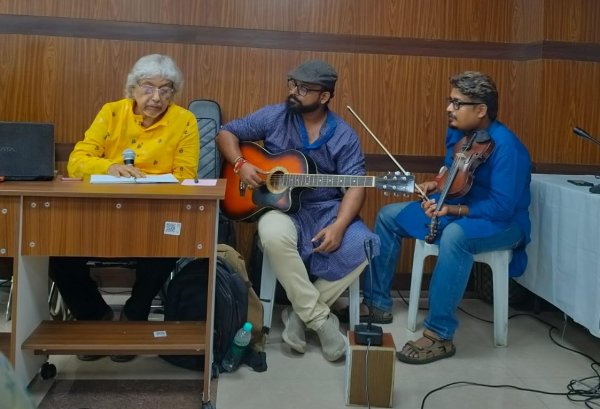 Amitava Mukhopadhyay, Ayan Mukherjee, Subhodeep Chakraborti At present, Dr. Mukherjee's students like Sayantika Majumdar, Dr. Satabdi Acharya Chakraborti, Dr. Soumya Bhowmick and Dr. Paromita Banerjee are bearing the legacy brilliantly. Throughout the event at Victoria Memorial Seminar Hall, a voice was resonating- that was of Pt. Amitava Mukhopadhyay's mellifluous singing. He is not only a singer with great depth but also researcher and has travelled a lot with Dr. Mahua Mukherjee for the same mission. Ayan Mukherjee on guitar and Subhodeep Chakraborti on violin adorned the stage with their melodious rendition. Dr. Mahua Mukherjee is still working hard for the resurrection of Gaudiya Nritya and for passing on this treasure for the present and future generation.  Debolina Ghosh is an MPhil scholar, Department of Sociology, University of Burdwan, West Bengal. |
