
|     |
|
| |

 The Pushmi-Pullyu World of the Immigrant Mother: Lessons from my Mothers- Kamini Dandapanie-mail: dandapanis@gmail.com Photos: John Braile November 17, 2025 Some of my fondest childhood memories are of curling up with the wonderful Dr. Doolittle books and following the adventures of the good doctor with his band of talking birds and animals. One creature in particular caught my fancy: the rare and elusive Pushmi-Pullyu with its two heads facing in opposite directions, a being forever looking forward and backward, existing simultaneously in multiple worlds. Little did I realize in that time of innocence that the Pushmi-Pullyu would come to epitomize my adult life. The life of an immigrant, more particularly, that of an immigrant mother, caught in an in-between world, a contradictory universe with nostalgia for a lost past and excitement for the possibilities of the future; the rules and expectations of the old land and the adaptations needed to survive in the new; conflicting loyalties, navigating the priorities of work and family across an ocean of love and longing; the dreaded phone call at night that further severs the fraying, increasingly threadbare connection to home and the cobbled-together new-world family that provides comfort and laughter and that, in time, feels more familial and familiar than the blood relatives back home; the very notion of home itself, which is here, there, nowhere, (and on a good day) everywhere. The push of the old, the pull of the new. And vice versa. The Pushmi-Pullyu world of every immigrant everywhere. As the show emphasized, repeatedly, arrival is not belonging. 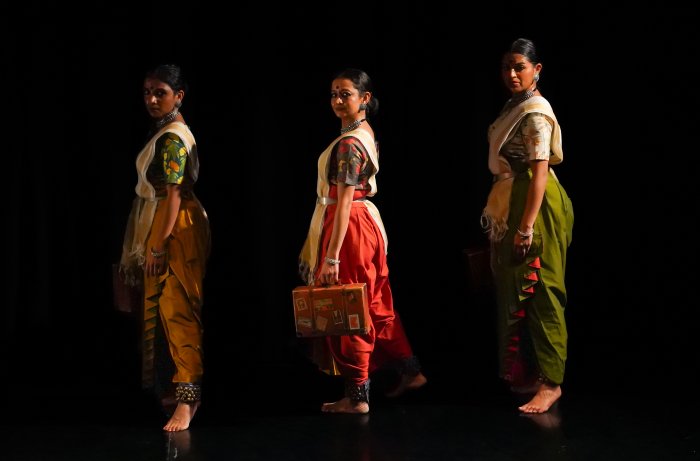 I recently watched this world come to life in a beautiful production, Lessons From My Mothers, that wove together dance, theater and the spoken word by Sonali Skandan of Jiva Performing Arts at the Gibney Theater in downtown Manhattan. Three superb dancers - Sonali, Aparna Shankar, and Rithika Ashok - played the roles of three sisters, at times an older generation of Mom, Masi and Kaki, at times as children, as young women, young brides and mothers. The performance consisted of a series of vignettes that evoked the experiences of immigrant mothers, their journeys of travel and displacement, their lives in their new homes with long, lonely days of housework and childcare, the relentless, monotonous drudgery of their daily routine, the aching sadness for what was left behind, the small, unexpected joys, and so much more. They were portrayed with a rich variety of dance moves that wove in strands of the traditional Bharatanatyam repertoire like the Jatiswaram and Thillana, along with movements that evoked Kathak, modern dance, folk dances and a good deal more. The bond between the three sisters was very moving to witness. Three women, sisters, yet so different from one another. One - a devoted mother and housewife; one, a rebel, marrying someone she chose, trying to shut out the vicious chorus of disapproval all around; and one, pretty, revelling in dressing up with jewelry and saris. All of them poring over recipes from a cherished cookbook handwritten by their mother, learning to adopt and adapt, adjust and tweak, explore boundaries and break them, treasure old memories and create new ones. Critical life lessons needed to survive in a new land, from a simple cookbook. 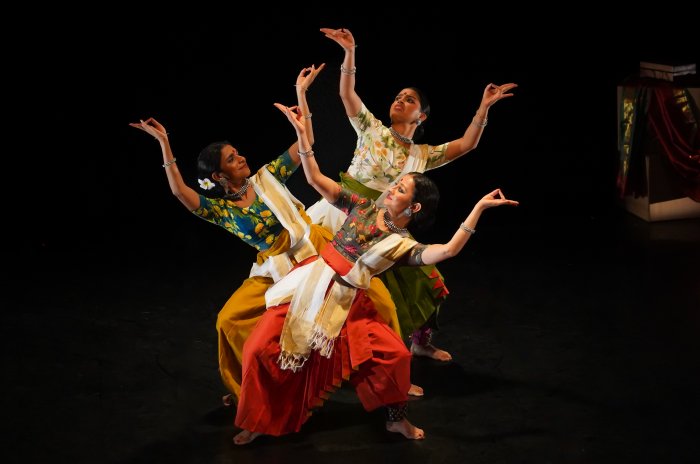 How poignantly, how keenly, Sonali, Aparna and Rithika brought to life the aching sadness, the loneliness, the everlasting unsettledness that are always there in a corner of every immigrant's heart. Watching them brought back a rush of memories from my own days as a young mother newly arrived in America. That is the power of good theater. And like life, it was not all desolation and pathos. There was the worry-tinged wonder of watching your daughter follow her dreams and navigate her own path. There were moments of levity too: the age-old saga of the mother-daughter hair-combing tussle elicited knowing chuckles from the audience; a moment when the three sisters posed for a photo, stiff, blank-faced, grim even, a nod to the photos of yore where nobody cracked a smile. Watching the three sisters delight in the first snowfall of the year was pure joy. The final items, rooted in the joyous Thillana of Bharatanatyam and the festive communality of the Garba, brought the show to a rousing end. Wherever we are, whatever our sorrows, there is wonder and cheer to be found even in the smallest things. This was storytelling through movement taken into exciting new directions. The stage set up was very simple with minimal props, so as not to distract attention from the dancers and their stories. There were a few sarees draped on cardboard boxes. Three small suitcases were used in a dance that used jathis and choppy puppet-like movements, invoking search, travel, transition, creating new paths, to the staccato soundtrack of sollukattu. 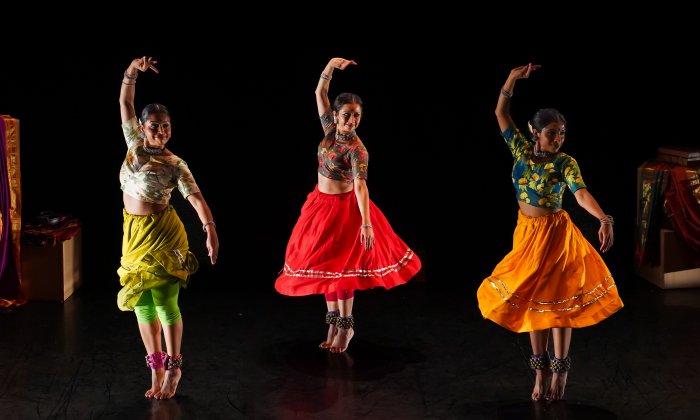 The music by Rajkumar Bharathi, created a lush and richly orchestrated soundscape to complement the dancers. The music was beautiful, but several times, I felt that something simpler, less grand, would be better suited to the intimate, deeply personal ethos of the performance. Sometimes, small and quiet carries more punch. Every show has a dedicated crew that works, often unheralded, behind the scenes, doing the countless things that make it a success. Swati Seshadri, the rehearsal director, got the show rolling with a lovely introduction that set the mood for what was to follow. Sreelakshmy Govardhanan's creative mentorship was evident throughout. And Betsy Chester's lighting created the perfect ambiance for the stories and scenes enacted by Sonali, Aparna and Rithika. Lessons From My Mothers played to a full house and a rapt audience. The particulars might vary, but the story of the immigrant mother is a universal one. It is a difficult challenge to cover and portray the universe of emotions, circumstances and perspectives of this story, but Sonali and her group did it marvellously well, and left us all the richer for the experience. 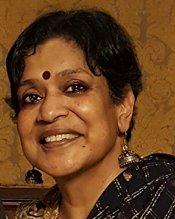 Kamini Dandapani is an aficionado of Carnatic music, Bharatanatyam and Pianoforte, having trained for many years in all three disciplines from great gurus in Madras. She now lives in New York. Her book, Rajaraja Chola, King of Kings, was published to high acclaim, and she is working on her next book on the empires of southern India. |
