
|     |
|
| |

 Krishnendu Saha: An intense immersion- Jaya Rao Dayale-mail: jayadayal@hotmail.com Photos: RN Sudhi and VB Suresh November 16, 2025 On my travel to a village on the Tamil Nadu / Kerala border, I had to fly into Coimbatore from New Delhi. A day before I was to leave, I read about a performance at Medai in Coimbatore called "The mystic Blue Lord", by an artist who I got to watch two years back at Kalakshetra in Chennai, as part of a production called 'Manodarpan.' I was totally taken up by this young artiste, an extremely talented disciple of Guru Sharmila Biswas. His solo piece on the Dashavatara was indeed very impactful. Since he was part of the repertory and part of a group performance, I obviously could not single out one artiste and write about him. This stayed in my mind until last week, when I got to watch his solo performance finally. 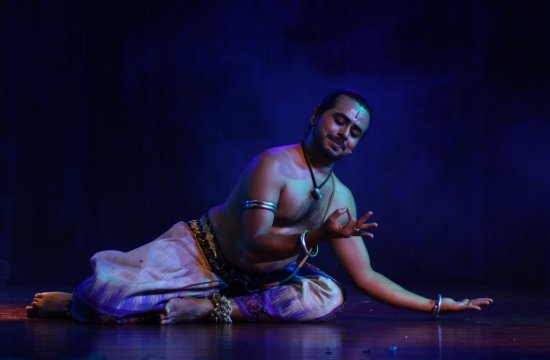 Krishnendu Saha Krishnendu Saha, an artiste par excellence. It is hard to believe that he started learning Odissi as an adult about thirteen years back. The hour long performance was divided into four parts. I will delve into the first and third pieces he performed which showed his complete artistry. As a viewer, I could sense the power of the body trained by the mind and the power of the mind making movements and expressions flourish. Krishnendu began with the traditional Ranga Puja. The ritualistic dance called Abahani meaning Avahanam, where much like the Tantric ritual, the artiste invites the divine within himself, here for an auspicious beginning of the performance. One could sense how beautifully the artiste's body is chiselled in preparation. The sculptor being none other than the artiste himself evidently with serious body conditioning and yoga. The artistry of mind and body in this piece makes me think about the coming together of ritual and performance making the body a ritual site. The music has been designed by Guru Sharmila Biswas with the guidance of eminent scholars, musicians and practicing priests of Odisha. The lyrics are collections from the traditional artistes and priests of rural Odisha. The third piece of the evening was dance choreographed to poetry in Braj bhasha, which deserves superlative praise for one of the finest abhinaya I have seen. In a conversation with Krishnendu, he mentioned that it had been choreographed by Guru Rama Vaidyanathan and was taught at a dance residency last year. I would like to introduce the text in order for a better understanding of where I thought the artiste excelled in the rendition. The poetry is written by a renowned poet Dev, also known as Kavi Dev, who lived and wrote in the late 17th -18th century in savaiya metre, known for the beautiful alliterations. राधिका कान्ह को ध्यान धरैं तब कान्ह ह्वै राधिका के गुन गावै। त्यों अँसुवा बरसै बरसाने को पाती लिखै लिखि राधिकै ध्यावै। राधे ह्वै जाइ तेही छिन देव सु प्रेम की पाती लै छाती लगावै। आपु ते आपुही मैं उरझै सुरझै बिरझै समुझै समुझावै॥ Radhika, so absorbed in Krishna forgets she is Radha. She thinks herself to be Krishna, who is describing her attributes. She is overwhelmed. Krishna seems to be writing love letters to Radha. For a moment, she returns to being herself as Radha and the revelation dawns that she is not Krishna. She holds the love letters to her heart. Engrossed in this, she loses her sense of who she is. She is at one moment Krishna, a little later somehow collects herself and realises she is Radha. She goes back and forth with this confusion, sometimes trying to resolve in this reconciliatory mode all along trying to explain to herself. The piece shone. Radha who was being portrayed in the text was so intensely handled by Krishnendu. At one moment she is befuddled, lost in love, obsessed with Krishna, and then she thinks she is Krishna. Where the artiste excelled was in the subtlety of its treatment. Switching from Radha, not to Krishna but to her thought that she is Krishna, time and again in the piece was beautifully depicted. The distinction in abhinaya of the characters was razor sharp with no spill over, no residue or not even a trace of an inconspicuous movement. Pure joy! A lot comes together to make any piece a distinct one. There is an element of partiality to hear a voice that one likes. Venkateswaran Kuppuswamy rendered the thumri which was set to music by Rajat Prasanna in raga Jog, who also was one of the accompanying artistes playing the flute. When I exchanged a few messages with the singer, he said raga Jog in general may not have been the best option for a thumri but it was the music composer Rajat Prasanna's insistence which paid off so beautifully. All this put together and choreographed by Guru Rama Vaidyanathan. 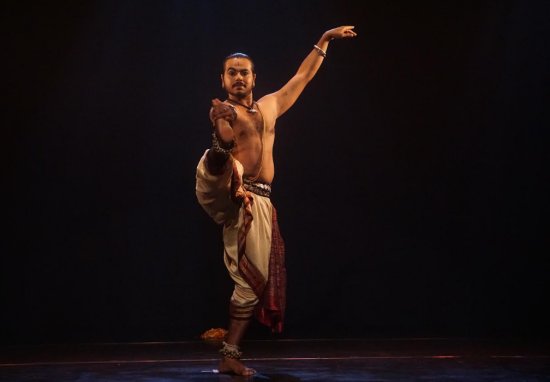 Krishnendu Saha The artiste and the world of art continue to strive to better the pursuit. What about the viewer? A deep sense of gratitude for getting to watch a beautiful performance. Krishnendu is a fine artiste. The intensity of each movement contained treatment of bhava making his presence on stage compelling. Indeed, a Protean artist. Post script: I had to leave the performance at the end of this piece. One, that I had to rush to get to the Isha Foundation premises where the curfew hour is 9.30pm. Secondly, I just wanted to remain in the beauty of Krishnendu's magical rendition of the piece. Thirdly, he was performing Dashavatra which I watched him perform in 2023. As viewers, even one powerful performance can be so impacting that watching it again could be at the risk of letting go of what we behold! 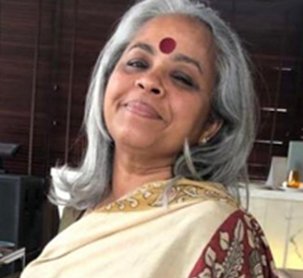 Jaya Rao Dayal is trained in Bharatanatyam. In the last two decades, she has been a student of Indian art and Indian Aesthetics. She submitted a dissertation on "The iconography of the 9th century temple complex of Sri Mukhalingesvara swamy in Andhra Pradesh" to Jnanapravaha in Mumbai, as part of a post graduate program in Indian aesthetics. |
