
|     |
|
| |

 Antarmukhi and a classic Margam- Satish Surie-mail: satishism@yahoo.co.in November 13, 2025 ANTARMUKHI - THE ETERNAL FLAME Photos: Rabinandan 'Antarmukhi' - The Eternal Flame, choreographed and performed by Sandhya Udupa and Prathibha Ramaswamy, on the 10th of October at Seva Sadan, Bangalore, traced the incandescent journey of Akka Mahadevi, the 12th-century mystic who renounced worldly ties in her all-consuming love for Chenna Mallikarjuna. What emerged was not a retelling but an awakening - a seamless confluence of movement, music, and metaphor that mirrored Akka Mahadevi's own passage from form to formlessness, from seeker to seer. The performance opened in a luminous hush, with the gentle strains of music setting a meditative tone. Prathibha Ramaswamy, portraying the sixteen-year-old Mahadevi, evoked an ethereal presence - fragile yet fierce in spirit. Through delicately nuanced sanchari bhavas, she traversed the arc of innocence and awakening - from the tender initiation of childhood to the quiet fire of devotion. Her abhinaya shimmered with emotional clarity, her gaze a vessel of yearning for her "beautiful Lord, Chenna Mallikarjuna, pure as jasmine" - the only male as defined by Mahadevi. 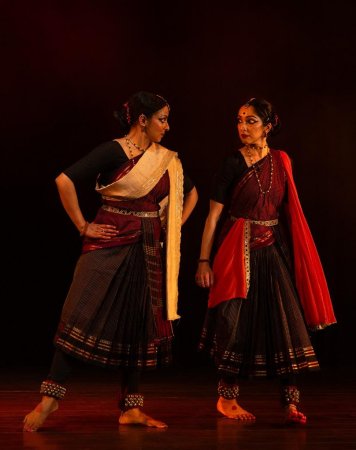 Sandhya Udupa and Prathibha Ramaswamy The entrance of King Koushika and his marriage to Mahadevi - after she extracts three solemn promises - was brought to life with majestic authority by Sandhya Udupa, introducing a resonant tension to the narrative. Udupa's precise Bharatanatyam vocabulary - rooted, assertive, and angular - embodied the weight of patriarchal dominance, while Prathibha Ramaswamy's fluid grace conveyed the soul's quiet defiance. Their interplay evolved into a dialogue of dualities: power and surrender, confinement and liberation, body and spirit. The duo's effortless transitions between roles revealed a profound synergy, each performer complementing and amplifying the other in an eloquent duet of contrasts. The climactic renunciation, where Mahadevi casts aside all material possessions, was rendered with rare delicacy. Eschewing literal depiction, the dancers wove a poetic tableau - silken fabric swirling into abstraction, gestures unfurling like silent hymns. As her cascading hair transformed into a divine veil, the image transcended theatre to become an act of sanctified surrender - an offering to the Infinite. The second act unfolded in the Anubhava Mantapa, under the spiritual guidance of Allamma Prabhu, the sacred congregation of saints. Here, the dancers drew inspiration from the dynamic pulse of tradition, infusing the narrative with a vigorous rhythm that echoed the Veerashaiva community's steadfast spirit of support. Akka Mahadevi, radiant in conviction, moved with expansive grace and tranquil authority, her presence suffused with an inner luminosity. The moment when she was conferred the honorific "Akka" (elder sister) by her spiritual brethren resonated with serene profundity - a gesture that celebrated her transcendence beyond gender, self and earthly confines. 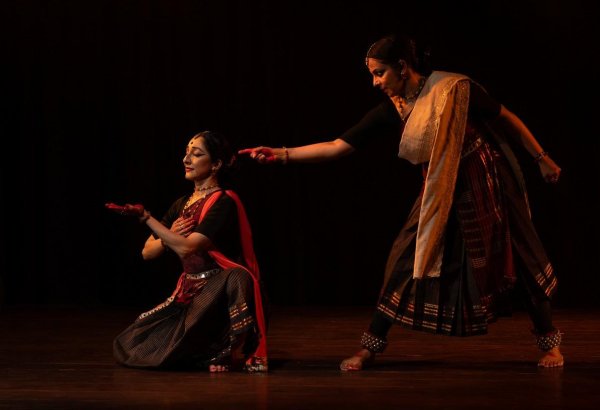 Sandhya Udupa and Prathibha Ramaswamy In a compelling contemporary layer, the production interwove Akka's mystical poetry through spoken word sancharis that flowed seamlessly within the classical idiom. Her vachanas, resonant and unadorned, emerged as a living voice - bridging centuries to speak directly to the audience. These moments created an arresting synthesis where word and movement became one - the rhythmic intricacies of Bharatanatyam aligning in perfect harmony with Akka's impassioned call for spiritual realisation. The result was a textured, multi-dimensional experience - intellectual, emotional, and deeply spiritual. The final sequence, set in the Kadali forest near Srisailam, was a visual hymn to dissolution. Through meditative, flowing gestures that suggested kalpavriksha trees, rivers, and the vastness of creation, Sandhya conveyed Akka's merging with the infinite. The dance tapered into stillness, and the stage was suffused with silence - the silence of realisation, of "Nothing, none whatsoever." The production's visual and sonic design elevated its spiritual intent. The musical score traversed devotional compositions and abstract soundscapes, mirroring Akka Mahadevi's inward journey. The lighting design by Surya Rao bathed the dancers in a play of shifting luminosity, creating an ethereal atmosphere that seemed to dissolve the boundaries between body and spirit. The minimalist stage design, suggestive yet unobtrusive, became a terrain of introspection. The musical ensemble lent the performance its vibrant pulse. Raghuraman Rajagopalan's mellifluous vocals, Sharat Suryanarayana's precise nattuvangam, Vinay Nagarajan's resonant mridangam, and Nitesh Ammanayya's evocative flute created a soundscape of devotion and depth. Apeksha Kamath's narration, poised and measured, anchored the transitions, guiding the audience through the spiritual continuum of Akka Mahadevi's life. In 'Antarmukhi' - The Eternal Flame, Sandhya Udupa and Prathibha Ramaswamy reaffirmed that dance, with their union of movement, poetry, and music, evoked not merely the story of Akka Mahadevi, but her enduring spirit - the eternal flame that continues to illumine the path of devotion, courage, and divine love. A CLASSICAL MARGAM Photos: Prof K.S.Krishnamurthy The Bharatanatyam Margam presentation by the disciples of Sandhya Udupa - Punyashree Hedge, Madhushree, Sanmathi, and Sankya - on the 17th October at Seva Sadan, Bangalore, established their credentials of training under a guru renowned for her precision and emotional depth in Bharatanatyam. The quartet, poised with the quiet confidence of seasoned performers, opened the evening with a seamless synergy that highlighted their synchronised footwork and expressive abhinaya. The quartet began with the traditional Alarippu, a composition of Chidambaram R. Suresh, invoking the rhythmic invocation through crisp teermanams and fluid torso undulations. The piece set a contemplative tone, with the dancers' araimandi unwavering as they traced intricate patterns in the air, their eyes conveying a subtle play of devotion. They followed it with pure nritta passages in the Jatiswaram, a composition of S. Krishnamurthy in Natta Kuranji raga. Here, the focus shifted to technical virtuosity: korvais built in escalating complexity, with the adavus landing in perfect unison, punctuated by the nattuvangam calls from the ensemble's accompanists. The raga's melodic contours were mirrored in the dancers' angular lines and swift pirouettes, creating a visual symphony that held the audience in rapt attention. The central piece of the evening, the varnam "Angayarkanni" in Ragamalika and adi tala -choreographed in the tradition of Lalgudi G. Jayaraman's celebrated navarasa composition - stood as the evening's emotional and technical fulcrum. A hymn of adoration to Goddess Kamakshi, the piece unfolded as an intricate dialogue between devotion and artistry, demanding from the dancers both precision in nritta and depth in abhinaya. 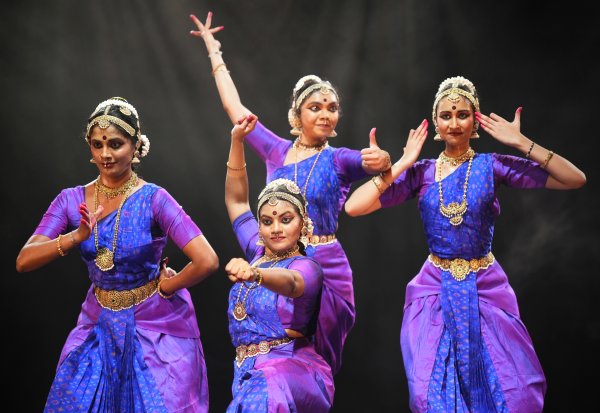 In the heart of the varnam, the Goddess Meenakshi springs to life through the nine rasas, her divine saga choreographed as a whirlwind of valour, love, and serenity. The pallavi in Bilahari erupts with veera rasa, portraying the warrior deity thundering forth in her horse drawn chariot, foes scattering before her unyielding might. Seamlessly, the anupallavi in Useni unfurls shringara's tender bloom: "Nangai Kailai naathan." Meenakshi's heart ensnared by Shiva, her ardour unyielding even as he, disguised as a wild-eyed ascetic - matted locks, ash-streaked, tiger skin clad, snake garlanded - tests her gaze with sly provocation. Adbhuta's wonder cascades in Valachi, the Goddess agape at Shiva's cosmic feats: Manmatha's incineration and the thunderous Tripurasamhara. Laughter ripples through Saranga's hasya "Kaikotti siritthal, vaipotthi nagaithal" as Parvati spies her lord, incognito as a lowly labourer, unleashing a voice that rivals the gods. Yet shadows deepen in Rucharitra's bibhatsa, her revulsion boiling at Daksha's scorn toward Shiva. Fury ignites in Athana's raudra, "Mahakali Kapalini Trishoolini". Meenakshi morphing into Kali and Kapalini, flames of righteous wrath devouring evil. Terror grips in Rasikapriya's bhayanaka: Parvati's dread at Shiva gulping the churning ocean's venomous halahala, and Ravana's hubristic upheaval of Kailash. Compassion softens the canvas in Sahana's karuna, her mercy a balm for the world's sorrows. The varnam crests in Nadanamakriya's shanta, "Shantaswaroopini sharanam Amma," the Goddess reclining in tranquil equanimity, a poised emblem of cosmic harmony. This navarasa tapestry, with its lyrical leaps across ragas, demands a dancer's alchemy - blending nritta's fire with abhinaya's soul - to truly evoke Meenakshi's eternal dance. The quartet - Punyashree Hedge, Madhushree, Sanmathi, and Sankya - rose to the challenge with remarkable cohesion, each embodying a facet of Meenakshi's divine essence. Their movements, steeped in the grammar of Bharatanatyam yet charged with spiritual fervour, traced the goddess's metamorphosis from warrior to lover, from fierce protector to compassionate mother. Sandhya Udupa's choreography balanced grandeur with introspection. The nritta passages shimmered with rhythmic clarity - the adavus sharp yet unhurried, the geometry of lines clean and precise. The abhinaya sections, by contrast, were inward and distilled: a quiver of the eyebrow suggesting curiosity, a fleeting smile revealing surrender, the gentle turning of the neck hinting at divine revelation. Each rasa flowed into the next with musical inevitability, aided by the Ragamalika's tonal modulations and the mridangam's sensitive support. Particularly striking was the transition from raudra to karuna - from the tempest of anger to the calm of compassion - where the dancers' synchronisation evoked both the might and the mercy of the divine feminine. The final teermanam, in adi tala, gathered the emotional strands into one pulsating crescendo, the dancers converging in a whirl of spirals and stillness before assuming the concluding posture. 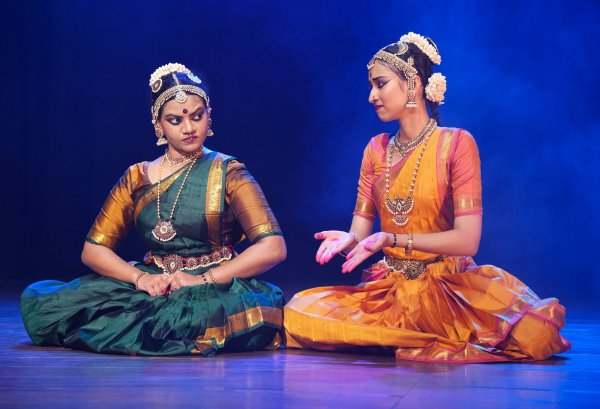 Madhushree (left) and Sankhya (right) The enactment of Sumangala Ratnakar's composition portrayed the khandita nayika - the heroine wounded by betrayal, refusing to meet Lord Muruga after learning of his disguised union with Valli. "Have you forgotten the way?" she questions, her voice trembling between indignation and hurt. Madhushree's interpretation gave the nayika a quiet dignity, every flicker of her eyes and curve of her lips revealing the ache beneath pride. Opposite her, Sankhya, as the empathetic sakhi, sought to soften her resolve, coaxing her back toward compassion. The dialogue between the two evolved into a gentle emotional duel - the friend's persuasion melting against the nayika's wounded pride - each pause, each sidelong glance shimmering with subtext. Their interplay exemplified abhinaya at its most refined, where silence carried the weight of poetry and gesture became inner monologue. In continuation of the padam, the line (Ariyadene Sakhiye / O Friend, I don't know) unveiled another nayika, this time bewildered by the mystic allure of her divine beloved, Krishna. Here, longing replaced resentment; wonder eclipsed reproach. The choreography, gentle yet profound, mirrored the inner tremor of surrender - the nayika's yearning oscillating between human vulnerability and divine transcendence. The portrayal distilled the essence of bhakti-sringara, where love becomes both wound and balm, and devotion, a mirror to the soul's awakening. 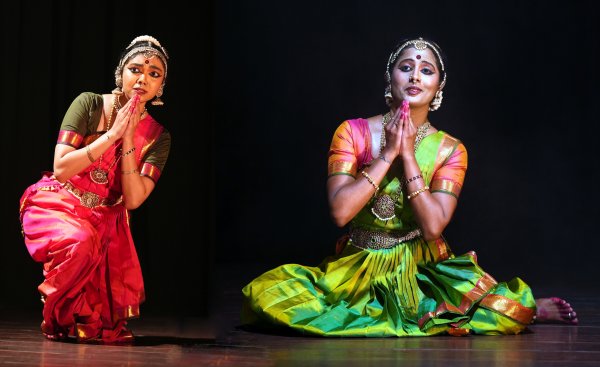 Sanmathi (left) and Punyashree (right) The duo of Punyashree and Sanmathi brought a serene yet impassioned clarity to their exposition of the Devarnama "Innu daya baradhe" (Why don't you still have compassion?), a heartfelt plea to Lord Hari (Vishnu) to shower mercy upon the devotee. Punyashree and Sanmathi embodied this surrender with eloquence, their movements tracing the soul's yearning, their expressions the delicate arc of devotion's evolution. As the Devarnama unfolded, the dancers captured the poignancy of the devotee's plea: "Why don't you still have compassion?" The contrast between rich and poor was laid bare in the poet's narrative, as two devotees approach the temple - one a man of wealth, the other of humble means. The former, with all his material riches, was unable to access the blessings of the Lord, while the latter, in his poverty, sought divine grace with pure humility. In a moment of spontaneous realisation, the wealthy man, moved by compassion, decides to help the poor devotee. This realisation was beautifully captured in the dancers' eyes and gestures - an abhinaya of transformation, where material wealth is rendered secondary to the wealth of grace. Through their tender portrayal, Punyashree and Sanmathi brought forth a profound narrative of humility and divine mercy, transcending material distinctions to reach a universal truth: that true wealth lies in devotion and surrender. The quartet concluded the evening with a sprightly Thillana, a composition of Padmacharan in Kapi raga, which served as a vibrant ode to the lotus feet of Krishna beside Radha. The choreography sparkled with rhythmic vitality, where music, movement, and melody converged in joyous abandon. Crisp adavus, buoyant leaps, and well-sculpted nritta passages intertwined with fleeting expressions of devotion, evoking the playful grace of the divine couple. The dancers' synchronisation, precise yet effervescent, reflected the celebratory spirit of the composition - an offering of rhythm and reverence. The presentation reaffirmed the dancers' rigorous grounding under Guru Sandhya Udupa, whose choreographic vision and attention to emotional nuance shaped each segment into a living expression of Bharatanatyam's timeless ethos. The musical ensemble lent depth and resonance to the evening's presentation. Raghuram Rajagopalan's evocative vocals carried both lyrical delicacy and emotional heft, shaping each composition's mood with sensitivity. Sandhya Udupa on nattuvangam, commanded the rhythmic framework with precision and grace, her crisp recitations guiding the dancers through complex jatis and tempo shifts. Vinay Nagarajan's mridangam anchored the performance with dynamic vitality, while Nitish Ammanayya's flute interludes added lilting lyricism, echoing the emotional undercurrents of each piece. The visual dimension found perfect balance through Surya Rao's lighting design, which subtly enhanced the narrative transitions and mirrored the tonal shades of the repertoire - completing the sensory tapestry of the evening.  Bangalore based Satish Suri is an avid dance rasika besides being a life member of the Music and Arts Society. |
