
|     |
|
| |

 'Radhe! Radhe! The Sweet Surrender' takes centre stage- Ratna Bharati Acharyae-mail: ratnabharati@gmail.com Photos: Fardeen Ahemad November 3, 2025 The evening's gathering was put together by Kala Kalp Sanskrutik Sansthan, New Delhi. The highlight was definitely 'Radhe! Radhe! The Sweet Surrender,' staged by Datuk Ramli Ibrahim, the director of Sutra Foundation, Malaysia. The whole vibe was lively and celebratory, with this production taking centre stage and drawing everyone's attention. The production was inspired by Radha Prema Leela. Before delving into a discussion of Radhe Radhe, it is essential to first shed some light on Radha Prema Leela. Radha Prema Leela is an exceptional form of musical theatre originating from Ganjam, Odisha, dedicated to portraying the devotional and romantic episodes of Radha and Krishna. Composed around the mid-19th century by Biswambhara Rajendradeba of Chikiti Gada, this tradition acknowledges Guru Raghunath Rajguru of Chikiti as its foremost teacher and innovator. The repertoire encompasses nearly 400 songs, each composed within the framework of classical Odissi music, seamlessly blending narrative expression, lyrical artistry, and melodic depth. While it is sometimes described as a folk art, such a categorization does not adequately capture its formal complexity, since every song adheres strictly to the Odissi Raga and Tala system. The tradition is distinguished by its profound musicality, especially its ability to express nuanced devotion and intricate storytelling through both song and dance. Notably, the songs are rendered in a Vilambit (exceedingly slow) pace, locally termed Jhika, which refers to a prolonged and meditative musical style. According to oral tradition, a complete performance of Radha Prema Leela featuring all its songs, may last up to twelve hours per day and often continues in succession for eight to ten days, offering a remarkable display of endurance, devotion, and artistic commitment. 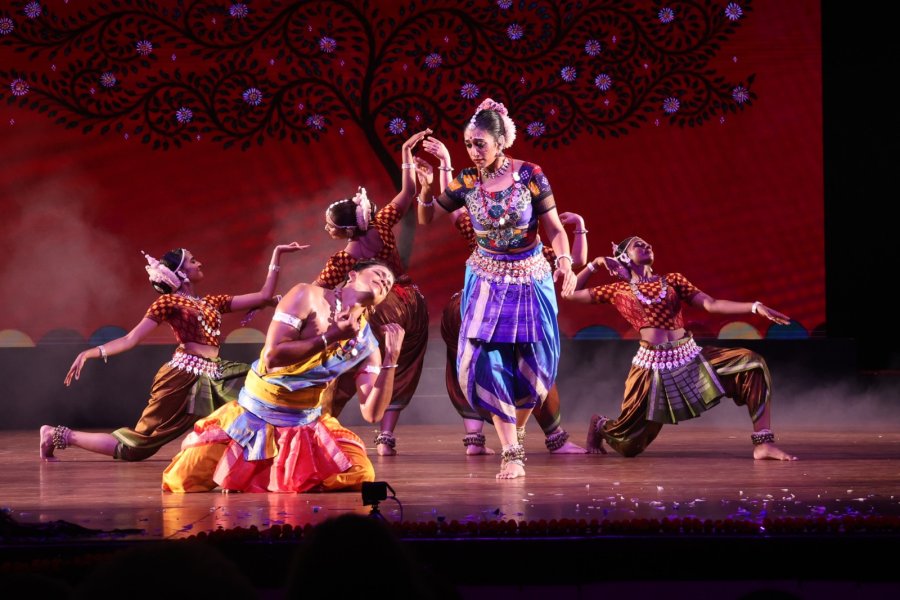 The performance on Oct 28 at Kamani Auditorium, New Delhi, was by Sutra Foundation - Co-artistic direction and composition was done by Guru Gajendra Panda (Tridhara, Bhubaneswar, India) and Datuk Ramli Ibrahim (Sutra Foundation, Malaysia). They have always been a remarkable team. Their earlier productions such as 'Ganjam' and 'Jai Ram' were equally impressive. The unmistakable influence of Ganjam's art continues to shine through their choreography. The production Radhe Radhe was presented in two segments. The first segment drew inspiration from the classical Odissi repertoire, integrating its structure and aesthetic discipline while adding fresh interpretive nuances. The production opened with a striking portrayal of Vatapatra sai - a dancer in the foreground mirrored the iconic pose depicted on a vibrant Pattachitra backdrop. This visual harmony immediately engaged the audience, creating a scene of deep resonance. Vatapatra sai represents the infant Krishna, reclining on a solitary banyan leaf and serenely afloat upon the cosmic ocean during the great flood or pralaya, all while sucking his toe. The image holds profound significance within Hindu mythology, symbolizing divine protection and the eternal nature of creation. 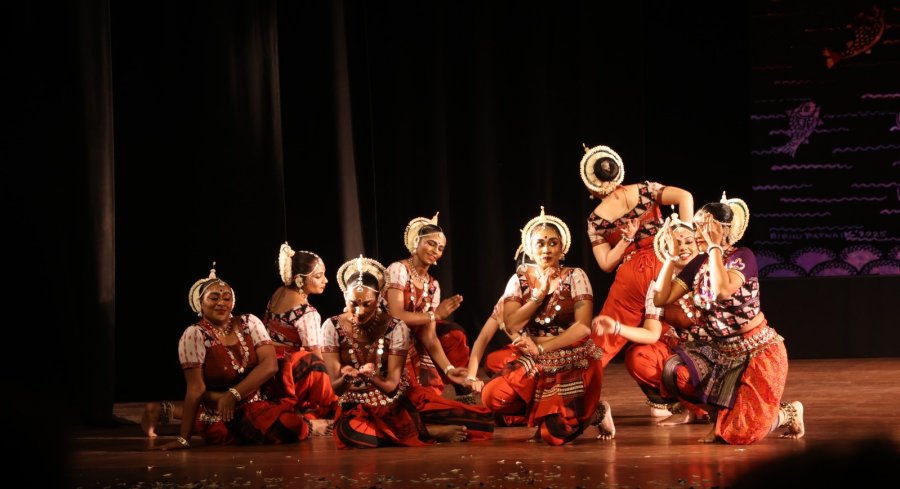 The segment began with a Mangalacharan dedicated to Radha, followed by Sthayi, Abhinaya, and finally Pallavi. Each piece carried a sense of clarity, rhythm, and invention. The choreography felt refreshing throughout - especially in the nritta sections of Sthayi and Pallavi, which balanced pure dance with a subtle narrative thread centred on Radha and Krishna. The Shabda Swara Pata passages within the Sthayi were beautifully crafted, binding technique and emotion seamlessly. The movement design was so visually dynamic that even a moment's distraction risked missing some intricate layer. Every corner of the stage held life, rhythm, and intent. In the second segment the production captured every shade of divine love - the playfulness, misunderstandings, longing, and reconciliation between the celestial lovers. The sequence traced Krishna through his many roles: the charioteer of Mahabharata, the saviour of elephant Gajendra, the protector of Draupadi, the husband of Satyabhama, and the humble cowherd of Vrindavan. Alongside, Radha's beauty and grace were introduced through lyrical narration, leading into their tender love episodes - the adorning of Radha by Krishna, the mediation by her sakhis, and the emotional turmoil during Krishna's dalliance with Chandrabali. 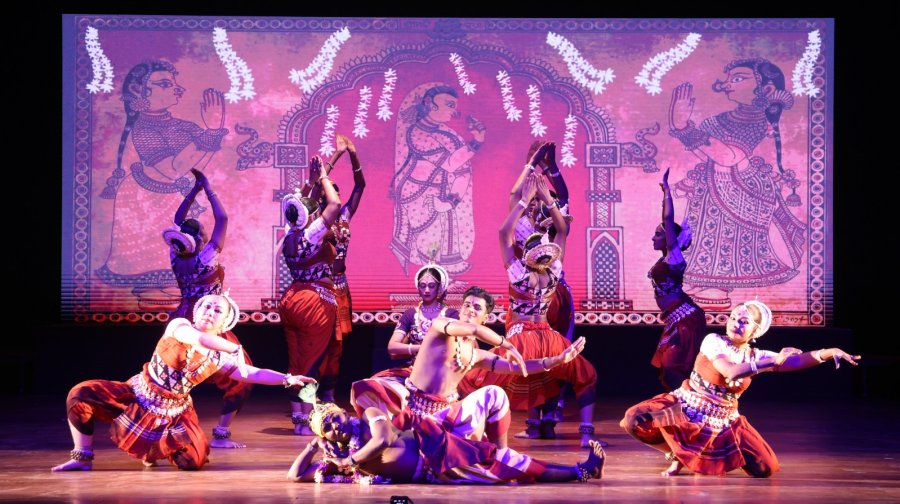 One of the most striking theatrical moments was Krishna's transformation sequence - his changing forms performed behind a revolving small screen, with each new avatar seamlessly taken up by another dancer. The finale, where Krishna reappeared disguised as a mendicant (jogi) seeking Radha's forgiveness, culminating in the Raas Leela, was especially moving. Radhe Radhe distinguished itself through its masterful choreography and evocative composition, skilfully blending the refined precision of classical technique with the energetic dynamism of folk-inspired footwork and movement. The music for Radhe Radhe was composed by Guru Gopal Chandra Panda. The music was different from the authentic Radha Prema Leela, because in the original tradition, the songs are sung at a very slow pace. The inclusion of mridanga also known as khol in Odisha added exceptional depth and vibrancy to the score, enhancing the rhythmic texture of the entire production. The recitation of Shabda Swara Pata and ukuta by Guru Gajendra Panda was particularly striking, marked by precision, clarity, and commanding energy. The vocal portions rendered by Satyabrata Katha and Sangita Panda were melodious and well-suited to the choreography. However, one point of artistic observation is that the traditional Radha Prema Leela compositions are generally sung in soft, lilting voices - typically those of children - imbuing them with innocence and simplicity. Sangita Panda's rich and powerful classical timbre, though impressive, seemed slightly at variance with the delicacy of the Odia songs. 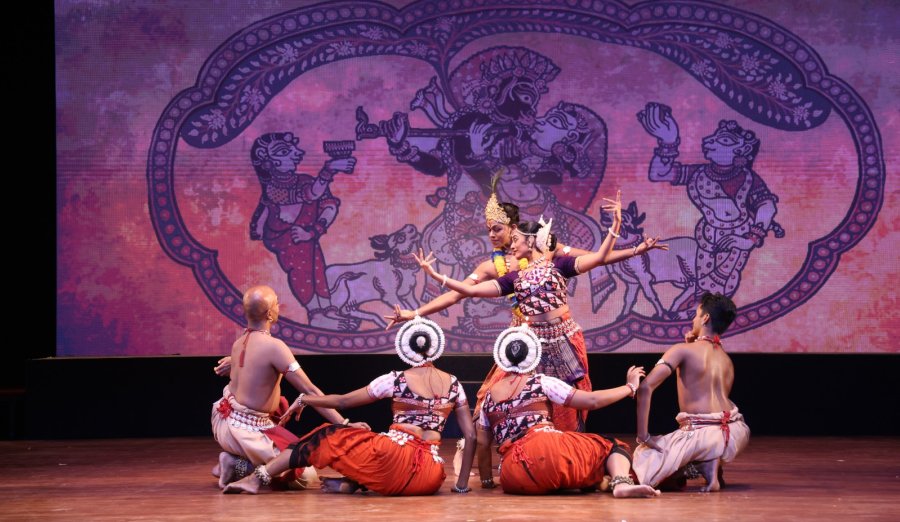 The visual design elements brilliantly elevated the performance. The lighting by Sivarajah Natarajan and the Pattachitra designs created by Bibhu Pattnaik demonstrated how backdrops, when thoughtfully employed, can profoundly enhance a stage narrative. The subtle incorporation of animated effects within the Pattachitras added a sense of movement and life to the scenes. At several moments, the figures painted on the scrolls seemed to merge seamlessly with the live dancers, evoking the enchanting illusion that the paintings themselves had come alive. The overall production tended to feel somewhat lengthy, yet it was the second segment that truly stood out. This part provided a stronger thematic coherence and did greater justice to the central concept of the production. In Radha Prema Leela, the main characters are Krishna, Radha and her eight sakhis and Chandrabali. In Radhe Radhe, however, only Lalita and Chandrabali, aside from Radha and Krishna, are highlighted - focusing the narrative but omitting the depth brought by the full ensemble of sakhis. Yet, setting aside direct comparisons, the production was truly remarkable. Every dancer from Sutra Foundation was excellent in every regard. This was not merely a dance performance but a celebration.  Ratna Bharati Acharya is an Odissi practitioner with a deep passion for the classical, folk, and traditional art forms of India, particularly those of Odisha. Her current focus involves an in-depth exploration of these artistic traditions, researching into their origins and subtle intricacies. Through her writing and storytelling, she strives to share these narratives with children as well as international audiences, especially dancers living beyond India's borders. |
