
|     |
|
| |

 Kalmrigaya in Gaudiya Nritya- Debolina Ghoshe-mail: debolina.2009@rediffmail.com October 29, 2025 Stories flow like river. A river passes through mountains, forests and plains. Stories also flow in different time and space but its underlying current remains the same. In the Ayodhya Kand of Ramayana, King Dasharatha repented for his karma that at a night of mishappening when he was out hunting, his arrow took the life of an innocent boy. 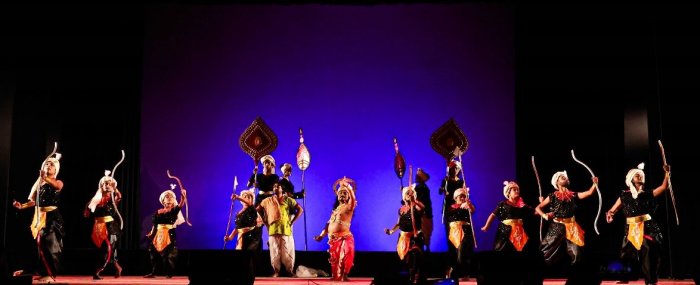 King Dasharatha with the hunters Shravan Kumar was the one and only heir and support of the blind sage. Though it was not an intentional act (King Dasharatha thought it was a deer drinking water in the Sarayu River), it was a serious misdeed which yielded a dire curse. That epic story takes new course and form in Rabindranath Tagore's creation 'Kalmrigaya - The Fatal Hunt'. A beautiful dance drama where love, care, dutifulness and bereavement create an environment of melancholic poignance. Gaudiya Charukala Bharati took this timeless work of Rabindranath Tagore and presented it in the form of Gaudiya Nritya on the evening of 14th September, at EZCC Salt Lake in Kolkata. Dr. Soumya Bhowmick, one of the brightest disciples of Dr. Mahua Mukherjee, presented this dance drama. Dr. Mahua Mukherjee is responsible for reviving Gaudiya Nritya, the classical dance form of Bengal. Her disciple Dr. Soumya Bhowmick, founder of Gaudiya Charukala Bharati, has been continuing the legacy of guru-shishya parampara with excellence. 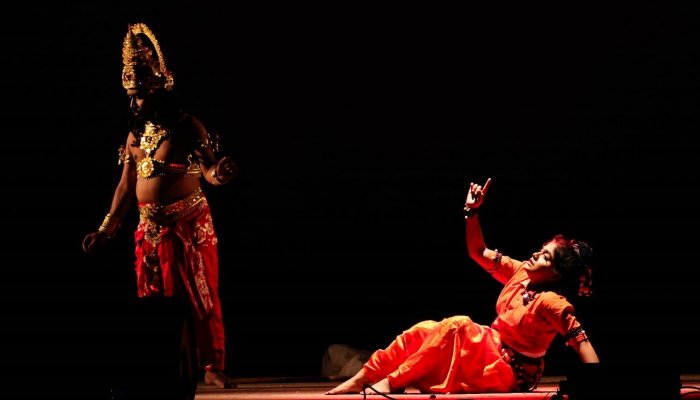 King Dasharatha and Hrishi Kumar As soon as the curtain rose, rasikas were transported to the serene ambience of a Vedic hermitage. The program started with the Upanishadic chant of "Antarishodara kosho bhumibudhno na jiryati...." This line from the Brihadaranyaka Upanishad set a divine note to the enactment. Shravan Kumar here in the dance drama is addressed as Hrishi Kumar. The child who played the role of Hrishi Kumar beautifully showed the sense of responsibility, care for his parents with agility and perfect postures of Gaudiya Nritya. The little girl who danced as Leela (a character in the dance drama) nicely portrayed the sweetness of friendship. Now, it's time to throw light on the Banadevis, the forest deities. Their joy and sorrow go parallel with that of Hrishi Kumar. They can also foresee any impending danger. Here, in the dance drama they act as chorus. In this context, Dr. Bhowmick's diligent training reflected in the coordination of the Banadevis is to be appreciated. 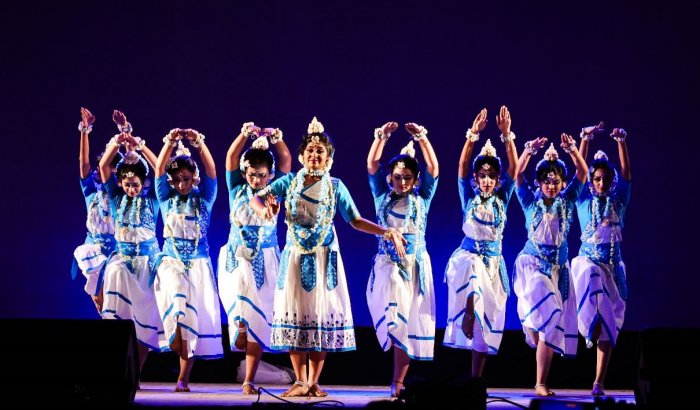 Banadevis 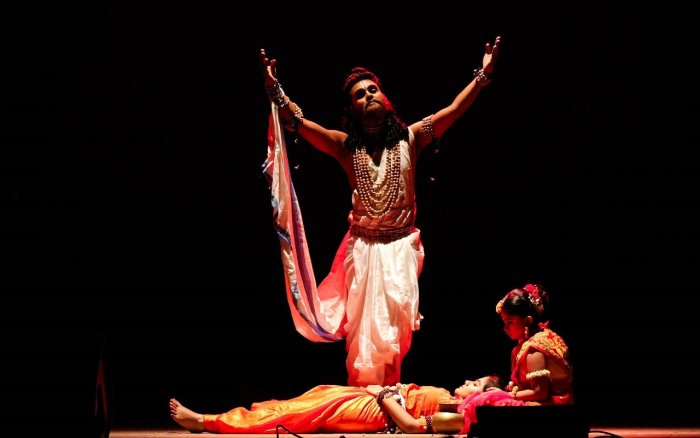 Pathos of the blind sage There are some songs in this dance drama, the composition of which has European folk influence. Tagore was highly influenced by Scottish, Irish folk music. This tells us that music has a universal appeal, it does not have any boundary. The vigour of the hunters and the zeal of King Dasharatha were superbly depicted. Postures and movements of veer rasa in Gaudiya Nritya helped a lot to portray the willingness of hunting among the hunters and the king. Pathos of the blind sage and his visual impairment got life through the extraordinary abhinaya of Dr. Soumya Bhowmick, a reflection of his dedicated practice for many years. Apart from the choreography, the songs were sung by little children which gave an innocent note to the overall presentation. Finally, the costumes were nicely designed that it had an aesthetic look at the same time not too heavy so that the dancers could perform freely. Overall, it was a presentation of a mesmerizing artistic journey presented by Dr. Soumya Bhowmick and the dancers of his institution Gaudiya Charukala Bharati.  Debolina Ghosh is an MPhil scholar, Department of Sociology, University of Burdwan, West Bengal. |
