
|     |
|
| |

 Timeless Rhythms: A journey through Koodiyattam and Odissi- Satish Surie-mail: satishism@yahoo.co.in October 27, 2025 SACRED THEATRE UNVEILED: BALIVADHAM'S EMOTIONAL JOURNEY THROUGH KOODIYATTAM Photo: Prof. K. S. Krishnamurthy On a Tuesday, 14th October evening at the Bangalore International Centre, the stage opened to a hush that felt almost sacramental. Nepathya Sreehari Chakyar's solo rendering of 'Balivadham' offered an intimate, unflinching voyage into the Ramayana's psychological core. In this seventh edition of the All for Dance series, curated by Malavika Sarukkai and organised by Kalavaahini, Koodiyattam demonstrated its extraordinary capacity to translate ancient myth into immediate, visceral experience. Chakyar's opening tableau laid down the performance's emotional bedrock with devastating clarity. Sugreeva sits in profound sorrow, a figure consumed by exile's psychic toll. The body speaks before the mouth can. In a gesture of utter abandonment, Chakyar's hands and facial expressions carry the weight of isolation as he contemplates a solitary life in the Malyavan forest, where elements are unrelenting and time itself seems to suspend in the glow of moonlit trees. The line - "My good God, will my miseries never end?" - emerges not as dialogue but as a litany etched into the air, a cry rendered without words, felt in the tremor of a brow, the tension of a jaw, the collapse of the shoulders. The forest becomes a mirror for the character's interior weather: wind-swept, bone-deep, and intermittently luminous with small, almost inaudible glints of memory. From there, the performance unfurled a sequence in which friendship and enmity are tested as a living metaphor. Chakyar's metamorphosis into a frightened deer fleeing a hunter's bow was a masterstroke of embodied storytelling. Every inch of his frame became the prey - the narrowing of the eyes, the quickened breath, the tremor that travels from the fingertips to the centre of the chest. The deer's terror was not a separate scene but a reflection of Sugreeva's vulnerability in a world that can turn on a whim. The subsequent transformation into a snake seeking refuge from Garuda expanded this vocabulary of fear across species while preserving the human thread at the centre. It was a microcosm of the Ramayana's larger tension: vulnerability magnified by peril, survival sharpened by cunning, and a constant negotiation between restraint and power. 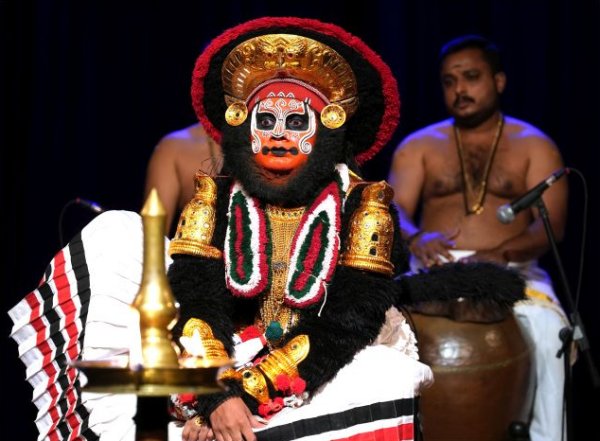 Nepathya Sreehari Chakyar The performance's central transformation unfolded with Hanuman's arrival and the ensuing alliance building. Chakyar's capacity to shift between characters while preserving narrative coherence was a testament to years of disciplined training. His portrayal of Hanuman - an emissary of truth, a seeker of friendship - formed a luminous contrast to Sugreeva's initial wariness. Subtle shifts in posture, gaze, and the slightest tilt of the head became decisive markers for distinguishing the two figures. The discernment of character through micro-movements revealed a performer at the peak of technical maturity, one who understands that in Koodiyattam the body is the primary instrument of narrative, with eyes and hands acting as the script. The encounter with Rama and Lakshmana by the Pampa River marked the evening's emotional apex. Chakyar's hands seemed to hold fire as he enacted the sacred pact, his eyes conveying desperation and dawning hope in equal measure. The transition from exile's despair to the feasibility of alliance was rendered with extraordinary nuance; it felt less like a plot development and more like an interior weather shift experienced through sensation as much as cognition. The choreography of gesture - hand forms, posture, breath, and facial expression - aligned with the music to produce a moment of almost palpable transformation. The sonic architecture of the evening, crafted in collaboration with Nepathya, was far more than accompaniment; it was a living dialogue with Chakyar's performance. Kalamandalam Manikandan and Nepathya Jinesh on mizhavu established a deep, resonant pulse that tethered the earthly narrative to a cosmic rhythm. The drums carried Sugreeva's forest reflections into a space that felt almost meditative, inviting the audience to listen for the unspoken inner monologue that the gestures staged so effectively. The percussion was not merely background - it was a listening partner, a voice that validated emotion in real time and made the body's language audible to the listening body of the room. Kalanilayam Rajan's edakka work offered intricate rhythmic commentary, especially during the peacock sequence in which Chakyar embodied the bird's triumphant dance amid rain-drenched flame. The percussion here shifted into celebration, matching the performer's visible transformation from sorrow to exuberance. This tonal swing - between melancholy and jubilation - provided a dynamic counterpoint to the more restrained moments, underscoring how Koodiyattam uses sound to sculpt emotion as much as form. Dr Indu G.'s thalam work proved pivotal during the pact between Sugreeva and Rama, the moment when fire is witnessed and a sacred vow is formed. Each cymbal strike sanctified the moment, her precise timing creating a sense of ritual witness that the narrative demands. Kalamandalam Satheesan's makeup artistry furnished the visual foundation for the performer's multiple transformations. The aharya - stylised, formalised aspects of costume and appearance - were both traditional and liberating here. Satheesan's work amplified, rather than constrained, the subtleties of emotional work contained within the performance. The face became a canvas of shifting identities, while the makeup signalled entry into each character's interior life without dampening the expressivity that is the heart of Koodiyattam. The climactic return to Kishkinda and the challenge to Bali required Chakyar to embody both righteous anger and strategic courage. The arc from the opening's dejection to the concluding empowerment was not merely a plot progression but a psychosocial trajectory: exile to agency, estrangement to alliance, fear to fortitude. The performer's physical transformation - stance, shoulder alignment with spine, chin tilt - mapped a noble evolution that felt, in its sincerity, deeply humane. It was not a performance of grand gesture alone but a patient, disciplined cultivation of character - an embodiment of virtue through motion. This presentation within Sarukkai's quarterly All for Dance series, managed by Shreya Nagarajan Singh Arts Development Consultancy, underscores how traditional forms remain vibrantly relevant in contemporary performance culture. The evening's success lay not only in Chakyar's extraordinary control of form - though that alone would suffice - but in the quiet generosity of the ensemble, the way the musicians, percussionists, and makeup artist contributed to a holistic emotional ecosystem. The musicians do not merely accompany; they converse with the performer, reply with a cadence, and extend the emotion that Chakyar channels through his body. The makeup is not a mask but a transition tool, a visible signpost that situates the audience within the narrative's evolving emotional geography. The careful coordination of actor, musician, makeup artist, and dramaturgical nerve produced not merely a show but a shared ritual of listening and understanding. MURTA MAHESWARA Photos: Prof. K.S.Krishnamurthy On the evening of October 15, 2025, the Bangalore International Centre's intimate auditorium transformed into a sacred grove, where the air hummed with anticipation and the faint scent of incense lingered like a whispered prayer. Guru Sharmila Biswas, the visionary choreographer and artistic director of the Odissi Vision & Movement Centre (OVM), unveiled 'Murta Maheswara' - a profound Odissi production that peels back the veils of myth to reveal Lord Shiva not as a distant icon, but as a pulsating force of creation, dissolution, stillness, and frenzy. Acclaimed for her innovative fusion of tradition and contemporary resonance, Biswas, a disciple of Guru Kelucharan Mohapatra, has long championed Odissi's roots in Odisha's temple sculptures and rhythmic poetry. Here, joined by her stellar ensemble of Koushik Das, Dipjoy Sarkar, Raaginni Hindocha, and Biswajit Mondal, she orchestrated a meditation on divinity's myriad forms, inviting the audience to glimpse the god within. 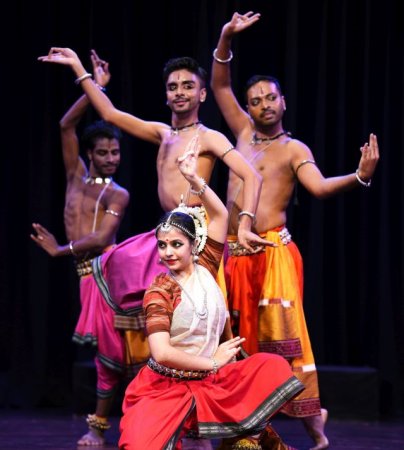 Murta Maheswara The evening opened with 'Gativilas' in the evocative Jog raga, a tour de force of pure nritta that plunged us into the wild heart of Pashupati's domain - Shiva's forest realm, where divinity guards the untamed pulse of life. Biswas's choreographic genius shone as her dancers summoned the animal kingdom through exquisite, interpretive strides. One by one, the creatures stirred to life: the horse's thunderous gallop, powered by elongated leaps and quivering flanks; the lion's regal stamp, a majestic pivot that commanded the stage like a tawny sovereign; the peacock's effortless fan dance, tail feathers unfurling in sinuous arcs amid an imagined woodland glade; the cuckoo's vibrating trill, body undulating with melodic fervor as if the bird's song coursed through sinew and bone; and the hawk's lightning descent, wings slicing the air in a telescopic swoop that blurred predator and prey. These weren't mere imitations but empathetic invocations - earthy mimes layered with Odissi's tribhangi curves and mudras, underscored by recorded wilderness calls and percussive pakhawaj that wove nature's chaos into harmonious devotion. The ensemble's synchronicity, from Das's precise footwork to Hindocha's lyrical extensions, evoked Shiva's carefree abandon: destroyer yet protector, forever entwined with his charges in a ballet of boundless trust. The pinnacle arrived with "Vilasini", a solo masterpiece performed by Biswas herself - a poignant homage to the last Maharis of Puri's Jagannath Temple, those storied devadasis whose lives embodied Shakti's devoted grace. Inspired by her own encounters with these vanishing custodians of ritual, the piece overflowed with abhinaya's layered sorcery, crafting a palimpsest of nostalgia, resilience, and unquenchable artistry. In a simple yet shattering vignette, an aged Mahari stirs from slumber, her reflection a map of wrinkles that time has etched, yet her spirit defies decay. Unable to quell the morning's adornment ritual, she yields to it with picaresque charm: knotting silver-streaked hair into a jasmine-crowned bun, anointing her forehead with crimson sindoor, rimming eyes with kohl's smoky allure. Earrings dangle like temple bells; a sandalwood streaked garland drapes her neck; a brocade jacket sheathes her form, necklaces cascading over a saree bordered in sacred motifs. Bangles chime on wrists, armlets gleam, feet blush red with alta and jingle with anklets. In a touch of sly ingenuity, she enlists imagined onlookers to slip on her toe ring, her bent frame a testament to age's quiet conspiracies. As the ritual crests, she dashes to the mirror, eyes alight with girlish wonder - and in that instant, the veil shattered. Biswas vanished; a true Mahari inhabited the stage. Every micro-movement - a furtive glance, a satisfied sigh - built the character with pore-deep vitality, brimming with earthly humour and sacred fire. This wasn't mimicry but metamorphosis, rasa distilled into bhakti's bittersweet elixir: the thrill of youth's vanities persisting against oblivion's tide. As the lights dimmed on her admiring pose, the audience exhaled in collective reverence, the rasa of shringara and karuna lingering like damaru's fading echo. 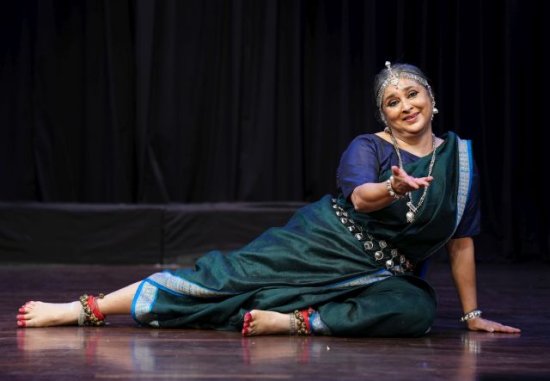 Sharmila Biswas Guru Sharmila Biswas's 'Murta Maheswara' reached its ethereal crescendo with "Dhwani-Pratidhwani", a mesmerising group choreography performed by her devoted ensemble - Koushik Das, Dipjoy Sarkar, Raaginni Hindocha, and Biswajit Mondal. This concluding piece, a hallmark of Biswas's innovative Odissi lexicon, served as the production's sonic and spiritual anchor, transforming the stage into a reverberating void where Shiva's damaru - the cosmic drum - unleashes creation's primal pulse. Drawing from Shaivite cosmology, where sound (dhwani) births form and echoes (pratidhwani) sustain the universe's rhythm, the work meditates on manifestation's subtle interplay: the unstruck syllable Om rippling through matter, much like Shiva's tandava igniting the stars. Dhwani-Pratidhwani eschews narrative linearity for an immersive soundscape, blending Odissi's intricate sabdas (rhythmic syllables) with experimental acoustics. The ensemble began in synchronised stillness - a tableau of tribhangi poses frozen like ancient Konark carvings, embodying Shiva's meditative core. Then, imperceptibly, the ghungroos stirred, their jingles merging with cymbals and mridangam thuds to forge a layered auditory architecture. Das and Sarkar's footwork etched geometric mandalas on the floor, each tukda a sonic invocation that echoed back distorted, amplified by live looping effects - a nod to Biswas's fusion of temple tradition and modern theatre. Hindocha's lyrical extensions and Mondal's grounded torque wove through the ensemble, their bodies as resonators: arms undulating like sound waves, torsos twisting in counterpoint to mimic echo's delay and decay. The piece plunged deeper into abstraction, with dancers vocalising breathy bols - half chants, half whispers - that blurred dancer and drum, human and divine. Here, Shiva emerges not as destroyer but as the eternal vibration, his anahata nada (unstruck sound) pulsing through the performers' synchronised breaths and glances. As the rhythms fractaled into frenzy, only to dissolve into silence, the audience was left suspended in profound peace - a reminder that every echo returns to source.  Bangalore based Satish Suri is an avid dance rasika besides being a life member of the Music and Arts Society. |
