|     |
|
| |

 Jyotsna Vaidee's 'Ananta': A brilliant artistic tribute to Guru CV Chandrasekhar- Jayanthi Balachandrane-mail: sun.arts.initiative@gmail.com Photos: Anubhava October 22, 2025 Jyotsna Vaidee, an outstanding and well-deserving disciple of a doyen of Bharatanatyam, C.V. Chandrasekhar or "Chandru Anna" as he was fondly called, took the Bay area by storm alongside her ensemble of talented, dedicated dancers and students. The program was well attended and every piece presented by Jyotsna and her ensemble was received with thunderous applause, in keeping with the superlative quality and high standards of dancing and choreography being presented. In a program befittingly titled 'Ananta', it was a heartfelt ode to one of the most distinguished Bharatanatyam exponents of our times, "Chandru Anna", whose work in the arts has indeed become "infinite" or "endless" in the minds of rasikas, as the title of the program suggests. He was not only a dancer par excellence, but also a gifted musician, dance scholar, composer, and choreographer. All these facets lent to his producing some extraordinary works of art during his lifetime. His subtle yet powerful aesthetics through dance became a hallmark of his artistic creations. However, what was even more exhilarating for the audience in the program staged by Jyotsna and her ensemble, was the "re-imagination" of each piece with creative liberty. A live orchestra of highly accomplished Bay area musicians took the production to new heights with its musicality and rendition. The accompanying artistes were Snigdha Venkatramani on vocal, Aditya Iswara on nattuvangam, Santosh Ravindra Bharathy on mridangam, Vikram Raghukumar on violin and Srivathsa Pasumarthi on flute. The artistic direction was entirely Jyotsna Vaidee's brainchild. The program commenced with a three-part opening in keeping with the choreographic imprint of Prof. C.V. Chandrasekhar. A brisk and rhythmic Pushpanjali preceded a solemn prayer to Lord Ganesha, which was followed by a sparkling and a deftly executed group presentation of an Alarippu. This was the very first item taught to Jyotsna by CVC Sir and hence held a very special place in her heart. It was set to Navarasa Kanada ragam and misrachapu talam (7 beat cycle). Both the music and dance composition were by CVC Sir himself. This piece was performed by the Samudra professional ensemble of Aishwarya Raman, Sriya Srirangarajan, Nikita Srikant, Akshaya Arunkumar and Jyotsna Vaidee. One of the striking features at the very beginning of the program was the fact that Jyotsna, despite being the director of the entire program, chose to adorn herself and her ensemble of dancers with an egalitarian approach. All the dancers wore similar coordinating and elegant costumes and jewelry, making for a visually pleasing presentation, without any one dancer outshining her peers on stage. This put the spotlight on the dance itself, which stood out with its chiseled movements, well-coordinated and thoroughly rehearsed presentation. It also set the stage for more demanding pieces to follow. 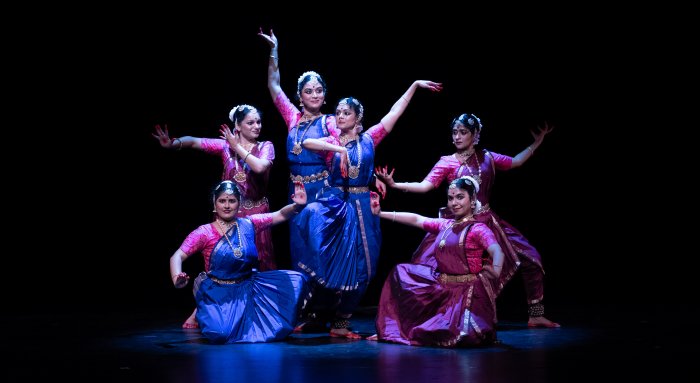 The second piece was a Jathiswaram in Yadukulakamboji, set to adi talam, composed by Prof. C.V. Chandrasekhar. He particularly loved Jathiswarams and has composed several of them. This composition beautifully blended graceful movements with playful rhythms and intricate patterns. It was beautifully and diligently performed by the Youth Ensemble. The direction for the rehearsal was done under the keen and watchful eye of Jyotsna Vaidee, with support from Soundarya Daliparthy. The youth dancers were Anika Vittal, Shriya Vittal, Amaira Tiwari, Sahana Agarwal, Harshitha (students of Jyotsna Vaidee), Kaavya Ravi Shankar (student of Meenakshi Ganesan), Niveda Balan, Nandita Ratnam (students of Snigdha Venkataramani), and Vidyuth Pasumarthi (student of Akila Rao / Viraja and Shyamjith). The piece de resistance of the program was the crown jewel of a Bharatanatyam repertoire, the Varnam, a composition by Papanasam Sivan in Nattukurinji ragam, adi talam, titled "Swami naan undan adimai". In keeping with a prayer through dance and addressed to Lord Nataraja, it was a breathtaking display of nritta and abhinaya in all its glory. Precision, speed and accuracy was evident for all to see in its finest nuances and delivery. Each sahitya or lyric was seeped in devotion, emotions and offered straight from the heart to the rasikas, transporting them to a divine plane along with the music and rhythm in the piece. The dancer in the Varnam expresses her devotion to Lord Nataraja thus: "Oh Lord, after all I belong to you; the whole world knows this. I am always immersed in your devotion, from sunrise to sunset. I search for you everywhere! Oh Lord, the God of the five elements, why this delay? I yearn to see your dancing form, your divine feet, in all their glory". On stage, the dancers constantly switched roles; the same dancer who embodied Shiva became the devotee, showing us how the divine is experienced uniquely by everyone, and that devotion flows in many forms. While a guru's teaching is often sacrosanct and preferably presented in its original, authentic form, Jyotsna's blending of traditional and contemporary came through like a bright, shining beacon of light in her group choreography. There were asymmetric placements and swift covering of space by the dancers whilst rendering difficult jathis and korvais with dexterity, catching the audience by surprise due to its novel and creative renditions. Unbeknownst to them and swept away by the life force in the dance, the audience found themselves keeping beat with the sprightly and complex rhythmic passages with joy and fervour. The contemporary formations presented side by side with the traditional format of a daunting piece such as a Varnam left an indelible mark in the minds of onlookers. It is hard enough to master a Varnam such as the one intricately choreographed by Chandru Anna. But to add to the level of complexity, there were many dimensions interwoven into the piece - challenging layers of group movements, poses that looked like sculptures coming alive on stage in the middle of a lightning movement, pauses that offered just the right amount of suspense, hands and feet taking on a life of their own in time and space. A "flow state" seemed to have taken hold on stage, with the audience flowing right along with the dancers in their mind's eye. This Varnam was physically grueling at around forty minutes in length. It allowed the audience to soak blissfully in the ananda thandavam of Lord Shiva, his legends and his compassion coming through in the Nattukurinji ragam, with all its melodious ebbs and flows in the sancharis and swarams. The gravity of the piece captivated the senses through soulful music and dance. Sheer artistry, and unfailing stamina dominated the piece from start to finish. It was choreographed by Chandrasekhar Sir in 1992, for the graduating class at Baroda University in India, while he was the head of the Department of Dance as well as the Dean of the faculty of Performing Arts. The Varnam was performed by the Samudra Ensemble of professional dancers: Aishwarya Raman, Sriya Srirangarajan, Nikita Srikant, Akshaya Arunkumar, Anusha Sreenivasan and Jyotsna Vaidee. The uttaranga or second half of the program provided a change in tempo with a solo presentation by Jyotsna Vaidee. Her artistic caliber spoke for itself in the ashtapadi "Nindati Chandana" set in raag Yaman Kalyan. An ashtapadi is a poetic composition, drawn from the Gita Govinda of Jayadeva, describing the eternal love story of Radha and Krishna. When it comes to abhinaya, CVC Sir believed in using metaphorical ideas from around us to explore an emotion. Jyotsna captured the depth and intensity of Radha's devotion and longing with aplomb. Her gentleness in the descriptive aspects, especially of elements of nature, combined with her fleeting expressions and deeply felt portrayal of viraha or pangs of separation by Radha towards Krishna, was an affirmation of her emotional maturity, complete involvement and surrender to the delicate requirements of abhinaya as it were. The next piece, "Shankara rudra roopa dikhilao" was a Hindi song composed by Prof. C.V. Chandrasekhar in raag Shankara. This was a truly unique composition in its content and in the choice of ragam, which matched the protagonist of the piece, Lord Shankara. The inspiration for this piece came from a poem CVC Sir had encountered when his daughters were performing in a school play. Struck by its imagery, he set it to music, weaving in intricate rhythmic patterns to create one of his masterpieces. The song invoked Lord Shiva in his dual aspects; Shankara, the giver of auspiciousness, and Rudra, the fierce, destructive force. Together, these names captured Shiva's paradoxical nature: benevolent yet immensely powerful, destructive yet ultimately uplifting for the world. An interesting personal anecdote is that Jyotsna did not have the opportunity to perform both this piece and the ashtapadi in the presence of her Guru while he was alive. Hence, it gave her great joy to present these two pieces and she hoped that her Guru was watching and blessing her from the heavens above. 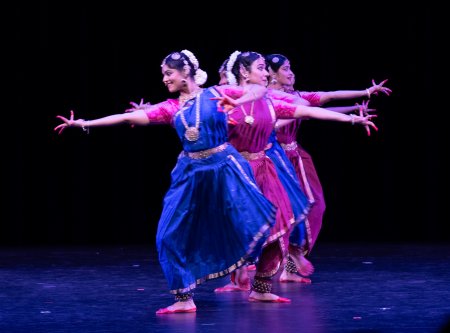 Next was a Tulsidas bhajan, composed and choreographed by Prof. C.V. Chandrasekhar to celebrate the 400th anniversary of Saint Tulsidas titled "Gayiye Ganapathi" in raag Kalavati, set to adi talam. Yet another unique piece from CVC Sir's vast repertoire, this devotional bhajan from Tulsidas' Vinay Patrika, was in praise of Lord Ganesha. Surprisingly presented as a penultimate piece in the program, this piece was envisioned as an intricate and vibrant group choreography. With a generosity of spirit, Jyotsna brought together past collaborators and members of the dance community, reflecting her Guru's inclusive spirit, who valued every dancer's unique expression over strict Banis or styles. This piece was performed by a group of local seasoned dancers from the Bay Area, comprising Chethana Sastry, Kavita Thirumalai, Aishwarya Venkat, Swathi Ramesh, Vaishali Ramachandran, Akshaya Ganesh, Lekshmi Sarath and Sukanya Kumar. Their expertise in dance shone through in their command of various facets of the dance. This elevated the essence and beauty of the piece and hence its deeper meaning. Each one brought their finesse and individual nuances to the fore, creating a spell-binding presentation. The concluding piece of Jyotsna's presentation was a treat for the heart and soul - a Thillana in the mellifluous Hamsanadam ragam, studded with enchanting rhythmic passages within the music. The origin and concept in praise of Goddess Annapoorneshwari was a touching story of Prof. C.V. Chandrasekhar who spent many years in Kashi and was inspired by the Kashi Vishwanath temple. The legend goes that one day Lord Shiva, the ascetic, dismissed food as mere illusion. Offended, Goddess Parvati disappeared, taking with her the very source of nourishment. The world plunged into famine; gods and humans alike suffered in hunger. Realizing his mistake, Shiva himself came to Kashi with a begging bowl, seeking alms. It was then that Parvati, as Annapoorani, appeared and offered him food, teaching that annam or nourishment, is not an illusion, but life itself. The Thillana was followed by the Mangalam, wherein a video of Prof. C.V. Chandrasekhar himself dancing the Mangalam was played on a large screen on stage, even while the dancers were performing live. This made for a divine moment of the guru and sishyas seemingly dancing alongside one another. It was a fitting finale - a mangala arthi through the idiom of dance and music. The humanitarian objective and a purposeful endeavor for the staging of this program was that the entire presentation was held as a fundraiser for a good cause - Remalaya, a nonprofit organization.  Jayanthi Balachandran is an ardent arts enthusiast. |
