
|     |
|
| |

 Pompi Paul's solo recital- Tapati Chowdhuriee-mail: tapatichow@yahoo.co.in Photo: Satyajit Sarkar October 20, 2025 On the 18th of September, Dr. Pompi Paul, the Artistic Director of Kalpodip, gave a solo recital at G.D. Birla Sabaghar, Kolkata. It was a Surchandam presentation, in collaboration with Upaj India and Vichitra Shala. An enviable musical accompaniment assisted Pompi Paul to lend aesthetic beauty to her performance. Sangita Gosain, known for her melodious voice, was the vocalist. Along with her was Satyabrata Katha, who sang sonorously. Mardala artiste Soumya Ranjan Nayak, violinist Ramesh Chandra Das, flautist Jabahar Mishra, sitarist Prakash Chandra Mohapatra and Kolkata's very own Shib Narayan Banerjee, who kept the beat with his manjira, made up the entire team. 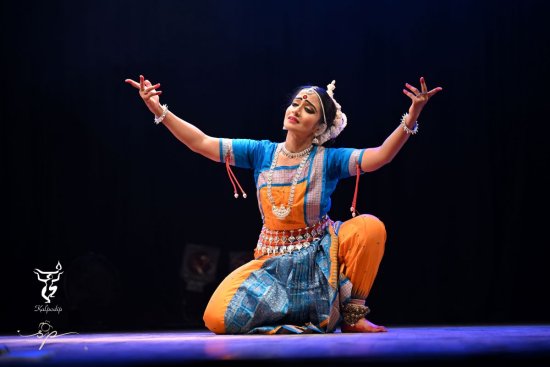 Pompi Paul The first piece, Kasturi Tilakam was dedicated to Sri Krishna. The composition was initiated and composed by Guru Poushali Mukherjee and Sangita Gosain, along with Swapneswar Chakraborty in 2014, and Pompi Paul had performed it at Thimpu in Bhutan for an ICCR sponsored program at the Embassy of India. This year, in June, the composition was rearranged, extended, and recorded in the memory of Guru Poushali Mukherjee. Some of the parts of the rearranged composition were choreographed by Pompi Paul and presented in this program as a tribute to her revered Guru. Pompi Paul commenced with flower offerings to Lord Jagannath and her Guru with heartfelt devotion. The presentation began with the first verse of Krishnashtakam, written by Adi Shankaracharya. In this part, the choreography portrayed how Krishna was born and taken to Gokula by his father Vasudeva, to subsequently grow up and rid the world of the tyrant Kamsa. The next part of the composition was based on music and portrayed the devotee decorating Lord Krishna's Murti. The final part was based on the Sanskrit verses of Sri Krishna Karnamrutham by Bilva Mangalar, which describes the divine beauty of Lord Krishna. This song by Sangita Gosain touched a chord in the hearts of the audience. Sringar Pallavi was next in line. The Pallavi blossomed with various dance movements like the petals of a lotus. It progressed from a slower rhythm to a faster one. The choreography described the preparation of a dancer before she appears on the stage in front of the audience. Through preparation, a dancer decorates herself with makeup, ornaments, costume, and flowers and wears her ghungroo or ankle bells. Additionally, different musical instruments are also placed on stage to accompany singers and musicians. In this composition, a complete scenario has been beautifully drawn by Guru Poushali Mukherjee. Sringar Pallavi was based on raga Ananda Bairavi and tala Ekatali. The music composed by Guru Satchidananda Das and Sumanta Mahanti was matchless in beauty. The Ram Bhajan "Prema mudita manse kahu Rama Ram Ram" was a traditional bhajan dedicated to Lord Rama. The bhajan described the true essence of devotion. The only lifelong treasure possessed by a devotee is the name of Rama. In her choreography of the piece, Guru Poushali Mukherjee had included various episodes from the Ramayana for elaboration like Ahalya Moksham, Sabari Moksham, and Kevat Pasang. 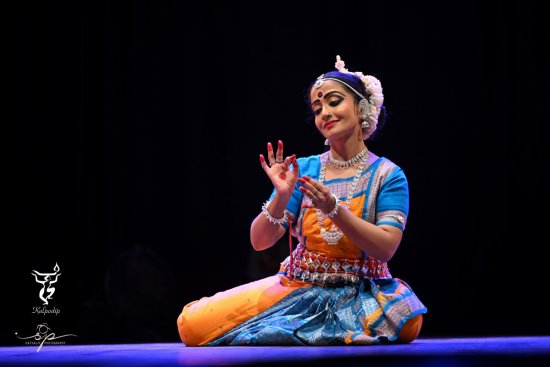 Pompi Paul Shiva Stuti, Jata kata hasambhrama bhramani limpanirjhari, performed by Pompi was based on raga Chandra Kosh and talamalika. The dance and music composers, Guru Poushali Mukherjee and Guru Satchidananda Das, along with Sumanta Mahanti, did a remarkable piece of work. Different stories from the Puranas and Mangal Kavya on Lord Shiva were imaginatively incorporated in this gem of a piece. The composition began with descriptions of Lord Shiva and continued with different stories like Madan Vasma and Samudra Manthan from the Puranas. It concluded with the story of Goddess Manasha and Chand Swadagar taken from the Manosha Mangal Kavya. Pompi Paul can be counted as one of the best Odissi dancers of her generation, which is popularly known as Generation Y. In the second half, Pandit Kumar Bose, who is a stalwart in his field, played Jhaptaal and Teentaal in the tradition of Banaras Gharana on tabla. He was accompanied by his nephew and student Rohen Bose on tabla and Pandit Hiranmay Mitra on harmonium. Satyajit Sarkar was the photographer of the evening, while lights were designed by Dhanapati Mondal.  Tapati Chowdhurie trained under Guru Gopinath in Madras and was briefly with International Centre for Kathakali in New Delhi. Presently, she is a freelance writer on the performing arts. She is the author of 'Guru Gopinath: The Making of a Legend.' |
