From Monasteries to Metropolises:
A confluence of Sattriya dance at the 2nd Satkara Nrityotsav in Noida
- Yasmin Rahman
e-mail: yasmn.rhmn@gmail.com
October 6, 2025
Although I had trained in the Jaipuri gharana of Kathak in faraway
Digboi, a small oil town in the farthest corner of Upper Assam, the
influence of Sattriya culture was deeply ingrained in me. It came
through fellow dancers, shared stages, and gurus who nurtured in us the
immeasurable curiosity to embrace not only our own chosen form but the
manifold expressions of Indian classical dance and the performing arts
more broadly. In the 1990s, when I was growing up, the Mahapurixia
tradition - or the Ek Saran Nama Dharma movement propagated by the
15th-century Vaishnavite saint Srimanta Sankaradeva and his disciple
Madhavadeva - remained vividly present in that region. Its many artistic
expressions, including Borgeet, Bhaona, and most prominently the
Sattriya dance, were not remote inheritances but part of a living,
breathing environment of creativity.
I recall one performance especially, when we were to appear at Dibrugarh
Doordarshan Kendra in the late 1990s. A handful of Kathak students were
selected to participate in the Dokhobotar Nritya (Dashavatara, or the
ten incarnations of Vishnu). We were not the principal performers; we
filled the studio with movements that lent breadth to the composition.
Yet for me, this marked a first initiation into Sattriya, not by
training but by osmosis. From then on, I rarely missed an opportunity to
watch a Sattriya performance whenever the opportunity presented itself.
This is why the recognition of Sattriya as a classical dance in 2000 by
the Sangeet Natak Akademi seemed less the conferring of prestige than
the belated acknowledgement of a truth long lived by those who grew up
in Assam. That recognition has since been joined by another: in 2024,
the Assamese language was granted classical language status along with
Marathi, Pali, Prakrit, and Bengali. Such milestones have helped bring
Assam and the Northeast into sharper focus within the artistic
consciousness of India.
It was in this spirit that I found myself a rapt member of the audience
at what I consider the most exhaustive and grand celebration of Sattriya
in Delhi-NCR in recent years: the second edition of the Satkara
Nrityotsav, titled A Sattriya Odyssey: Bridging Oceans and Traditions.
Held on the fervent last night of August, as if in anticipation of the
Assamese celebration of Krishna Janmashtami on 14 September (observed in
distinction from much of India, which marked it on 16 August), the
festival unfolded in the precincts of the Sabari Cultural Centre at the
Ayappa Temple in Noida. For one evening, that modest hall became a
sanctum of rhythm and devotion, filled with the resonances of an art
form rooted in fifteenth century monasteries yet alive and expansive
today.
The evening was shaped by the vision of Adhyapika Meenakshi Medhi,
disciple of the late Adhyapak Jibanjit Dutta, who founded Satkara in
2013 in Guwahati as a society dedicated to propagating Sattriya culture.
From its beginnings in Assam, Satkara has grown into a foundation based
in New Delhi, with a school - Sattriya Nrityasala, established in 2018
and affiliated with the Sangeet Sattra Pariksha Parishad, Guwahati - that
trains students across India and abroad. This year's well-curated
festival demonstrated not only the vitality of Sattriya but also how it
enters into dialogue with other traditions, reaffirming the universality
of devotion through dance.
The programme commenced with the ceremonial lighting of the lamp by the
Chief Guest, Raju Das, Secretary of Sangeet Natak Akademi. The youngest
pupils of the Nrityasala - Reeyanshi Paul, Aaranya Baniah, and Bipaanchi
M. Kashyap - then enacted a brief skit evoking the timeless Guru-Shishya
parampara. Their gestures, unembellished yet sincere, recalled the roots
of all Indian classical dance in devotion, discipline, and
transmission. This was followed by Shri Krishna Stuti, a prayer from the Bhagavat
Purana enumerating the many attributes of Krishna, performed by
Madhusmita Baruah, Priyanka Das, Mansi Baluni, and Hridy Jonaki Bhuyan.
On this evening, Krishna appeared not only as the vanquisher of evil but
as the beloved, whose presence completes Radha's devotion.
From invocation, the stage moved to vigour: Nadubhangi Nritya, composed
by Madhavdeva and marked by robust masculine movement. Aaditri Kumar
presented the twofold composition of Ramdani and Geetor Naas with
clarity and force. In striking contrast came Xuddha Saali Nritya, a pure
dance of lasya delicacy, also composed by Madhavdeva, performed with
grace by Anuradha Kaushik. Side by side, these two pieces revealed how
the Sattriya tradition encompasses both tandava and lasya, vigour and
tenderness, discipline and abandon.
A fitting interlude came with Kathak performances by the guest artistes,
Rupa Rani Das Bora of the Lucknow gharana and Madhusmita Handique, a
disciple of Pt. Birju Maharaj and Pt. Jaikishan Maharaj. Their duet
invoked Shiva in a devotional bhajan, their synchronised abhinaya
conjuring both his majesty and his gentleness. Handique followed with a
Tarana in raga Kalawati, a composition of Pandit Birju Maharaj, marked
by crisp footwork and elegant movements. Then Das Bora presented a
Thumri on the playful exchanges of Radha and Krishna, a piece whose
lyrical abhinaya acquired particular poignancy in proximity to
Janmashtami. She concluded with a composition in Teental, the
foundational sixteen-beat cycle of Kathak. Her dazzling footwork and
rhythmic command left the audience spellbound.
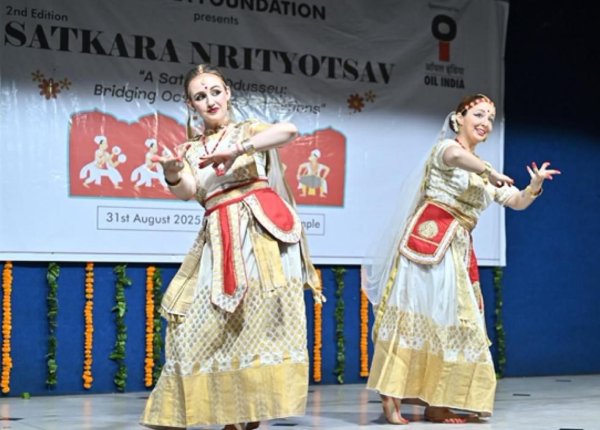
Perrine Legoullon and Francisca Salina
The festival's theme found luminous articulation in the duet by Perrine
Legoullon (France) and Francisca Salina (Chile). Their programme began
with Isha Vandana, a devotional offering to Krishna originally composed
by the late Adhyapak Jibanjit Dutta, followed by Krishna Rup Varnana from
Sankaradeva's Kirtan Ghoxa. They concluded with Xuddha Saali Nritya,
again to Barman's composition. Their disciplined training and sensitive
execution affirmed how Sattriya inspires artists far beyond India's
borders, and how its devotional essence can be embraced as a lifelong
discipline even in distant lands.
Equally memorable was Ajamil Upakhyan, performed by Ananya Baruah,
Pragati Kalita, and Anuradha Kaushik. Based on the Bhagavat Purana, it
recounts the story of the fallen Brahmin Ajamila, redeemed through the
utterance of Narayana's name. With choreography rooted in Sankaradeva's
Ankiya Naat tradition, the performance united drama and abhinaya in a
manner both edifying and deeply moving.
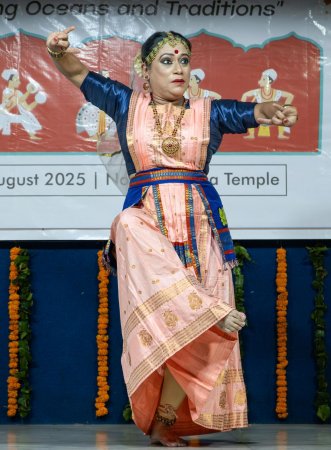
Anita Sharma
The culmination and highlight of the evening was the appearance of Anita
Sharma, the renowned Sattriya exponent from Guwahati and recipient of
the Sangeet Natak Akademi Award. She performed Uma Rudra Sambad, a
narrative drawn from Sankaradeva's Bhagavata. Beginning with the Ojapali
tune and unfolding through ragas Bhatiyali, Manjyoti, and Kharuman, the
piece depicted the anguish of Sati, the wrath of Shiva, and the
ultimate supremacy of Vishnu. With music by Bhaskarjyoti Ojah, Sharma's
performance was a masterclass in abhinaya and rhythm, holding the
audience in profound attention.
The evening closed with the collective prayer Xamoroni Ghat, rendered by
all the students of Sattriya Nrityasala. Each of their performances
bore the signature choreography of Adhyapika Meenakshi Medhi, reflecting
her aesthetic vision. Notably, two students were honoured: Anuradha
Kaushik for completing her Gunin (Diploma) in Sattriya, and Aaditri
Kumar as the first from Uttar Pradesh to secure the CCRT Scholarship.
These recognitions underscored Satkara's rigorous training and the
expanding reach of Sattriya beyond Assam.
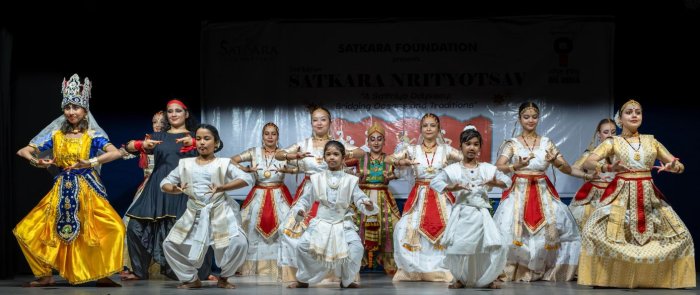
Xamoroni Ghat
What lingered after the festival was not only the richness of the
evening's repertoire but also the sight of dancers from foreign shores
devoting themselves with seriousness to this form. Indian classical
dance is not a pastime; it demands lifelong commitment. To see
international students embrace Sattriya with that very rigour is
heartening. It signals that the form is no longer bound by geography; it
is entering the global repertoire of sacred art.
Closing Reflections
With its second edition, Satkara Nrityotsav has established itself as a
landmark in Delhi-NCR's cultural calendar. If the first edition
announced its arrival, this year affirmed its stature. The evening
revealed devotion reimagined in forms at once rigorous and graceful. The
intertwined stories of Radha and Krishna remain inexhaustible
wellsprings of inspiration for Kathak, while Sattriya itself, born of
Sankaradeva's bhakti vision, continues to renew its vitality. On that
night in Noida, one could sense that the pulse of Sattriya beats not
only in Assam but across India and far beyond her shores, carried by new
generations who will guard and expand its legacy.

Yasmin Rahman is an editor, translator, and writer with an MPhil in
English from the University of Hyderabad. Since 2007, she has worked in
the publishing industry in Delhi with Katha, Oxford University Press,
Pearson, Harper Collins Publishers, and Penguin. Her writing focuses on
sharing the art, literature, and culture of her home state, Assam, with a
wider audience. Yasmin trained for 12 years under the late Tapas Guha
in the Jaipuri Gharana of Kathak. (@lost_in_rumination)
|