
|     |
|
| |

 Beeja - the silent witness!- Nrupa Somane-mail: nrupas@gmail.com Photos: Innee Singh October 2, 2025 In a single glowing light, she stands alone. Slowly, with measured steps to the verses from the Hiranyagarbha Sukta (or the Golden womb - the story of the creation of the universe), she pushes out, exploring the space around her, as she becomes one with the sprouting seed or the Beeja, the protagonist of the production. On 10th September, Malavika Sarukkai's 'Beeja' came alive at Kamani Auditorium, New Delhi to a full house packed with artistes and connoisseurs alike. With a soundscape and audio experience rivalling an award winning movie, Beeja is an immersive experience. From the first note to the last flickering light, Sarukkai holds your attention and grips you with her simple tale of a seed that 'held its ground'. 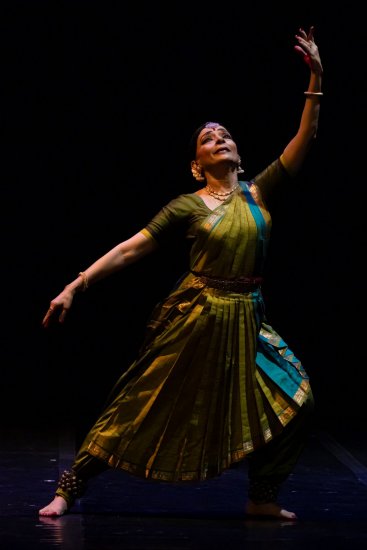 It is a tale oft told, of Man and his greed, and the price nature pays for his selfishness. Yet in the hands of Sarukkai, this 75 minute narrative takes on Disney's Bambi-esque appeal. It starts out describing the origin of the cosmos, a universe created in God's image perhaps. The sheer scale of richness and natural beauty that Sarukkai depicts with Bharatanatyam as her core vocabulary, finds the happy medium between traditional and contemporary. The stage is bare, the vocalist and mridangist each in their own space, observing and accompanying. Sarukkai embarks on this tale, setting the tone of an idyllic world starting with Varsha, the season of rain. A time for the earth and its residents to sprout and love and grow. An abundance of classical monsoon iconography is witnessed here: the trees and the flowers and birds, the beautiful peacock and the yearning for the beloved that permeates in the very air. We have the stars and the moon and the lotuses, that all make room for the majestic swan. And here the production truly finds it groove. It is not a fast paced, racy production, but it is soft and deep and seeps into your very soul. I saw reeds and deep blue waters and vines as Sarukkai bobbed gently like a swan, creating a stillness that makes you fall in love with the wonders of the world all over again. She used her ghungroos effectively here, as an instrument and not merely bells that jingle when you move, making "water" come alive for the audience. 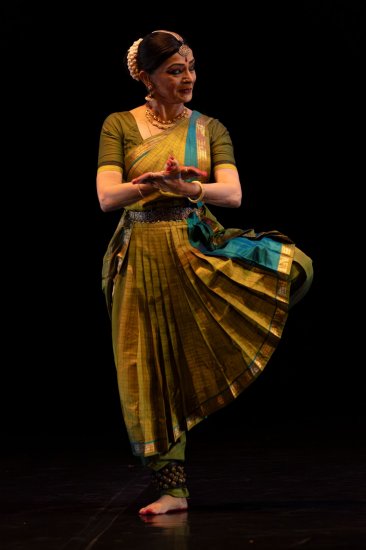 The swans then led to greater wonders of serpents and elephants and the deer and its mother. As you are lulled into what feels like Attenborough's world, a loud crash jolts you to remind you of the very point of this story. She underlines the pain felt by the animals and trees as Man inflicts violence upon violence on the innocents. The trees are cut, entire forests annihilated. She even depicts the aftermath of a nuclear attack, as animals and trees burn to crisp. It would have been very easy at this point to slide into unnecessary theatrics. Sarukkai's achievement is the thin line she walks. The music, the story in itself, is contemporary yet it doesn't aim to be experimental theatre and stays well within its vocabulary, doing great service to prove that classical dance can express a plethora of ideas, adapting to a new age without losing any of its essence. The production comes a full circle, underlining the seed and the tree that it bore, witness to the changing seasons and Man's fickle character. With masterful support and creativity from her entire team - narration by Sumantra Ghosal, music by Rajkumar Bharati, sound design by Sai Shravanam, lights by Niranjan Gokhale, Kritika Arvind for vocals and Nellai Balaji on the mridangam, Beeja is a work of art. Kritika Arvind's rendition of raga Desh summons before our eyes an image of the earth all green and lush, petrichor in the air, beads of raindrops adorning the leaves and streams and rivers flowing in gay abandon. Singing in time to match Sarukkai's movements, mindful of the pre-recorded soundtrack, Arvind delivers a measured yet memorable performance. Special mention for the exceptional light design! Many a piece has suffered from poor light design/execution. But here Gokhale's lights transform from warm, expansive; flooding the stage, to a single laser like spot, highlighting the very expanse of the story - from mighty forests to a single tiny seed. The lights must conjure scenes of a gentle earth, or of steel cutting through the woods, or of blazing fires on a bare stage, with a lone performer. But it succeeds and how! Detailed yet free from unnecessary frills, in every aspect, Beeja lets the story take centrestage. There are no gimmicks for the sake of it, no drama - it is straightforward and thus it manages to deliver a punch. As an aside, my five-year-old spent the second half of Beeja, watching through shielded eyes, with tears rolling down her face for the poor deer. That truly speaks of the honesty with which Beeja has been made, and of course Sarukkai's genius, to be able to communicate to an "illiterate audience", who knows nothing of the classical language of dance, yet found its heart beating to the same rhythm. Kudos!  Nrupa Soman is a Pune/Delhi based dancer, dance researcher and anchor of classical dance and music festivals. |
