
|     |
|
| |

 Kaleidoscope of dance performances- Satish Surie-mail: satishism@yahoo.co.in September 28, 2025 RAMACHANDRAM BHAVAYAMI – FEMININE VOICES OF THE RAMAYANA Photos: Prof K.S.Krishnamurthy At the Bangalore International Centre, on the 26th of August, Ramya Ramnarayan's 'Ramachandram Bhavayami' unfolded as a distinctive confluence of Katha (narrative storytelling) and nrityam (dance), illuminating the lives of four women from the Ramayana - Kaikeyi, Shoorpanakha, Tara and Mandodari. Conceived in collaboration with the erudite Dushyanth Sridhar, the production offered a feminist retelling of the epic, foregrounding how these women, though often relegated to the margins, bore the profound consequences of Rama's actions and yet remained bound to him through threads of adoration, conflict, and reverence. 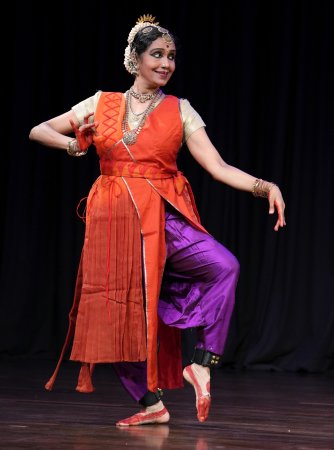
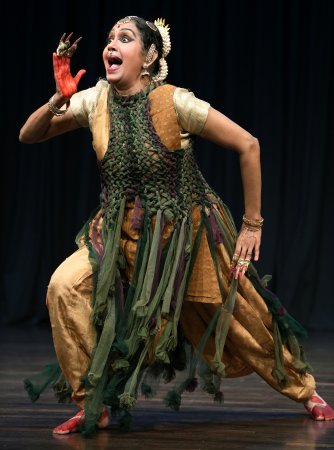
Kaikeyi emerged as a woman of contradictions - Dasharatha's queen, Bharata's mother, and the catalyst of Rama's exile. Ramya's choreography captured her ambivalence: the regal authority shaped by political obligation, the anguish of maternal instinct, and the residual affection for Rama. The narrative drew upon Valmiki and Kamban, revealing Kaikeyi not as a villain but as a mother driven by circumstance and manipulated loyalty. Shoorpanakha, Ravana's sister, was rendered with a raw intensity. Her attraction to Rama, her rejection, and the humiliation of her disfigurement were etched in gestures that conveyed desire, rage, and despair. No longer a mere caricature of lust, Shoorpanakha emerged as a woman whose thwarted longing ignited the chain of events that defined the epic's tragedy. Tara, Vali's consort, embodied wisdom and poise. Ramya's portrayal highlighted her grief at Vali's death and her pragmatic embrace of political realignment with Sugriva, underscoring the dignity with which she navigates personal loss and duty. Her reverence for Rama as the divine arbiter of dharma lent her story a quiet gravitas. Mandodari, Ravana's virtuous queen, was the still centre of Lanka's chaos. Her inner conflict - torn between loyalty to her husband and recognition of Rama's righteousness - was expressed with serene dignity. Through her, the performance evoked the poignancy of devotion that transcends marital allegiance, casting Mandodari as a woman of strength and foresight. Ramya's solo Bharatanatyam choreography alternated seamlessly between narrative and dance. The precision of adavus, the eloquence of mudras, and the depth of abhinaya lent each character a distinct voice: Kaikeyi's ambition, Shoorpanakha's defiance, Tara's grief, and Mandodari's quiet resilience. Her aharya choices were purposeful, designed to make the characters relatable yet mythical, subtly enhancing the performance's emotional landscape without overshadowing the dance. The musical ensemble enriched the production values with remarkable artistry. Krithika Arvind and R. P. Shravan lent evocative vocal support, while Ganapathi Venkatasubramanian on tabla and special effects and Nagai S. Narayanan on the mridangam created a rhythmic canvas of layered intensity. The melodic richness was heightened by Subramanya Sarma on the veena, Embar Kannan on the violin, and J. B. Sruthi Sagar on the flute. At the heart of it all was Rajkumar Bharathi's sensitive musical composition, which, complemented by Sai Shravanam's sound design, wove the narrative and dance into a seamless aesthetic whole. Anchoring the evening, Dushyanth Sridhar interwove erudite mini-upanyasams, contextualising each episode through Valmiki and Kamban's Ramayanas and devotional compositions of Tyagaraja and Bhadrachala Ramdas. His scholarship framed the dance with intellectual depth, enabling the audience to traverse the layered emotional terrain of these women. What emerged was not merely a retelling of the Ramayana but a reclamation of voices - women often overshadowed by the grandeur of the epic yet essential to its moral and emotional fabric. 'Ramachandram Bhavayami' invited the audience to see Kaikeyi, Shoorpanakha, Tara, and Mandodari anew: not as footnotes to Rama's saga but as complex, resilient women whose devotion, desire, grief, and moral clarity enrich the epic's timeless resonance. 12TH ANNIVERSARY CELEBRATION OF SILAMBAM ACADEMY OF FINE ARTS Photos: Aashrith Mallur On August 30th, the Silambam Academy of Fine Arts marked its twelfth anniversary with a special celebration at the Indian Institute of World Culture in Bengaluru, an occasion that also coincided with the twenty-fifth anniversary of its founder Aishwarya Anant Karthik's own arangetram. The evening carried both the weight of memory and the assurance of continuity, as Aishwarya herself took the stage for a margam presentation, accompanied by a distinguished live orchestra whose presence lent the performance its emotional depth. 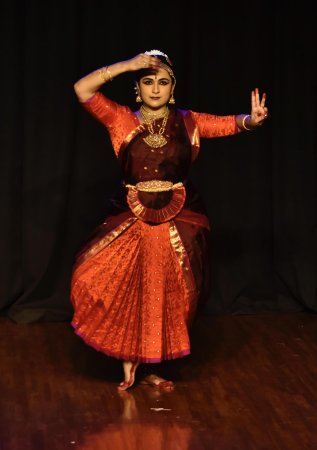 Aishwarya Anant Karthik A disciple of Prof. Sudharani Raghupathy, Aishwarya opened with a Navasandhi Kautvam in Malhari raga and Khandachapu tala dedicated to Eeshana, one of the nine directional deities. Rarely seen outside temple contexts, the piece set a solemn and elevated tone, and Aishwarya's rendering revealed her control of both nritta and abhinaya. Her precise movements and measured expression brought alive the essence of the northeastern guardian deity associated with Shiva, establishing a devotional intensity that carried through the recital. The varnam, "Sami ni rammanave" in Khamas and adi tala, formed the centrepiece of the recital. In this piece, Aishwarya embodied the role of a love-lorn nayika who pleads with her sakhi to bring her Lord to her. Her abhinaya unfolded with striking detail as she conveyed a layered spectrum of emotions - anguish at separation, disbelief at her plight, and a simmering defiance that underlined her resilience. With lines such as "rave na maṭavinu", her appeal to the sakhi resonated with raw immediacy. The sancharis extended the narrative beyond the literal text, drawing the audience into the nayika's conflicted state of mind, while her face and eyes became eloquent canvases of shifting emotion. The rhythmic passages of the varnam offered equal testimony to her command over form. The trikala jatis were rendered with clarity and precision, her erect posture and clean lines imparting weight and dignity to every sequence. The synchrony between her movement and Priya Murle's authoritative nattuvangam, underpinned by the vibrant mridangam of G. S. Nagaraj, created a pulsating energy that drew repeated applause. The recital closed on a note of bhakti with "Bhavayami Gopalabalam" in Yamuna Kalyani. Here, the intensity of the earlier sequences softened into tender devotion. Aishwarya's abhinaya evoked the divine child Krishna with affectionate delicacy, while invoking the sacred geography of Thiruvenkatachalam in Tirupati. The gentle lyricism of the piece offered a fitting resolution to the evening's arc, drawing the audience into a reflective mood. The live ensemble added layers of refinement, with the soulful singing of Nandini Anand shaping the mood of each piece, the nattuvangam of Priya Murle guiding the dance with authority, Dayakar's violin and Skanda Kumar's flute providing melodic contour, and the mridangam of G.S. Nagaraj anchoring the rhythm. The synergy between the dancer and musicians was palpable, lending the performance a unity that felt both rooted in tradition and alive in the moment. 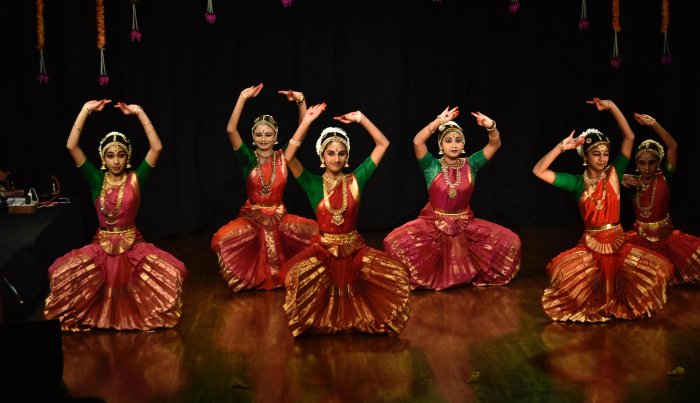 Silambam ensemble The program continued with the students of Silambam Academy of Fine Arts presenting an evening of Bharatanatyam that shimmered with discipline, artistry, and emotional intensity, leaving the audience immersed in its layered beauty. The dancers - Niyathi, Dharini, Devika, Drithi, Riddhi, Ranita, Riya, and Aanya - brought to the stage a collective synergy that spoke of rigorous training and a deep engagement with the form, making the performance a celebration of movement and storytelling. The artists opened on a contemplative note with an invocation to Lord Ganesha, set to Purandaradasa's soulful composition. The dancers, in perfect synchrony, evoked the remover of obstacles with gentle grace and quiet power. This mood gave way to the brisk and vibrant cadence of a Jatiswaram in Poorvi Kalyani, a composition of Madurai N. Krishnan. Here, the dancers displayed their command over rhythm, form, and space, their precise footwork creating intricate rhythmic dialogues with the nattuvangam. The symmetrical group patterns unfolded like a living tapestry, where angular geometry and fluid transitions created visual poetry. The dancers' ability to hold their energy in unison while simultaneously projecting individual brilliance was a mark of both discipline and joy. The centrepiece was the varnam "Aadharam neeye" in Karaharapriya, which explored the dual strands of bhakti (devotion) and viraha (yearning). The dancers embodied the depth of the composition with a blend of technical rigour and emotional poignancy. Through evocative sancharis, the narrative traversed the epic canvas of Hindu mythology: the divine rescue of Gajendra, symbolising the Lord's boundless compassion; the immortal wisdom of Gitopadesam, capturing the eternal dialogue between Krishna and Arjuna; and the miraculous intervention in Draupadi's moment of despair, exemplifying the Lord's unfailing protection. These episodes of divine grace stood in poignant contrast to the lovelorn Nayika, tormented by the arrows of Manmatha, her anguish palpable in every glance and gesture as she questioned where her solace might be found. The concluding piece was a spirited Thillana, a composition of Madurai N. Krishnan in Brindavani Saranga. With brisk movements, intricate rhythmic play, and joyous abandon, the dancers filled the stage with an infectious energy that brought the evening to a resounding close. Their Guru, Aishwarya Anant Karthik, joined them on stage, her presence embodying both guidance and participation, while the cymbals in the hands of Priya Murle lent a sparkling percussive brilliance. This finale captured the essence of celebration, balancing discipline with exuberance, and reaffirmed the vitality of the art form. The music ensemble enriched the presentation, providing both the architecture and the emotional texture that underpinned the dance. Jyotsna's soulful vocals lent depth and resonance to the compositions, her voice carrying both the serenity of bhakti and the urgency of yearning. The nattuvangam by Aishwarya Anant Karthik guided the dancers with precision and vitality, anchoring the rhythmic framework with authority. G.S. Nagaraj on the mridangam infused the performance with pulsating energy, his percussion conversing with the dancers' feet in moments of striking synergy. Dayakar on the violin and Skanda Kumar on the flute created melodic layers that shifted seamlessly between tenderness and grandeur, illuminating the moods of each piece with subtle artistry. Together, the ensemble ensured that the music was not a backdrop but an integral, breathing presence within the performance. The evening had the quality of a milestone - marking twelve years of the academy's presence, but more significantly, tracing the arc of Aishwarya's journey from her arangetram to her current role as performer and teacher. AHARNISHI 2025 Photos: Prof K.S.Krishnamurthy On September 1, at the Aharnishi Festival 2025, organised by Ananya Kala Niketana under the guidance of Guru Brunda, Pritam Das presented a Bharatanatyam recital at Seva Sadan, Bengaluru. The performance distinguished itself by seamlessly weaving traditional depth with contemporary artistic sensibility, setting the tone for an evening that was both intellectually rich and emotionally resonant. 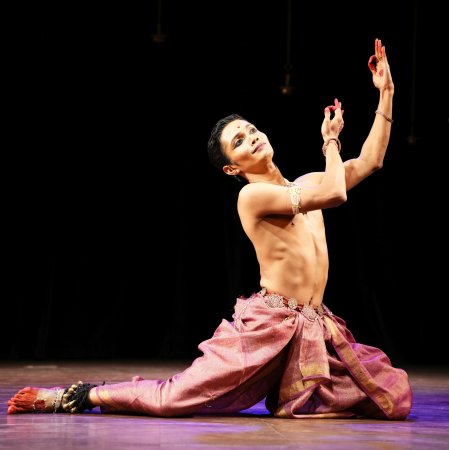 Pritam Das The performance opened with a composition by Muthuswami Dikshitar, one of the celebrated Kamalamba Navavarna Kritis. This cycle of nine devotional hymns dedicated to Goddess Kamalambika, known for its intricate musical architecture and profound spiritual resonance, set a majestic tone for the evening. The dance composition was by Dr. S. Vasudevan, with choreography crafted by the artist himself, which provided a strong framework for exploration. Pritam brought the kriti alive through a synthesis of precision and feeling, embodying its devotional essence with remarkable clarity. From this solemn invocation, the recital moved into the varnam, "Pannagendra sayana", choreographed by his Guru Rama Vaidyanathan, where Pritam's artistry reached its peak. The varnam unfolded as a journey into the world of the nayika, a devotee consumed by ardent love for Lord Padmanabha. His portrayal illuminated her layered emotions - yearning, anguish, playful teasing with the sakhis, and eventual surrender. The brilliance lay in the balance: the nritta segments sparkled with clarity and rhythmic finesse, while the abhinaya passages revealed an inner world of longing with subtle shifts of expression and gesture that conveyed intensity without excess. The varnam's narrative, structured through eight lyrical statements, gained vividness through Pritam's nuanced interpretations. He began with the nayika's vulnerable plea in Kamboji raga, and then moved into the tenderly playful exchanges in Bhairavi raga. His ability to draw out the distinct emotional timbre of each raga reflected his maturity as a performer. Transitions between ragas and recurring refrains were rendered with precision, anchoring the flow while allowing the story to unfold with measured grace. The choreography ensured that pure dance sequences never broke the emotive thread, but instead heightened the storytelling. The recital concluded with "Mamiyam chalita" from Jayadeva's Gita Govinda, set to the evocative music of Raghunath Panigrahi. The choreography, created by Madhavi Mudgal in the Odissi tradition, was celebrated for its lyrical fluidity and expressive depth, capturing the delicate nuances of Jayadeva's poetry. In presenting it within the Bharatanatyam idiom, Pritam offered an adaptation that honoured Mudgal's vision while shaping it to the angular precision and rhythmic density of his own form. The result was a dialogue between two classical vocabularies - Odissi's lyrical flow and Bharatanatyam's structural clarity - without losing the essence of devotion and longing. The performance culminated in a striking final tableau. As Krishna, Pritam seated himself at the corner of the stage, his hand extended outward in a gesture of desolation. This frozen image distilled the emotional weight of separation into a single, unforgettable frieze - a moment where divine yearning appeared almost palpably human. The music ensemble played a pivotal role in shaping the evening's atmosphere. Ajeesh Menon's evocative vocals and precise nattuvangam provided a resonant anchor; Karthik Vydathri's dynamic mridangam lent rhythmic vitality; and Vikram Kashyap's violin enriched the textures with warmth and sensitivity. Together, they created a soundscape that both supported and elevated Pritam's performance, allowing dance and music to breathe as one. 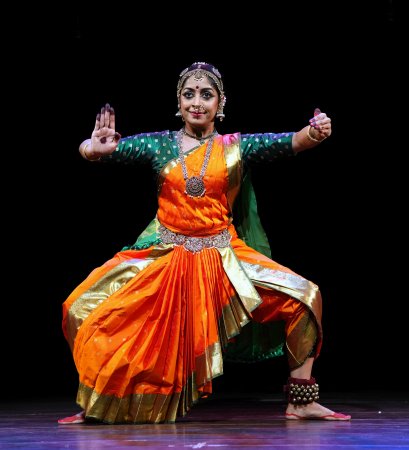 Gowri Sagar Gowri Sagar, a disciple of Satyanarayana Raju, took to the stage with poise and quiet confidence, embodying the discipline and aesthetic refinement of her training. Gowri opened her recital with a prayer to Lord Shiva, "Para Para Parameshwara," which set a deeply devotional tone for the evening. The composition served as a reverent invocation to the supreme being, its lyrics seeking blessings for spiritual growth and liberation. The centrepiece of the performance was the varnam in Poorvi Kalyani, "Swamiye vara solladi," a classic composition of K.N. Dandayudhapani Pillai. Gowri's command over technique was exemplary, as she wove together complex rhythmic patterns with imaginative choreography. The narrative unfolded through the voice of a nayika, pleading with her sakhi to bring Lord Muruga, for whom she longed. Gowri's abhinaya shone in the richly detailed sancharis, which conjured a dream-like world celebrating the divine qualities of the Lord revered by all. A striking moment came when she depicted Muruga explaining the significance of the sacred syllable "OM" to his father, Lord Shiva, who, in a poignant inversion of roles, humbly assumed the posture of a devotee at his son's command. These evocative passages found balance in the dancer's energetic, pure dance interludes, marked by precision and vitality. The varnam deepened in emotional intensity during the charanam. Here, the nayika's yearning transformed into palpable turmoil. Struck by Cupid's arrows, she questioned her beloved's compassion with heart-wrenching directness: "Is his heart made of stone?" Gowri conveyed this vulnerable accusation with poignant abhinaya, laying bare the raw anguish of unfulfilled love. The music ensemble elevated the performance further. Harshita Vidya's inspired vocals gave depth to the narrative, while Bharat Sundar on the nattuvangam anchored the rhythmic framework with clarity. Vidyashankar's mridangam provided steady vigour, and Mahesha Swamy's flute added delicate melodic colour, together creating a cohesive aural tapestry. The recital concluded with the javali "Nee matale mayanura." Gowri transformed the nayika's simmering frustration into a compelling dance narrative that evolved from indignation to resolute closure. The pointed questions - "Why these lies? Where are your promises?" - were delivered with biting urgency. The climactic moment arrived not with submission, but with defiance: as the hesitant nayaka lingered at her door, Gowri's sweeping gesture of firmly shutting it became a powerful act of self-assertion. What could have been merely a lament of betrayal was elevated into a study of empowerment. The nayika, once vulnerable to empty words, now reclaimed her agency. Quick, agitated jathis embodied her turmoil, giving way to measured, deliberate mudras that mirrored her resolve. The performance ended with a profound sense of finality - not just a door closing, but a self reclaimed. Rendered with wit, narrative grace, and theatrical finesse, Gowri Sagar's recital left an indelible impression of artistry rooted in both tradition and contemporary resonance.  Bangalore based Satish Suri is an avid dance rasika besides being a life member of the Music and Arts Society. |
