
|     |
|
| |

 Shakti: A Nritya Harikatha presentation at NMACC- Chandra Anande-mail: chandra6267@yahoo.co.in Photos courtesy: NMACC September 28, 2025 In Natyasastra, it is said natya is an amalgamation of vachika, angika, aharya and satvika aspects and it is performed with a mixture of natya, geeta and vadya. Likewise, a nritya Harikatha production, presented at NMACC, Mumbai, on 14th September 2025, had all the above elements concocted in the right proportions. The presentation was at its height of appropriate storytelling, music, dance, costume and ideas of philosophy performed with hearty oration, music and dance accompanied with instruments, all the while upholding an underlying sense of calmness. It was presented by Harikatha artiste Vishakha Hari along with Bharatanatyam dancers from Sridevi Nrithyalaya headed by Sheela Unnikrishnan, the artistic director. "Harikatha" means "The Lord's Story" and refers to an Indian traditional performance art form that combines storytelling, music, dance and poetry to narrate episodes from Hindu epics, puranas, and the lives of saints. It's an engaging way to transmit religious, cultural, and philosophical values to the masses. It serves as a form of entertainment that also serves as a powerful educational tool. In the performance of 'Nritya Harikatha', performance of classical dance is integrated into the Harikatha presentation. The Nritya Harikatha presentation 'Shakti: An Ode to Devi' was dedicated to the festival of Navaratri, the ten-day festival of Goddesses, where the first three days commemorates goddess Durga, then goddess Lakshmi and the last three days worship of goddess Saraswati. Through this festival one feels and speaks about the glory of the goddesses, by way of which, the great tribute and respect the religion of Hinduism gives to the women is amplified. The Hindu religion and its philosophy, which also represents the Indian culture and ethos, holds women on par with the men, promoting equal status to men and women alike. Invoking the goddesses with a shloka, "Yaa devi sarva bhootheshu" the dancers showcased varied images of them. "Kanchi Kamakshi", Bhairavi jatiswaram, one of the ratna trayam of Shyama Shastri, was performed showcasing elements of the Bharatanatyam style - a brisk and graceful jathi wherein wonderful formations ended with a theermanam, clear gesticulation of the last lyrical verse of the jatiswaram invoking her and entreating her to give protection and finished with lovely statuesque poses of the divine goddesses, driving likewise the point of the festival and the presentation, in the audience mind. 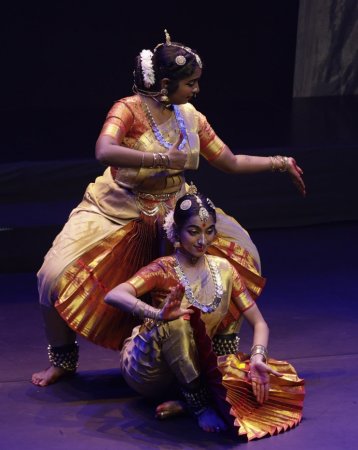 If anything, through this religion and its many rituals one understands that women are given more respect in India. Women of all ages are considered as goddess Lakshmi worthy of being worshipped; for example, kanya poojas and suhasini poojas are held at different festivals. Even gods' names were intertwined with names of their consorts like Umamaheshwar, Sitaraman, Radhakrishnan etc. Thus, respect of women is already imbibed in the Indian culture. And these names, represent the balance of female and male energies, which complement and supplement each other, that is maintained in the universe. The equality and intrinsic connection between man and woman essential for the creation and maintenance of the universe was expressed beautifully through nritta and nritya with the kriti "Ardhanareeshwaram", a composition of Muthuswami Dikshitar. The choreographic piece delineating the Lord as riding the bull shone as it also expressed the affection between Shiva and Nandi. Goddess Badrakali though seen in a gory form, is said to have benign character, by Ramakrishna Paramahamsa. He calls her Maakali who is full of compassion to the normal human beings and aggressive to the people with demon like quality. She is one who eliminates them from the world and makes this world good to live. She was connected to the goddess Tulja Bhavani who was revered by Chhatrapathi Shivaji Bhosale, native to Maharashtra soil and the protector of the women and the weak. His steadfast devotion to goddess Tulja Bhavani is proved when she appeared in his dream, presented him with a sword and blessed him saying he would always be victorious. This story was well connected to the Shyama Shastri kriti "Shamkari sankuru". Chittaswarams were added to the song to give the nritta element to the performance. Along with Shivaji's story, it was informed that Jijabai represents "the mother of nation" figure, as it was she who brought him up instilling in him righteousness and resolve. 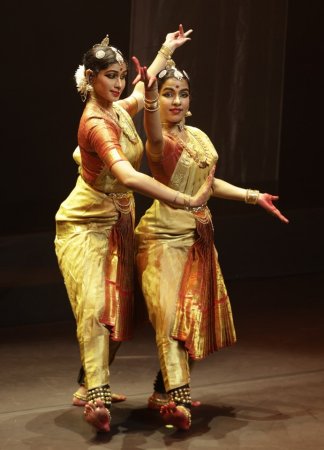 Vishakha's preceptor, Guru Krishnapremi has written a Sanskrit treatise, "Vaishnava Samhitha", a magnum opus, in which he has covered the stories of more than 500 saints of India. Shivaji Raje's and Jijabai's story was taken from the story of Saint Samarth Ramdas, who was Shivaji's mentor. So, for once, the classical performing art of India explored story unrelated to Ramayana, Mahabharata and Puranas which are embodied with morals of Vedas and Upanishads in them. Vishakha captured their essence by relating how Jijabai told Shivaji stories from the epics during his upbringing and how Shivaji designed the tiger claw weapon from the story of Lord Narasimha killing Hiranyakashipu in Prahalada Charitam, and accentuated the importance and perpetual relevance of our Indian epics and philosophy. The graces of Lakshmi, goddess of wealth and abundance, required to access all aspects of life, was introduced with the stories of Bhagavatpada Adi Shankara chanting the 'Kanakadara Stotram' that was instrumental for the shower of golden gooseberries; Vidyaranya coming across the cave of wealth through her grace; a mention of Srinivasan Rao who saw her appearing from within a sandalwood piece; and the story of Muthuswami Dikshitar that made him write the song "Hiranmayeem Lakshmi" in ragam Lalita. His wife wanted to wear gold jewelry. Muthuswami Dikshitar sang the song describing Lakshmi herself as being golden (Hiranmayeeem); she is the gold that he aspires for. Lakshmi appeared to his wife in her dream well-bedecked with jewelry. Seeing the vision of the goddess in her dream, she is satisfied and takes back her words. She apologized to Diskshitar for ever wanting any material wealth when they were so blessed with divine wealth. Part of the song was danced to, gesticulating the descriptions with imageries of the goddesses mentioned in the song. In the last lyrical line of the charanam, gestures were performed with apt thatti mettu that accentuated the dhurita kala rhythm. 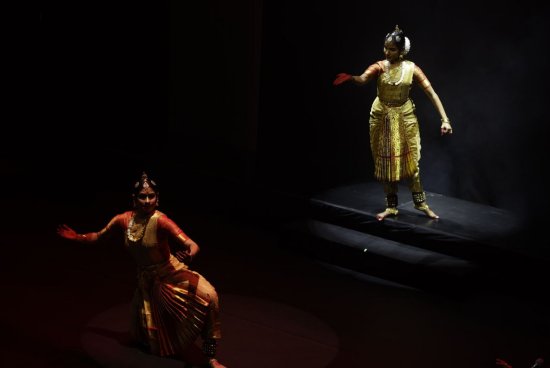 The story of the composing of "Sri Sthuthi" shlokam by Vedanta Desikar who uttered it at the Periya Thayar sannidhi to help a young man to acquire wealth so that he could get married was narrated and was well connected to the song "Shri Varalakshmi namastubhyam" in ragam Abhogi composed by Muthuswami Dikshitar. The pallavi and anupallavi of the song was danced to and the line "Shri sarasa pade rasa pade sapade pade pade" was well explained with gestures complemented with appropriate pada lakshana/stances of the lower limbs. "O Sri (name of Lakshmi) with feet (pade) as soft as a lotus (sarasa), you are the bestower (prade) of affection (rasa), be my companion (sa-pade) at every step (pade pade)". Goddess Lakshmi was "Moksha Lakshmi" for Vedanta Desikar. The significance of goddess Saraswathi was explained having four hands - two hands holding the veena, one another left hand holding a pustak (book) and the fourth one..., the pause got the audience thinking, held the japamala. This showed the arts (veena) was equally important as knowledge (book) and a calm mind (japamala used for meditation) helps sharpen the brain, for essence of the experience can be grabbed easily only by an insightful mind. The story of Varadan, a chef at the temple of Srirangam, was related to show the grace of Saraswati on him. He was in the right place at the right time and her grace fell on him. He became the Kavi Kalamegham. Kavi Bharathiyar writes "Vellai thamarai mel" on goddess Saraswathi describing her presence in all things in the universe that is heard but the main line here meaningful to humans is, "She is in the compassionate speech of every being" giving all a message to speak in a gentle manner. This song also was performed by the dancers. Another story was of Kumaraguruparar, author of "Sakala Kalavalli Malai" on goddess Saraswathi. It connected the north and south of India as Kedar Ghat was the place given by Dara Shukho, son of Shahjahan, to Kumaraguruparar to spread Shaivism and sustain Hinduism in that area. The presentation ended with a thillana by Lalgudi Jayaraman on goddess Parvati. There was good use of brahmari for the last korvai. 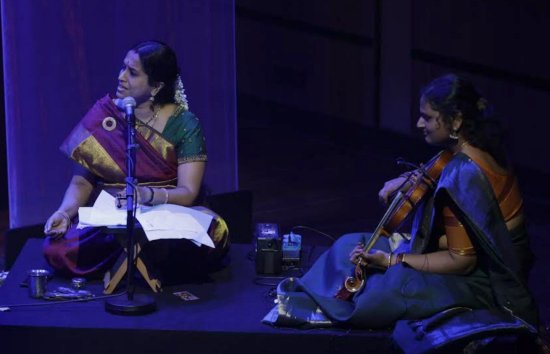 Vishakha Hari & Nandini Sai Giridhar 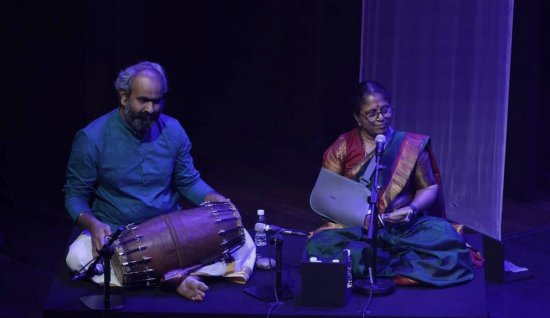 Guru Bharadwaj & Sheela Unnikrishnan In all, the elements of dance, music and storytelling were used in equal proportions. All above information about the festival, the philosophical connotations of the production and the greatness of the Indian cultural legacy transmitted through continuing traditions to our present generation was all well brought out in the oratorical skill of Vishakha Hari. The theme was well connected to the items performed with composure showcasing the beauty of Bharatanatyam. The motif in the dance element was wonderful picturesque poses of the three Devis with their spouses. The patriotism and an understanding of how great our nation is in its art, culture and philosophy was acknowledged well by all.  Chandra Anand is a Bharatanatyam artiste and teacher. She has an MA in Bharatanatyam from Tilak Maharashtra Vidyapeeth, and her series on 'Education in spiritual values through Bharatanatyam' is featured in narthaki.com. |
