
|     |
|
| |

 Enthralling Kuchipudi and Odissi recitals- Tapati Chowdhuriee-mail: tapatichow@yahoo.co.in September 23, 2025 AMRITA SINGH PRESENTS SOBHAMRUTAM 2 Amrita Singh, Artistic Director of Kuchipudi Kalamrita, presented Sobhamrutam 2, on the 9th of August 2025 at Vidya Bhavan, Basheer Bagh in Hyderabad to honour her late guru Sobha Naidu. It was a spectacular evening of dance and devotion. The students of Kuchipudi Kalamrita had the honour of presenting three iconic choreographies of the legendary Dr. Sobha Naidu. The performances were a heartfelt tribute to her unparalleled artistry. Students trained at the Kuchipudi Kalamrita dance school (established in 2019 in Begumpet, Hyderabad by Amrita Singh), captivated the audience with an invocatory piece, Ganesh Pancharatnam in Ragamalika, adi talam. The stotra was composed by Adi Shankara in the 8th century on the Hindu deity Ganesha. In the five verses the dancers praised Lord Ganesha in pristine Kuchipudi vocabulary, which helped in building up an ambience, where art could be associated with pure bhakti. The enchanting Swagatham Krishna in Mohana ragam and adi talam was sheer beauty of movement replete with bhakti-sringara rasa that permeated to the audience, fulfilling the choreographer's ultimate goal of reaching out to the audience in full measure. The qualities of Krishna described in the Kriti in the language of Kuchipudi enthralled the audience. A vibrant and powerful Kunthalavarali Thillana was mesmerizing. It was a joy to see these timeless pieces. Looking back at the incredible legacy of Sobha Naidu, prime disciple of the venerated Guru Vempati Chinna Satyam, a discerning observer notices that she has carved out from this very unique style, a style which is her very own. She has created an unparalleled niche for herself which can safely be named the "Sobha Naidu style" of Kuchipudi - a style that captivated audiences in her lifetime and continues to do so till date, thanks to her disciple Amrita Singh, who has assiduously adopted her style to propagate her greatness. What struck me most was how Sobha Naidu had combined fast, rhythmic footwork with such clean, graceful movements. But her true magic was in her abhinaya. She wasn't just a dancer; she believed in living the emotions of every character. No one can forget her mesmerizing portrayals of Satyabhama, Krishna, and Sai Baba. She was the Queen of Abhinaya in every sense. 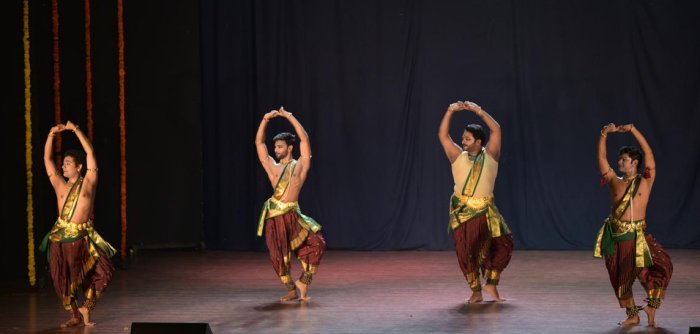 Sai Venkata Gangadhar, Pasumarthy Kumara Datta, Chakravarty, and S.V.K.V.P. Deekshitulu The dancers Sai Venkata Gangadhar, Pasumarthy Kumara Datta, Chakravarty, and S.V.K.V.P. Deekshitulu performed the unique Ananda Tandavam and Thillana and made them come alive. They came together to create a space for artistic dialogue, shared growth, and collective exploration enriching the Kuchipudi dance form which is their primary goal. Ananda Tandavam in Ragamalika and adi talam showcased the celestial dance of joy. This powerful dance number portraying the divine cosmic union of Lord Shiva and Goddess Parvati with its exquisite blend of nritta featuring intricate rhythmic patterns and sculpturesque poses brought ancient iconography to life. The performance encapsulated the masculine energy and ecstasy of Lord Siva's Tandava, executed with brisk, dynamic movements, and was beautifully counterbalanced with the soft, graceful expressions and delicate movements of Parvati. This contrast and harmony symbolized the perfect balance between the dynamic and the serene, the manifest and the subtle. As the celestial couple danced in divine union, they were accompanied by a heavenly orchestra - Lord Vishnu played the mridangam, Lord Indra enchanted the gods present with his divine flute music, Lord Brahma kept rhythm with the cymbals, Goddess Saraswatī strummed the veena, while Goddess Lakshmi sang melodiously. This witnessed by the inhabitants of all three worlds left them awestruck. On a deeper level, Chidambaram - the metaphysical stage of this dance - symbolized the pure consciousness of the spiritual seeker. It is here that the Ananda Tandava, the joyous dance of the soul uniting with the Supreme, takes place, which is an eternal celebration of self-realization and divine bliss. Thillana in ragam Vasantha and talam adi, an Ammachathram Kannuswamy Pillai composition was choreographed by SVKVP Deekshitulu. It showcased technical brilliance and expressive depth. The piece featured a rich tapestry of charis, pada movements, hastas and gati bhedas, all woven together with rhythmic precision. The charana of this Thillana was a tribute to Lord Hanuman, celebrating his unmatched strength, selfless service, and unwavering devotion to Lord Rama. Through a blend of vigorous nritta and evocative abhinaya, the choreography brought to life Hanuman's valour and divine grace. His role as a fearless protector and a beacon of devotion was portrayed with intensity and reverence. With its dynamic rhythm and intricate choreography, this Thillana left the audience spellbound. 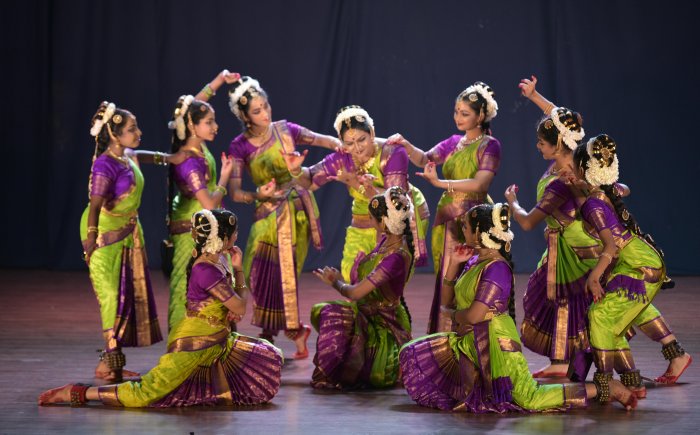 Amrita Singh's troupe Bho Shambho, a deeply contemplative composition by Swami Dayananda Saraswati, renowned teacher of Advaita Vedanta and founder of the Arya Samaj, was set in the evocative Revati raga. This keertanam is an invocation of Lord Shiva - Shambho, the source of auspiciousness; he is Sadashiva the eternal; and Advaita, the infinite non-dual reality. The composition subtly recalled an iconic episode from the Shiva Purana - the story of Ravana, the mighty king of Lanka, who intoxicated by power, attempted to uproot and lift Mount Kailash, Shiva's sacred abode. In response, Shiva pressed the mountain down with a mere touch of his toe, pinning Ravana beneath it. Trapped and overcome with humility, Ravana turned inward and began an intense act of devotion. Using his own body, he forged a Rudra Veena and played it while singing hymns in praise of Shiva. Moved by this depth of surrender and musical devotion, Shiva forgave him and blessed him. The story is symbolic. It's a reminder that true strength lies in surrender, and that devotion, when sincere, transforms even arrogance into grace. Bho Shambho carries this spirit - a musical offering that is both an act of praise and a reflection on the nature of the divine as the Self within. It was an 'eka nrityam' by Guru B. Sudheer Rao. 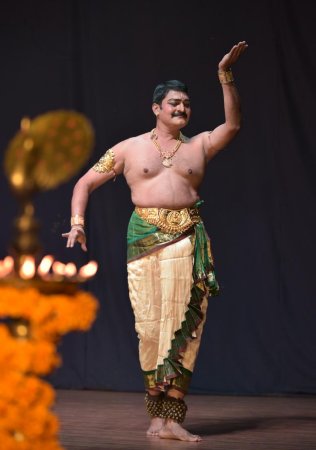 Guru B Sudheer Rao 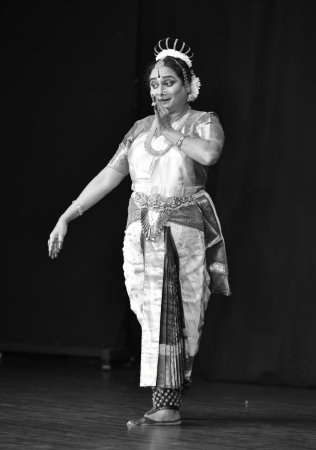 Sailaja Samuhika Nritya Vaibhavam was presented by Sailaja and her troupe. They started with Pushpanjali as an invocatory composition in praise of Lord Ganesha, the remover of obstacles and Goddess Saraswathi, the embodiment of knowledge whose body radiates like thousand sun rays, in Gambheera Nattai and adi taal written by Pappu Venugopala Rao and composed by Veeraraghavan. Sailaja followed it up with the ashtapadi "Chandana charchita", where a Gopi tells Radha about Sri Krishna's frolicking and playing with the damsels in Brindavan. This ashtapadi was actually a discussion between Radha and her Sakhi. She describes vividly about Sri Krishna's love dalliance with the Gopikas in Brindavan. The metaphors in the ashtapadi which roused the emotion of jealousy in Radha was a subtle display of the individual soul's unpreparedness to accept Sri Krishna as the God who is looked up to, by all mortals. A seasoned dancer like Sailaja reflected its nuances in its perfect detail perpetuating bhakti rasa. Niroshta- a swaravali piece showcasing the myriad nrittas in Kuchipudi like a kaleidoscope was to a composition of Bhagavathula Seetharama Sharma. Narayana Teertha's Krishna Leela Tarangini's "Jaya Jaya Srinivasa" in Ragamalika, adi tala aesthetically presented rounded off Sailaja's recital. This was composed by Rajeshwari, Sailaja's student. It was performed by Aarthi Vasudevan, Samyukta Suresh, Abhirami Devi, D. Dilip, Dr. Candy Priyadharshini, Sritanya Sanjana and she herself enriched the evening with a neat presentation. 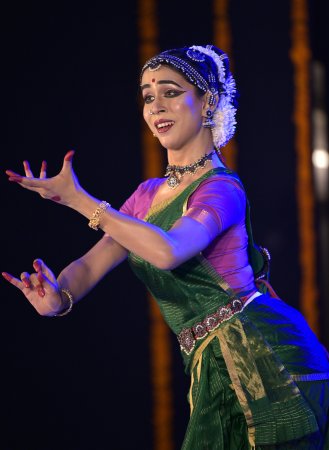 Amrita Singh Kamakshi Stuthi by Amrita Singh was the icing on the cake. "Kancha dalaya dakshi Kamakshi" is a Sanskrit song praising goddess Kamakshi, whose "eyes are like lotus petals". The lyrics composed by Muthuswami Dikshitar, describe her as the beloved of Lakshmi, with an elephant like majestic gait, and the protector of those who meditate on her. The lyric, heavily ornamented with similes, onomatopoeia and other figures of speech is a literary gem, which was translated captivatingly in Kuchipudi. NANDINI GHOSAL AND TROUPE PRESENT ODISSI Nandini Ghosal is a well-known name in the Odissi firmament. Having started Odissi lessons from Poushali Mukhopadhyay in her early life, she went on to specialize in the subject under the tutelage of Guru Kelucharan Mohapatra for almost a decade and a half and came to be one of the foremost practitioners of the form. She has been the prima donna of almost all the major dance-drama productions of her guru during her time. Her portrayal of Sita in Guru Kelucharan Mohapatra's dance-drama 'Dashanan' performed at several major festivals all over the country has won her fame and acclaim. Besides being a dancer, Nandini is also an accomplished screen actress having played the central role in several feature films. 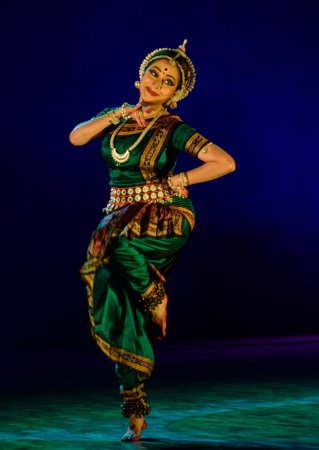 Nandini Ghosal She commenced the evening with Mangalacharan. With offerings of fresh blossoms by her bejewelled and bedecked disciples to the Lord of the world, they urged to be blessed by him, followed by "Bhumipranam" and "Devstuti", hymns dedicated to Gods and Goddesses and "Trikhandi Pranam" - threefold salutation performed as a mark of respect to the Gods, Guru and the audience along with accompanying musicians. Namami is a popular Mangalacharan where the dancers pay homage to Lord Ganesha, the beloved son of Lord Shiva and Goddess Uma, who is the destroyer of obstacles and harbinger of wisdom and success. The original composition of Guru Kelucharan Mohapatra was rechoreographed by Nandini. The second piece was 'Batu' nritya - a dance close to the heart of Guru Kelucharan Mohapatra known for its rhythm accompanied by a song in which the 'bols' or rhythmic syllables of the mardala are sung. The dance illustrates various poses from the beautiful sculptures adorning the temples of Odisha. This rare number often bypassed by performers was danced with joy and verve. This dance is dedicated to 'Botukeshwar' Shiva. The sculpturesque poses foretold action packed movements of great beauty. 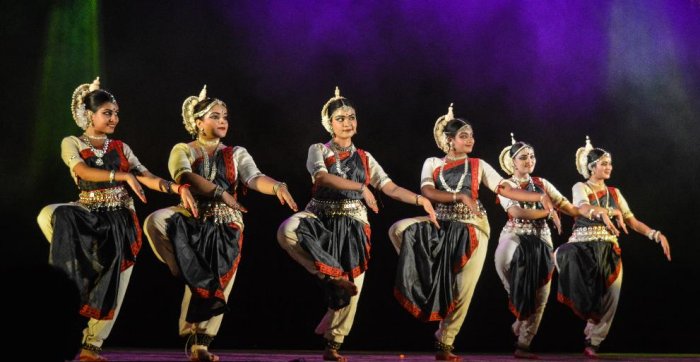 Singhendra Pallavi One of the most vigorous Pallavis composed by Guru Kelucharan Mohapatra is the Singhendra Madhyam Pallavi. Starting with flowing movements, this pallavi gradually becomes vigorous with intricate taal patterns, Sawal-Jawabs and Tihais reaching a complicated crescendo. The participants showed their talim under their teacher. Saveri Odissi Dance School has added a new wing this year - the folk dance classes. Young dancers transported the rasikas to the lighter world of our rich folk dances. We were virtually lifted to the vibrant world of Sambalpuri folk dance. Clad in Odisha's very own Sambalpuri cotton printed sarees, they provided us with the much needed interlude. The abhinaya piece "Srita Kamala" from Kavi Jayadeva's Geet Govinda was an added treat. The praise of Narayana and his consort Lakshmi was appreciated for its lyrical beauty and was a moving piece conceived and composed by Guru Kelucharan Mohapatra."Nachanti Rangey Srihari" was yet another precious jewel - a vibrant 'Saabhinaya' in which Lord Krishna dances a joyful Ananda tandava accompanied by the gopis who sing and play various instruments in different ragas creating a rich melodious atmosphere that captivates the mind and heart. 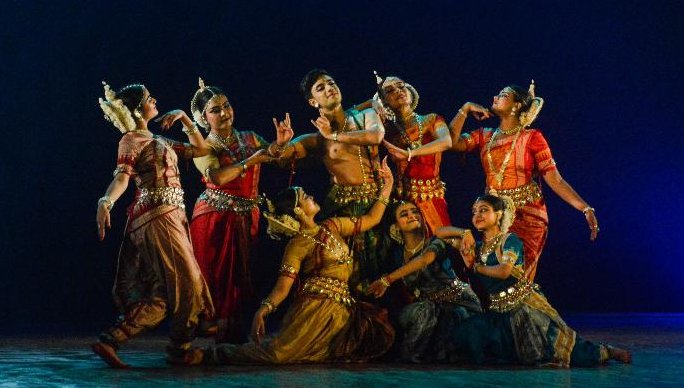 Patha chaadi de "Patha chaadi de" was a plea of the gopis to naughty Krishna, who is blocking their way, to allow them to go about their business at the break of dawn. What was interesting in this piece was the gopis alternating their dance with fake anger and appeasement to win Krishna over. However, it is only when they promise to come back to him that makes Krishna leave the way. This piece was based on an Odiya song by the poet Gopalkrishna Pattanaik. The dance was composed and choreographed by Guru Kelucharan Mohapatra. Nandini Ghosal selected Mohana Pallavi for her accomplished students to display their talent. The dance that began with soft movements gradually rose to a crescendo of racy variations in note and tune progressing with increasing swiftness towards a thunderous climax. This dance composition by Kelubabu was electrifying, accompanied by the music composition of Pt Bhubaneswar Mishra. The penultimate piece of the festival was performed by Nandini Ghosal herself to a composition of Debasish Sarkar, in which she is a young and beautiful maiden who is admiring herself in the mirror. She feels the awakening of love and asks Cupid why he's shooting his love arrows on her. In reality the Gods had asked Madana or Cupid to break Shiva's penance and meditation so that he may fall in love with Uma. Madana went about causing flowers to bloom in the forest and make the animals and birds pair up. And then as the beautiful Uma worships at Shiva's feet, Madana shoots his arrow at Shiva, who burns Madana to ashes with his third eye. Uma asks Madana not to mistake her for Shiva and shoot his arrow at her. Poet Vidyapati says that Madana may be mistaken because of the similarity in the names of Shiva with the maiden. But both are called Bama. Uma and Maheswara together is one entity - Purusha and Prakriti and that is not a mistake. Nandini Ghosal outshone with her craft. After all the goal of every dancer is to create rasa in her audience, which she managed very well. The last piece "Nrityero Taale Taale" - a Rabindra Sangeet - was creatively composed for the students. The English translation of the song which may not do justice to the one written by Tagore in Bengali means, "Oh Nataraja! May your dance fill my heart like unfathomable treasure. The breeze kissing your dancing feet brings the joy of arts to the world. Creation trembles with the rhythm of your dance. Your dance is of liberation yet it binds together the entire universe. You behold the cycle of life and death in the sound of your damaru. Oh Nataraja! May the thunderous sound of your damaru fill my heart like unfathomable treasure." Nrusingh is the fourth and one of the most fierce avatars of Lord Vishnu. This unique half-human, half-lion incarnation emerged to annihilate the demon king Hiranyakashipu, who due to a powerful boon, believed himself to be invincible. Hiranyakashipu's boon prevented him from being killed by man or beast during day or night, inside or outside, on land or in the sky, or by any weapon. To cleverly circumvent these conditions, Nrusingh appeared at twilight (neither day nor night), on the threshold (neither inside nor outside), placed the demon on his lap (neither land nor sky), and tore him apart with his sharp claws (neither a weapon nor bare hands). Nrusingh's avatar profoundly symbolizes divine protection for devotees and the ultimate triumph of good over evil. It showcases Vishnu's boundless power and intelligence in upholding Dharma, even when faced with seemingly unbreakable boons. "Namo Nrusingha" was performed excellently by guest artistes Noor Raza and Kalpana Sahoo of Brahmapur, Odisha.  Tapati Chowdhurie trained under Guru Gopinath in Madras and was briefly with International Centre for Kathakali in New Delhi. Presently, she is a freelance writer on the performing arts. She is the author of 'Guru Gopinath: The Making of a Legend.' |
