|     |
|
| |

 The New York Kathak Festival 2025- Manjari Sinhae-mail: manjari@sinha.com Photos: Marcus Lewis September 21, 2025 The New York Kathak Festival 2025 was held on August 22-24, 2025 at the Alvin Ailey Theatre, New York City, presenting three days of performances by both established and emerging artists from the U.S. and beyond. The first festival of its kind, the NYKF brings together the Kathak community to learn, share, and connect - fostering cultural exchange between local practitioners and New York audiences. The festival is organised entirely by a passionate team of young volunteers, who balance their love of Kathak with professional careers in diverse fields, including fashion, technology, finance, education, journalism, design, and medicine. Based in the New York metropolitan area, these dedicated volunteers work year-round to produce this eagerly awaited annual celebration of Kathak through performances and workshops. Kathak itself arrived in the U.S. in the 1950s and 1960s, when Americans travelled to India to train under great masters. Among them was Janaki Patrik, who studied Kathak at Kathak Kendra in Delhi under Pt. Birju Maharaj, alongside training in Hindustani vocal music and tabla. She attended all three days of NYKF 2025, a living reminder of the pioneering generation that seeded Kathak in America. As the organisers themselves note, "This festival is our expression of gratitude for the art passed on to us by our teachers, and by their teachers before them - often against difficult odds and without recognition." 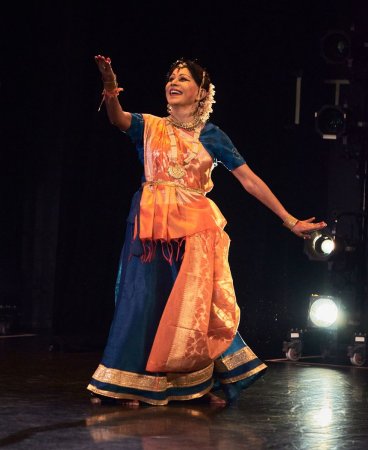 Shovana Narayan The three-day festival culminated with a powerful performance by Shovana Narayan, who offered rare gems from her vast repertoire of choicest old-time compositions. Beginning with a Uthaan and the invocation "Shantakaram bhujaga shayanam...", she wove in a strikingly off-beat composition, the Naag Paran evoking the graceful gait of a serpent, followed by vibrant depictions of monsoon clouds, thunder, and the playful Jhula Paran of maidens enjoying swings in the rainy season. For abhinaya, Shovana chose the Kathak specific Gat Bhava over the more common Thumri Dadra. Drawing on Natya Shastra elements - karanas, hastas, and subtle expressions - she enacted the dramatic Draupadi Cheer Haran. The unfolding of the dice game, Draupadi's humiliation, and Krishna's divine intervention were heightened by the plaintive strains of raga Puriya Dhanashree and evocative sound effects. The narrative concluded in a devotional crescendo with "Govind bolo jai jai Gopal bolo...", pointedly linking Draupadi's ordeal to the injustices faced by women today. Her finale, Yashodhara, explored the anguish of Siddharth's wife as he renounces worldly life to become the Buddha, without telling her. The poignant song "Sakhi ve mujhse kah kar jaate" expressed Yashodhara's anguish and quiet strength, culminating in her sacrifice of offering their son Rahul to his father, who comes as a Buddhist monk asking for Bhiksha (alms). Shovana's live orchestra, a rare treat at the NYKF 2025, magnified the impact. The music for Yashodhara was originally composed by Late Jwala Prasad. This evening, his son Madho Prasad provided vocal support, played the harmonium, and conducted the sound effects. There were also Mahaveer Gangani on pakhawaj, Narendra Budhkar on tabla and Indrojit Roy Chowdhury on sitar. Shovana's eloquent preface to each item established an instant rapport with the audience that responded with a standing ovation. The evening opened with Shiva-Shakti, a solo by Richa Joshi, a US-based disciple of Tapan Roy. The Kavitt "Dimik dimik dimi damroo baje" was apt for the Dhrupad "Shankar ati prachand". Surprisingly, the raga of Dhrupad was announced as raga Adana, while actually it was composed and sung in raga Malkauns. 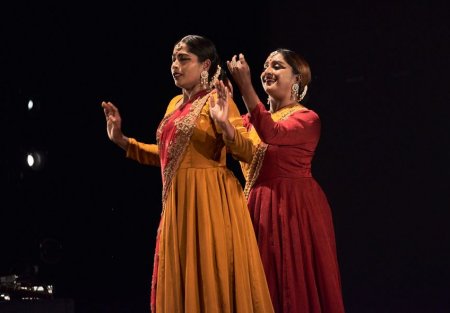 Varsha Prasad and Cyenthia Vijaykumar This was followed by 'Chaturang', a pleasing duet performed by Varsha Prasad and Cyenthia Vijaykumar. The Chaturang composed by Pt. Birju Maharaj in raga Janasammodini comprised four segments, namely, poetry, Sargam, Trivat and Tarana and carried the mudra 'Brij Shyam', which was the pen name of Pt. Birju Maharaj. Varsha and Cyenthia did full justice to each segment. 'Pendulum' by Priyanka Tope was an experimental piece on 'memory, repetition and hope' accompanied on cello by Saskia Rao De Haas, and tabla by Tejas Tope. It opened with swaras of Ahir Bhairav with pakhawaj (the name of the pakhawaj player was not announced). There was an Urdu couplet "Koi ummid bar nahin aati / koi surat nazar nahin aati", and a Khand Jati Ladi with cello and pakhawaj. Tabla joined in medium tempo Teentala with a nagma in Malkauns for footwork. Though imaginative, the effort suffered from uneven tuning of the instruments, resulting in a discordant effect. 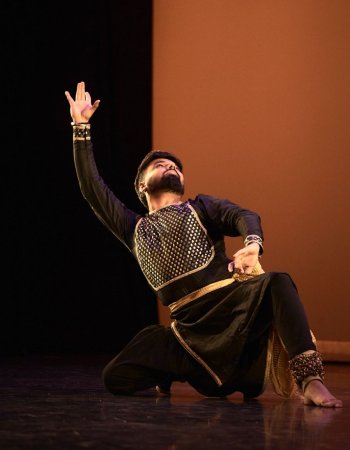 Raghav Monga Raghav Monga, a Canada based disciple of Jaikishan Maharaj impressed with 'Shivaar' which opened with a Shivastuti in raga Bhairav as a Dhrupad "Shankar Shri Mahadeva" set to taal Chautal. The same raga continued for the Lehera in his performance of Taal Dhamar, a challenging taal of a fourteen beat time cycle. The use of just the taanpura and manjeera for his 'Vaadya Paran' sounded serene. Raghav displayed his complete command over laya while presenting Chakradaar Parans with intricate rhythmic patterns in the Misra Jaati, a seven beat Chhand. The second evening belonged to Sanjukta Sinha, whose signature blend of tradition and contemporary sensibility captivated the audience. Her two-part vilambit and madhya laya Teentala presentation unfolded like a living painting - beginning with the image of a virahini nayika holding a flower amid rows of glowing diyas, and climaxing in ecstatic whirls to "Ye kisne bajai bansuriya" in raga Desh. Joined briefly by her workshop students, she ended in rapturous abandon, earning a standing ovation. 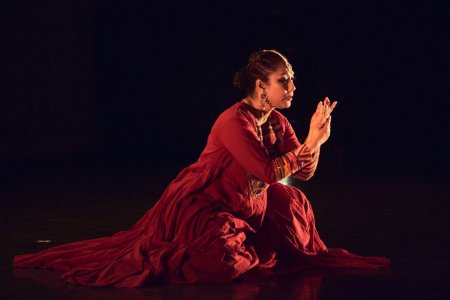 Sanjukta Sinha A brilliant disciple of Late Arjun Mishra and Guru Kumudini Lakhia, Sanjukta creatively conceived and choreographed her performance. It opened with Sanjukta sitting in the middle of the pitch dark stage, lit only by the rows of shimmering diyas, with the melodious backdrop of aalap in Shyam Kalyan, a romantic evening raga. She looked like a virahini nayika sitting on the banks of a river with floating diyas, or like a painting of Raja Ravi Varma with a ladylove holding a flower in her delicate hands, when the aalap gave way to the vilambit theka of Teentala for the song "Tum bin lage na mora jiya piya". The melody of the raga and the rhythm of the slow theka pulsated through her body, invigorating her to move slowly in the andaaz of a Baithaki Bhava Thumri. The stage lights slowly came on as she gradually stood up to perform the 'Thaat', which is called the 'Khade hone ka andaaz'! With the melody and rhythm flowing through her body, she would show the 'sam' with a flick of the eyebrows or a delicate hand gesture. It was a rare opportunity to witness the old world charm of underscoring the 'Kasak-Masak' of the torso and the 'dora' (slim thread) of the neck inflexions in the leisurely 'Thaat' followed by Aamad, Paran Jodi Aamad "Dhatak thunga..." et al. The Lehera continued on sarangi, and the tabla accompanied the Tode, Tukde and Parans like "dig dig thei, ta thei, ta thei" interspersed with the crisp footwork. The second segment of Madhya Laya (medium tempo) had the lovely 'Bandishi Thumri' "Ye kisne bajai bansuriya" in raga Desh set to Addha Theka of Teentala that later continued with the Lehra in the same raga for nritta in the faster tempo of drut teentala. Here, two of her students from the workshop she conducted at the NYKF 2025 also joined, dressed in white costumes, drawing a striking contrast. The ascending pace of Ati Drut Teentaal saw Sanjukta taking endless pirouettes, where only the taanpura, flute and manjeera remained to let the climax merge into the ecstasy created by Sanjukta. No wonder she got a standing ovation. Also notable were Aliyah Banerjee's vibrant exploration of raga Basant, Simantini Ghosh's elegant Nritya Abhyas in Teentala, and Lasya Kathak Dance Academy's group work 'Strings & Motion' in raga Yaman. 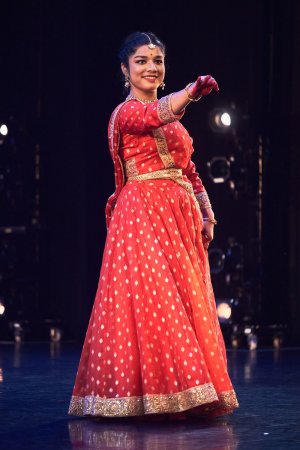 Aliyah Banerjee This evening opened with a solo by Aliyah Banerjee, a student of Jaikishan Maharaj. Opening with a Pramelu "Dhittam dhittam dag-dag thuntak thun...", she presented a Drut Ektal Bandish "Rasa barsat, nritya karat van upavan" in raga Basant, depicting nature's bounty in the spring season. She performed Tisra Jati Ladi with the pakhawaj playing Chautala, and the tabla playing Drut Ektal (both the talas of the same 12-beat time cycle) on Dhrupad "Shiva Shankar" set to Chautala, concluding with Drut Teentala on sargam of raga Basant. 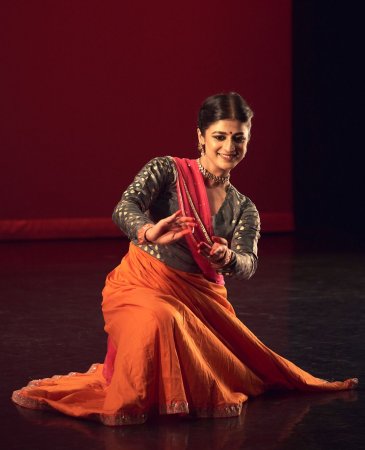 Simantini Ghosh Simantini Ghosh presented "Nritya Abhyas", a lovely presentation based on Teentala. The mesmerising music was composed by Chandrachud Bhattacharya. She incorporated nearly all the intra-forms from Thaat, Aamad, Tode-Tukde, Paran, Chakkardar Tihais to the beautiful Gat-Nikas and Gat-Bhava in her sleek presentation. The delicate dancer looked like a miniature painting with perfect ang sanchaalan (body movements) and rhythmic precision, but for just one 'belated sam'! She must remember that in Kathak, 'sam' cannot afford even a split second delay; it should come exactly on the desired beat like lightning, heralding 'Waah-Waahs' from discerning audiences. 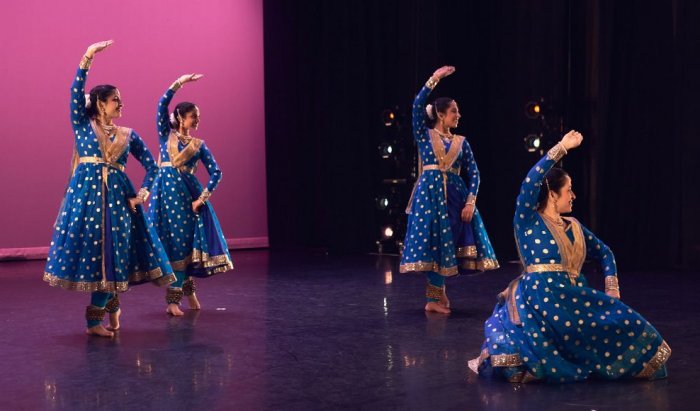 Lasya Kathak Dance Academy Lasya Kathak Dance Academy from DC presented 'Strings & Motion', a group presentation by Purvi Bhatt and three of her students. Purvi took raga Yaman and presented it from Aalap to the Vilambit and Drut Gat compositions in Teentala. It was a complete Kathak choreography from Thaat, Aamad to Paran and Chakkardar Tihai, Gat-nikas to Tatkar, climaxing with the Jhala on sitar. The NYKF 2025 opened by Indro Roy Chowdhury and James Musto - with an improvised take on "Haveli", the musical theme for the year and closed with a melodious Sarod recital by Alam Khan, son and disciple of the legendary Ud. Ali Akbar Khan. Introducing the essence of Indian classical music to the eager and inquisitive audiences, Alam Khan played raga Zila Kafi. The introductory aalap was followed by the Thumari Ang composition set to Addha Theka of Teentala. This gradually turned into a 'Raga-Mala' (a garland of different ragas), matching the mood of the romantic raga he started with. He was ably accompanied on tabla by Pt. Abhijit Banerjee. 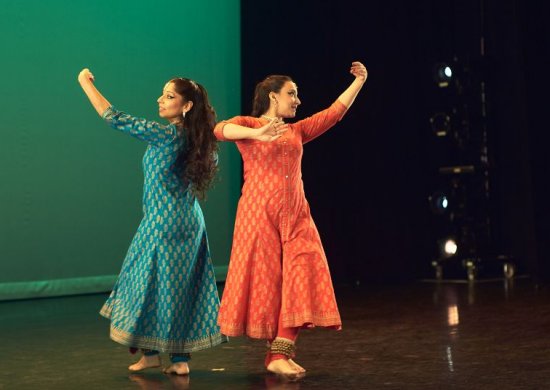 Anjali Nath & Labonee Mohanta The inaugural evening also had a solo Kathak performance by Pankaj Sihag, a group presentation by Susan Mohip Dance Company and a duet by Anjali Nath and Labonee Mohanta. Brilliant disciples of the Late Pt. Chitresh Das, Anjali and Labonee presented excerpts from their new work 'Half'. A rhythmically intricate and visually striking Kathak production, 'Half' delved into the profound themes of internal and external divisiveness. The dynamic duo explored paradoxical tensions, blending the elements of Kathak technique with contemporary resonance. Anchored efficiently throughout by Kuhokee Kumari Das, the festival affirmed its mission: to create a fertile ground for cultural exchange by uniting global artists and local audiences through Kathak. The workshops by Shovana Narayan and Sanjukta Sinha drew enthusiastic participation, and short video films introduced each evening's performers. Original festival theme music by Indrajit Roy Chowdhury (a disciple of Subroto Roy Chowdhury) added a further thread of continuity - he was also seen accompanying Shovana Narayan on sitar. The NYKF 2025 demonstrated not only the continuing vitality of Kathak in the U.S. but also its power to inspire cross-cultural appreciation. It was a moving tribute to tradition, innovation, and the enduring spirit of this art form.  Manjari Sinha is a musicologist and an acclaimed classical music and dance critic. She has an MA in Sanskrit from Allahabad University, MA in Music from Vikram University, Ujjain; Sangeet Prabhakar in Hindustani Vocal, Tabla, Sitar and Kathak dance from Prayag Sangeet Samiti, Allahabad; and further training in Sitar under Guru Pt. Arvind Parikh in the lineage of Ustad Vilayat Khan. She has authored a book on Ustad Bade Ghulam Ali Khan, commissioned & published by Roli Books. She has contributed the chapter on Kathak for 'Indian Dance: the Ultimate Metaphor'. Her articles in English and Hindi on Music, Dance, Art & Culture are regularly showcased in a variety of leading journals and periodicals. |
