
|     |
|
| |

 Naatyotsava 2.0: A dynamic confluence of captivating conversations- Ranjini Ganapathye-mail: ranjiniganapathy@gmail.com September 17, 2025 Naatyotsava 2.0 - a multicultural classical dance concert, hosted by The Queensland Kannadigas Cultural & Sports Society Inc was a dynamic confluence of captivating conversations. Offering a platter of performances grounded in the various classical dance traditions of India, a select ensemble of established, rising, and emerging artists from different Australian cities converged on the stage at the auditorium of Calamvale Community College in Brisbane. In the spirit of speaking into meaningful existence the living legacies of their respective artistic practices through stylised, embodied storytelling, the dancers collectively ignited a sense of curiosity and wonderment in me on that cool, crisp evening. Governed predominantly either by conceptual ideas from varied philosophies or conventional, coded narratives inspired by Hindu mythology, the intricately layered items sustained my undivided attention. 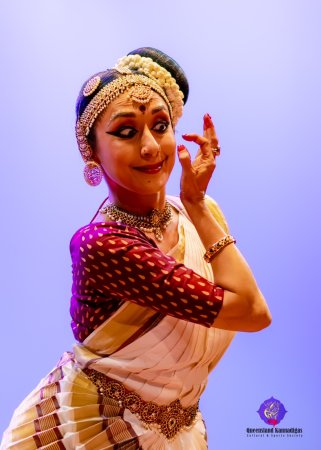 Bindu Rajendren As the sonorous tones of the violin enveloped the modestly decorated stage as well as the walls of the wider performance space, Bindu Rajendren, a Mohiniyattam dancer, made an enchanting entry with her alluring gaze and graceful presence. Her reimagined rendition of the late esteemed Bharatanatyam nattuvanar, Swamimalai Rajarathnam Pillai's composition of Pushpanjali in ragam Nattai was a solid nod to the dance lexicon of Mohiniyattam and set an auspicious tone. Her measured delivery of footwork and movements carried sublimely by the lively percussive beats of the mridangam evoked many moments of striking stillness. These flashes of serenity both fleeting and sustained in equal measure were impossible to ignore. Their presence underscored the yogic principle of Anandamayakosha on which her choreographic work was consciously predicated. Known as the bliss sheath, Anandamayakosha represents that level of realisation where oneness is achieved within and beyond perceived limitations. In that sense, there was an undeniable congruity between the intention behind and articulation of her choreography. With palms glued to each other, arms outstretched and held above her head, a series of sweeping salutations were executed in humble reverence. In invoking the divine, she extended a warm invitation to those present to journey as witnesses alongside her. Anandamayakosha - unlocked and activated. 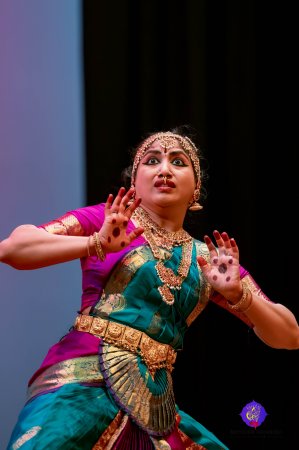 Ambika Ganeshprasad Quantitatively speaking, Bharatanatyam pieces reigned supreme in the showcase. As an expansive language it was presented in varying shades coloured by differing stylistic approaches and aesthetic preferences. Having imbibed the masterful teaching of her gurus at the Mysuru based Nrityagiri Academy of Performing Arts and Research Centre, Ambika Ganeshprasad took to the stage with three of her most promising students: Roopa Praveen, Saanvi Sunil and Dhriti Kulkarni. In spite of the disparities in technical execution and emotive capacities amongst the dancers, they unitedly embodied a commanding presence in their articulation of Ganesha Sthuthi, Ashtadikpaalaka Vandana, and a Jatiswaram. Cohesively strung together as a garland radiating an assortment of floral notes, the variation in formations kept the choreography of this musical medley refreshing. An especially laudable effort on the part of the students. Personally, it was simply lovely and heartwarming to watch a teacher like Ambika Ganeshprasad intentionally construct an aspirational platform for her students to strive towards. With her calm demeanour and arresting display of remarkable body control, Ambika was the embodiment of an unshakeable, steadying force of nature in her solo exposition of Devi's powerful physical and intangible qualities. Her rendition of Devi Ashtakam, also known as Rajarajeshwari Ashtakam and set to Ragamalika, showcased not only her nuanced delivery of both nritta and abhinaya but also the heightened level of clarity in which her storytelling prowess took form. Her nimble finger work breathed life into her imagined playing of the veena while Mahishasura's bullish arrogance along with his belligerent mood and mannerisms were captured with conviction through her angika abhinaya. The stage was awash with a burst of youthful energy as Shivani Sriram filled the space with verve and vigour during her Bharatanatyam presentation. Ably guided by her mother, Guru Padmalakshmi Sriram, founder and director of the Lalithakalalaya School of Bharatanatyam, Shivani's beautiful clarity in lines coupled with her dexterous footwork injected excitement in the unfolding of the varnam's jathis. Set in Charukeshi ragam, an apt vehicle in eliciting emotions of melancholic longing and pathos, Shivani effectively essayed the role of a virahotkantita nayika (a heroine taunted by the absence of her lover) in Lalgudi Jayaraman's "Innum en manam" varnam. Her yearning for Yadhava, though succinctly expressed that night, has potential to soar and swell in complexity and intensity in future iterations. The choreography by Padmalakshmi Sriram wonderfully highlighted Shivani Sriram's explosive strength in nritta. This was further expanded upon in her rendition of a devotional song resulting in a vibrant and joyful performance centred on the loving essence of Lord Vitthal, the deity synonymous with the temple town of Pandharpur. 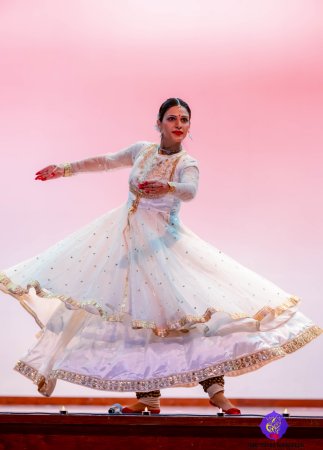 Sanchita Abrol Drawing parallels between the Big Bang Theory and Indian cosmological beliefs where the primordial Universe emerged from a nebulous state, Melbourne-based Kathak dancer Sanchita Abrol painted a visual canvas of the ever-expanding Universe with her impressive spins and fast-paced rhythmic footwork. With the summoning of the damaru, Shiva's tandav was unleashed. Her presentation was an exuberant exploration of the dualities which coexist in the perceptible and metaphysical realms of consciousness. Set against an aural backdrop of guttural sounds from the blowing of the conch and frenzied tabla beats, the mysterious nature of the cosmos was evoked. Abstract concepts such as the existence of feminine and masculine energies, the vibrational sound of Om and its consequent silence, the dual nature of light moving as a wave and interacting as a particle took on a concrete form in her corporeality. A fleeting sense of drama punctuated by precious pauses unravelled itself in the softness of her hand gestures conjuring images of Shakthi adorning her earrings, and in the controlled swing of her arms and body slicing the air in a display of athleticism and playful abandon. Perhaps the most profound choreographic piece of the evening came in the form of Bindu Rajendren's gently provocative and transcendental translation of Mookuthi. An integral item in the eminent Guru Nirmala Paniker's Desi Mohiniyattam repertoire, Mookuthi was pieced together after years of meticulous research and an illuminating exchange with a learned teacher she fortuitously encountered. Watching Bindu intently unearth its philosophical truths and traverse its spiritual pathway made me immensely grateful that this composition was not entirely erased into quiet oblivion by the Anti-Nautch campaign, a social reform movement which gained momentum in colonial India. The lyricism in her movements transported me to the natural environs of Kerala and I saw before me a young woman whose obsession with her nose pin was bewitching. Her eyes which spoke volumes in a series of delicate seconds accentuated the sensual arrogance she embodied while waxing lyrical about the grandeur of her gleaming diamond mookuthi. From experiencing heartbreaking disappointment in the loss of her nose ornament to realising deep wisdom in its very disappearance, Bindu's articulation of kundalini (latent primordial energy) rising emphatically stressed the visceral power of ultimate liberation over the ephemeral nature of desire. 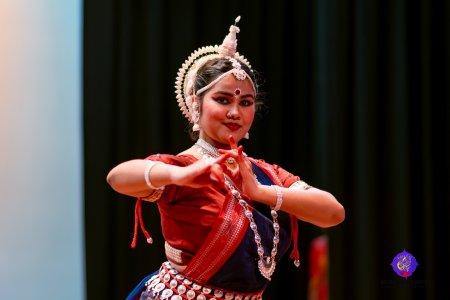 Anwesha Das The latter part of the show was marked by a short Odissi presentation by Brisbane-based Anwesha Das. Her rendition of "Kiyo lo sajani," an Odia abhinaya piece, was lovely to watch for its soft, lyrical beauty. There was a visible effortlessness in her seamlessly flowing movements. A longer presentation may have allowed me to grasp better the gravity of her art making. Based in Sydney and Melbourne respectively, Hema Venugopalan and Sreeanusha Viswanathan treated us to a Kuchipudi presentation encompassing an Ashtapadi from Jayadeva's Gita Govinda and a piece on Goddess Durga by saint-composer Sree Narayana Theertha. Their skills combined with their years of training and teaching were evident in their manipulation of the brass plates. Underpinning their joint presentation was a harmonious synergy which revealed a quiet understanding between them. I look forward to a more impactful and innovative delivery in their future performances. Naatyotsava 2.0 has to be applauded and truly appreciated for its meaningful undertaking of a monumental responsibility in spotlighting in our midst the diasporic cultural custodians of these art forms. I await with enthusiasm to witness it grow from strength to strength on Australian soil.  Ranjini Ganapathy is an experienced History and Language tutor. In her reinvention as a creative arts educator, she conceptualises and curates cultural storytelling programs for the young and young at heart. |
