
|     |
|
| |

 Utsava- Satish Surie-mail: satishism@yahoo.co.in Photos: Prof. K.S.Krishnamurthy September 14, 2025 On August 24, the Udupa Foundation marked a significant milestone - ten years since its inception - with a full day of music and dance at the J.S.S. Auditorium, Bangalore. The morning session was dedicated to a series of music concerts, setting a resonant tone for the celebrations. The evening unfolded with a vibrant presentation of Bharatanatyam, featuring three accomplished dancers: Yukthi Udupa, Satyanarayana Raju, and Meera Sreenarayanan, each bringing their unique artistry to the stage. 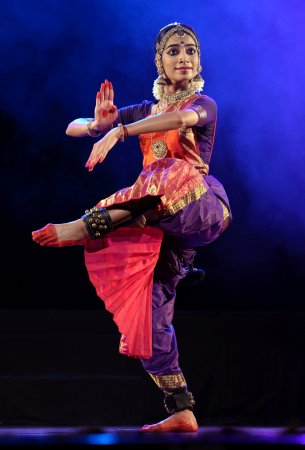 Yukthi Udupa The auditorium fell into an anticipatory silence with the first resonant strike of the nattuvangam, heralding the arrival of the varnam - the centrepiece of Bharatanatyam where a dancer's technical mastery and emotional depth are laid bare. Yukthi Udupa, disciple of Pravitha Ashok of Nritya Vasantha Natyalaya Kundapur, presented T.R. Subramaniam's "Angayar kanni neeye", transforming the stage into a space of divine dialogue. From the outset, the choice of Misra Shivaranjani raga - its sweetness laced with yearning - cast a devotional aura over the performance. The vocalist rendered its plaintive contours with poignant clarity, anchoring the ensemble's lush melodic foundation. Against this, Yukthi began with a concentrated stillness, inviting the audience into her quest. The opening line "Angayar kanni neeye" - "You, the one with fish-like eyes" - was shaped with precise abhinaya. Her gaze, fluid and luminous, embodied the grace of Goddess Meenakshi. With subtle shifts, she moved seamlessly between the majesty of the deity and the vulnerability of the devotee, her expression melting into humble supplication. When rhythm took over, her adavus struck the floor with crisp assurance, each stamp echoing like a prayer punctuated in sound. The devotee's long pilgrimage to Madurai emerged not in literal mime but in the urgency of her steps and the desperation of her searching eyes. 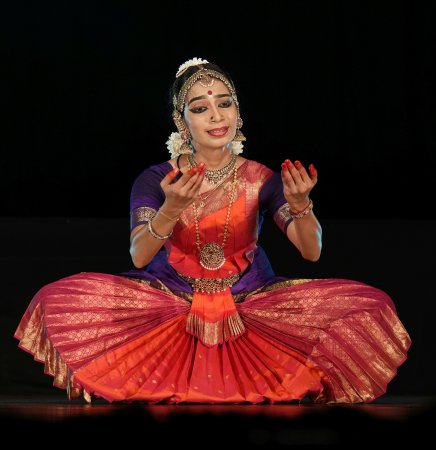 Yukthi Udupa The varnam's narrative sections revealed the full depth of her artistry. The sanchari passages showcased her versatility: her skill in warfare came alive in the fierce movements depicting the destruction of the demon Bandasura, her body taut with martial precision and her eyes blazing with divine resolve. In striking contrast, her abhinaya softened into compassion when portraying the Goddess's care for the welfare of her devotees, radiating maternal tenderness and protective grace. As Daksha's daughter, her frame stiffened and her eyes flashed with the remembered fury of Sati's self-sacrifice. This was instantly followed by the plea, "Do not be angry with me," where she seemed to shrink, her gestures becoming small and tender, a mortal seeking forgiveness from immense power. When she evoked the Goddess as supreme - worshipped even by gods - her abhinaya expanded magnificently, hands stretching outward as if to encompass the cosmos, her face radiant with sovereign majesty. Perhaps most moving was her rendering of the Goddess's familial bonds. As Padmanabha's sister, she exuded gentle, reverential affection, and as Shiva's consort, her entire being softened into serene devotion, embodying the eternal union of Shakti and Shiva. Each burst of nritta following these emotive passages felt like a release - pure joy flowing from the vision of divinity. Underlying this tapestry of emotion and rhythm was the thoughtful choreography of Sheejith Krishna, which gave the piece its structural integrity and dramatic momentum. His vision shaped the ebb and flow of the varnam, allowing Yukthi's artistry to unfold in layered dimensions - at once devotional, narrative, and abstract - making the entire presentation both cohesive and deeply moving. Having traversed awe, anger, devotion, and love, Yukthi returned to her central plea: to be graced by compassion. Her final stillness was not the pause of a performer awaiting applause, but the quietude of a devotee receiving darshan. Eyes shimmering with the radiance of blessing, she stood bathed in peace. The performance itself was a testament to collaborative artistry, with the recorded musical track providing a resonant architectural backbone that supported and elevated the presentation. A SACRED GARLAND: SATYANARAYANA RAJU'S 32ND VARNAM IN THE 60 VARNAM ODYSSEY The evening unfolded as a tapestry of artistry, with an exquisite Bharatanatyam performance by the distinguished dancer, choreographer, and teacher Satyanarayana Raju. For Raju, the occasion was a personal milestone in his ambitious quest - his vow to perform sixty varnams in honour of his birthday across different venues. This evening marked the 32nd varnam in the series, a rare gem of the repertoire: the Navaragamalika varnam "Swami ninne korinanu ra," presented under the aegis of Utsava. A varnam set as an Ashtaragamalika - a garland of eight ragas - is no ordinary undertaking. It demands of the dancer not just stamina and precision, but an ability to move seamlessly between moods, ragas, and layers of expression, all while sustaining the architectural grandeur of the form. Originally choreographed by his Guru Narmada, the piece carried the weight of tradition. Yet in Raju's hands it was not a mere repetition, but a reimagining, refined with his own sensibilities, his own interpretative depth, his own artistic imprint, while never abandoning the essence gifted by the guru. 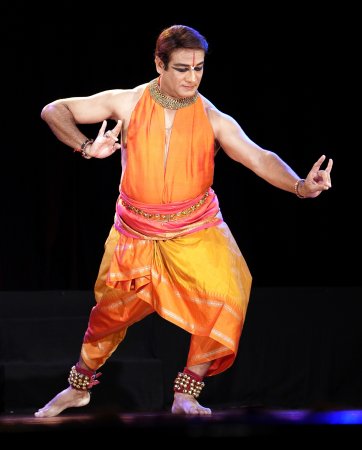 Satyanarayana Raju From the first moment, Raju's nritta proclaimed his command of geometry and rhythm. His araimandi was held with sculptural clarity, his torso firm, arms etching precise lines in the air, and feet resounding with sharp, decisive accents. Each jati unfolded with a crystalline rhythm, a dialogue between nattuvangam and dancer that brought the hall alive with kinetic energy. If the pure dance revealed discipline and rigour, the abhinaya revealed the soul of the dancer. The varnam, steeped in the voice of the devotee pleading with the divine, became a theatre of emotions under Raju's mastery. His subtle modulations of expression traced the journey of the nayika - the devotee's alter ego - through yearning, doubt, anguish, surrender, and transcendence. In every fleeting glance, every tightening of the brow, every quiver of the lip, the narrative deepened. One of the evening's most unforgettable moments came in Raju's enactment of the line "Biraana nannelukora Brihadeeshwara." Here, he transformed imagery into a living experience. With profound humility, he embodied the heroine's infinitesimal smallness before the majestic presence of Lord Brihadeeshwara, whose colossal temple loomed in her mind's eye. His physicality seemed to shrink into supplication, while his face glowed with awe at the vastness of the divine. In that instant, the metaphor dissolved, leaving behind a raw, visceral articulation of devotion - a soul pressing against the enormity of godhood. 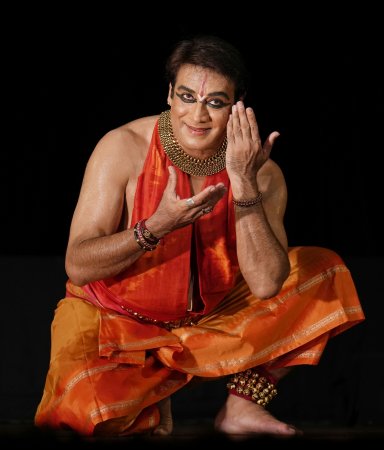 Satyanarayana Raju Yet devotion was not the only hue in this palette. The nayika's cajoling and playful teasing of the Lord to hasten their union provided a delightful vignette. Her eyes sparkled with mischief as she pleaded, "The time is right - why hesitate?" In this shifting play between reverence and longing, between awe and intimacy, Raju revealed the full spectrum of bhakti, at once cosmic in scale and endearingly human. Much of this transformative power stemmed from the extraordinary live orchestra, whose synergy elevated the evening into something larger than performance. On nattuvangam, Bharat Sundar provided the rhythmic scaffolding, his crisp, commanding recitation energising every movement of the dancer. Vocalist Balasubrahmanya Sarma wove emotion into sound, his resonant voice embodying the devotee's plea, and in turn igniting Raju's abhinaya in a dynamic, almost conversational exchange. The flute of H.S. Venugopal sang like a golden thread through the texture of sound, amplifying the moods of each raga, while Vidyashankar on the mridangam anchored the performance with percussive brilliance, answering every stamp of the dancer's foot with mathematical precision and thrilling complexity. What unfolded was a rare synergy where dancer and musicians functioned as one living organism - breathing together, building together, soaring together. In the larger arc of Raju's artistic journey, this performance also assumed the weight of a metaphor. His vow to perform sixty varnams is not just an act of celebration, but a profound offering - an artistic vrata that mirrors the very spirit of Bharatanatyam itself: discipline, surrender, and transformation. Each varnam becomes a chapter in a larger story, each stage a sanctum, each performance an act of worship. Through Samskruthi – The Temple of Art, and through endeavours such as this, Satyanarayana Raju is not merely keeping tradition alive - he is chiselling new space for it in the modern cultural landscape, showing that the varnam is not a relic of the past but a living, breathing vessel of devotion and artistry. That evening at JSS Auditorium, as the audience rose in applause, it was clear that the 32nd varnam had become far more than a milestone in his vow. It was a reaffirmation of art's highest purpose: to connect the human and the divine, to turn performance into prayer, and to remind us that the dancer's body, when consecrated by discipline and devotion, becomes nothing less than a temple. HARINI – THE SOUL'S JOURNEY THROUGH LAKSHMI'S LOTUS Some performances showcase skill, others that unfold narratives, and then there are those rare evenings when the stage transforms into a sanctified space. Meera Sreenarayanan's 'Harini' belonged to this latter category. Conceived and choreographed by Meera, Harini is an imaginative recreation of the soul's eternal yearning for divine union. The metaphor is at once simple and profound: a golden bee, restless and intoxicated, seeks nectar within the lotus. The bee is the Jeevathma, the individual soul; the lotus is Lord Vishnu, the Paramathma; and the guiding hand that draws the bee toward the nectar is Lakshmi, the Guru, the compassionate mediator between seeking and fulfilment. The central question hovers through the performance like the bee itself: Will the soul ever taste the nectar of eternal bliss? 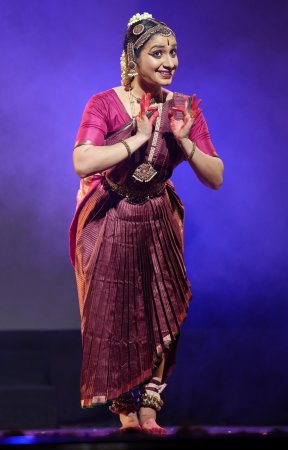 Meera Sreenarayanan The recital began in silence, with a traditional Alarippu. Against the wash of blue light, a silhouette unfurled into pure geometry of movement, the body carving rhythms that mirrored unopened buds, curled petals, flowers half-bloomed and in full blossom. This blossoming became the metaphor of the soul's unfolding consciousness. Here, Surya Rao's lighting created not just illumination but atmosphere: the stage seemed to breathe, petals of light opening and closing in response to Meera's movements. Lakshmi emerged as radiance itself, dazzling "like a thousand suns," while the bee, chanting "Shreem, Shreem, Shreem," sought the nectar. The play of light and shadow heightened the bee's longing - each dimming and brightening a reminder of grace given, withheld, and revealed. The bee's monologue unfolded as a kaleidoscope of rasas. Adbhutam (wonder) shimmered in the vision of Gaja Lakshmi rising from the churning of the Milky Ocean, holding lotuses; she appeared miraculous, framed in a glow of light that suggested both water and fire, Veeram (valour). Then came Shringaram (love), tender and radiant. Here, the bee, overcome by its own bashfulness, swarmed with a shy flutter, as though hesitant to describe the ineffable love between Mahavishnu and his chosen complementary counterpart, the Goddess herself. Meera's abhinaya, layered with delicacy, translated this hesitation into a soft luminosity of gesture - suggesting that love, even divine love, is at once shy, playful, and eternal. Then Raudram (anger) and Bhayanakam (fear) surged in her fierce aspect as Mahishasura Mardhini - eighteen arms striking against the lion's energy, while the lighting fractured into red and shadow, amplifying the terror of divine fury. 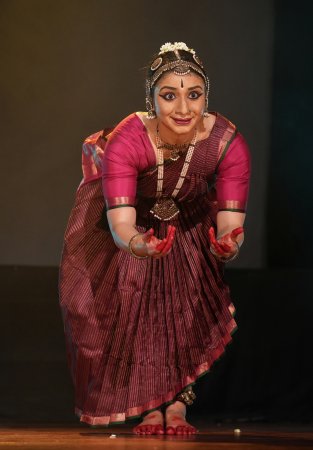 Meera Sreenarayanan Just when the atmosphere seemed weighted with intensity, humour entered like a playful breeze in the memorable leela between Sri Devi and Bhu Devi. Their tug-of-war over Vishnu was rendered with sparkle and wit, Meera's abhinaya balancing Hasyam (humour) with reverence. The bee, caught between laughter and devotion, exclaimed, "Oh Lakshmi, wasn't that too a leela of yours?" The journey then descended into Bhibhatsam (disgust), drawn from the Odia classic Lakshmi Purana. Here, Lakshmi was denied entry into Lord Jagannath's sanctum because she had visited the home of a Chandala woman, an act deemed "polluting." Meera's portrayal captured both the sting of rejection and the hypocrisy of orthodoxy. The lighting dimmed into muted tones, casting the stage in a stark austerity that mirrored exclusion itself. This episode gave Harini sharp social resonance, the bees' revulsion directed not at Lakshmi but at the narrowness of human boundaries. From this moment of rejection, the performance softened into Karuna (compassion). In the Kanakadhara Stotram, where Lakshmi's heart melts at the plight of a poor devotee, Meera's eyes softened, her body curved with tenderness, her gestures caressing rather than proclaiming. The bee surrendered fully here, the restless hum stilled into silence - an image of the soul's offering to the Guru. The entire emotional arc was held together by the music, culled with sensitivity from diverse sources by Edapilly Ajit Kumar. His curation provided not just accompaniment but a living framework for the dancer's exposition. Among these, the inclusion of the Odia song "Manabasa Gurubara" was particularly poignant - it carried within it the echoes of the Lakshmi Purana, sharpening the resonance of Bhibhatsam, where Lakshmi's compassion towards the Chandala woman clashed against the walls of exclusion. The layered textures of the score - alternating between grandeur, ferocity, tenderness, and lament - became the bee's unseen wings, lifting Meera's performance into a seamless weave of sound, movement, and rasa. What made 'Harini' extraordinary was the seamless unity of its elements. Meera's abhinaya was intelligent and layered, allowing each rasa to unfold fully. The ensemble's music was sensitive and textured - precise nattuvangam by Indira Kadambi, soulful vocals by Bijeesh Krishna, Charudatt on mridangam, Hariprasad on flute, Shyam Kalyan on the violin and Aswathy lending voice. Surya Rao's lighting, however, gave the production its visual soul: sculpting space, magnifying mood, and creating a temple like ambience where dance, music, and myth could converge. Together, the curated score became a hidden protagonist. It was the pulse beneath the bee's wings, the breath within the dancer's body, the invisible thread binding the performance into one seamless tapestry of sound, light, and movement. By the time the concluding Thillana dissolved into stillness, the performance had become more than an offering. The bee did not simply vanish; its hum lingered in the silence, its yearning and a mangalam echoed in memory.  Bangalore based Satish Suri is an avid dance rasika besides being a life member of the Music and Arts Society. |
