|     |
|
| |

 Pranamya 2 - A tribute to Guru C. V. Chandrasekhar- Tapati Chowdhuriee-mail: tapatichow@yahoo.co.in Photos: Arijit Roy September 10, 2025 'Pranamya 2' was a tribute to Bharatanatyam Guru C. V. Chandrasekhar on the eve of his first death anniversary. It was organised by Samrat Dutta, the Founder Director of Angamantra in Kolkata, and held on the 18th of July at Rabindra Bhavan in Baranagar. The evening showcased the Indian tradition of Guru-Sishya p arampara in the format of an audiovisual presentation with the nomenclature Nrithya Gandharva, produced by Madhura Kala Niketan. As a living example of this ancient system, Samrat Dutta, a devoted disciple of Prof Chandrasekhar, exhibited some of his own compositions, which are inspirations from his guru. Through his own compositions and choreographies, he traced the path taken by his guru, which has rubbed onto him in a great measure as well as on account of the priceless moments spent with his guru for so many years. As a true sishya, Samrat Dutta has performed many of his guru's immortal compositions and has taught the same to his students, besides taking his legacy forward with his own new and innovative compositions. 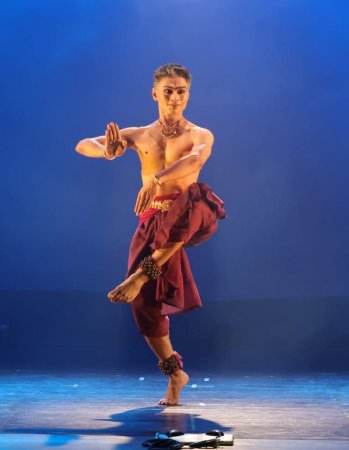 Samrat Dutta The evening was inaugurated with Samrat Dutta performing solo, a composition of his guru. It was a bhajan, "Shankara rudra roop dikhlao", set to raag Shankara and taal adi, a masterpiece composition of Guru Chandrasekhar composed when he was in Banaras. Every inch of the piece was full of alankaras and nuances that evoked rasa in the rasikas present. It was a breathtaking composition rendered with perfection. Nrithya Gandharva was an audiovisual presentation filmed in 2018 during the lifetime of Prof. Chandrasekhar. Samrat Dutta used the video to interweave the past with the present by his live onstage performance. He presented a few of his own innovative compositions in the spirit of his guru's compositions. Pushpanjali in raag Nattai and taal Chatusra Ekam with his very own music and dance composition is but one such example. 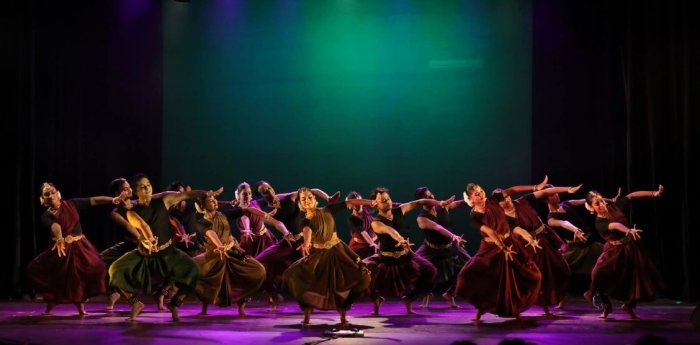 Samrat Dutta's disciples "Guru Brahma" in raag Shree and Kalavati and taal adi was a composition that served as a continuity of the video of the Guru puja shown in the film, which took place during Pranamya 1 in 2018 in Kolkata, where Prof Chandrasekhar himself had performed a full Margam. Here they got to see Guru-Sishya parampara completing a full circle. A series of adavus woven with suitable melody and rhythm danced by Samrat's disciples showcased what he had imbibed meticulously from Prof Chandrasekhar's sensitivity in incorporating adavus into new shapes and dimensions suited to each individual while adhering to the roots of Bharatanatyam intact. He had pictured this jatiswaram, where he had incorporated movements related to shringara or love. It may be the shringara of nature, such as the soothing breeze, water waves, rain, etc. Sometimes, shringara is in the moods of humans or animals. Maybe a swan, or a deer, or a beautiful girl expressing her joy after meeting her beloved. These sequences were subjected to Samrat's mind when he was choreographing this piece. In the charanam, he had introduced a sawal jawab part which is often found in Kathak and the tarangams in Kuchipudi. He constructed the adavus with subtle and tender movements. The vision of this jatiswaram is to showcase the soft and tender movements of Bharatanatyam with the playfulness of the talam and the complexity of the kannakus, keeping the poised beauty of the form. 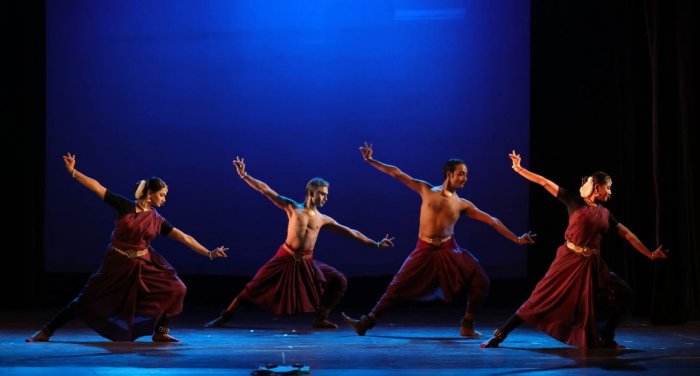 Samrat Dutta and disciples The Kirtanam "Gajananautyam Ganeshwaram," a composition of Muthuswami Dikshitar in raag Chakravakam and taal adi, was choreographed by Samrat Dutta. In this, Samrat's imagination made him recall the huge idols of Ganesha taken for immersion in Maharashtra. The idol of Ganesha becomes a symbol of godly presence to him. Ganesha is no longer an idol, waiting to be immersed. The elephant-headed god has taken upon himself an identity which goes beyond. This idea of bhakti was incorporated in the Pallavi, where the lyrics and the instruments are sung and played alternately to spread a profusion of joy with the stories of Ganesha's life. Music was composed by Swati Atmanathan. Samrat has composed the kannakus and the korvais of the piece, setting the rhythm in the panchajati format. In keeping with the philosophy of his guru-ma, Jaya Chandrasekhar, who believes that a local language that is understood by the people is a better choice than using an alien language, Samrat chose "Anjali loho mor sangite" from the works of renowned Bengali poet Kazi Nazrul Islam. So did he make his offerings to the Almighty through a song in his mother tongue. The rich imageries or rather alankaras, made it more than palatable to the audience. The duo Samrat and Santanu won the day. The richly flavoured piece came in for thunderous applause. Raag Mishra Tilang and taal Chatusra Ekam of the song made the piece all the more endearing. "Sri Jagadishwari Durga Mata," a composition of Lalgudi Jayaraman in raag Ahir Bhairav and taal adi composed into dance by Samrat Dutta, came in for a lot of appreciation as well. Tillana was the ultimate piece. Swati Atmanathan composed the music, while the rhythm composition was by Samrat Dutta in raag Malkauns, taal adi. The program ended within 1 hour 50 mins with a Rabindra Sangeet, "Jao re ananta dhame", a song which was addressed to the departed soul to rest in eternal peace. Love to the departed guru was an aesthetic presentation. Some of the senior students of Samrat whose names deserve special mention are Santanu Roy, his senior student, a solo performer, teacher and administrator of Angamantra, Suman Bari and Sathi Jar. Vocalists Brinda Radha Krishnan, Anand Jayaram, and Anushtoop Mazumder and mridanga players Shankar Narayanaswamy and Sarvesh Karthick gave excellent support. Nattuvangam was done by Mohana Iyer, Samrat Dutta, Milan Adhikary and Santanu Roy. Flautists Rupak Mukherjee and Rick Mukherjee provided aesthetic support. Violinists S. Satyavishal and Anand Jayaram gave a fullness to the ensemble. Script and narration were by Arunima Sengupta. 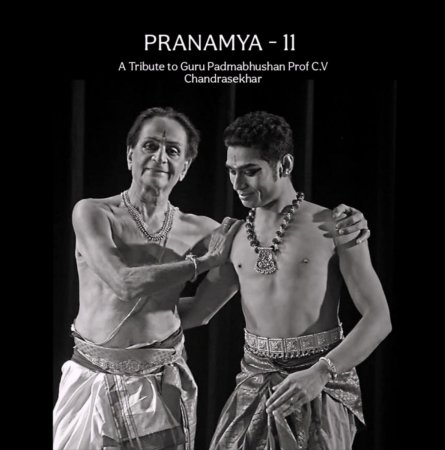 Samrat Dutta with Guru CV Chandrasekhar In the choreographer's note, Samrat Dutta says that he could identify himself with his guru's philosophy, which had become a part of him without his realisation. So much so his works are but a reflection of his mentor's work. Whatever he has thought unconsciously or subconsciously in his artistic journey has got correlated with his pattern of thinking. Perhaps it could be because of the valuable time which he had spent with him. Samrat confesses that after his mentor's passing away, 'Nrithya Gandharva' became his companion.  Tapati Chowdhurie trained under Guru Gopinath in Madras and was briefly with International Centre for Kathakali in New Delhi. Presently, she is a freelance writer on the performing arts. She is the author of 'Guru Gopinath: The Making of a Legend.' |
