
|     |
|
| |

 Muruga: Myths in melody and movement- Satish Surie-mail: satishism@yahoo.co.in Photos: Prof K.S.Krishnamurthy September 8, 2025 'SKANDAANUBHAVAM' BY SATHVIKAA SHANKAR On the evening of 5th August, the Bangalore International Centre resonated with devotion and artistry, as the programme unfolded in two distinct yet complementary halves. It began with a Harikatha by Suchitra B, who transported the audience into the sacred realm of Lord Muruga. With a storyteller's finesse, she wove together myth, music, and philosophy, highlighting how Muruga's divine grace inspired the legendary composer Muthuswamy Dikshitar, whose kritis remain timeless tributes to the deity. Her narrative, rather dilatory, projected on screen drew from Arunagirinathar's Tiruppugazh and the Skanda Purana, tracing Murugan's divine birth, the symbolism of his six heads, and the origin of Palani. Enriched with melodic passages and rhythmic interludes, painted vivid images of Muruga's valour, compassion, and spiritual radiance. Suchitra's narrative functioned as a contemplative prelude, setting a luminous tone for the dance that followed. 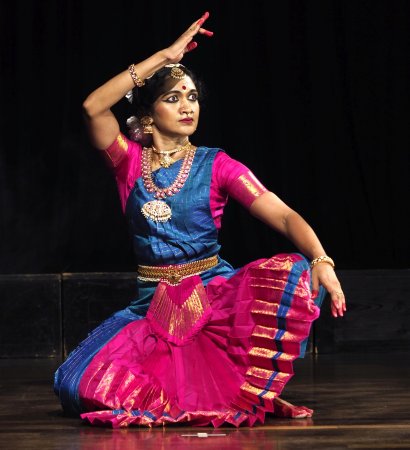 Sathvikaa Shankar From this devotional immersion emerged the second half of the evening, 'Skandaanubhavam - The World of Blissful Consciousness,' a solo Bharatanatyam performance by Sathvikaa Shankar. She entered like a continuation of the Harikatha's spirit, translating its devotional essence into the language of movement. With precise nritta, fluid lines, and emotive abhinaya, Sathvikaa's recital became a visual offering, where each gesture seemed to echo the stories and sentiments that had just been narrated. Conceptualised and choreographed by Sathvikaa herself under the guidance of acharya Anitha Guha, the performance drew upon Murugan's leelas and iconography as metaphors for longing, surrender, and divine bliss. Sathvikaa's solo presence filled the stage with quiet intensity. The first segment depicted Murugan's battle with Soorapadman at Tiruchendur. Sathvikaa's angular adavus, sharply etched mudras, and fierce abhinaya conveyed the demon's defiance and the deity's serene power. The visual highlight was the transformation of the asura into a peacock and rooster, executed through a compelling jathi korvai. The shift from tandava to lasya underscored the narrative of redemption and divine grace. The second narrative traced Murugan's marriage to Devasena. Sathvikaa portrayed Devasena with refined grace, her gentle abhinaya and lyrical movement capturing the sanctity of divine union. Murugan's arrival was suggested through layered hastas, evoking his six heads, while soft korvais and a serene sanchari reflected the saint's surrender to the divine. The final narrative brought together themes of longing, surrender, and bliss through the story of Palani and the kavadi ritual. Sathvikaa's portrayal of Idumban - his journey, confrontation, and eventual transformation - was marked by grounded movement and philosophical depth. The kavadi attam, rendered with shoulder-pole motifs and circular floor patterns, evoked the devotional intensity of pilgrimage. The musical ensemble with Jayashree Ramanathan (nattuvangam), Raam Shankar Babu (mridangam), Sriranjani Tapasya Santhanagopalan (vocals), Sruti Sagar (flute), and Eashwar Ramakrishnan (violin), created a soundscape of depth and delicacy, with rhythmic architecture by Vijay Kumar and evocative lighting by Surya Rao enhancing every transition. KALATRA: THE ETERNAL CONSORT On August 19 at the Bangalore International Centre, 'Kalatra: The Eternal Consort' presented by the Keelaka Dance Company, unfolded less as a performance and more as a sanctum. Conceived by Jyotsna Shourie and Aneesha Grover, the work reimagined Murugan's story not through the blazing aura of the god himself but through the fragile, tangled lives of the women at his side - Valli and Devanai. Myth was not offered as a distant spectacle but unravelled into human immediacy, where rivalry, longing, and destiny trembled as the true pulse of devotion. The evening opened with a Mallari, dancers embodying the pomp and splendour of a celestial procession. This ritual invocation, stately and precise, set the stage as one would prepare a sanctum. From this ceremonial grandeur, the narrative unfolded, drawing the audience deeper into the shadowed complexities of Murugan's world. Dance-theatre became the medium of this reimagining. Rather than fusing forms into a neat hybrid, Bharatanatyam, Kuchipudi, Kathak, and contemporary vocabulary conversed with each other: the sharp geometry of one answered by the spirals of another, a sudden fall fracturing classical symmetry. Character found shape through these stylistic dialogues - divine grace flickering uneasily alongside mortal hurt. Anchored in layered sources - regional poetry, folk memory, and the syncretic worship of Murugan at Kataragama in Sri Lanka - the work drew its most poignant depth from a small voice of tradition: Devanai, it is said, could not bear to witness Murugan visiting Valli. That fragile, human truth reshaped the cosmic marriage drama into a story of raw emotion and intimate vulnerability. 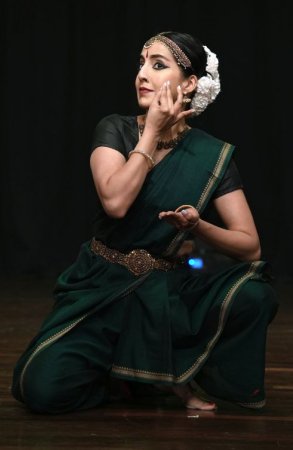 Aneesha Grover 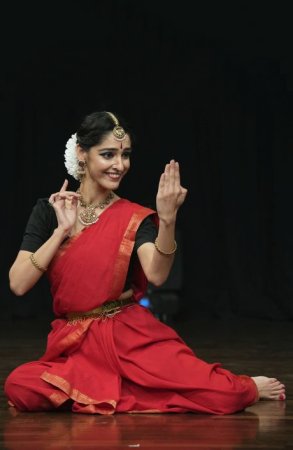 Nandita Kalan 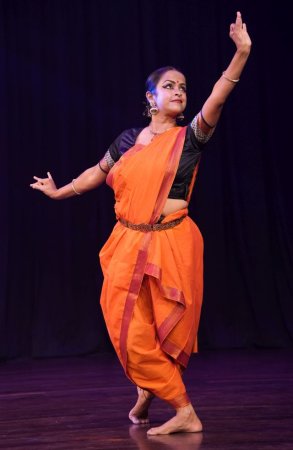 Amrita Sivakumar The dancers gave this vision flesh. Aneesha Grover as Devanai, Nandita Kalan as Valli, and Amrita Sivakumar as Kamadeva moved with technical precision softened by disarming vulnerability. Benjamin Jacob's Murugan, radiant yet still, stood in contrast to Joe Mathew's spirited embodiment of chaos and ego, culminating in the breathtaking sequence of Soorapadman's transformation into the peacock - a transfiguration of fury into elegance, where myth became metaphor for compassion's alchemy. 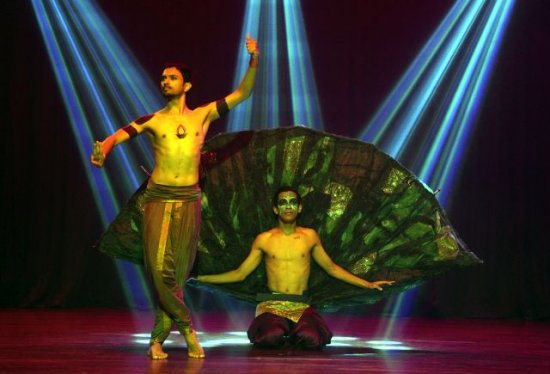 Benjamin Jacob & Joe Mathew The production established Murugan's divine stature through references to his valour as a celestial general and his erudition in giving the Pranava Mantra to Shiva. Benjamin Jacob's portrayal of Murugan was a study in contained power and grace. His kinetic vocabulary was characterised by linear stretches, sharp angularity, and precise, authoritative movements rooted in classical form. His breathtaking spins on one leg embodied both equilibrium and controlled energy, representing the god's unwavering resolve. Mathew's Soorapadman writhed in distorted power, stomping, hunched, angular - ego given form. Murugan's containment eroded the demon's fury until transfiguration arrived: the angularity dissolved into fluid undulations, the hunched torso unfurled into arcs of avian elegance, and a magnificent peacock prop fused seamlessly with Mathew's body. In that instant, the demon was not destroyed but liberated into beauty. The peacock emerged not as ornament but as essence, its fan an extension of spine, its delicate steps the purification of once-violent stomps. This intricate character work was exemplified in the captivating presentation of Murugan's courtship of Valli. Here, the dancer's expressive agility was on full display, seamlessly shifting through a series of divine guises. We see the charming, slightly comedic portrayal of the old man - a disguise full of stooped postures and gentle, persuasive gestures. This is followed by the sudden, dramatic intervention of Ganesha's elephant form, a moment of controlled power and playful surprise. Most captivating was the portrayal of Valli's bewildered resistance, a flurry of confused footwork, defensive arm movements, and wide-eyed fear that slowly, inevitably, melts into curiosity and then affection, resulting in wedlock, making the mythical relatable through its attention to emotional detail. The emotional crescendo unfolded with the entrance of Kamadeva, portrayed by Amrita Sivakumar in a role at once ethereal and unsettling. He enters with the poignant verse from the Mohamana Varnam, "Maaran kanaigal thoovuran saramaariyaay," positioning himself as a witness and a confessor to the ongoing complaints of Valli and Devanai. He arrived not as a provocateur but as a confessor - a divine psychologist listening to the complaints of Valli and Devanai. Their duet of identities was sharp and revealing: Devanai's movement steeped in structured, courtly geometry, asserting her celestial claim; Valli's gestures wild and earthy, claiming the unbound passion of the forest. Their rivalry, shaped by posture and rhythm, sharpened until Kamadeva's admission shifted the ground beneath them: he was the one who let loose the arrows of desire. His revelation that they were once sisters reframed conflict as forgotten kinship, and his chastisement - "you will have no perfect taalam and no samam" - resonated as both rebuke and reminder: their discord had unstrung the cosmic rhythm. 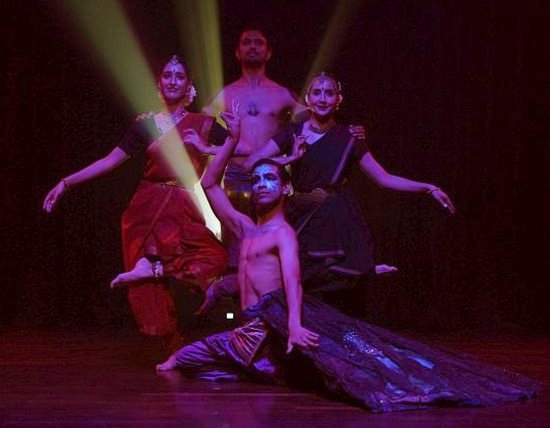 Kalatra group This wisdom released the drama into catharsis. A joyous thillana followed, bodies weaving in intricate synchrony, restoring the lost talam and samam. The final tableau was a breathtaking frieze: Murugan serene at the centre, Valli and Devanai flanking him not as rivals but as complementary embodiments of devotion, the peacock - ego transfigured - spread gloriously at his feet. This closing vision did not erase the story's complexities; it reframed them within a cosmology of compassion, offering resolution not through conquest but through understanding. The soundscape, composed by Daniel B George, OS Arun, and Madstarbase, was another protagonist. Carnatic melodies of haunting beauty entwined with earthy folk rhythms and atmospheric electronic textures, conjuring a sonic world where the ancient breathed through the modern. The music on a recorded track and theatrical devices extended the immersive fabric until myth itself seemed to pulse within the theatre. This rich tapestry of movement and narrative was elevated by the lighting design of Charles, which did not merely illuminate the stage but embellished the entire rendition with an intrinsic, emotional intensity.  Bangalore based Satish Suri is an avid dance rasika besides being a life member of the Music and Arts Society. |
