
|     |
|
| |

 Multiple layers of aesthetic splendor- V. Kaladharane-mail: vkdamaru.eda@gmail.com Photos: Lijan James September 3, 2025 Kochi, the Queen of Arabian Sea, has of late, become the hub of three major dance festivals. Kalandhika Cultural Society headed by the noted Mohiniyattam dancer, Dr. Mini Pramod Menon, is one among them holding dance festivals for quite some years. The four-day national dance festival (Aug 14 - 17) staged at the Kerala Fine Arts Society Hall under its auspices turned out to be a grand aesthetic treat on all counts. 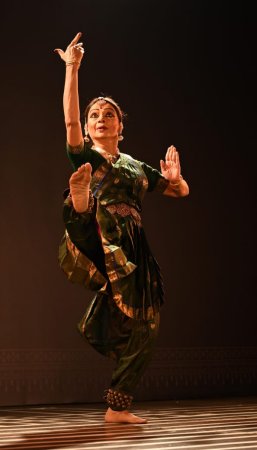 Malavika Sarukkai The festival began with the sterling Bharatanatyam recital of none other than the redoubtable Malavika Sarukkai. The first segment of her performance was devoted to Lord Siva commencing with the rhythmic syllable, Tha Thi Thom Nam. The verses from the Balaramabharatam of Karthika Thirunal Maharaja blossomed into remarkable images of Lord Siva as Nataraja asserting his invincibility. Her movement dynamics infused with an extraordinary energy and elegance was in perfect harmony with her facial expressions and the music, vocal and instrumental. Krithika's vocal rendition and Nellai Balaji's taps on the mridangam deserve special adulation in this context. Adi Sankara's Sivashtakam in raga Hamirkalyani, followed adjacent to which Malavika did a pure dance piece set to ragas Kamboji and Varali. In the second segment, the dancer's choice of the verses from the Nachiyar Thirumozhi and from the Krishnakarnamrutham exemplified Lord Krishna in myriad hues. Malavika's visual interpretation of Annamacharya's "Bhavayami gopalam" was magnificent. One of her vinyasas zeroed in on to Yashoda unleashing child Krishna whose pranks had forced her to tie him up. The moment he is released, Krishna runs away. The subtle articulations of Malavika's eyes and hands unraveling the entire anecdote defy description. For her, abhinaya is not a module to be superimposed on dance. Instead, it is an intrinsic constituent of dance. The finale of her recital was the Thillana of Balamuralikrishna in raga Brindavani, followed by Vande Matharam reinforcing the fact that in both textual and non-textual dance, she is inimitable and indomitable. The geometrical magnificence of her movements is, in fact, a consistently cultivated aesthetic culture as well. When it comes to aharya, especially the costumes, I cannot imagine of any color that doesn't suit her appearance both on and off stage. Yet, Malavika becomes all the more beautiful on stage when the color of her sari and blouse is either tomato red or royal blue. This time she went in for a different color combination that was relatively less striking in appearance. Nonetheless, the modulations of lighting made it convincing. 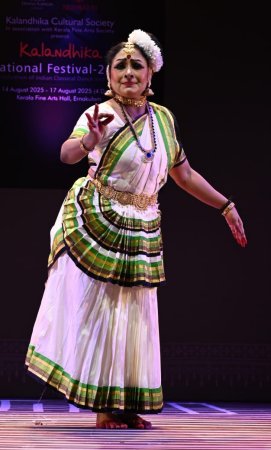 Jayaprabha Menon The second day evening started with the Mohiniyattam recital of Jayaprabha Menon, the disciple of the eminent dancer, Bharati Shivaji. Jayaprabha, like her Guru, is a faithful follower of the late Kavalam Narayana Panikkar in her approach to and involvement in the musical-segment of Mohiniyattam. Yet her very first item Ganapathi stuthi was a composition in raga Kunthalavarali which is not even distantly aligned to any of the indigenous ragas Kavalam was intensely fond of. She then moved on to Thatwam, an item brimming with native flavor. Jayadeva's ashtapadi, "Rathi sukhasare" in raga Kedaragaula, was the highlight of Jayaprabha's recital. She successfully unfolded the full import of each and every line and in the process depicted the subtle layers of Radha's rathyunmaada. Jayaprabha concluded her recital with the visual interpretation of Keshamithu, a poem penned by the late poet and lyricist, O.N.V. Kurup, illustrating the mortification experienced by Draupadi and extending it to the traumas undergone by the women of the day. The dancer tried her best to make it appealing to the audience. The background vocalist and the instrumentalists supported the dancer generously. 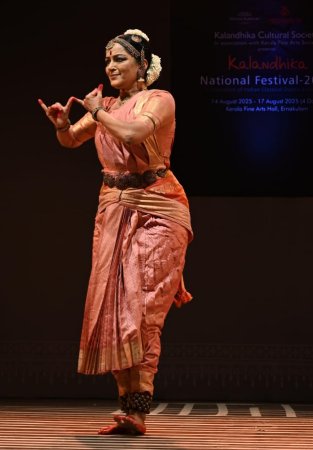 Vidhya Subramanian Trained under veteran Gurus, especially under, Swamimalai Rajarathnam Pillai, Vidhya Subramanian is in a class of her own in the field of Bharatanatyam. The verve and veracity of the Vazhavoor Bani are innate in her movement vocabulary. She is fully conscious of whatever she does on stage both in terms of angika and satwika abhinayas. At the same time, her articulations are fluent and spontaneous to the core. The very first item with which Vidhya captivated the spectators was the all too familiar "Swagatham Krishna," a composition of Oothukadu Venkata Subbaiyar. The piece de resistance of the recital was the Lalgudi varnam, "Innum en manam" in raga Charukesi set to adi tala. Differing slightly from the conventional track, Vidhya explicated the mood of the Nayika for a while in the Pallavi before proceeding to the thrikala jathi. As part of the Vinyasa, the dancer as the Nayika ornamented herself like the temple ready to receive her Nayaka. While decorating the bed with the small Jasmine flowers, they blossom into Vyjayanthi flowers pleading to be strung into a garland for him. She, like Andal, tries it on herself first before adorning her beloved. He, but rejects it. The Nayika then recollects the childhood pranks of Krishna including gopasthree vasthraapaharanam, his stealing of the butter and the releasing of the cows from their sheds. She then imagines. "His eyes are like lotuses. When they shut themselves refusing to see me, my eyes shed tears". All the vinyasas were succinct and were consistently connected with the present moods of the Nayika. Precision and purity were the hallmarks of her adavus elegantly complemented by the jathis and the swaras. The visual rendition of the Swathi Thirunal Padam, "Theliviyalum mukham" in raga Punnagavarali, followed. In depicting the sorrow of separation of the Khandita nayika, Vidhya was quite composed yet profoundly involved. "Mutta Vaddura", a well-known Javali of the Tanjore Quartet was her next piece. She effortlessly enacted the angry disposition of the Nayika towards the Nayaka whose infidelity she couldn't put up with. Being aware of his flirtations with other women, the Nayika was in no mood to relent. Vidhya did drive home the annoyed state of mind of the Nayika. The concluding item of her recital was a Thillana composed by Lalgudi Vijayalakshmi in raga Shudha Sarang. There was hardly much of a difference between the color-tone of Vidhya's aharya and her skin-tone. The facial make-up could seldom convey clearly the sthayi (enduring) and the sanchari (transitory) bhavas of the Nayika. I wish she were a bit more prudent about her onstage aharya. However, Vijay Kumar's awe-inspiring recitation of the jathis, Janani Hamsini's mellifluous music, Yaswanth Hampiholi's gamaka laden beats on the mridangam and Nandini Sai Giridhar's clean fingerings on the violin more than offset the deficits. Amrita Jayakrishnan's directions on lighting did have a reasonable impact on the stage-ambience. 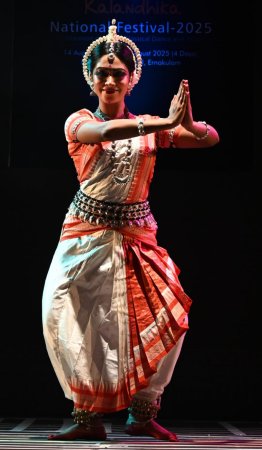 Preetisha Mohapatra On the third day evening, Preetisha Mohapatra, daughter of the eminent Odissi dancer Sujata Mohapatra, began her recital by recounting the Virutham, "Shantheya gaurardha shareerakaya" in praise of Lord Siva. Her brisk movements and vivid expressions concretized the glow and grandeur of the Lord as Nataraja. Preetisha then moved on to the depiction of a portion from Syamaladandakam. Lines rendered in ragas Bheemplasi, Madhuvanthi and Kalavathi were alluring as the dancer switched from thandava to lasya and back. Striking was her picturization of Ardhanareeshwara. The second item was a Hamsadhwani Pallavi which brought to the fore the ineffable charm of shudha nritta (non-textual dance). The rhythmic variations in the swara segments were in perfect sync with the hastas, body-movements and facial expressions tinted with sringara rasa. In the Bhajan that followed, Preetisha portrayed portions from the Ramayana including Seetha swayamvara, abduction of Sita and the Rama-Ravana battle. On the whole, Preetisha proved to be a proficient dancer capable of creating a style of her own in the near future. The vocal and instrumental music empowered her performance in no small measure. 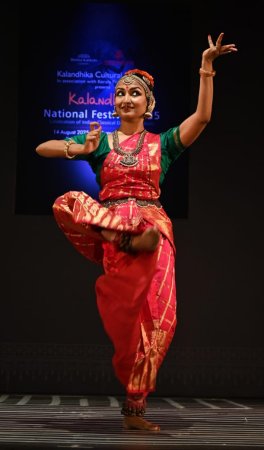 Bhavana Reddy While most of the legendary figures in Kuchipudi are no more, the remaining few are past their prime. There are still several highly talented youngsters in the field who are, for reasons unknown, not given enough opportunities by the Sabhas or cultural organizations in south India to perform before initiated spectators. Bhavana Reddy, the daughter of Raja Reddy and Radha Reddy, the celebrated Kuchipudi acharyas, came to Kochi for the first time and performed at the Kalandhika festival. A proud product of the Vedantam School of Kuchipudi, Bhavana commenced her recital with Ganapati vandanam. Right from the very beginning, she entranced the audience with her unquestionable command over the language of Kuchipudi. The irresistible fluency of her movements and foot-works coupled with apposite facial expressions were upheld through and through. The way she treated Jayadeva's Ashtapadi, "Kuru yadu Nandana" in Ragamalika and set to talas adi and mishrachapu, was singular in many respects. As Radha, she intensely embodied the subtleties of sensualism. Radha's exhortations to her supreme Lord brimming with erotic metaphors and images were transformed into enticing aesthetic idioms by the gifted dancer. Bhavana, afterwards, moved on to a Madana Daruvu again in Ragamalika and adi tala in which Satyabhama conveys her deep yearning for her lover, Lord Krishna. Bhavana poignantly depicted the scene in which Satyabhama is writing a letter to her beloved. Here, the dancer sang the lines in raga Arabhi, thereby evidencing her instinct in music as well. The last but one piece was the Kuchipudi-version of the Swathi Thirunal Thillana in raga Dhanashri. It bore a distinctive tone. The last item was the famed Tharangam, Rasa shabdam in raga Arabhi authored by Oothukkadu Venkatakavi. Bhavana's treatment of the line, "Kanakamanimaya noopuracharana" was admirably different from the way her peers in the field characteristically deal with it. While all her background musicians did contribute considerably to Bhavana's performance, Manohar Balatchandirane deserves special mention since he wielded both mridangam and nattuvangam with an incredible acumen. 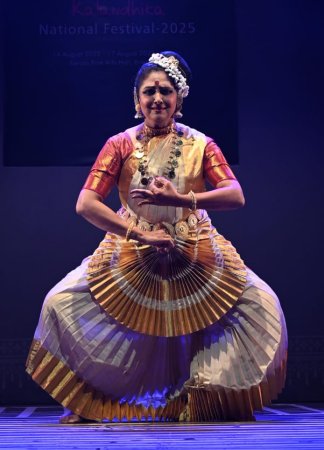 Sunanda Nair On the concluding day of the festival, Sunanda Nair, the most prominent disciple of the late maestro, Dr. Kanak Rele, performed Mohiniyattam reinforcing the uniqueness of the baani carved out by her Guru in the 1980's. She began her recital invoking Lord Ganesha, the remover of all the obstacles. The vocalist, Bijeesh Krishna, beautifully sang the lyrics in raga Surutti, following which, Sunanda presented "Sriman Narayana," the well-known Kirtana penned by Annamacharya in raga Bhauli, in the format of Mohiniyattam. The two Vinyasas she incorporated viz. Gajendra moksham and Narasimhavathara in it were stunning to say the least. Sunanda later presented Ashtanayika dexterously choreographed by her Guru. The lyrics were composed in eight different ragas which added flavor to the eight different moods of the Nayika convincingly expressed by the dancer. Such an exposition is quite demanding since each and every expression is guided by a set of rules. The next one was Kubja, a composition bearing the imprint of the vision and the musical sensibility of the late Kavalam Narayana Panikkar. Its theme is rather simple; Lord Krishna chancing upon Kubja (hunchback) and their conversation resulting in the latter's redemption. Sunanda, through its portrayal, was indirectly conveying a message that Kubja represents the soul of the Indian women. A set of skilled musicians supported Sunanda unstintingly to make her recital impressive. The melodious notes on the edakka by the veteran player Nandakumar, added to the indigenous fragrance of Sunanda's performance. 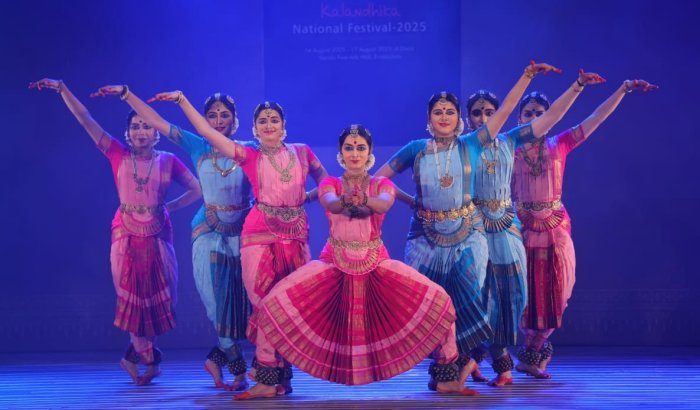 Anitha Guha's disciples The finale of the four-day festival was a Bharatanatyam recital by a team of outstanding young dancers led by the Acharya, Anitha Guha. The very first item, "Sreenivasa karavalambam" in praise of Lord Venkateswara, drew immense applause from the audience. The dancers then proceeded to perform Swathi Thirunal's acclaimed Kriti, "Bhavayami Raghuramam" in Ragamalika set to roopaka tala. Strictly adhering to Margam, the dancers transformed it into a classic Varnam. Anitha's astute choreography together with the prowess of each and every dancer in the group made all the excerpts encapsulating the epic Ramayana, most memorable. Side by side with solid visual phrases, there were slices of humor too. The dancers were vying with one another to establish their presence in the minds of the spectators. The "formations" on stage were spectacular. Saint Thyagaraja's "Nagumo" was Anitha's next choice. In it, the Vinyasas viz. Krishna's lifting of the mountain Govardhana, and Gajendra moksham were an enriching visual treat. In the following item, Melpathur's Agre pashyami, and Ambujam Krishna's "Om namo Narayana" were combined to create a devotional aura. The recital concluded with Swaranjali, a composition of P.R. Venkatasubramaniam. Anitha is mostly confined to her mission of imparting Bharatanatyam in its pristine purity to dozens of her brilliant disciples over the years. Her disciples stand testimony to the glorious endeavor Anitha Guha has been immersed in against all the odds. As part of the festival, Kalandhika organized a three-day dance workshop too led by noted Bharatanatyam dancer and teacher Uma Sathyanarayanan, one of the dear disciples of the eminent dancer, Chitra Visweswaran.  Former Deputy Registrar of Kerala Kalamandalam, V Kaladharan is also an art critic. He has published several articles at the academic level. 'From Meditative Learning to Impersonal Pedagogy' was published in an anthology 'Qui Parley' initiated and released by scholars and writers from the University of California, Berkeley. His articles on Indian performing arts and literature regularly appear in magazines and journals, and in the Friday Page of The Hindu. |
