|     |
|
| |

 Muktir Ahwan in Gaudiya nritya- Debolina Ghoshe-mail: debolina.2009@rediffmail.com August 29, 2025 Gaudiya Nritya which is encompassed under the Oudhra Magadhi pravritti is the sole treasured classical dance of Bengal. It is not only a classical dance form which abides by the tenets of Natyasastra but it is also a platform which exhibits history, literature, temple architecture, sculpture, folk music and dance of ancient Bengal. Like Rukmini Devi's name is associated with Bharatanatyam, in the same way, Dr. Mahua Mukherjee's name is associated with Gaudiya Nritya. Her strong willpower and intense research have helped to shape the form. Dr. Mukherjee has travelled all over Bengal to collect documents, scripts, fragments of sculptures, observed architecture in the temple walls. She learnt and practiced various folk dances of Bengal like Baul, Nachni, Raybenshe and Chhau. All these are the building blocks of Gaudiya Nritya. Keertan is the heart of Bengal's spiritual music and also the base of Gaudiya Nritya repertoire. Gaudiya - the name is derived from Gaur which was the capital of Bengal. The dance bears the glory of Bengal. 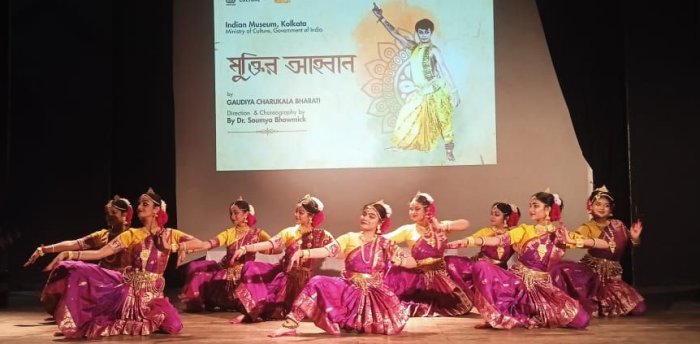 Ambika Stuti Dr. Soumya Bhowmik, disciple of Dr. Mahua Mukherjee is bearing the legacy of Gaudiya Nritya. His institution Gaudiya Charukala Bharati on the eve of Independence Day at Indian Museum of Kolkata presented Muktir Ahwan (on the glory of freedom movement) in the Independence Day ceremonial programme named Sanskriti ke Rang Azadi ke Sang. The recital was set on the context of freedom movement of India. The programme started with Ambika Stuti. Dancers of Gaudiya Charukala Bharati nicely performed Joy ma Ambike, Trilok palike. After praising the primeval force of the cosmos, they moved on to Gauranga Ashtakam. This is in praise of Chaitanya Mahaprabhu who is the pioneer of Bhakti movement in Bengal. He devoted all of his time to live harmoniously, irrespective of caste, class and religion. The third item was on Ardhanariswar. The Shiva-Shakti unison not only tells about gender equality, it also tells how things can coexist harmoniously even having basic differences. Dr. Bhowmik gave its interpretation in the context of Indian freedom movement that in spite of our vast diversity, our souls were integrated to break the shackles of bondage and brought independence for our motherland. 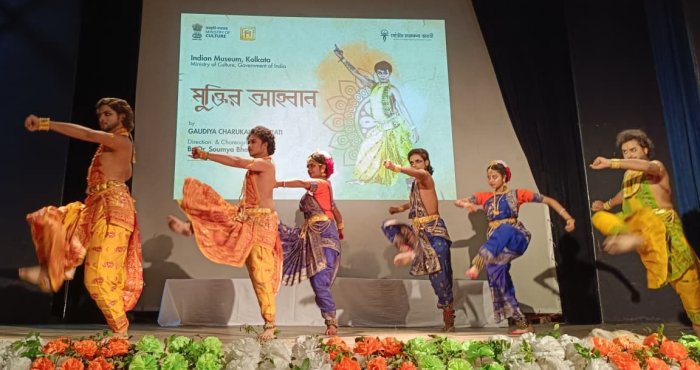 Nazrul Geeti The next item in the recital was a folk dance which tells about the struggle of Sidhu-Kanho, Chand and Bhairav Murmu. They were among the bravest personalities of Indian peasant movement. We have fertile land. Our socio-economy is based on agriculture. Ruthless laws and tyranny of the Britishers played havoc on the lives of our farmers. Fiery revolution broke out. The dance celebrated that vigour and fulmination. The syllables of the song, hurur tang tang charged up the audience into a chivalrous mood. The stage was graced by the fifth presentation based on a Nazrul Geeti. Kazi Nazrul Islam is called bidrohi kobi (poet of revolution). His song Durgam giri, kantar moru, dustor parabar hey! / Langhite hobe ratri nishithe, yatrira hushiyar ...was a clarion call to the hearts of millions of Indians and to boost them up with patriotism. The dancers gave a vivid expression of fervent patriotism through their presentation. The program concluded with Matri bondana showing dedication and devotion to our motherland. Yatridal sab sajo hey / subho sankha bajaha bajo hey - Kabi Rabindranath Tagore summoned the people to dedicate their lives to Mother India. Irrespective of caste, class and gender he pleaded to make free our country from the bondage. Dancers of Gaudiya Charukala Bharati justified the song with their perfect posture and grace. Their dedication towards their dance form made the evening of 79th Independence Day of India very special.  Debolina Ghosh is an MPhil scholar, Department of Sociology, University of Burdwan, West Bengal. |
