
|     |
|
| |

 Ankiya Bhaona Festival- Tapati Chowdhuriee-mail: tapatichow@yahoo.co.in Photos: Arup Jyoti Kalita August 18, 2025 Sattriya Kendra Guwahati, Centre for Music, Dance and Theatre Traditions of Sangeet Natak Akademi, New Delhi, an autonomous body of the Ministry of Culture, Government of India, collaborated with the District Administration and the Ministry of Education and Training, Morigaon, to hold the Ankiya Bhaona Festival at Sri Sri Krishna Raas Mahotsav and Srimanta Sankaradeva Janmotsav Urjaponar Sarbajanin Harimandir, Morigaon, on 29th June 2025. 'Parijat Haran' authored by the prolific writer Srimanta Sankaradeva, was enacted on the 4th and final day of the 15th Ankiya Bhavana Samaroh. Srimanta Sankaradeva was a 15th-16th century Assamese polymath: a saint-scholar, poet, playwright, dancer, actor, musician, artist, social-religious reformer and a figure of importance in the cultural and religious history of the Bhakti movement in Assam. Most of his works are renderings of Sanskrit texts. He translated much of the Bhagavata Purana and the Uttarakanda of the Ramayana into Assamese and wrote narrative poems such as Rukmini. Harana Kavya and the Harishcandra Upakhyana are based on puranic themes. These are not translations in the modern sense of the word, since Sankaradeva had condensed and added colour, plus new details and had combined elements from different texts. In most cases he had transformed his translations into an altogether new work. His language was colloquial rather than Sanskritised; his works were free-flowing and idiomatic and full of humour. Sankaradeva had also written devotional lyrics, the best known of which are the Bargit and the Kirtana-ghosha, a collection of lyrics based on the Bhagavata which were intended for congregational chanting. It is said that no Hindu home in his part of the country was without a copy of the Kirtana-ghosha - a doctrinal work of the Bhaktiratnakara. Sankaradeva was also the author of six plays belonging to a genre of dramatic literature known as Ankiya Nat, a term first employed by the charita writers. Sankaradeva himself preferred the terms 'nata' or 'nataka' and 'yatra'. The Sanskrit term 'anka' denotes a one-act play, and though efforts have been made to establish the origins of Ankiya Nat in Sanskrit models, this has proven to be difficult since Assamese dramas violate many of the rules of Sanskrit dramaturgy and differ in structure, subject, treatment, and language. Sankaradeva must have been influenced by Maithili dramas, which were flourishing at the time Ankiya Nat had first appeared, but his plays did not follow Maithili models either. Sankaradeva was an innovator rather than an imitator. One of the most distinctive features of Sankaradeva's plays is their language. Sanskrit plays were written in a mixture of Sanskrit and various Prakrits, and in contemporary Maithili dramas, while the dialogue was in Sanskrit and Prakrit, the songs were in Maithili. Sankaradeva's dramas consisted of a sprinkling of Sanskrit couplets, while the prose dialogue and the songs were written in a language scholars call it Vrajavali, or Assamese Brajabuli. It is also the language in which the Bargits was written. The language was not difficult to understand, which is why Sankaradeva decided to use it. An Assamese verse on the mixture of languages in the Ankiya Nat states that Sanskrit verses could be understood by scholars and Brahmins who knew the language, but for the understanding of the villagers, Brajabuli would be suitable. Ankiya Nats were usually performed during the night, when agricultural labourers had time to watch, and on religious occasions such as Janmashtami, or on full-moon nights, etc. Performances were held at the Nam Ghar - places of worship. The villagers also served as actors. Female roles were played by young men. The audience sat on mats or on the bare floor. Costumes, masks, and other props were used. Sankaradeva's dramas began and ended with a benediction (bhatima). They had a sutradhara, who introduced the play and the characters as in classical drama but continued in this role throughout. The sutradhara sang, danced, and delivered brief discourses. These verses were composed by Sankaradeva. The prose dialogue alternated with songs in appropriate ragas, along with interludes of dancing. This made the Ankiya Nat resemble modern Western musicals. The masterpiece Ankiya Nat 'Parijat Haran' was written toward the end of Sankaradeva's life. It has well-developed dialogues, bold and almost realistic characterisation with a finely developed plot and humour. 'Parijat Haran' retells two stories from the Bhagavata and the Vishnu Puranas. The storyline speaks of Indra's rejection from heaven by the demon Narakasura, who appealed to Krishna for aid. In response, Krishna travelled to Pragyotishapura, accompanied by his wife Satyabhama on Garuda's back, and slew the demon and his generals after a fierce battle. It came to pass that the divine Parijat tree was uprooted from the heavens to be replanted at Dwaraka in the house of Satyabhama. The story perhaps was especially attractive because of its connection with Assamese history. The demon Naraka, the son of the demon Hiranyaksha and the earth goddess, was the first ruler of Pragjyotishapura, which is ancient Assam. His son Bhagadatta, whom the Mahabharata refers to as a king of the Mlecchas, was killed by Arjuna. 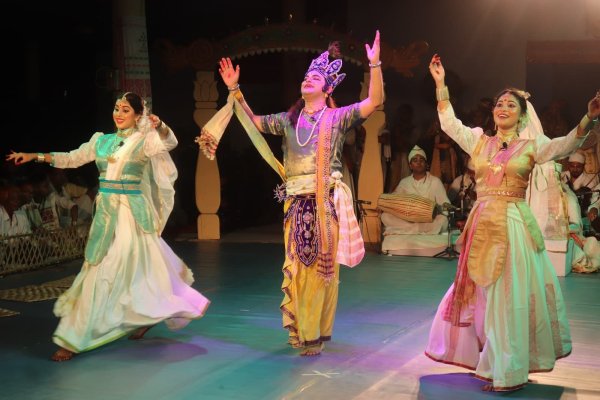 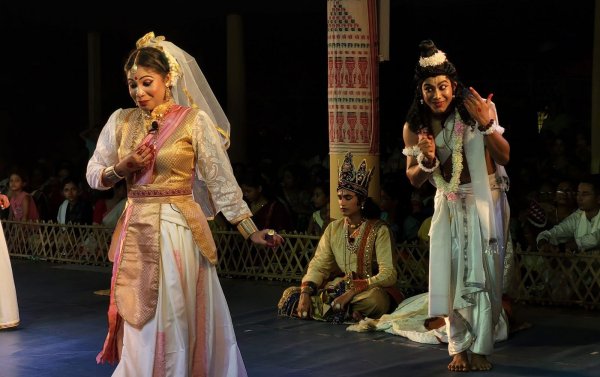 In 'Parijat Haran', the director Dulal Roy recounts how Krishna forcibly uproots the parijat tree from heaven and plants it in his kingdom at Dwarka. The sage Narada had come from heaven with some parijat flowers to Krishna's court and had presented them to him, saying that wherever the flower exists, there will be prosperity as its fragrance remains for a long period, and the woman who wears the parijat flower will earn luck and fortune and her husband's supreme love. The chief queen, Rukmini, asks Krishna for the flower due to her foremost position among his consorts. Krishna adorns her lovely hair with the parijat. When his other queen Satyabhama learns about it, she is livid with jealousy. Krishna promises to fetch some flowers from heaven for her. However, when Krishna requested Indra for some flowers, his queen Sachi prevented Indra from doing so, because the parijat flowers were not for mortals. To pacify Satyabhama, Krishna waged a war against Indra, uprooted the parijat tree and planted it in Satyabhama's courtyard. Values upheld in the drama were love and devotion and the ultimate power of the Almighty. The director has given his masterstroke to this piece. He has managed to give the drama a contemporary angle. 'Parijat Haran' written during mediaeval times on a theme that existed centuries earlier, has been made relevant by dramatist Dulal Roy. 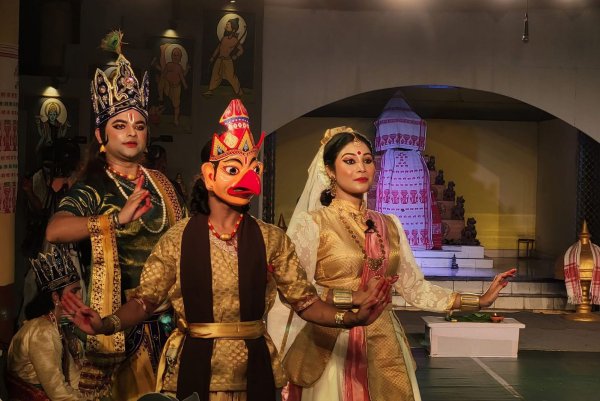 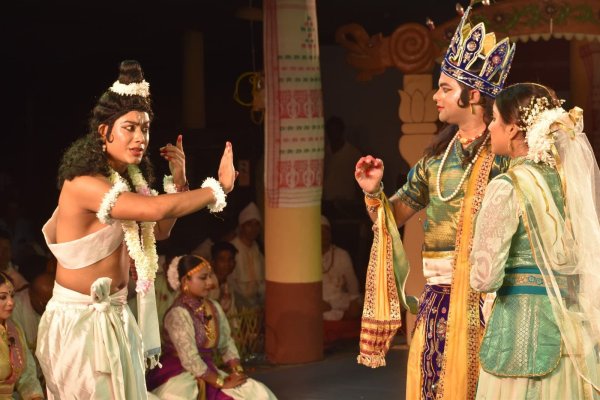 Atul Bhuyan, Arunabh Jyoti Malakar, Pradip Kalita, Jyotirgamay Bhuyan, Biswajit Bordoloi, Kangkan Jyoti Saikia, Jishnu Goswami and Bhargav Jyoti Saikia enhanced the beauty of the drama with their excellent Gayan Bayan playing. Hriday Parash Kalita was the Sutradhar, while Boris Dutta was the protagonist Krishna and Jyotishman Moran was Narada. Jatindra Kakoti was Indra, Namrata Kashyap was Rukmini, and Sonica Hazarika played Satyabhama. Karabi Pathak was in the role of Sachi. The Dwar Rakshaks were Gyanen Kashyap and Tirtha Kumar Nath. Manash Pratim Borah was Devata, and Madhumakshika Choudhury, Deiji Gogoi, Dhritismita Borah and Twinkle Rajbongshi were the Apsara Sakhis. Samikhya Rani Borah was Basumati, Rajdeep Lahon was Bhagadutta, and Suman Sarma was Garura. Nibir Borah was Narakasur. Musical accompanists were Arunabh Jyoti Malakar and Atul Bhuyan in Khol badan. Krishna Goswami, Gautam Bayan, Rupanjali Mahanta and Nandita Das were the vocalists. Ratan Hazarika recited the slokas, and Paban Rabha was the flautist. Ripunjeet Borah was the violinist. Kangkan Jyoti Saikia, Biswajit Bordoloi, and Sunmoni Das were the rhythm keepers. Mintu Shaan was in charge of the masks. Tapan Baruah took care of the lights. Dulal Roy was the choreographer and director. He was assisted by Boris Dutta. It was a Sattriya Kendra, SNA production.  Tapati Chowdhurie trained under Guru Gopinath in Madras and was briefly with International Centre for Kathakali in New Delhi. Presently, she is a freelance writer on the performing arts. She is the author of 'Guru Gopinath: The Making of a Legend.' |
