
|     |
|
| |

 Rhythmic journeys: Dance showcases at the Bangalore International Centre- Satish Surie-mail: satishism@yahoo.co.in Photos: Prof K.S.Krishnamurthy August 14, 2025 AUM: THE JOURNEY WITHIN A collaborative performance by Dr. Sahana Selvaganesh (Bharatanatyam, disciple of Guru Roja Kannan) and Pooja Kale (Odissi, disciple of Guru Rasika Gumaste) unfolded as a profound spiritual odyssey titled 'Aum: The Journey Within', on the 15th of July. Rooted in India's sacred geography and the symbolism of the five elemental Shiva Kshetras, the evening was an invitation to inward reflection, where devotion and dance converged in meditative synergy. 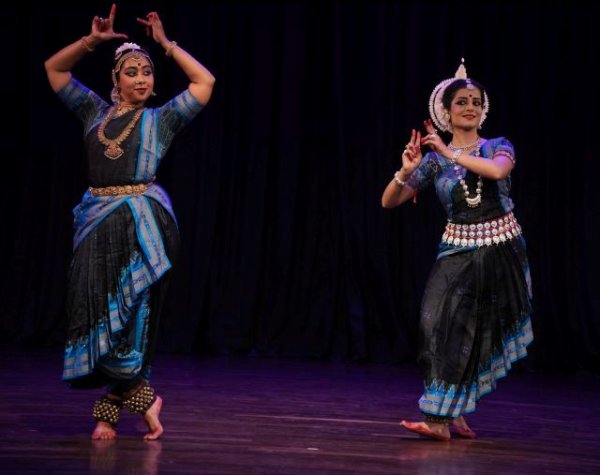 Dr. Sahana Selvaganesh & Pooja Kale The performance opened with the resonant intonation of "Trayambakam Yajamahe," invoking Lord Shiva and setting a contemplative tone. The melodic strains of Patadeep Pallavi followed, establishing a striking interweaving of Bharatanatyam's angular precision with the lyrical curves of Odissi, creating an immersive tapestry of rhythm and grace. Sahana Selvaganesh embodied the anguish of the Pandavas, her grounded abhinaya portraying the weight of fraternal bloodshed at Kurukshetra. In contrast, Pooja Kale's supple tribhangi conveyed a seeker's yearning for redemption at the icy altars of Kedarnath. Their movements, at once penitent and celebratory, dissolved into the chant of "Chidananda Roopa Shivoham Shivoham", transforming the stage into a sanctum of inner awakening. Descending into the wind-swept sanctity of Kalahasti - kshetra of Vayu - Selvaganesh offered a poignant rendition of Papanasam Sivan's "Swami naan unthan adimai" in Nattaikurunji. The piece evoked the tale of Kannappa, the tribal devotee who plucked out his eyes in fervent bhakti, only to be blessed with restored vision by Shiva. The undying temple lamp, flickering in celebration of Vayu, became a metaphor for the resilience of faith. At Tiruvannamalai, seat of the Agni Lingam, the performers explored dual narratives: the cosmic contest between Vishnu and Brahma, and the lesser-known tale of Thumbai, whose pure-hearted wish led the Thumba flower to adorn Shiva's matted locks. Dikshitar's "Arunachala natham smarami" underscored the fiery majesty of the site, its spiritual luminosity rendered through striking visuals and expressive depth. Kanchipuram's Ekambareswarar Temple, representing the Prithvi Lingam, was portrayed with delicate nuance. The story of Parvati shaping a sand lingam beneath a mango tree and protecting it from the deluge through unwavering devotion resonated with the verse "Devanaam devaha poojathe Uma." The performers evoked this myth through meditative choreography, aligning Parvati's penance with the seeker's spiritual resolve. The sacred mango tree - with branches symbolising the four Vedas - stood as a living testament to divine union and grace. The Jambukeswarar Temple at Tiruvanaikaval, representing the element of Jala (water), inspired a poignant enactment of the tale of the spider and the elephant. Through eloquent abhinaya and dynamic movement, the performers portrayed the quiet tension between the spider's protective web and the elephant's ritual ablution - two contrasting yet equally sincere expressions of devotion. The narrative unfolded as a metaphor for the transcendence of ego, culminating in the liberation of both beings through Shiva's compassionate grace. The anecdote of King Kochengat Chola - believed to be the spider reborn - offered a resonant echo of the karmic cycle of service, devotion, and divine recognition. The musical composition "Jambupathe Mampahi" provided a fittingly evocative backbone for this exposition, enhancing the storytelling with lyrical depth and melodic sensitivity. The journey culminated at Chidambaram, the kshetra of Akasha (ether), where Shiva is venerated not merely as a lingam, but as Nataraja - the cosmic dancer. The temple's symbolic alignment with the human body - the Chit Sabha representing the head, the Kanaka Sabha as heart, and the gopurams as limbs - was explored with choreographic ingenuity. The spiritual ascent through the chakras found expression in Dikshitar's "Ananda natana prakasam", with Shiva's Ananda Tandava embodying the eternal rhythm of creation and dissolution. Parvati's awe and eventual participation in the cosmic dance reflected the dynamic interplay of Shiva and Shakti, Purusha and Prakriti. The performance concluded with Moksha, the dancers softly intoning "Soham Soham", dissolving the self into the universal. The final verse - "Sambasadashiva bhajate damaru" - reverberated through the space, echoing the cosmic beat of Shiva's damaru and the primal vibration of Aum. With compelling artistry and spiritual gravitas, Dr. Sahana Selvaganesh and Pooja Kale transcended stylistic boundaries, offering a moving exploration of devotion, transformation, and the eternal sound that dwells within. CHANDALIKA: A STIRRING KUCHIPUDI ADAPTATION OF TAGORE'S TIMELESS DANCE DRAMA Chinmayi Nrithyalaya's (from New Jersey) staging of Chandalika at the Bangalore International Centre on the 16th July 2025, under the artistic direction of Guru Sridevi Chalagalla Mungara, offered a poignant Kuchipudi interpretation of Rabindranath Tagore's classic dance drama. With its core themes of caste, identity, and spiritual awakening, the production resonated powerfully with contemporary sensibilities, while staying rooted in tradition. Anchored in the stylistic lineage of Kuchipudi legends Vempati Chinna Satyam and Sobha Naidu, the choreography deftly blended vigorous nritta with expressive abhinaya. The narrative follows Prakriti, an "untouchable" woman whose life transforms after a chance encounter with Ananda, a Buddhist monk who treats her with dignity and compassion. The opening sequence featured an ode to Rabindranath Tagore, followed by a marketplace sequence that was notable for its evocative group choreography. Flower sellers, bangle vendors, and milkmaids dramatically refused to engage with Prakriti, isolating her with forceful gestures and synchronised spatial arrangements. The visual impact of these movements heightened the emotional tone, amplifying Prakriti's sense of rejection and shame. 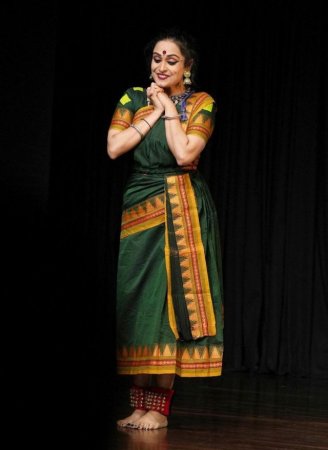 Chinmayi Mungara As Prakriti, Chinmayi Mungara's performance captured the character's arc from innocence and humiliation to self-realisation and liberation. Her abhinaya in "Enduku naki shapamaya" was particularly moving - each glance, gesture, and body contour reflecting a maelstrom of despair and longing. Her transformation was rendered with sensitivity, never lapsing into melodrama. The character of Ananda served as the spiritual and moral axis of the piece. His calm demeanour and restrained movement vocabulary created a striking contrast to the emotional turbulence of Prakriti. His few but potent gestures, offering water, speaking of equality, were imbued with gravitas and lent the production its philosophical undercurrent. Maya, Prakriti's mother, was portrayed by Sridevi Mungara as both protective and powerful. Her use of witchcraft to summon Ananda back marked the production's dramatic high point. The ensemble rendered this sequence with energy and conviction, supported by rhythmic percussion. The sight of Ananda returning in chains, subdued by Maya's sorcery, was disturbing yet dramatically effective. Prakriti, on seeing Ananda in this condition, repents; finally, she takes to Buddhism, becomes Ananda's disciple and follows him. 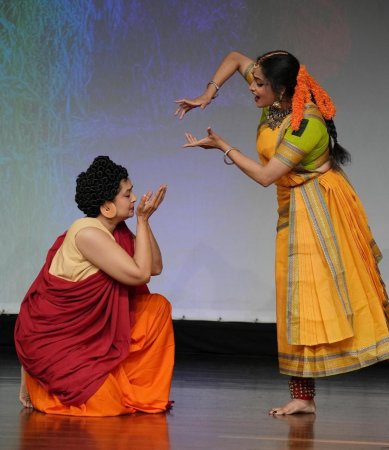 Chandalika The recorded Carnatic score, enhanced by mridangam, veena, and flute, provided a rich soundscape, maintaining both narrative momentum and emotional nuance. The minimalist set design - highlighted by the dancers' costumes - accentuated the drama without overpowering it. These visual choices drew attention to the characters' emotional journeys while evoking a sense of timelessness. The supporting cast - Jahnavi Yalavarthi, Harini Panchagnula, Charvi Reddy Kamjula, Neelima Kalidindi, Mahankali Sreshta, and Abhinaya Maganti - performed with synchrony and conviction, adding texture to the production's larger group scenes. Their cohesion as a troupe contributed significantly to the visual fluidity of the narrative. Ultimately, 'Chandalika' reaffirmed the enduring relevance of Tagore's vision. Through Kuchipudi's eloquent vocabulary, Chinmayi Nrithyalaya not only retold a story of social injustice and spiritual emancipation but also reminded us of dance's power to provoke thought and inspire change. It was a compelling evening - deeply moving, aesthetically refined, and socially conscious. DVAITA | DUALITY TWO TRADITIONS, ONE SOUL: A KUCHIPUDI BALINESE DUET On the evening of July 24, 2025, the Bangalore International Centre hosted a performance that transcended boundaries of culture, form, and philosophy - Dvaita | Duality, conceptualised and directed by Gomathi Boorada, Artistic Director of the Shivamanohari School of Performing Arts, Edmonton. In collaboration with the renowned Balinese dancer-choreographer Putu Widiantini, a graduate of the Indonesian Institute of the Arts, Bali, and her ensemble of dancers, the production became a remarkable confluence of classical Indian and Balinese traditions. Thematically anchored in the iconography of Ardhanareeswara - the composite form of Shiva and Shakti - the performance explored opposites not as contradictions, but as complementary facets of a unified whole. Rather than fusing forms into a singular idiom, the choreography preserved the distinctiveness of both Kuchipudi and Balinese dance, allowing each to resonate with its integrity while engaging in a shared metaphysical dialogue. 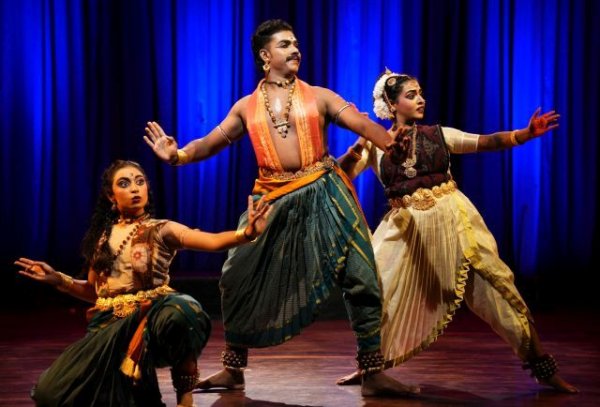 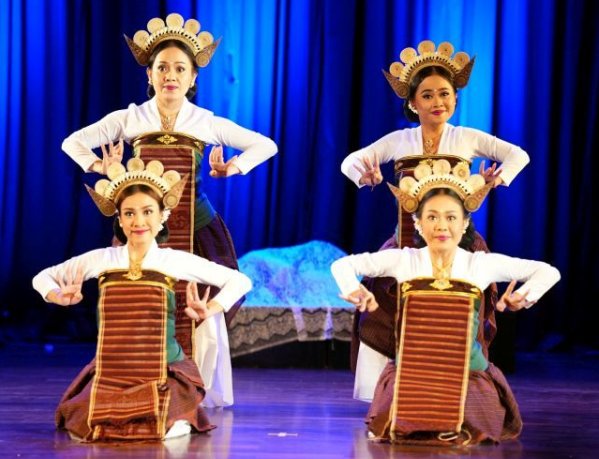 The production opened on a meditative note. A lone Balinese dancer emerged, veiled in a translucent shroud gently weighted at the corners. As the fabric moved like a breathing lung, the dancer's initial ripple - subtle and spiral - evoked the genesis of being, an emergence before naming or division. It suggested a state of consciousness before identity, where the body itself asked: what remains when all labels fall away? Gomathi Boorada's choreographic intent was evident in her careful structuring. Tandava and Lasya - masculine and feminine energies - appeared not as opposing forces but as parallel truths. To the chant of "Aum" and the existential question "Who am I?", the dancers embodied a philosophical inquiry. Identity, the work seemed to suggest, need not be confined to the binaries of male and female but could flow between them, gathering meaning through movement rather than classification. A particularly poignant section unfolded through the Kuchipudi ensemble's portrayal of Kamakshi of Kanchipuram. Performed by Gomathi Boorada, Jesitta Jilju, Neharika Renjith Nair, Hemali Subramanyam Boorada, Alphonsa Ashwajit Kamble, Sneha Chandrababu, and Goutham Maheswaran, this piece traced the nine divine manifestations of the Goddess. The dancers moved with sculptural clarity and rhythmic force, their gestures painting vivid imagery in the air. The choreography transitioned seamlessly from lyrical grace to fierce dynamism, reflecting the Goddess's paradoxical nature as both nurturer and destroyer. As the sequence built toward the Ardhanareeswara Stotram, Adi Shankaracharya's verses were brought to life with symbolic depth. The duality of Shiva and Shakti became palpable - Shiva's matted locks, serpents, and ashes set against Shakti's cascading hair, floral ornaments, and sensuous adornment. The contrast extended beyond costume into movement, where austerity and abundance, stillness and fluidity, were rendered in a tightly knit visual counterpoint. 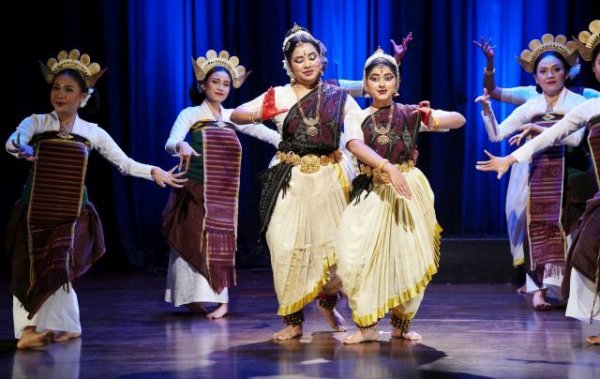 The cohesion of the ensemble was one of the evening's strongest aspects. The Kuchipudi dancers responded with expressive abhinaya and rhythmic precision, while the Balinese dancers - Putu Widiantini, Ni Wayan Pia Wahyuni, Ni Komang Erna Sriwahyuni, and Ni Kadek Santi Wiadnyani - brought with them a commanding presence, executing exacting movements with ceremonial poise. Together, they created a visual conversation in which contrasting vocabularies echoed, refracted, and amplified each other. Metrical jatis established Shiva's presence with angular force, answered by the fluid, lilting patterns that announced Shakti's emergence. The choreography sustained its aesthetic clarity, culminating in a seamless merging - yet never a loss - of identities. The music by D.S.V. Sastry and I Wayan Sudirana added a deep aural texture. The blending of Carnatic and Balinese musical structures created a dynamic soundscape that underlined the philosophical tensions and resolutions of the choreography. Rather than dominate, the score supported the dancers with sensitivity, moving from meditative calm to rhythmic complexity with grace. Every gesture, every transition, seemed to meditate on the principle of duality - its necessity, its challenge, and its beauty. The production moved with the gravity of ritual, yet remained accessible in its emotive language. Dvaita | Duality offered the audience more than aesthetic pleasure. It stood as a rare example of cultural collaboration grounded in mutual respect and deep inquiry, and a testament to the power of classical forms to engage timeless questions. AMUKTAMALYADA: ANDAL'S SACRED JOURNEY UNFOLDS THROUGH KRISHNADEVARAYA'S VERSES Dr. Janaki Rangarajan's solo presentation at the Bangalore International Centre on July 27 offered a luminous reimagining of Krishnadevaraya's 16th century Telugu epic 'Amuktamalyada'. In her hands, the classical Bharatanatyam repertoire became a resonant canvas for Andal's incandescent longing - lyrical, unflinching, and deeply human. Folding the king-poet's ornate verses into a seamless narrative arc, Janaki moved with unbroken focus and interpretive finesse, evoking an experience that was at once classical and utterly contemporary. The performance began in Srivilliputhur, where a young Goda Devi gathers flowers for her father's garland. A glint of gold - a metaphor drawn from Krishnadevaraya's poetry - skims across the jasmine: "the golden bee who sips at the hearts of lovers." The Alarippu unfolded with disarming intimacy: each flick of the wrist released an invisible petal, while the arch of an eyebrow extended the child's innocent curiosity. As the bee lingered, its presence transformed from fascination to possession. The dancer subtly charted the shift - innocence dissolving into the first ache of longing. The Jatiswaram that followed was technically pristine with precise araimandis and crisp teermanams. Beneath the orthodox surface, Janaki infused subversion. The arms that once gathered blossoms now warded off an invisible presence; every rhythmic sollukattu landed like an accusation. The emotional terrain had shifted: Andal was "no longer interested in gardens." A restless undercurrent ran through the music, mirroring her disoriented psyche. From this internal churn emerged a fiery protest in the Ninda Stuti. Janaki shed the child's persona to inhabit Andal the poet, addressing unseen sakhis with a conspiratorial tilt of the head. Through rapid-fire sancharis, she dissected Vishnu's ten avatars - Matsya, Kurma, Varaha - not with devotion, but with irony. Each avatar was summoned like a courtroom witness, accused of betrayal. The dancer's mudras - a bow-wielding gesture for Rama, a flute-playing pose for Krishna - tied Andal's devotion to Vishnu's cosmic presence, adding a layer of universality. The mridangam mocked her with playful korvais, yet her gaze remained dry and blazing - sarcasm wielded as a shield against heartbreak. 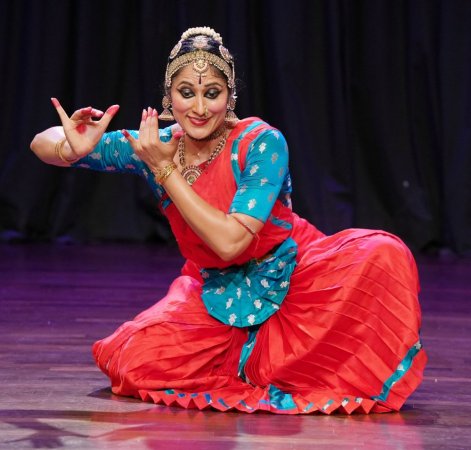 Janaki Rangarajan In a striking transformation, Janaki became Periyalvar, Andal's anguished father. With no costume change, only a deeper bend of the knees and a tremor in the palms, she shifted roles. His plea to Lord Ranganatha - "How dare you steal my daughter?" - was voiced through a single slow arc of the arm, once protective, now trembling with despair. The moment was hushed, a single violin note sliding downward like a prayer that had lost its way. Despair gave way to fevered delirium. In the Viraha sequence, Andal - unable to eat or sleep - was a figure undone. Her hands fluttered like moths, her feet dragged through the same half-circle, making the stage itself seem to reel. Then, without overt transition, Janaki became Surpanakha - wounded, not grotesque. A subtle collapse of the ribcage, a clawing of the fingers, and the stage was split: Andal stood upright, demanding justice; Surpanakha hunched, begging for mercy. Both spoke the same language of desire - one divine, one defiled. What held the entire performance together was not just choreographic sophistication but the musical score - crafted with sensitivity and brilliance by Nandini Anand and Rohit Bhat. Their compositions captured the poem's emotional and rhythmic nuances, alternating between stillness and storm, devotion and defiance. The recorded orchestra - featuring mridangam, violin, and flute - wove a rich sonic tapestry, supporting Janaki's every impulse without overpowering her. The vocalist, M.K. Sangeeth, brought clarity and emotional weight, rendering the verses - both translated and in Telugu - with impeccable articulation. Lighting subtly sculpted the space, cuing shifts in mood and persona with grace. The dancer's vibrant costume echoed Andal's divine beauty, but it was Janaki's abhinaya that truly brought Krishnadevaraya's poetic empathy for feminine audacity to the fore. The performance culminated in a radiant Thillana, where Andal's celestial wedding to Lord Ranganatha unfolded. Garlands framed the stage; soft light conjured the sanctity of Srirangam. Delicate mudras portrayed Andal shielding her grace, and the interplay of nritta and nritya became a visual hymn to human-divine union. The final tableau - Andal poised in surrender and fulfilment - offered a moment of transcendence. With rigorous technique, the delicate integration of karanas into her movement vocabulary, and a depth of emotional intelligence, she brought Andal to life - not as a distant saint enshrined in myth, but as a woman ablaze with longing, whose desire still pulses through every heart that dares to love the divine.  Bangalore based Satish Suri is an avid dance rasika besides being a life member of the Music and Arts Society. |
