Dancing through time:
The record-breaking Bharatanatyam that spoke to the world
- Anurag Chauhan
e-mail: anuragchauhanoffice@gmail.com
Photo credit: Apulalva photography
August 9, 2025
In an era where attention spans have dwindled and instant gratification
often overshadows depth, a young artiste's extraordinary feat of
performing Bharatanatyam continuously for 170 hours has emerged not
merely as a headline but as a profound cultural statement. It is a
testament not only to her endurance and devotion but also to the
resilience of an ancient tradition that continues to breathe through the
discipline and passion of its practitioners.
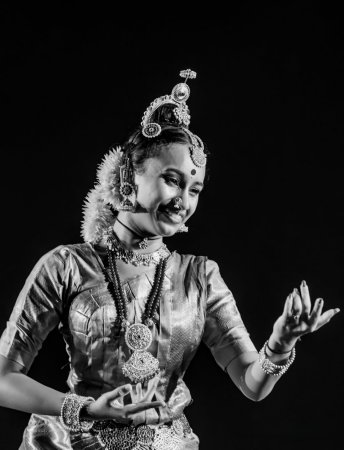
Remona Evette Pereira
At just 20 years old, Remona Evette Pereira, a final-year BA student at
St. Aloysius (Deemed to Be) University in Mangaluru, etched her name in
history by setting a world record recognized by the Golden Book of World
Records, surpassing the previous 127-hour record by an astonishing 43
hours. Her marathon, held at the Robert Sequeira Hall of her college,
began on July 21, 2025, and concluded on July 28, spanning seven
relentless days of rhythmic devotion. With only brief fifteen-minute
breaks every three hours, she danced through fatigue and pain, beginning
with an invocation to Lord Ganesha and ending with a piece dedicated to
Goddess Durga.
Bharatanatyam is not merely a dance form. It is a centuries-old
spiritual practice, believed to have originated in Tamil Nadu as a
devotional offering within South Indian temples. Rooted in the Natya
Shastra, an ancient Sanskrit text on performance arts, it fuses rhythm,
storytelling, and symbolism, transforming the dancer into both narrator
and deity. Its intricate footwork, sculptural poses, and expressive
gestures known as mudras, retell epics like the Ramayana and
Mahabharata, blurring the line between ritual and performance. Over
time, this sacred tradition migrated from temple floors to global
stages, yet its essence remained unchanged: a dialogue between the
mortal and the divine. When someone like Remona dedicates herself to
such an art, she does more than perform. She becomes part of an unbroken
lineage, carrying forward a legacy that stretches back centuries.
Her journey began at the age of three under the guidance of her guru
Shrividya Muralidhar and culminated in her rangapravesha, or formal
debut, in 2019. Her dedication was recognized nationally when she was
awarded the Pradhan Mantri Rashtriya Bal Puraskar in 2022 for excellence
in art and culture. Preparing for this record demanded months of
discipline—five to six hours of daily practice, physical conditioning,
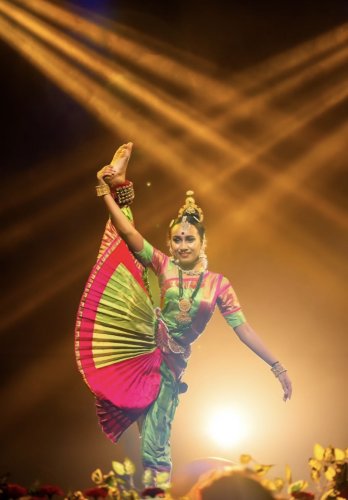
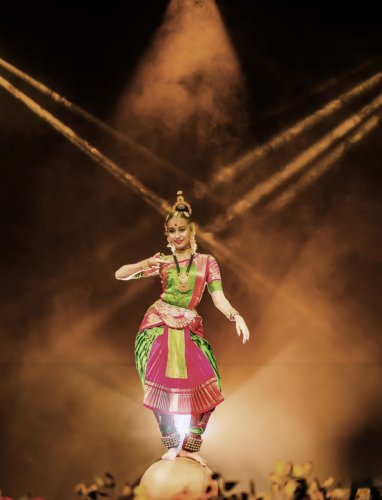
and an unwavering mental focus. Beyond Bharatanatyam, her repertoire
spans semi-classical, folk, and Western forms, along with daring feats
like dancing atop broken glass and balancing fire pots, blending
innovation with deep respect for tradition.
Remona Evette Pereira
When videos of her marathon performance began circulating online, they
drew reactions of awe from across the globe. Viewers marvelled not just
at her physical endurance but at the sheer spiritual and cultural depth
on display. In a world of fleeting attention, her dance became a
meditation on continuity, a reminder that classical arts survive not in
archives but in living bodies and breathing devotion.
India's artistic wealth has always been its truest inheritance.
Classical forms like Bharatanatyam are not relics of a bygone era but
vibrant expressions of a shared past, carrying within them history,
philosophy, and identity. To keep them alive demands conscious effort:
robust arts education, mentorship for young aspirants, and platforms
that make these traditions accessible without diluting their rigor.
Remona's vision extends beyond personal achievement; she hopes to pursue
a PhD in Bharatanatyam and use dance as a tool for empowerment,
teaching orphans, persons with disabilities, and transgender
communities. Her story is a reminder that art is not only preservation,
it is renewal and transformation.
Her feat resonates beyond India. In an increasingly homogenized world,
preserving classical arts is not merely a regional responsibility but a
global one. Just as flamenco belongs not only to Spain or ballet to
Russia, Bharatanatyam belongs to the world as part of the shared human
story. When a young woman in Mangaluru can ignite conversations across
continents, it proves that art is our most enduring language.
By dancing for 170 hours, Remona Evette Pereira did more than etch her
name in a record book. She reminded us that heritage is not inherited
passively - it is practiced, embodied, and passed on. Her performance
was both a celebration of India's cultural wealth and an invitation to
the world to witness the timelessness of classical art. In her movement,
we see not just a dancer, but the living rhythm of history itself.
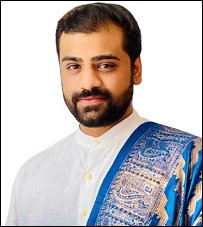
Anurag Chauhan, an award-winning social worker and arts impresario,
combines literature and philanthropy to inspire positive change. His
impactful storytelling and cultural events enrich lives and communities.
|