
|     |
|
| |

 In and about Damaru- Chitra Maheshe-mail: chithoo@gmail.com Photos: Rishi Raj August 7, 2025 From the great void, came sound or the word and then on everything emerged. Common to many philosophies, the idea of Nothingness to Everything, is filled with tremendous potential in interpretation and its creative depiction when it comes to any form of art. It also becomes a special thing in the month of Sawan especially in North India, where Shiva and his Damaru are extolled, worshipped, meditated upon with austerity, fire and devotion. The Damaru is about the duality - Existence / Creation and Destruction, Male and Female. It also reflects the interconnectedness of all things. And then there is the Jiva caught in the play of Shiva and moves according to his will and force. He is considered the Father of all sounds, languages, music and vibrations and the Damaru symbolizes his connection with it all. 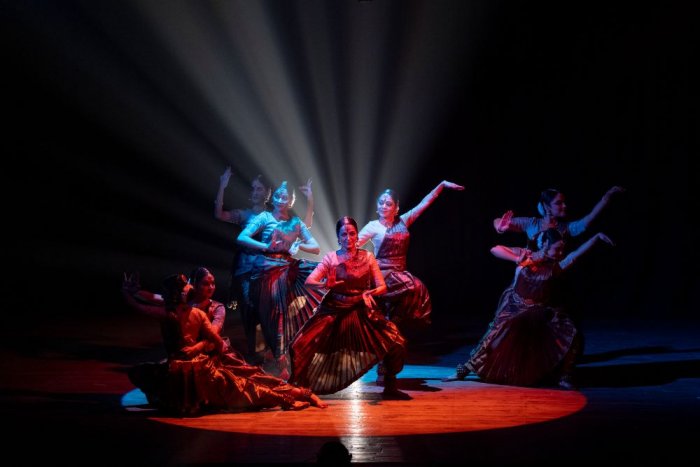 So, it is understandable when a production like Damaru emerges to face all kinds of expectations (specially mine, which is why I went for the show); about how it would be dealt with, and that too by a very seasoned, excellent artiste such as Vidhya Subramanian. But allow me to set the preamble - this is not meant to be a review. It is a collection of thoughts that determined the evening for me. Any work of art is subjective and I would not wish to slot into some category that need not make sense to anyone else. That said, Vidhya and Sparsha Dance Ensemble brought together very competent dancers to show how the Damaru is literally the driving force behind the production. The artiste explores the nuances of this magnificent instrument of Shiva with these ideas and thoughts! "The Damaru manifests the flow of energy between Purusha and Prakriti. In the Damaru is contained the origin of sound; sound that is the genesis of creation, of movement. This work explores the tug between dichotomies in the limitless quest for balance", the concept being developed by Vidhya, also the choreographer. 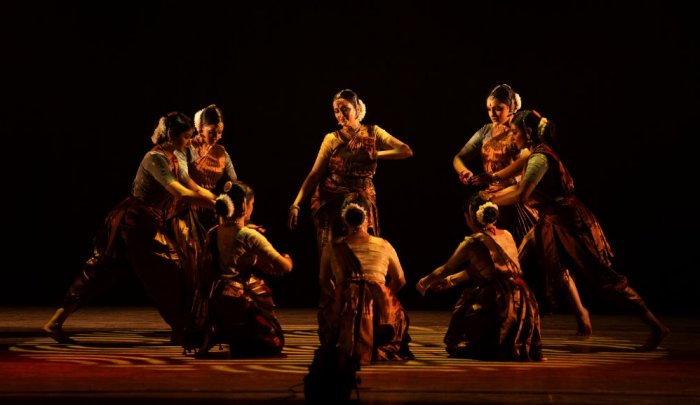 How do you actually describe the process of Silence to Sound, from Rhythm to Chaos and then back to the Silence? How do you actually do this using the body, movements, music and the formations? This is an endless search. Just as I imagined Damaru to be something with fire and brimstone and all things extra vibrant and primeval, the artiste came up with a vision incorporating excellent choreography married to a great soundscape quite within the traditional Bharatanatyam idiom mostly. Within the very tasteful formations for each aspect, the choreography stood out in its endeavour to depict the simplicity yet complex elements of male and female procreativity, creation of the world, its destruction and also the fusion in the concept of Ardhanari - a stage where both energies blend. The piece was set to a dhrupad - Damaru har kar baaje - along with the Ardhanari Stotram of Adi Shankara tuned by Vijay Kumar. 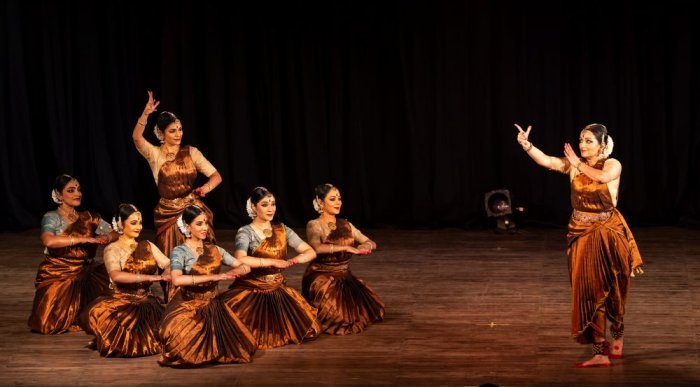 As Vidhya explored and brought in aspects of the elemental sound of the Damaru, my thoughts raced towards the work of Shamans (incidentally Shiva is the original Shaman), the shattering sounds rising fervour, the fierceness of it all. All pieces were well done - absolutely no doubt on that. Costumes were gorgeous, the lighting impeccable and dancers put themselves out there bringing to life the choreographer's vision. Viraha was about opposites - Earth and Sky, Union and Separation and this was infused with the desire for union, dualities inherent in the weather and beautiful beings joining and separating. Yes, this was also about the Nayika "desiring to be in Sambhoga with the Nayaka. Stillness is a yearning through all the upheavals and conflicting emotions." Music for this piece was by Dhandayudapani Pillai. 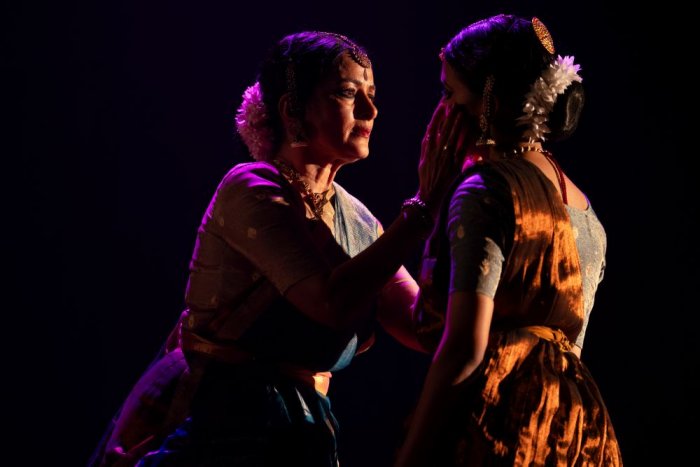 Antaranga set to a Thumri, Saanwari Salaoni, explored the veil - to put it simply. What hides the Truth and the Self through the age and timelines. Can we break out of the illusions? "To understand reality, I split it into two. There is you and there is me. I try to see myself in the mirror. But there is nothing there, except the memories of a lifetime etched upon the lines on my skin. If I break through this overpowering illusion, perhaps I can see the one reality by tearing the veil. Kabir says: 'Ghoonghat ke pat kohl, Tohe piya milenge.' Lift up the veil and you will see the beloved." Prakriti showed how one divine feminine aspect expands into the 64 yoginis. Music by Praveen Sparsh was particularly aligned to the melancholy of the female energies, even when strong and powerful.  Chitra Mahesh is a senior journalist based in Chennai. |
