
|     |
|
| |

 Deepa Raghavan's expressive debut in Mumbai- Chandra Anande-mail: chandra6267@yahoo.co.in Photos: Avinash Pasricha August 4, 2025 The Fine Arts Society, Chembur, presented Bharatanatyam by Deepa Raghavan on 13th June 2025, at the FAS, RCF Academy Hall, Chembur, Mumbai. Deepa commenced her presentation with a bhajan "Gale Bhujang" (Kamalsri, Misrachapu), describing Lord Shiva's various attributes. It was not a very great start to the program for she did not get the attention of the audience to focus on her. Perhaps a rhythmic start would have aided her to get into form and captivate the audience. 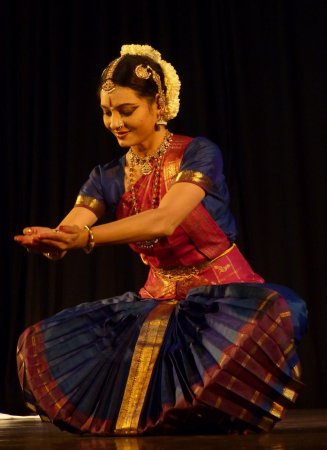 Varnam "Innum en manam" (Charukesi, adi tala) was a composition of the violin maestro Lalgudi G. Jayaraman, where the nayika enquires with Krishna, if it was fair to act as if he did not know her feelings for him and show indifference to her, when she saw him reciprocate to other devotees or gopis. It was performed with aplomb depicting his pranks and graces as sancharis in appropriate lyrical lines. Ramayana Laali (Misra Maru Behag, Misrachapu) composed by Karthik Hebbar, portrays a mother, who narrates the story of Ramayana to calm her little restless son by telling that Rama is nobody else but he, who is her son. A few episodes of Ramayana were enacted briefly to show graces of Rama and reminded all of the old item, "En palli kondirayya." As the vatsalya bhava came through, an astute view into mothers who tease and test their son's love towards them by saying that when sons get married, they forget their mother's love was delineated. Navarasa Shoorpanakha Gadya (Ragamalika), another composition by Karthik Hebbar, was where navarasas were portrayed through the character of Shoorpanaka. It was a creative exploration of the emotions experienced by the Rakshasa princess from when she first came across Rama and Lakshmana in the forest, and events that followed. Through this item, a bout of empathy was created for Shoorpanaka as she traversed through a gamut of emotions in the short but important cameo she plays in the epical story of Rama. In "Yahi Madhava" (Sindubhairavi, adi), Jayadeva's ashtapadi, Krishna comes back after yet another night of dalliance with other gopis. Fed up with his unfaithfulness, Radha says, "Go away, Krishna! Go away, O Keshava! I can't take any more of your lies and deceit." With subtle abhinaya, Deepa emoted the khandita nayika which is the persona of Radha in this ashtapadi. Deepa's presentation stood out for its simple brief and crisp style of dancing. Her expressions came through easily and effectively. It was her debut performance in Mumbai which led the small audience attending that day, to know more about her, as a senior artiste, teacher and choreographer. This writer ventured to take an interview to get to know more about her persona and experiences in her art form. Tell us how your interest developed for Bharatanatyam and enlighten us with some snippets from your early training. My initial exposure to dance was Kathak in junior school in Ghaziabad. We moved to Delhi when I was around 13 years old, where I learnt Mohiniattam from Guru Bharati Shivaji and her daughter Vijayalakshmi for about a year before switching to Bharatanatyam under the tutelage of Guru Nagarajan. After my arangetram, I joined Guru Kanaka Srinivasan. Kanaka Aunty was my inspiration, for under her, I learnt to really appreciate the beauty and grace of the dance form, and my interest blossomed into passion. I think the switch from interest to passion, truly happened, after my performance in Dehradun in 1996. On the morning of the performance, as we were on our way to Dehradun from Delhi, we realised that it was Rama Navami and Kanaka Aunty decided to add a Rama Bhajan "Lokopakaara Kaarana Avatara Raghava" to the performance repertoire. The musicians reached there around lunch time, and she requested O.S. Sridhar, the vocalist to sing the bhajan, choreographed it, explained and taught it to me in the next 30 minutes, and that piece was the highlight of the performance according to Subbudu mama who was present for the performance. That whole experience was so memorable and kindled my passion for the art form. I started learning from Bragha Bessel around 2011. It was beautiful just watching her set the abhinaya to the songs she taught. That itself was a great learning experience. She emphasized the importance of sthayi and holding it through sancharis. I used to associate abhinaya mainly with mukhabhinaya (facial expressions) but from her I learnt the importance of the complete body language, the stance, the nadai (walk) - how they all have an impact. And of course, her nature and humility and affection - something that I cherish and hope to emulate. 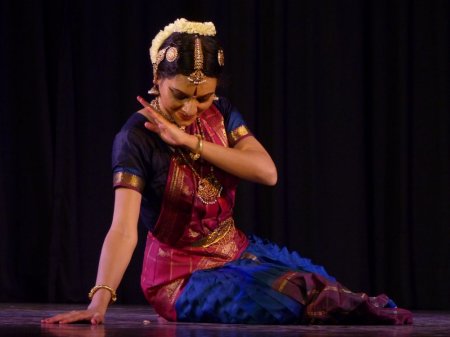 What do you think of the Margam format presentation of Bharatanatyam? Please express your views on it with the present day trends like thematic presentation in the idiom, its fusion with Bharata Nrityam and jugalbandi shows and neo Bharatanatyam. The margam is timeless, isn't it? The structure of the margam allows the artiste to progress systematically through the pieces, portraying all the aspects of the dance form. Fusion with other forms is a matter of personal choice, and for me, the Bharatanatyam format and repertoire is expansive enough to visualise what I want to present. It's a good happening now that artistes use songs from contemporary composers for abhinaya section. The 'Ramayana Laali' you did resonated "En palli kondirayya" (Mohanam). What made you pick up this song? When I first heard this song by Karthik Hebbar, I almost immediately visualised 2 versions - one, an older Kausalya welcoming Rama when he comes back with Seeta and Lakshmana after his 14 year exile, and the other, as a mother trying to pacify her little child by telling him his favourite story (Ramayana) but visualising her son in the character of Rama. Both portray vatsalya, but very differently, and that's what appealed to me - a chance to set the song in two different ways. 'Navarasa Shoorpanaka Gadya' was good. A new angle to character of Ramayana? Why did you think that the character of Shoorpanaka also needs to be verified with navarasas? This is yet another composition of Karthik Hebbar's, which one of my students wanted to learn for her arangetram. That's how I started working on it initially. Being a creative exploration of Shoorpanaka's thoughts and emotions when she sees Rama and Lakshmana, the complete freedom in visualising the piece was very fulfilling. The composition fits in the navarasas with the story beautifully. What is your idea of Mumbai cultural scene and how did you prepare for this show? Mumbai has a very active and thriving cultural scene and I had been looking forward to performing here for quite some time. I had sent my resume to The Fine Arts Society, Chembur, around 3 years ago, but at that time, they had a backlog owing to Covid. So, I finally got the opportunity to perform now. What is your training and experiences in music? I learnt Hindustani music very briefly and Carnatic music for several years. Thus, the Fine Arts Society, Chembur, Mumbai, showcased an artiste with well-defined knowledge of the art form of Bharatanatyam.  Chandra Anand is a Bharatanatyam artiste and teacher. She has an MA in Bharatanatyam from Tilak Maharashtra Vidyapeeth, and her series on 'Education in spiritual values through Bharatanatyam' is featured in narthaki.com. |
