|     |
|
| |

 Alok Murali Festival- Tapati Chowdhuriee-mail: tapatichow@yahoo.co.in Photos courtesy: Sriparna Bose July 30, 2025 Odissi performer Sriparna Bose celebrated Alok Murali Festival 2025 in honour of her mentors Guru Aloka Kanungo and Guru Muralidhar Majhi on 26th June at Rabindra Sadan, Kolkata. As a mark of respect to her gurus, she wanted to do something for generation next. This made her provide a platform to talented and young upcoming dancers. At a time when too many distractions have taken away the interest of the youth from the classical arts, it was heartening to watch young aspirants taking interest in the traditional dances of India. Meerashrita Das is a senior and passionate Odissi dancer who has trained at Jyoti Kala Mandir, Bhubaneswar, under the guidance of Guru Jyoti Rout. She started dancing at the age of four in Santiniketan with her first guru, Aloka Kanungo. Later, she trained under Guru Dillip Mahapatra of Odisha. A beautiful dancer, she gave the evening a fitting start with Sringar Pallavi in raag Bageshri and Ek Taal, choreographed and composed by Guru Jyoti Rout, supported by vocalist Guru Sarat Kumar Sahoo and mardala player Sachitananda Das. Then there was Debanjali Bandyopadhyaya training under Priyadarshini Ghosh and Mohana Iyer, a repertory member of Natyanova Art Centre, a company founded by the duo. She performed a Jatiswaram in Mohiniyattam style, thereby proving her mettle in the circular movements and adavus typical to the form. Lyrics, music and dance composition were by Guru Kala Vijayan; vocals and violin were by Anand Jayraman and nattuvangam by Mohana Iyer, edakka by Kalamandalam Gopakumar, mridangam by Shankar Narayanaswamy, while Sriram Mahadevan played the veena. 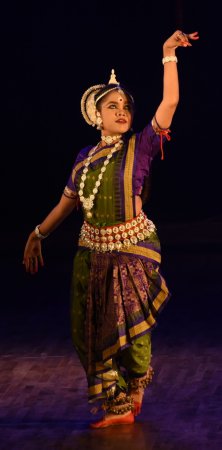 Meerashrita Das 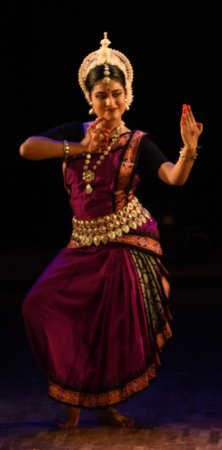 Roopsa Kahali Roopsa Kahali, a disciple of Dr. Jyotsna Rani Sahoo, is undergoing intense training in Odissi dance from Indira Kala Sangeet Biswa Vidyalaya in Chhattisgarh and pursuing her master's degree in dance (Odissi) from Rabindra Bharati University. She danced an abhinaya piece, "Leela nidhi hey" written by Kavi Surya Baladev Rath in taal Khemta and raag Desh. It was a composition of Guru Kelucharan Mohapatra and Pandit Bhubaneswar Mishra. 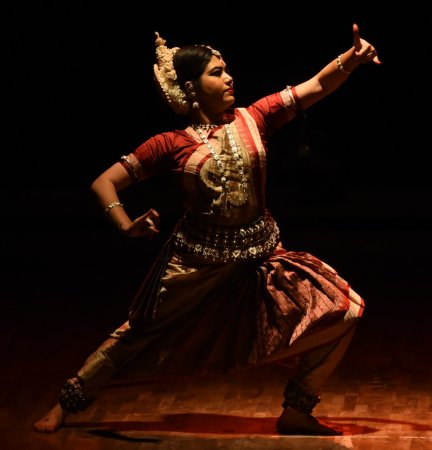 Swapna Dutta Senior disciple of Meera Das, Swapna Dutta began her journey in Odissi at a young age, dedicating herself to mastering the intricate nuances of this classical dance form. As a core repertory member of the Gunjan Dance Ensemble, she has performed extensively across India and internationally. She took up the challenging piece Shabari, a devotee of Sri Ram, and portrayed her story tellingly, to a composition of Srinibas Satpathy in ragamalika and talamalika. The rhythm composition was by Satchidananda Das. Bhumisuta Welfare Foundation of Performing Arts under the directorship of Dr Debasmita Biswas trained in Indian classical and creative dance forms as well as Rabindra Nritya from Prachin Kala Kendra and Shanti Bose and Sunanda Bose Amritavarshini, presented a thematic classical production. It was a group performance by Arunima Das, Indrani Pal, Lipika Sarkar, Moumita Gupta, Poulami Sarkar, Shreya Pramanick and Sraya Ghosh. 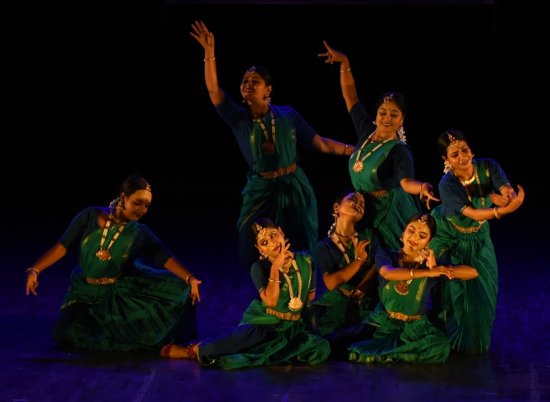 Bhumisuta Performing Arts group Rajveer Rana, a budding disciple of Guru Nandini Ghosal, embarked on a transformative journey into the realm of Odissi. Rajveer has pursued an MA in Dance from Rabindra Bharati University. "Mare bano dhara" is a beautiful composition celebrating the monsoon. The dance was composed by Guru Kelucharan Mohapatra, while its music was a composition of Prafulla Kar. Sandip Kundu, a Kuchipudi performer from Kolkata training under Biraj Roy, a scholarship holder from CCRT, Ministry of Culture, proved his excellence with Natesha Kauthuvam in praise of Lord Shiva, who is also worshipped as Nataraja, the god of dance. His crisp movements and graceful poses described the form and iconography of Lord Shiva as the one who is worshipped by sages and asuras, and who dances the tandava with bells on his feet, holding the damru in one hand, wears tiger skin, holds the trishula or trident, has Nandi the bull as his vahana, and has the sun and moon as his ornaments. The dancer performed both nritya and abhinaya with a fair degree of perfection. 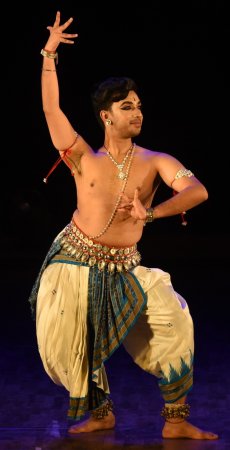 Rajveer Rana 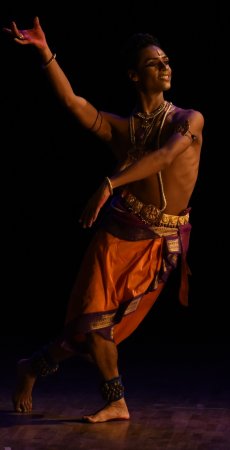 Sandip Kundu 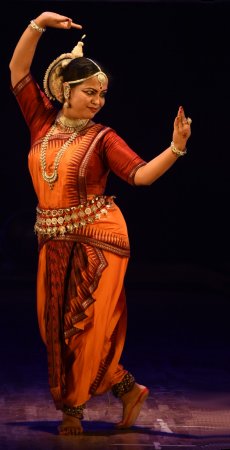 Paulomi Chakraborty Paulomi Chakraborty, disciple of Guru Aloka Kanungo and a recipient of the Junior Fellowship in the field of Odissi dance from the Ministry of Culture, performed Kamodi Pallavi, a composition of her guru Aloka Kanungo. She was not at her best. Sourav Samanta, disciple of Guru Sutapa Talukdar and Guru Jhelum Paranjape - a recipient of the Senior National Scholarship from the Ministry of Culture, Govt of India - performed "Mani bimane Gobinda", which was about the Chandan Yatra festival of Madanmohan, a piece written by Kavi Banamali Das. It was a group rendition by Sukarna Mazumder, Anwesha Das, Srijani Banerjee, Aishiki Ghosal and Sunandini Das. Dance choreography was by Sourav Samanta. It was a neat production. 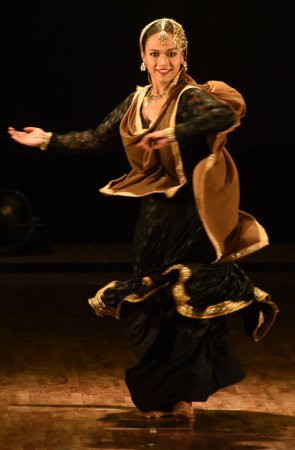 Sayani Mondal Kathak dancer Sayani Mondal from Bihar, a disciple of Guru Madhumita Roy, with a master's in Kathak dance from Rabindra Bharati University, Kolkata, and a CCRT scholarship holder to boot, is a fairly good performer. However, Sayoni used a music which she found on YouTube. The real beauty of Kathak dance blossoms with live music, the cost of which is not always affordable. The dancer could have performed on recorded music. 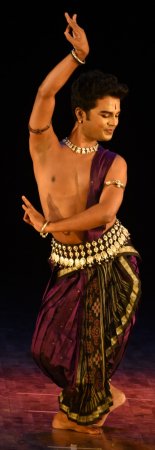 Tamal Das Tamal Das, a young, talented and dynamic Odissi dancer from Kolkata and a disciple of Ratikant Mohapatra, showcased his guru's style and vision. Technical perfection of Guru Kelucharan Mohapatra Gharana was visible in his dance. He has a Rabindranritya scholarship from RBU, Kolkata. He displayed his technical perfection in Kalyani Pallavi, choreographed and composed by Guru Kelucharan Mohapatra and Pandit Bhubaneswar Misra. Manipuri performer Debanjana Roy, a disciple of Poushali Chatterjee, was also trained under Darshana Jhaveri, among others. A CCRT scholarship holder, she chose to perform Krishna Kaali, which was about Radha's secret encounters with Krishna arousing the suspicions of her husband, Ayan. To shield Radha's honour and preserve their divine love, Krishna assumes the form of Kaali, Ayan's family deity. His flute transforms into the weapon Kali holds, and the flower garland turns into a skull garland; his turban turns into flowing, matted hair. In fact, Krishna becomes Kaali. When Ayan arrives, he finds Radha immersed in worshipping the goddess, unaware that the deity before him is actually Krishna in disguise. An interesting story of illusion revealing the inseparable unity of the masculine and feminine aspects of the divine. The theme chosen was choreographed by Debanjana Roy herself. Music was composed by Mitradheya. R.K. Upendra, Hanglen Indu Devi, and Sanglakpam Nandeswori Devi were the accompanying artistes. 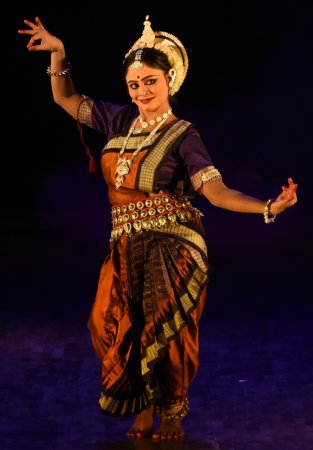 Paromita Banerjee Paromita Banerjee, disciple of Guru Rina Jana and Guru Lipsa Satapathy, performed Rageshree Pallavi, choreographed by Guru Gangadhar Pradhan. She has potential. 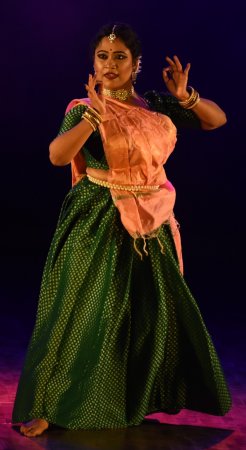 Shramana Chattopadhyay Shramana Chattopadhyay, disciple of Prof. Amita Dutt, is a CCRT Junior and National Scholarship holder under the Ministry of Culture, Government of India, and danced on the much-revered cosmic dancer Nataraja, who is known for his Tandava dance. It symbolised the cyclical nature of creation, preservation, and destruction of the universe. The dance embodied the fierce and energetic aspect of Shiva, with each movement and gesture carrying symbolic meaning. Choreographed by Guru Amita Dutt, the music was traditional sadra of the Patiala gharana. Odissi performer Atrayee Dutta trained under late Guru Muralidhar Majhi and late Guru Poushali Mukherjee. Currently she is honing her skills under Guru Suhag Nalini Das and Guru Sarat Das. Atrayee has received the Young Artist scholarship from the Ministry of Culture, Govt. of India. She presented the much-performed Naba Durga choreographed by Guru Pankaj Charan Das, which is deeply influenced by his Mahari style of Odissi dance. This item is an ode to Devi Bhagawati and her nine divine forms - the destroyer of evil and the one who grants health and happiness to mankind. Odissi dancer Sriparna Bose, a gifted versatile dancer and intelligent choreographer, has indeed made room for upcoming dancers to prove their mettle in their chosen and very challenging dance careers. She is a recipient of the Senior Fellowship 2021-2022 from CCRT, Govt. of India, New Delhi, and is a recipient of a National Scholarship from the Department of Culture, Ministry of Culture and Human Resources, Government of India. To hold a festival with named and famed artists is usual and has less of a hassle, but to gather performers whose names have not yet gained prominence takes a lot of courage and most of the chosen ones were promising. The efforts of Sriparna Bose is commendable. Jyoti Dutta was in charge of anchoring the entire program. To see so many youngsters dance, taking care to dance perfectly, was a great example to the others to think seriously about dance.  Tapati Chowdhurie trained under Guru Gopinath in Madras and was briefly with International Centre for Kathakali in New Delhi. Presently, she is a freelance writer on the performing arts. She is the author of 'Guru Gopinath: The Making of a Legend.' |
