
|     |
|
| |

 Kalpavriksha and Visvambhara impress- Satish Surie-mail: satishism@yahoo.co.in July 26, 2025 KALPAVRIKSHA: A KATHAK ODYSSEY IN MOTION Photos: Prof K.S.Krishnamurthy 'Kalpavriksha', the mythical wish-fulfilling tree, embodies the eternal cycle of life, where every ending marks a new beginning. As a symbol of hope, resilience, and transformation, it nurtures growth, shelters the vulnerable, and offers strength to weather life's tempests. With roots reaching toward the divine and branches entwined in worldly existence, it stands as a metaphor for the soul's journey from attachment to liberation. 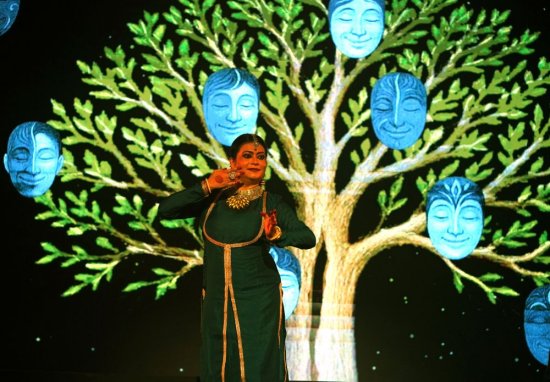 In a luminous tribute to the timeless genius of Pandit Birju Maharaj, choreographer Jayeeta Dutta - founder of her Kathak institute 'Nahabat' - assembled fifty of her students, spanning junior to senior, in a majestic presentation on the 12th of July at the Bangalore International Centre, that honoured tradition while pulsing with contemporary vitality. 'Kalpavriksha' emerged not only as a celebration of Kathak's rhythmic and expressive vocabulary but also as a spiritual invocation - of nature, energy, and transformation. The evening opened with 'Surya Vandana', invoking the elemental power of the sun. Arms rose in graceful arcs, heads tilted in meditative alignment - dancers sculpted light with their bodies. The serenity of movement mirrored the illumination of dawn, each gesture echoing sacred stillness. Mandala formations on stage suggested cosmic harmony, reflecting Kathak's devotional roots through technical precision and quiet introspection. This transitioned into Prakrithi, an ode to nature's elemental beauty. The choreography unfolded in spirals, curves, and rippling forms - torsos undulated like water, hands fluttered like foliage, and chakkars bloomed like petals. The dancers embodied the pulse of life, their hastaks evocative rather than literal - the rustle of leaves, the arc of a bird in flight, the quiet generosity of the Kalpavriksha. Keerthi Kumar's atmospheric lighting design conjured a living landscape, shifting from forest canopy to riverine mist, rendering the visual space as dynamic as the dance. 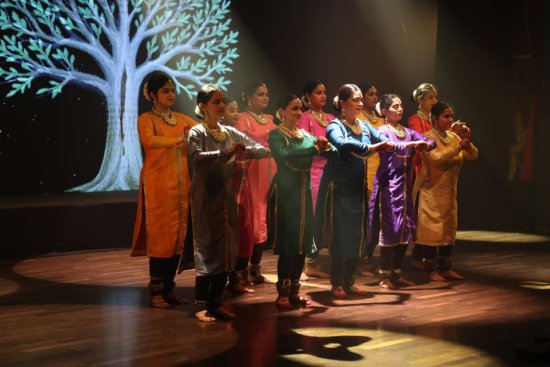 A powerful tonal shift followed in 'Gagana Mardala', a Dhrut Kheyal composition from the Dhrupad tradition, created by Pandit Jnan Prakash Ghosh and performed as a solo by Jayeeta Dutta. In a striking departure from the ensemble's serenity,Jayeeta Dutta transformed into a force of elemental disruption. Angular, intense, and deeply expressive, her performance evoked a rupture in natural harmony - tatkars thundered like storm-claps, and directional pivots cut through space with sharp precision. It was a portrayal of cosmic chaos and catharsis, where destruction was not an end but a clearing ground for renewal. Jayeeta Dutta's mastery shone as she wove tension and release into a solo that commanded attention and revealed the dancer as both storyteller and elemental force. From this turbulence emerged 'Ati Vilambit', a contemplative section bearing the emotional weight of the aftermath. Time felt suspended. A soloist cradled emptiness, evoking absence and longing; another's slow spin mirrored the beauty of decay. The abhinaya turned inward, restrained and poignant, a meditation on impermanence. Stillness within motion reflected the quiet force of sama, the still point where all movement dissolves. 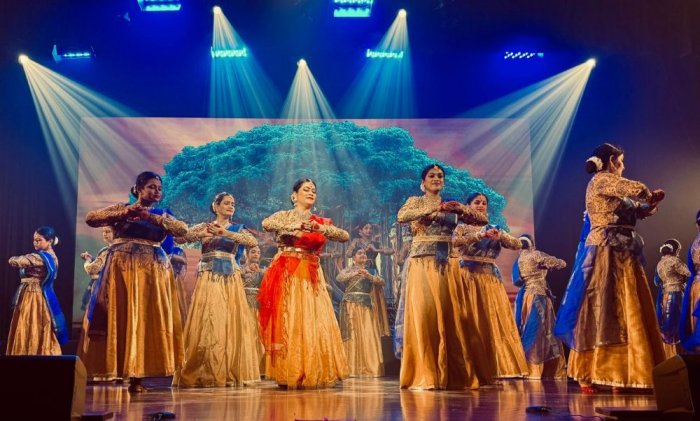 A distinctive segment featured Jayeeta Dutta and ten dancers responding to Pandit Birju Maharaj's 11-matra compositions, symbolically aligned with the concept of "eleven souls." Each soul represented an aspect of human experience - growth, struggle, resilience. The irregular, cyclical rhythm mirrored the journey through samsara (cyclical existence). Maharaj's rhythmic-poetic brilliance allowed the dancers to embody each soul with emotional nuance through abhinaya, portraying states of joy, sorrow, and awakening. Ensemble formations reflected this philosophy - dancers branching out like leaves from the same divine source. The culmination arrived in a Tarana charged with chakkars - first by the juniors, then the seniors. What began in meditative stillness culminated in ecstatic release. The ensemble burst into tukras and parans, rhythm building into a trance-like crescendo. Spins intensified, and the soaring lehera guided the performance into a state of euphoric momentum. 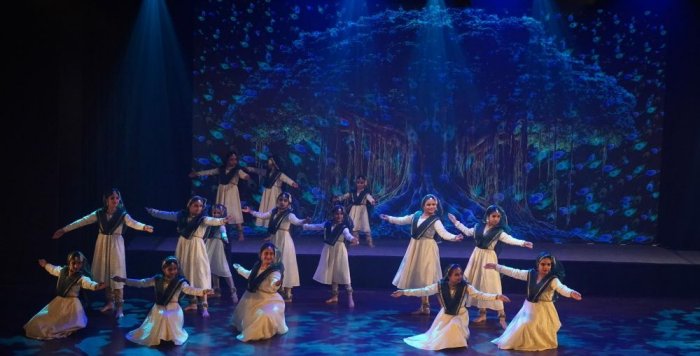 The production's musical architecture played a critical role in elevating the evening. Music and rhythm compositions were by Pandit Birju Maharaj and the Kalashram team, whose creative vision formed the core of the performance. On tabla and pakhawaj, Ajay Singh provided rhythmic depth and clarity, while Raghupati Jha's evocative vocals lent emotional resonance. Bol padhant across the production was rendered by Jayeeta Dutta, with two key segments - a Ladi and a Paran within the solo - delivered by Keerthi Kumar, whose resonant voice added gravitas to the heavy Dhrupad tonality. Kumar's contribution extended to lighting design as well - his illumination of the visual backdrop enriched the stage imagery, shifting moods and evoking environments with poetic sensitivity. Vijay Gonahalu on sitar offered meditative melodic contours, while Shreya Singh on harmonium and keyboard added warmth and harmonic layering. This ensemble did more than accompany; it conversed with the dance, echoing, enhancing, and expanding its emotional dimensions. Choreographed with vision and deep sensitivity, 'Kalpavriksha' affirmed Kathak's power to transform space, time, and spirit. With fifty dancers embodying a living continuum of tradition and innovation, the production became more than homage - it became a dynamic expression of lineage reborn. Drawing from Pandit Birju Maharaj's legacy, Jayeeta Dutta did not merely preserve it - she reimagined and reanimated it. What emerged was not a static offering but a vibrant, breathing tapestry - rooted in tradition, lifted by imagination, and radiant with the promise of renewal. VISVAMBHARA: A KINETIC YAJNA IN PRAISE OF SHIVA Photos: Aswin Vijay Shreema Upadhyaya's 'Visvambhara' unfolded as a profound Bharatanatyam offering to Lord Shiva, where devotion met artistry under the nuanced choreographic vision of Guru P. Praveen Kumar. Presented by the Chithkala School of Dance at Medai, Bangalore, on 17th July in Bengaluru, the performance wove together intricate nritta and evocative abhinaya, portraying Shiva as the cosmic 'Visvambhara'. 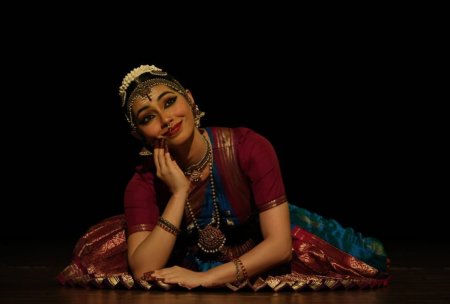 Shreema Upadhyaya The opening sequence framed by Praveen Kumar in Bhairavi raga and mishrachapu tala, set a contemplative tone, marked by the devotee's yearning inquiry as she addresses Lord Tyagesa, "You show only your face. What is the secret? Have you something to hide?" - expressed through delicate gestures and searching glances. Shreema's abhinaya captured the inner turbulence of devotion, her mudras delicately tracing the crescent moon and third eye of Shiva's visage, while subtle shifts in expression reflected the seeker's restlessness. As the narrative deepened, the longing for a glimpse of Nataraja's dance emerged through dynamic footwork and vigorous tandava-inspired movements. Sharp angles, brisk spins, and rhythmic precision animated the line: "One look of your dancing body and dancing feet is what I seek." The contrast between Shiva's earlier formless mystique and the ensuing explosive presence of the cosmic dancer was beautifully etched in movement. The interplay of bhakti and shringara resonated through Shreema's portrayal - her eyes flickering between reverence and playful reproach, expanding the emotional landscape through nuanced sanchari bhavas. Praveen Kumar's choreography wove sculptural pauses and intricate jathis that gave physical shape to Shiva's dual nature as both destroyer and creator. 'Visvambhara' was anchored in Muthuswami Dikshitar's majestic kriti "Sri Viswanatham Bhajeham", whose musical architecture - spanning 14 ragas with viloma svara patterns set to chaturashra eka tala - became the foundation for an expansive choreographic meditation on Shiva's mythic and cosmic facets. In Shreema Upadhyaya's single-evening exegesis, the kṛiti was not merely sung - it was incarnated. Everything the ear heard, the eye re-invented. The performance opened with a shloka in Sri raga, which established a quietude - a spare, almost whispered namaskaram that gradually expanded, via Arabhi's bright ascent, into the first full kinetic image of Śiva as the arching sky of Advaita. Gauri followed with a delicate, inward tone, introducing Visalakshi - her compassion made visible through the tremulous alapadma of Shreema's hands. The choreography then moved into the twin rigours of Nata and Gaula, where nṛitta became a mode of argument. The mridanga's teermanams were met with lightning-quick bhramaris, as if the rhythmic tension of the music found its equal and opposite in the dancer's unerring velocity. The emotional high point came in the Markandeya episode. In a sudden blackout, Shreema's body folded into the image of the sixteen-year-old sage gripped by terror. Each tremor in her fingers mapped the tightening noose of Yama, and the audience seemed to feel the very chill of mortality. Then - with a burst of light and one explosive leap - Shiva arrived. A swift, circular bhramari became the god's foot, kicking death aside, while her outstretched arms hurled the noose into the void. In Mohana raga, with the phrase "Mohanakaralingam", the tone shifted toward enchantment. Shreema's eyes became the linga's third axis, each glance forming a syllable of sringara-bhakti. As the kṛiti moved into Sama, the tempo slowed to the rhythm of a heartbeat; the sweep of her arms gave shape to unseen celestial beings leaning in, drawn by the meditative stillness. The narrative pivoted dramatically in Bhairavi, as angular karanas and flaring gazes depicted Shiva's destruction of the Tripura Asuras, her spinning bhramaris evoking celestial conflagration. A masterstroke emerged in the viloma svara sequences, where Shreema's Guru's choreography mirrored Dikshitar's musical palindrome. Her body became a living yantra - adavus reversing direction, mudras unfolding then refolding like lotus petals, culminating in the Shankarabharana section's elemental meditation. Through crystalline hastas, she manifested the Panchabhuta: earth (prithvi mudra), water (Ganga's cascade), fire (third eye's blaze), air (undulating nagabandha), and space (the Nataraja's encircling arms). The climax built through Kambhoji's regal cadences into Devakriya's benevolent outpouring, where Shreema's portrayal of Shiva as "Vadaanya Devakriya Kelanam" radiated divine playfulness. As the final Bhupala verses celebrated Shiva's sovereignty ("Bhoopala Palanam"), her abhinaya softened into devotional surrender. The closing tableau - Nataraja's ananda tandava frozen in space - dissolved into a slow namaskaram, leaving the hushed audience with the echo of Dikshitar's mudra: the guru's presence (Guruguha) lingering like temple incense. Throughout, Guru Praveen Kumar's choreographic genius shone in the seamless weaving of nritta's geometric purity with abhinaya's emotional spectrum, while Shreema's technical mastery ensured each raga's distinct bhava resonated through her every muscle and glance. The performance didn't merely depict Shiva's stories - it became a kinetic yajna, where music, movement and metaphysics merged in transcendent harmony. 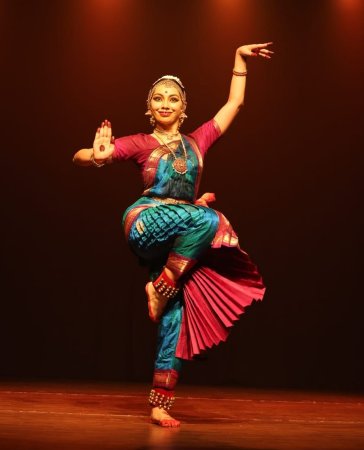 Shreema Upadhyaya The next piece began with a hushed invocation "Teruvil varano…" In that moment, the vastness of the divine seemed to collapse into the intimacy of a solitary street. Shreema re-entered to the strains of Kamas rāga, not with theatricality, but with a quiet, inward focus. Her steps were measured and silent, skimming the ground lightly, evoking a sense of hesitation and inward searching. A raised hamsasya mudra, suspended in midair, suggested the fragility of a glance not yet offered. She evoked the memory of a temple procession through restrained abhinaya - imagining the flicker of oil lamps, the tremble of flags, and the steady rhythm of approaching drums. Her eyes shifted as if catching a distant sound, then lowered, bracing against the possibility of being mistaken. At the lyric, "ennai satru tirumbi paaraano," she pivoted gently and paused mid-turn, allowing the stillness to echo the unresolved longing at the heart of the composition. Throughout the piece, each gamaka in Kamas raga was reflected in her movement - a gentle swing, a subtle shift, each one suggesting an emotion unspoken or a moment suspended. The choreography avoided closure, reinforcing the theme of yearning. In the charanam, "oru nokku taruvano," she finally offered the long-sought glance - subtle, fleeting, and deeply affecting. The restraint in her abhinaya, paired with the melodic richness of the raga, brought a quiet intensity to the closing moments of the piece. The performance culminated in a breathtaking finale with Muthu Tandavar's composition in raga Mayamalavagowla, celebrating Shiva as Nataraja at Chidambaram. Shreema transformed the stage into the Kanaka Sabha (Golden Hall), her ananda tandava embodying a spectacle that "needs a thousand eyes." The deep, resonant Mayamalavagowla lent a majestic gravitas, with Shreema's nritta exploding into dynamic adavus and soaring bhramaris. Her mudras vividly depicted Shiva's adornments: the tiger skin through bold, grounded stances; serpents coiling around his neck and arms with sinuous gestures; and flowers adorning his matted locks with delicate hasta movements. The choreography by Praveen Kumar drew on Chidambaram's iconography, with Shreema's poses mirroring the Nataraja idol - raised leg, damaru in hand, and fiery ring of cosmic dance. Her abhinaya captured the exhilaration of Shiva's dance, her eyes flashing with divine ecstasy as if reflecting the chidambara rahasya (the secret of consciousness). The jathis, synchronised with the mridangam's thunderous beats, echoed the cosmic rhythm, while the violin's soulful notes in Mayamalavagowla enhanced the devotional fervour. The final moments brought the performance to a cohesive conclusion. Shreema held the Nataraja pose with stability and grace, her form embodying the sustaining force of the universe through dance. The closing namaskaram - measured and composed - echoed the thematic arc of the evening: reverence, inquiry, surrender, and "To that Divinity I bow" lingered in the space she had briefly hollowed out for the divine. S. Raghuram's resonant vocals, Praveen Kumar's precise nattuvangam, Vidyashankar's dynamic mridangam - ranging from thunderous cadence to whispered grace - Keshav Mohankumar's expressive violin, and Shruti Doss's sensitive lighting design together created a richly textured emotional landscape. They shaped a sonic and visual tapestry that seamlessly bridged temple, street, and sky, offering Shreema both anchor and elevation in her interpretive flight.  Bangalore based Satish Suri is an avid dance rasika besides being a life member of the Music and Arts Society. |
