
|     |
|
| |

 Mohiniyattam by Pallavi Krishnan and ensemble- Tapati Chowdhuriee-mail: tapatichow@yahoo.co.in Photos: Arijit Roy July 19, 2025 Artistic Director Pallavi Krishnan of Lasya Akademi of Mohiniyattam celebrated 'Sandhya' at Gyan Manch in Kolkata. An awardee of Sangeet Natak Akademi in Mohiniyattam settled in Kerala, the presentation marked her gratitude to her state of origin that had given her so much. This daughter of Bengal had trained under Kalamandalam Sankaranarayanan at Viswabharati. Subsequently she trained in Mohiniyattam under Bharati Shivaji and Kalamandalam Sugandhi. She has had the privilege of learning in the two most prestigious universities in the country - Viswabharati and Kerala Kalamandalam. She has trained many a talented dancer in the art of Mohiniyattam and intends to train many more in her own home state as well. With this wish in mind, she held a Mohiniyattam workshop in Kolkata, where the response was overwhelming. Her branch of Lasya Akademi in Bengal which she had started a few years back already has a few talented dancers who participated in the Mohiniyattam Sandhya celebrated on 26th June. Pallavi's disciples commenced with the traditional Cholkettu, the very first item of Mohiniyattam. 'Chollu' means 'syllables' and 'Kettu' is 'threading'. In this dance piece, soft and graceful movements of the genre were aesthetically threaded with ragas and talas into a garland. Traditionally it began with a sloka and was followed by a choreography that focused on the abstract, non-dramatic, aspect of Mohiniyattam. The piece began with a salutation to Devi Saraswati, a composition of Vayalar Rajendran in ragas Kedaragoula and Hamir Kalyan in adi talam. Chronologically the next piece performed was Jatiswaram, a piece of pure dance where the jatis were strung together with musical notes. The melodious Chenchurutti raag gave beauty to the Jatiswaram. 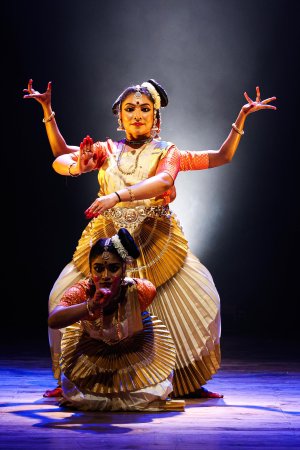 Shiva Panchakshara Stotram All dancers worship Shiva / Nataraja. Pallavi chose Shiva Tatwam NA MA SHI VA YA, based on Adi Shankaracharya's Shiva Panchakshara Stotram. Salutations were offered to Lord Shiva, who had for his adornment the serpent, who possesses three eyes. Shiva's body smeared with ashes and all his attributes described in the shloka was presented. It was a group dance where they paid their naman to Shiva and worshipped the Lord of Nandi with water from the river Mandakini and sandalwood paste. They saluted Lord Shiva, who makes Parvati blossom like a lotus and he is the destroyer of the Yagna of Daksha. Thus did they worship like the other gods who worship Lord Shiva, whose three eyes possess the moon, the sun and fire. It is said that anyone who offers these sacred five syllables, NA MA SHI VA YA, attains bliss. Kavalam Narayana Panicker has composed the music in ragas Saveri, Ritigoula and Revati, set to Panchari talam. The dancers translated the entire shloka into dance vocabulary with utmost devotion, winning the appreciation of the audience. 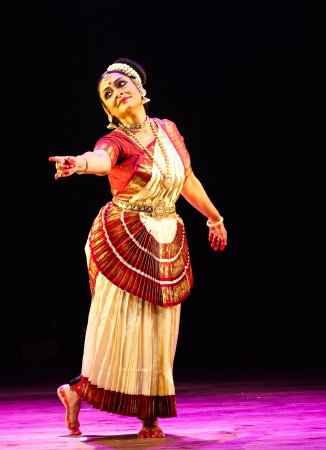 Pingala Pingala, performed solo by Pallavi, was the story of a courtesan whose life experiences from innocence to experience opened her inner eye to tell her the eternal truth that external beauty is of no consequence. Beauty is only skin deep. Pingala lived in the ancient city of Mithila, and was renowned for her extraordinary beauty, a woman whose charm captivated kings, nobles, and merchants alike. Her pride had a fall. Pingala thought that the world was hers, because of her physical grace. But in her pursuit of admiration and wealth, she had closed her heart to love, compassion, and deeper connections. As the years passed by unnoticed by her, her beauty had begun to wane. It was a shock for her to discover that none sought her graces anymore. Either her mirror lied, or she was under an illusion when she still had faith in her unconquerable physical beauty. Her false confidence soon came to nought. Finally, she was face-to-face with the truth. Her once glowing face looked pale. Loneliness enveloped her. But she was not abandoned; she seems to have heard the name of divine Rama whispered into her ears. It was a spark of hope which ignited her. The name of Rama filled her with peace and joy she had never experienced before. She underwent a transformation. Chanting the name of Rama proved to be a great solace to her. Her inner beauty, overshadowed by vanity, began to shine with a serene radiance. In the final stage of her journey, she experienced the divine aura of Lord Rama. Pingala surrendered herself completely at the feet of Rama, where there was fulfilment she had longed for and attained moksha. It was a moving piece of storytelling by Namangalam Madhavan Namboodri based on the poem Pingala written by Poet Laureate Ulloor S. Parameswara Iyer in 1914. Pallavi wove magic as she went through the life of the courtesan in her moment of joy and sorrow when hit by tragedy and finally found solace in the arms of Vishnu's incarnation, Rama. The music of the piece was composed by Palakkad Surya Narayanan and Nedumpally Rammohan. 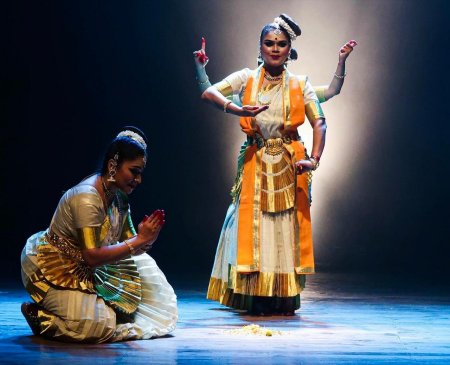 Maya Mohana Krishna 'Maya Mohana Krishna' recounted three celebrated stories from the Maha Bhagavatam and Mahabharata that illustrated the divine power of Lord Krishna. The first story involved Lord Krishna saving Draupadi from being disrobed in front of the court by Dussasana after the Pandavas lost the dice game against the Kauravas. In the second story, Lord Vishnu uses his sacred weapon, the Sudarshana Chakra, to save his devotee elephant Gajendra from a crocodile attack while Gajendra was engaged in penance near a lake on a hilltop. In the final tale, Lord Krishna provides emotional solace to the great warrior Arjuna, who is distressed upon seeing his family and Guru fighting on the opposite side of the Kurukshetra battlefield. Lord Krishna imparts the divine advice of the Bhagavad Gita to Arjuna. Written by Kavalam Narayana Panicker, the piece was conceived with care. Music composition by Kalamandalam Jayprakash with the sonorous ragas - Mohanam, Kanada, Kedaragoula, and Lavangi used in the composition were captivating. Besides, it depended on four rhythm systems like Ayyadi, Panchri, Adi, and Kanda Chapu. A unique piece in all its aspects. 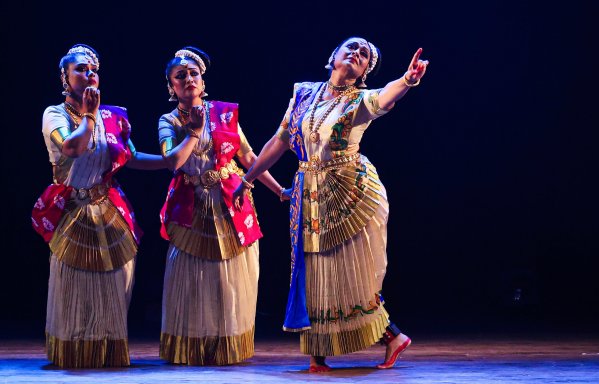 Shangono gagane The penultimate piece "Shangono gagane ghor ghanaghata" was a composition of Rabindranath Tagore from his play Bhanusingher Padabali. It was a group presentation. Radha hears Krishna playing his flute and is overtaken by yearning to meet him. The night is stormy and so she is dissuaded by her sakhis from going for her rendezvous. She pleads with her sakhis to bedeck and bejewel her and let her undertake the arduous journey to meet Krishna, but at this point the poet who is her devotee entreats her not to venture out when the storm is raging. Portrayal of love in separation could not have been expressed in a better way. 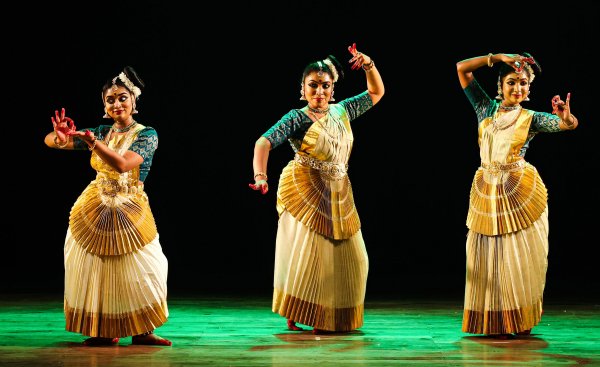 Tillana The beautiful evening was brought to a close with a Tillana composed by Maharaja Swathi Tirunal in raag Dhanasree and taal adi. The Mohinis left us enchanted. Pallavi Krishnan had choreographed all the dance pieces herself and performed remarkably along with her students.  Tapati Chowdhurie trained under Guru Gopinath in Madras and was briefly with International Centre for Kathakali in New Delhi. Presently, she is a freelance writer on the performing arts. She is the author of 'Guru Gopinath: The Making of a Legend.' |
