
Madhura Murali: Meenakshi Srinivasan's
evocative Krishna reverie in Bharatanatyam
- Satish Suri
e-mail: satishism@yahoo.co.in
Photos: Prof K.S. Krishnamurthy
July 11, 2025
'Madhura Murali' presented on June 26th as part of the All for Dance
series curated by Malavika Sarukkai, was a joint presentation by
Kalavaahini and the Bangalore International Centre. In this evocative
solo, Meenakshi Srinivasan offered a luminous portrait of Lord
Krishna - one that transcended narrative to become a deeply felt
spiritual
invocation. Known for her distilled abhinaya and the elegant precision
rooted in the Pandanallur bani, Meenakshi, a senior disciple of Alarmel
Valli, brought to this Krishna-themed performance a quiet power that
lingered long after the curtain had fallen.
The production was not a linear retelling of Krishna's life but a
textured meditation on his many facets - the cosmic protector, the
philosophical absolute, the mischievous child, and the irresistible
lover. Meenakshi's aesthetic was marked by introspective quietude, where
each movement seemed to arise from inner stillness and refined thought.
The performance unfolded in four distinct segments, each deepening the
emotional and philosophical journey.
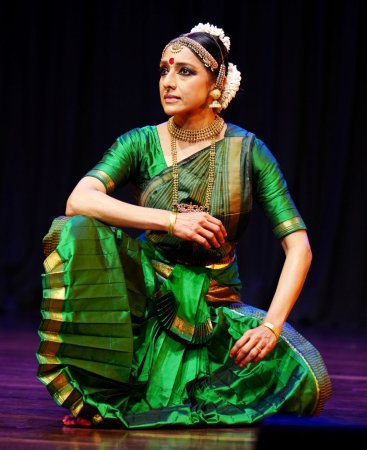
The evening commenced with a verse from the Srimad Bhagavatam ("Atha
sarva"), in which Meenakshi embodied the celestial rejoicing at
Krishna's birth - her mudras evoking the alignment of planets, the music
of the Gandharvas, and the dances of the Apsaras. Flautist Sruthi
Sagar's melodic lines seamlessly mirrored the murali, conjuring the
enchantment of Krishna's presence. This seamlessly led into Swathi
Thirunal's ragamalika kriti "Kalyani khalu" set to Rupaka tala. From the
outset, Krishna was revealed not as a flamboyant deity, but as a
gentle, compassionate force. Episodes such as the Gajendra Moksha, the
subjugation of Kaliya, and the lifting of Govardhana were rendered with
clarity and restraint, minimalistic yet potent. Suggestion became her
language: a subtle shift in the shoulder, a flicker of the eyes, a
softly arched foot. The ensemble - Kaniyal Hariprasad (vocal), Jayashree
Ramanathan (nattuvangam), Ishwar Ramakrishnan (violin), Vedakrishna Ram
(mridangam), and Sruthi Sagar (flute) - provided an elegant and
meditative aural canvas. The segment concluded with a benedictory
invocation, "May that Keshava protect us."
The evening's centrepiece, "Omkara pranava nadothbhava" composed by Dr.
M. Balamuralikrishna in Shanmugapriya raga and adi tala, elevated the
narrative into the metaphysical. Here, Krishna was evoked as Om - the
primal sound, the source of all creation, and the embodiment of supreme
consciousness. The choreography was intellectually intricate and
rhythmically layered, demanding both philosophical depth and technical
clarity. Meenakshi rose to the challenge with unerring grace - her deeply
rooted araimandi, her precise teermanams, and her lasya-infused adavus
rendered form into meditative sculpture. Particularly striking was her
command over the charanam swaras, introduced after a suspended beat,
where anticipation and release shaped the rhythmic contour. In these
moments, she didn't just move to the rhythm, she seemed to become it.
Jayashree Ramanathan's nattuvangam was a model of clarity, guiding and
enhancing the kinetic tapestry without overpowering it.
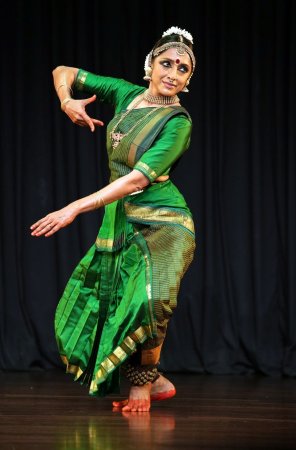
If the varnam showcased her structural mastery, the padam "Yemiseyyudu
ee mohamu" (Charukesi raga, misra chapu tala), attributed to Kshetrayya
and tuned by Hariprasad, revealed the emotional core of Meenakshi's
artistry. Here, the concept of viraha - the aching separation from the
beloved - was interpreted not from the usual feminine perspective of the
nayika, but through Krishna himself, longing for his beloved Radha. "Who
will bring my beloved to me?" he wonders, finding solace in a painting
of her - a memory that awakens his yearning. He recalls her sensuous eyes,
her radiant face, her graceful neck, and their bodies entwined in
moments of ecstatic love. "What shall I do to quell this passion?" he
cries. Meenakshi portrayed these emotional shades with restrained
intensity - never theatrical, always internalised. The slow curling of
fingers, a tremulous breath, the half-lit sadness in her gaze - these
spoke of desire, devotion, and the sublime loneliness of love. Sruthi
Sagar's subdued flute phrases lent the scene a haunting intimacy.
The final piece, a thillana composed by Balamuralikrishna (Ta nom nom
ta, set in ragam Kalyani) concluded the performance on an effervescent
note. Interestingly, though structured in Kalyani, Balamuralikrishna
introduces tonal shifts that allow the charanams to evoke other
ragas - Mohanam, Hindolam, and Darbari Kanada - imbuing the composition with
a dynamic, kaleidoscopic energy. Meenakshi responded with joyous
abandon. Her brisk spins, well-calibrated teermanams, and sculptural
poses reflected the playful energy of Krishna, especially in his Rasa
Leela form. The choreography culminated in a resonant offering, "To you,
and the glory of your flute, I make this my offering." The ensemble,
particularly the nattuvangam, matched her vivacity with crisp rhythmic
articulation, bringing the evening to a spirited and celebratory close.
What set 'Madhura Murali' apart was its synthesis of devotion and
discipline, inner stillness and outer command. It was a performance
rooted deeply in the classical tradition yet marked by a contemporary
sensibility - a quiet elegance, an integrity of approach, and a reflective
aesthetic that resisted spectacle. Meenakshi's Krishna was not merely
seen or described - he was intuited, and invoked. The evening stood as a
testament to Bharatanatyam's enduring capacity to transcend the temporal
and touch the spiritual, when placed in the hands of an artiste who
dances not just with skill, but with soul.
Bangalore based Satish Suri is an avid dance rasika besides being a life member of the Music and Arts Society.
|




