
|     |
|
| |

 Maya's Triptych: Mirage, Rama Amritham, Ekatwa - Satish Suri e-mail: satishism@yahoo.co.in Photos: Prof. K.S. Krishnamurthy April 27, 2025 MIRAGE - A LUST FOR LIFE Mirage - A Lust for Life originated as a short dance film in 2021, premiering at several dance festivals, including the InMotion Dance Film Festival. Building upon this foundation, the work was reimagined for the proscenium stage. The event, which was held at the Bangalore International Centre on March 15th, commenced with a short film screening, followed by a live performance. This transition from screen to stage allowed the creative team to expand and deepen the narrative, offering a more immersive experience for the audience. Sangita Chatterjee's Mirage, a thematic Kathak presentation performed by the Kalpataru Dance Company, was a breathtaking confluence of movement, philosophy, and theatrical craft. It explored the ceaseless pursuit of desire and the ephemeral nature of fulfilment. The choreography wove together fluid formations and sharp, structured movements, reflecting the duality of longing - an intoxicating pull and the inevitable dissolution of aspiration. 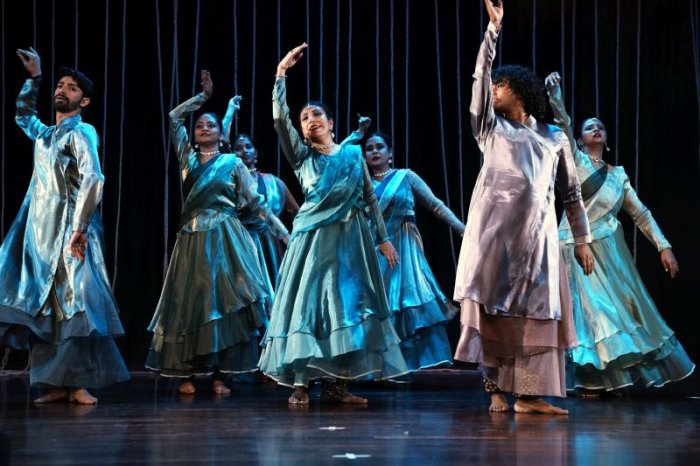 Mirage The stage unfolded like a fever dream of shifting blues - indigo, sapphire, the pale wash of twilight - where the dancers moved as fragments of a restless wind. Sandhya Raman's costumes billowed like spectres of desire, their layers revealing the unseen architecture of illusion. Overhead, suspended ropes swayed between entanglement and release, mirroring the mind's vacillation between grasping and surrender. The hanging ropes - now taut, now slack - mirrored the mind's vacillation between control and abandon. When the dancers clutched at them, the ropes slipped like sand; when they let go, the strands swayed toward them, teasing, adding a dynamic visual element to the performance. This creative use of props complemented the costume design by Sandhya Raman, whose costumes were more than fabric; they were ephemera-given form, the way desire billows and collapses in on itself. Raman's design, particularly the three-layered lehenga with a salwar underneath, symbolised the swirling world of activity while remaining in place. The costumes enhanced the narrative by visually representing the elusive nature of the dancers' pursuit, much like a mirage that promises but never delivers. Sangita's sahitya whispered paradoxes: "Dor tute to sulijhayu" (When the rope snaps, you are freed). Sangita's sequences exploited Kathak's innate duality - the tihaai teased closure but often halted mid-gesture. The male dancers' chakkars were deliberately earthbound, while the women floated, heightening the dissonance. When the dancers spun, the lehengas lifted in widening gyres, yet their feet remained rooted - a contradiction, like a tree trying to uproot itself with each turn. Milind Srivastava's lighting sculpted the air into fleeting geometries - bodies dissolving into silhouette, then re-emerging gilded, as if the stage itself were breathing. Shadows pooled at the dancers' feet, making them appear momentarily untethered until the insistent jingle of ankle bells grounded them in reality. The rhythmic patterns stuttered and surged, the sound of bare feet striking the stage mirroring the mind's frantic chase. Anirban Chatterjee's score was a labyrinth of ragas: oscillating between the smoky seduction of Jog, the moonlit ache of Chandrakauns, and the fevered spiral of Mand, each note a hook pulling the dancers deeper into the illusion of pursuit. Even the silences throbbed with presence, pauses laden with yearning. 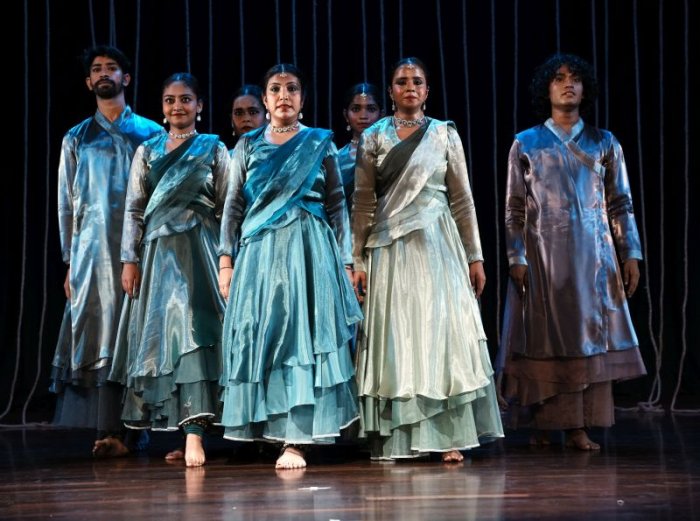 Mirage At its heart, Mirage embodied Maya's philosophy - the illusion of the material world. The choreography became a meditation on the futility of chasing mirages, much like the musk deer that seeks a fragrance emanating from within. As the performance progressed, it revealed that the pursuit was an illusion, and it transcended this futility into a powerful commentary. Like the Sufi's drunken dance or the moha mriga (delusion deer) of myth, what if the goal is not to arrive but to exhaust the delusion of destinations? Kabir's "Man lagaayo yaar phir kyun hoya bechain" (After dedication to the beloved, why do you still feel unsettled?) choreography embodies a paradox, bringing it to life through movement. The piece's core metaphor - mirage as maya - was drawn from the Vedantic concept of cosmic illusion, where the material world is a shimmering veil obscuring Brahman (ultimate reality). But here, the dancers don't just represent Maya; they embody its operating system. The repetitive footwork (tatkars) mirrors the karmic loop - the soul's cyclical trap in samsara. Yet, unlike traditional narratives that preach transcendence, Mirage lingers in the addiction to the chase. The dancers' exhaustion became the first crack in the illusion, leading to a climactic unravelling. Their spins grew heavier, drunk with revelation, until they stilled - not in supplication, but in surrender to the absence of the mirage itself. The finale, set to Bhairavi, was less about resolution and more about release - a final exhale into awareness. When the lights rose, the audience sat in stunned contemplation, not just of the spectacle but of its deeper resonance. The performance of Mirage - A Lust for Life was a resounding success, illustrated by Sangita Chatterjee's visionary choreography and the remarkable artistry of her talented students - Kavita Das, Lisa Saha, Nabiha Yusuf, Samadrita Chandra, Praveen Prasad, and Manpreet. The aesthetic design, from Sandhya Raman's evocative costumes to Milind Srivastava's atmospheric lighting, contributed to the immersive quality of the performance. The evocative music by Anirban Bhattacharya further deepened the emotional resonance, mirroring the cyclical tension of yearning and realization. RAMA AMRITHAM - A DIVINE MUSICAL TRIBUTE TO LORD RAMA On 27th March, Sujatha Ramanathan delivered a soulful thematic presentation at the Bangalore International Centre, celebrating the glory of Lord Rama through music and devotion. The performance began with a Mallari, a rhythmic invocation, setting a sacred tone. Sujatha then paid heartfelt homage to her Gurus, whose blessings she credited as the foundation of her artistry. The veena's resonant melodies elevated the experience. During a sacred conversation between Goddess Parvati and Lord Shiva, Parvati inquired whether there existed an alternative to chanting Vishnu's thousand names. With profound wisdom, Shiva revealed that the essence of both deities merged in a single, powerful name - Rama. He explained that the syllable "Ra" originated from Vishnu's Ashtakshara mantra ("Om Namo Narayanaya"), while "Ma" came from Shiva's own Panchakshara mantra ("Namah Shivaya"). These sacred syllables formed the divine name Rama, embodying the united consciousness of both Shiva and Vishnu. The compassionate lord assured that chanting this holy name would establish a direct connection with the divine, serving as a complete spiritual practice in itself. This revelation beautifully demonstrated the non-dual nature of reality, where apparent distinctions between deities dissolved into one supreme. The name Rama thus became a sacred bridge, uniting devotees with the absolute through its simple yet profound vibration. 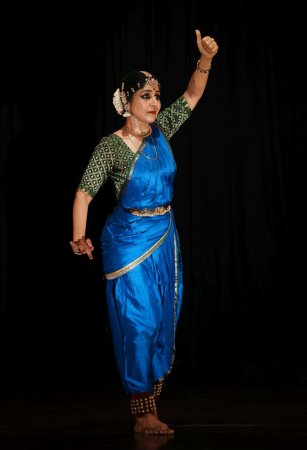 Sujatha Ramanathan The artiste tenderly unfolded Tulsidas's celestial vision from the Ramayana - that sublime moment when infant Rama, adorned in golden radiance, crawled in divine play. Neither the ancient Vedas with their cosmic wisdom nor mighty Sheshnag with his thousand tongues could adequately describe this sight. Yet, the blessed poet Tulsidas, through his devotional rapture, captured its ineffable beauty in verse. As the performance flowed into Tulsidas's beloved bhajan "Tumak chalat Ramchandra," the air shimmered with devotion. The simple, lilting melody painted the sacred scene of baby Rama's first stumbling steps, his tiny anklets dancing to their celestial rhythm. Each note carried the audience deeper into that hallowed moment where the divine became delightfully human, and the human touchingly divine. In this shared experience of bhakti, time stood still as all present glimpsed, if only for a breath, what Tulsidas saw - the infinite contained in a child's smile, the eternal captured in a single golden moment. The performance reached its zenith with P.S. Krishnamurthy's sublime composition in Mohana Kalyani raga - "Raman Ravikulambudhi Somam" - a poetic paradox that captured Rama's divine duality. Like the blazing sun (Ravi Kalam), he stood as the warrior prince, fierce in his protection of righteousness, his brilliance dispelling the darkness of adharma. Yet simultaneously, he embodied the cool serenity of the moon (Somam), radiating benevolence and compassion that soothed all suffering. In that transcendent moment, Rama's divine aura eclipsed his mortal guise - no longer merely a warrior prince but Vishnu's eternal avatar, radiating cosmic sovereignty. The artiste's subtle nod to the Dashavatara deepened the revelation: here was the same sacred presence that had coursed through history - as the fish who saved the Vedas, the tortoise who bore the universe, the lion-man who tore through tyranny. Now, in Rama's serene yet unwavering gaze, all these forms coalesced. The reference was fleeting but profound - a whisper of divinity beneath the human drama, reminding all that this exile, this battle, was but one note in an infinite divine symphony. Through melodic phrases that alternated between vigour and tranquillity, the raga revealed Rama's complete mastery over circumstance. When confronted with his cruel exile, his equanimity remained unshaken - the meditative king accepted destiny's decree without bitterness, demonstrating perfect resilience. The composition thus became more than a musical offering; it transformed into a living teaching on navigating life's trials. In this artistic revelation, Rama emerged not merely as a deity to worship but as the eternal paradigm of balanced living - where strength and serenity, action and acceptance, become one harmonious whole. 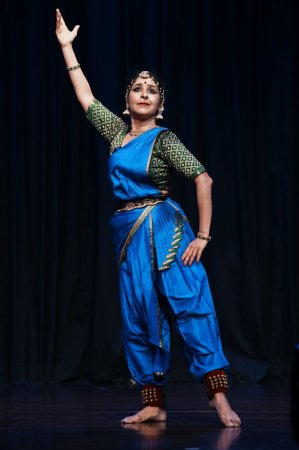 Sujatha Ramanathan The performance reached a poignant crescendo as Sujatha Ramanathan vividly depicted the sanchari bhava of Jatayu's valiant attack on Ravana - wings thrashing against the demon king's chariot, talons tearing at evil itself, even as life ebbed from his mortal frame. The air trembled with the weight of his sacrifice, a lone warrior-king of the skies giving his last breath to defend dharma. Then came Rama. The moment his divine gaze fell upon Jatayu's broken form, time itself seemed to be still. Here was no mere bird but a father - one who had loved Sita as his own, who had fought with a parent's fury. Rama knelt, cradling Jatayu with hands that trembled not with godly might but with human grief. His touch was reverence, his tears an offering. In that sacred pause between life and death, the prince of Ayodhya honoured the fallen as family. It is love that recognizes no boundaries of blood or form. Jatayu's wings had shielded not just Sita but the very essence of what it means to be kin. And Rama, in his compassion, taught the universe that devotion, in its purest form, turns even strangers into fathers and every act of sacrifice into a covenant of the divine. Thus, the performance transcended art, becoming a sadhana of sight and sound. Through music and abhinaya, it taught what scriptures whisper: that dharma, at its zenith, is the courage to defend and the wisdom to weep; that the same God who stands unwavering as the sun against darkness also kneels, cool as moonlight, to cradle the broken in his arms. Sujatha Ramanathan brought her transcendent performance to a close with a vibrant Tarana composed by the renowned vocalist Raghuram Rajagopalan. The piece, a dazzling interplay of rhythmic syllables and melodic improvisation, cascaded through intricate taans and bols, blending technical brilliance with spiritual abandon. The tarana's dynamic energy - its percussive "na-dhir-dhir" phrases dancing alongside the veena's resonant tones - created a joyous crescendo as if celebrating the divine journey just traversed. From the meditative depths of Mohana Kalyani to the fiery pathos of Jatayu's sacrifice, this finale wove all threads together: devotion became rhythm, philosophy became music, and Rama's name itself turned into a celestial dance. The accomplished ensemble elevated the performance with exceptional artistry. Raghuram Rajagopalan's soulful vocals guided the melodic journey with perfect pitch and emotional depth, while Prasanna Kumar's precise nattuvangam provided the rhythmic foundation. Satish Krishnamurthy demonstrated masterful percussion work on mridangam and kanjira, delivering intricate patterns that enhanced both lyrical and abstract passages. Prasanth Rudrapatnam's veena stood out with exquisite melodic improvisations - his phrases balanced technical brilliance with expressive beauty, particularly shining during reflective alapana sections and lively rhythmic exchanges. The musicians achieved remarkable synergy, blending disciplined craftsmanship with spontaneous creativity to create a transcendent musical experience. EKATWA Ayana Mukherjee, a disciple of Gurus Jayarama Rao and Vanashree Rao, presented a solo Kuchipudi exploration titled "Ekatwa" on the 3rd of April at the Bangalore International Centre. She began her Kuchipudi performance with Tanjore Shankar Iyer's composition "Mahadeva Shiva Shambo" in raga Revati, immersing the audience in Shiva's divine essence. Her movements wove together the sacred symbols of Shiva - the damaru's rhythmic pulse evoked through precise hasta mudras, the sinuous flow of Ganga through his matted locks expressed in graceful neck and shoulder rechakas, and the fierce trishula rendered in sharp shikhara gestures. 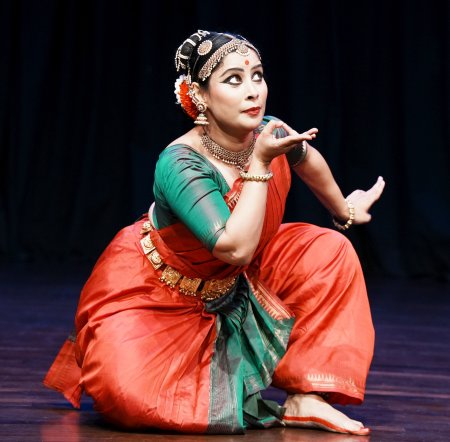 Ayana Mukherjee Her portrayal deepened as she transitioned into sanchari bhava, unfolding the story of Shiva shielding the child-sage Markandeya from Yama's grasp. The contrast between Yama's relentless approach - marked by rigid, angular strides - and Shiva's sudden, thunderous intervention created a gripping tension. When Shiva manifested as the protector, her abhinaya shifted into raudra rasa, eyes flaring, limbs taut with divine wrath, before softening into karuna as she cradled the devotee, embodying the deity's paradoxical nature. The piece balanced nritta and nritya seamlessly - the crisp footwork mirrored the damaru's cosmic rhythm while her expressive eyes and fluid gestures narrated the layers of Shiva's legend. Through this opening, Ayana set the stage for Ekatwa, where the dance became a bridge between the mortal and the eternal, the many and the One. The Markandeya episode, in particular, crystallized the theme of oneness - the moment when devotee and deity merged, and even death bowed to grace. Ayana's performance flowed seamlessly into "Gopeswara", another facet of Shiva that dissolved boundaries between the divine and the earthly, reinforcing the thread of oneness. The storyline, scripted by Rishiraj Pathak and music composition by K.Venkateswaran, depicted Shiva as no longer the ascetic meditating in Kailash but the cosmic dancer who descended into the pastoral world of the gopis in Vrindavan, merging the sacred and the playful. Ayana's performance wove a mesmerizing tale of divine fluidity, beginning with Shiva deep in meditation on Kailash until the celestial rhythms of Krishna's Raas Leela called to him. At Parvati's suggestion, the mighty ascetic transformed himself by bathing in the Yamuna's sacred waters, emerging as the radiant Gopeshwari to join the divine dance. Her portrayal captured this metamorphosis beautifully. The same cosmic consciousness meditating eternally on Kailash also yearns to dance in Vrindavan's groves, reminding us that ultimate reality is beyond form and is joyfully present in every form. Her performance became a living mandala of non-duality, where Shiva's stillness and Krishna's movement, the ascetic's rigour and the gopi's devotion, were revealed as inseparable aspects of one sublime reality. The performance paid tribute to the living tradition of Gopeswara Temple in Vrindavan, where the divine transcends gender through sacred ritual. To this day, the deity is worshipped as Shiva in the morning and transforms into Gopeshwari in the evening, adorned with shodasa shringara (sixteen bridal ornaments). 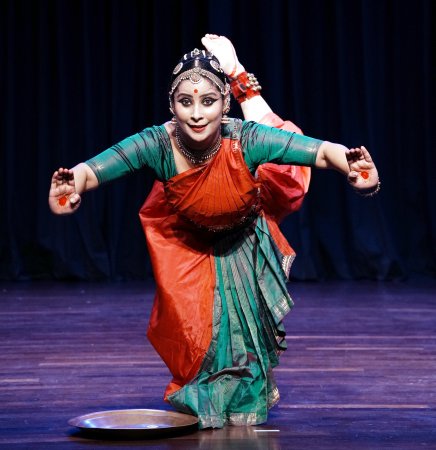 Ayana Mukherjee Ayana's rendition of the padam "Evvade vaadu" in raga Mohanam unfolded as a delicate dance of discovery, tracing a young heroine's first flutterings of divine recognition. With subtle abhinaya honed under Guru Vanashree Rao's guidance, she brought to life the mugdha nayika's tender curiosity about the mysterious stranger whose yearning gaze suggests he might be Parthasarathi himself. Mohanam's sweet strains, enhanced by embellishments and rhythmic variations, mirrored her emotional journey from innocent wonder to dawning devotion. The nayika's simple question, "Who is he?" became the soul's eternal query, her tentative steps toward the stranger a metaphor for every seeker's journey toward the divine. Ayana's "Dasavatara" performance traced Vishnu's ten incarnations. She transitioned from Matsya's aquatic motions to Varaha's strength, Narasimha's intensity to Krishna's playfulness, ending with Kalki's decisive energy. Each incarnation was connected to the next, demonstrating divine intervention. The music shifted between ragas and rhythms. The performance conveyed the principle of oneness: diverse divine forms originating from and returning to a single source. Ayana concluded her performance with the signature Tarangam, dedicating this technical masterpiece to Lord Shiva through one of Narayana Teertha's rare compositions. Balancing rhythmic precision with devotional expression, she executed intricate footwork while dancing atop a brass plate - a defining Kuchipudi challenge. The composition, set in Ragamalika and choreographed by her Gurus, wove together Shiva's paradoxical nature: her steps mirrored the damaru's staccato beats (symbolising creation), while her flowing arm movements evoked the Ganga's descent (embodying grace). The plate's metallic resonance became a sonic metaphor for the cosmos - simultaneously fragile and unshakable, like Shiva's dance of dissolution and renewal. The ankle bells' jingles merged with the plate's resonant tones to create a sonic mandala, dissolving the boundary between the percussionist and the dancer. A Shanti Shloka provided closure to the proceedings. Ayana expressed deep gratitude to the musicians who elevated her performance: K. Venkateswaran's soulful vocals, Dr. Sridhar Vasudevan's precise nattuvangam, Manohar Balatchandirane and Kesavan's rhythmic mridangam, Rajat Prasanna's evocative flute, and R. Prasad's resonant violin. Their synergy brought alive the music's emotional and technical depths.  Bangalore based Satish Suri is an avid dance rasika besides being a life member of the Music and Arts Society. |
