
|     |
|
| |

 Marga Utsav 2025 - Tapati Chowdhurie e-mail: tapatichow@yahoo.co.in Photos courtesy: Sandip Kumar April 26, 2025 Chidakash Kalalay Centre of Art and Divinity presented their festival Marga Utsava with their new and experimental production Chaturbhaani on March 23, 2025 at Kolkata. The meticulously planned evenings of the two-day festival were adorned with freshly sprouted branches. Chaturbhaani, the mainstay of the festival, was followed with the awarding of the Chidakash Natyakala Chudamani Samman 2025 to Nandini Ramani, who is an accomplished Bharatanatyam dancer trained by T. Balasaraswati and her close associate nattuvanar K. Ganesan. Professor B. Krishnamoorthy and T. Mukta honed her in Carnatic vocal music. She is a chip off the old block, her father being the renowned Sanskrit scholar Dr. V. Raghavan. At the Memorial Lecture of Dr. V. Raghavan (1908-1979), Nandini Ramani, his illustrious daughter, spoke about the great scholar and musicologist. A Sahitya Akademi awardee for Sanskrit, who wrote a phenomenal number of books and articles and was awarded Padma Bhushan by the Government of India, Dr. V. Raghavan's life and works need to be known to aspiring scholars of Sanskrit. The audience was all ears when Nandini Ramani spoke of him. Indeed, Dr. Raghavan was a rare and unique scholar among his generation and his place in the scholarly scene remains extraordinary and unparallelled to this day. His is a life worthy of emulation. 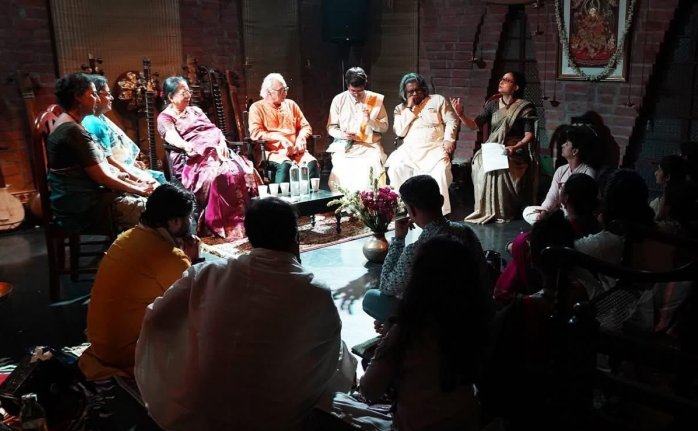 Interactive session The interactive session on Dr. Raghavan's contribution to Indian dance had Mysore B. Nagaraj, Piyal Bhattacharya, Laxminarayan Jena, Dr. Umamaheshwara, Arpita Venkatesh, Mahua Mukhopadhyay, and Jalsa Chandra, moderated by Deep Ghosh and Rudrarup Mukhopadhyay, who did hold a torch to embellish what Nandini Ramani spoke. The audience hungered for more. Kathak exponent Mysore B. Nagaraj received the Natyakala Chudamani Samman, while the Chidakash Kala Siromani Samman was bestowed on Kathak dancer Ashimbandhu Bhattacharya. Chaturbhaani was a one-of-a-kind presentation by Chidakash Kalalay at their annual festival. It was a production where educating the public and entertaining them went hand in hand. Chaturbhaani was adapted from Bhaan, which is a writing system that demonstrates actors speaking and enacting different characters. Actors take a journey, and while doing so, they give up their identity and enact the roles of characters they meet. The ancient treatises of Anandavardan and Vamangupta - teachers of Abhinavagupta - mention that Bhaans produce laughter and create a world of sublime feelings emanating from the laughter. Commentator Bhattallat opines that the major character Vita is like a yogi, who has a true sense of values and the ability to differentiate between the permanent and the transient, between the real and the illusion, and comment on them, thus making a balance between the comic and the serious. As we analyze, 'hasya' is not the central emotion of Bhaan as it is in Prahasana, but shringara and veera, which ultimately render a grave and ethical justification on the ways of life. Bhaan is one of the most complex and creative patterns of dramatic writing from ancient India, revolving around a solo act. Bhaan centers around the chronicles of one character, the Vit, and the exploits of his one single day. A Bhaan has a perfect amalgamation of Kavya, Abhinaya, and Alankara with an exposition of Veera and Shringara rasa, making it almost a pedagogy of a dramatic performance. Bhaans are satirical in nature, imitating characters and chastening the high class by lampooning them. 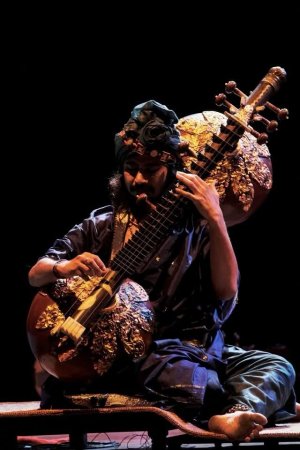 Sayak Mitra 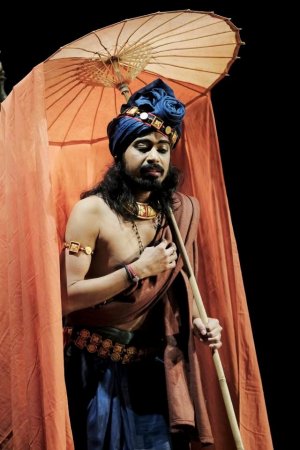 Inderpal Singh 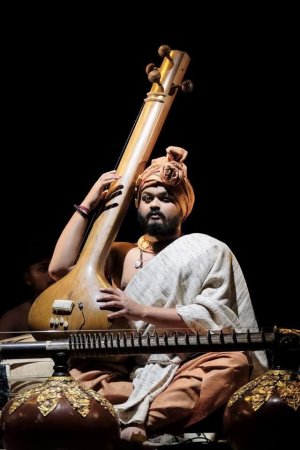 Rudrarup Mukhopadhyay Chaturbhaani was based on four ancient Bhaans: Padmapravritakam, Ubhayabhisarika, Padataditakam, and Dhurtavitasamvada, written by Sudraka, Vararuchi, Shyamilaka, and Iswardutta, respectively, between the 4th and the 8th C.E. This compiled and unified text is about the character of a Vit. A Vit is one who in medieval India was known as a parasite of the king. However, Vit is no ordinary person. He was well versed in the arts, but he was a lazy worker. Chaturbhaani depicted the character of Vits, who were apathetic to earning a living but were dedicated to their art. In Chaturbhaani, a Vit starts a journey in the morning and meets several people as he passes through the city and makes witty and humorous observations, to culminate to a deep realization that becomes a timeless journey of a person. We are shown the activities of Vits at the advent of the monsoon. Sayak Mitra, Avijit Roy, Rick Mukherjee, and Mohit Roy created an ambience of the monsoon season with raag Megh. Vit Rudrarup laments lazily about being jobless. His comment, "My veena's tantri and sur embrace me; how can I leave my Kachchapi veena to find work?" evoke laughter. 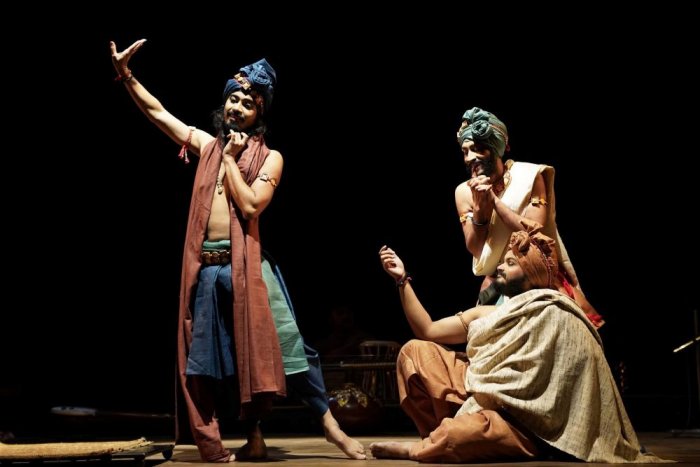 Sayak Mitra, Rudrarup Mukhopadhyay & Inderpal Singh As is, won't he speak about the message of love between the prince and the princess that happens during springtime? The Vits are players who are social commentators. They reflect on the activities of people in an artistic way, albeit with a raw humor. The modern-day audience had to freeze their inhibitions to enjoy the play, because every human relation under the sun was touched upon with a sarcasm in a supposedly naïve way. The case of Kristilal, who was brought up by his father, shielding him from evil, is seen coming out from the brothel by the Vit, who makes sarcastic comments in a witty manner, and is but one such example. Chaturbhaani used the choicest literature of many languages used by the Vits, who passed through many lands and cultures. They spoke different dialects and languages with ease. It can thus be concluded that to play the role of the Vit, one had to be both intelligent and multilingual. The actors had a fine understanding of poetry, music, and the art of dramaturgy. Talking about music, Sayak Mitra, in the role of a Vait, played the Rudra Veena effortlessly and sang and chanted Vedic texts full-throatedly. He is a comedian par excellence. Actors were adept in the art of monologue, the audience could feel the presence of the persons spoken to. The purpose of the Vits / comic artistes was to hold a mirror up to society, to reflect its follies and vices, in the hope that they would be mended. 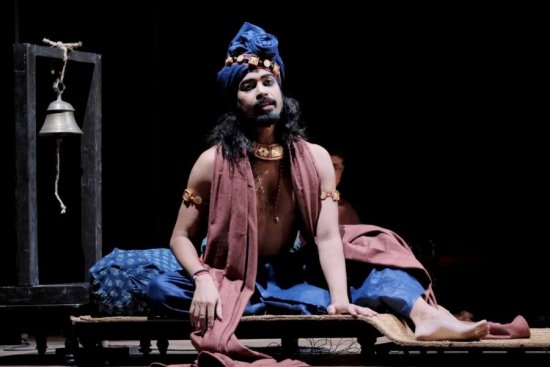 Inderpal Singh The team of Chidakash Kalalay has toiled and contemplated for more than six months to present Chaturbhaani and has amalgamated in it significant Bhaans of the Gupta Period. Dr. Umamaheshwara (Ashtaavadaani) was responsible for teaching the Shastra. He has also provided its literature. Chaturbhaani was conceptualized and constructed by Piyal Bhattacharya. The festival was a confluence of artistes, scholars, and passionate enthusiasts uniting them in a vibrant and immersive celebration of India's rich tapestry of performing arts. It highlighted the institution's unwavering commitment to promoting and preserving meticulously the artistic and spiritual essence inherent in these traditions.  Tapati Chowdhurie trained under Guru Gopinath in Madras and was briefly with International Centre for Kathakali in New Delhi. Presently, she is a freelance writer on the performing arts. She is the author of 'Guru Gopinath: The Making of a Legend.' |
