
|     |
|
| |

 'Aharya 2.0' at Mudra Dance Festival - Chandra Anand e-mail: chandra6267@yahoo.co.in Photos courtesy: NCPA April 24, 2025 The theme for the NCPA's annual Mudra dance festival was the aharya abhinaya of the classical dances. Bharata says, 'Just as the soul of a person enters the body of another person, gives up his own nature and assumes another being, so a person decorated with a different colour and costume takes on the behavior of the costume he wears.' According to Abhinavagupta, costumes help the audience to forget the person acting out and help easily identify the roles played by the actor in the situation. That aharya abhinaya is the representation of a character in a play through costumes and jewelry and makeup. Bangalore based Vyjayanthi Kashi, a senior artiste practicing Kuchipudi for 4 decades, artistic director of Shambhavi School of Dance, with a team of dancers presented 'Shobhita: the resplendence of Aharya' at Experimental Theater, NCPA, Mumbai. The presentation highlighted the importance of aharya, the external expression of dance through costume, ornaments, and adornment. A musical opening heralded the presentation with sound of bells from the gunghroos resounding different rhythms as the dancers danced holding the hair braid in the customary stance. Also, the tarangam item where the dance is performed standing on the rim of the brass plate for footwork was shown. Both the gunghroos and brass plate were denoted as representing the main items of aharya for the Kuchipudi dance form demarcating the Kuchipudi style from other classical styles. 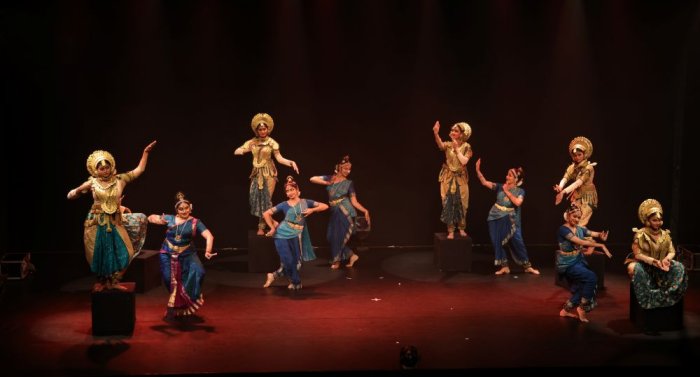 Shilpa Soundarya In 'Shilpa Soundarya', the alankara classification of aharya abhinaya was brought forth through sculptures of our temples. A few young dancers dressed up as sculptures were standing on pedestals and through them was explained the beauty of the dress, ornaments, hairstyle, and head jewels of Hoysala sculptures. The costumes and ornamentation designed in the sculptures were brought out with abhinaya and rhythm. The lyrics were specially written for this purpose. 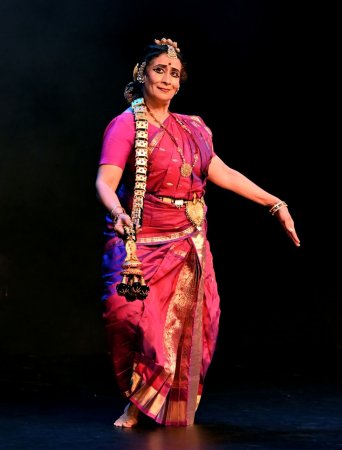 Vyjayanthi Kashi as Satyabhama 'Veni Vritantam' depicted the story of the traditional braid, the alankara aharya of the Kuchipudi dance, through which was made known that this braid holds special meaning in the Kuchipudi tradition. It explored the legendary origin of Satyabhama's braid - not just as an ornament, but as a symbol of cosmic beauty and spiritual power. Crafted by Vishwakarma, the celestial architect, the braid is said to contain the essence of the universe - Adishesha, the Sun and Moon, divine pairs, the 27 stars, and tassels representing the zodiac signs and the three worlds. Rooted in Soundarya Shastra and Tantric philosophy, the braid's movement is believed to awaken the chakras and balance the five elements within the body. Passed down from Saraswati to Mohini, then from Indra's consort to Satyabhama, this divine adornment finds its final home in the beloved of Krishna. 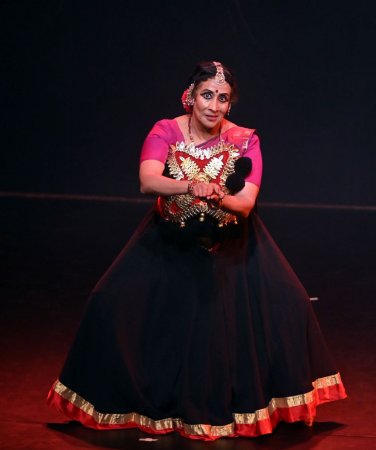 Vyjayanthi Kashi as Pootana 'Krishna Charitham' was a piece rich in theatrical expression and abundant in Aharyabhinaya of the Kuchipudi format. 'Pootana vadha' brought out the costume and makeup part of the aharya abhinaya. The performance by Vyjayanthi Kashi showed her great abhinaya prowess. She managed to convince the audience through her gestures and movements the demonic qualities of Pootana. After Pootana is ordered by Kamsa to kill baby Krishna, she transforms herself. Here the use of thirai in Kuchipudi format was clearly indicated. At first, she shows her face and performs an enchanting dance as a transformed woman. In spite of becoming a Tripurasundari, she shows her inner nature when things do not go her way. The change of character was well enacted by Kashi. Here, the red dress and red lighting, perhaps, accentuated the use of rakta varna as a makeup tool. Bharata says, 'As the moon illuminates the darkness of the night so will the abhinaya of the body, if used to combination with the varied hues of the face, be twice as beautiful'. The change of the patra from bad to good, along with the music, costumes and lights totally drew the attention of the audience to the presentation. The performance concluded with a mangalam, reinforcing that bhakti is the highest form of aharya, the truest adornment that unites the soul with the divine. The ensemble dancers were Prateeksha Kashi, Ashwini C, Abhirami, Hima Vaishnavi, Shivani Avadani and the sculptures were students of Guru Shamal Pawar, Atharva School of Dance, Mumbai. The presentation was performed to recorded music that supported the dance performance excellently. An interaction with Kashi later, gave in-depth understanding on aharya of Kuchipudi nrityam. How did you approach this concept of aharya when given to you? When I was invited to present a theme based on Aharyabhinaya, my first thought was to explore Shilpa Soundarya - a journey both exciting and challenging. I turned to the Naṭyasastra, particularly the chapter on Aharya, and found striking relevance in the adornments and stylizations depicted in temple sculpture. Indeed, these sculptures are a tangible, living expression of Naṭyasastra. Every detail - from scripting and music, to tempo, stage design, aesthetics, and ornamentation - was meticulously planned to reflect the sculptural beauty in adherence to shastric principles, all while staying true to the chosen theme of Aharya. And I concluded the piece with a powerful visual - where dancers become the sculptures, and in turn, the sculptures come alive through the gaze of true appreciation denoting a deep relation between dancers and the sculptures. Even today, the costumes and ornamentation in these sculptures remain exquisite, timeless, and breathtaking. Many thoughts and questions stirred within me. Is it only the external beauty and ornamentation that matter? Since Veni vritanta theme holds special meaning in the Kuchipudi tradition - and is visually and philosophically layered - I chose it as the second piece in our presentation. It not only brings out the grandeur of Aharyabhinaya but also invites us to reflect on the mystical and symbolic power of adornment in the classical arts. 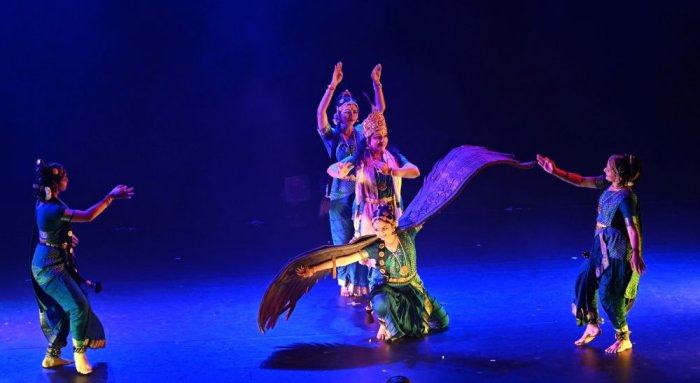 A still from Krishna Charitham I chose to conclude our presentation with Krishna Charitham - a piece rich in theatrical expression and abundant in Aharyabhinaya. The choreography of Pootana Vada blends lasya and taṇḍava, showcasing the duality of human nature - grace and aggression, divinity and delusion. From Krishna's attire to the appearance of Garuda, the changing curtain colors, and Pootana's transformation - from black and red to soft pink - every aharya element was thoughtfully designed to amplify the narrative.  Chandra Anand is a Bharatanatyam artiste and teacher. She has an MA in Bharatanatyam from Tilak Maharashtra Vidyapeeth, and her series on 'Education in spiritual values through Bharatanatyam' is featured in narthaki.com. |
