
|     |
|
| |

 Nimagna: An immersion into the Supreme Consciousness - AM Hari Shankar e-mail: hshankar252@gmail.com Photos courtesy: Parampara Foundation April 23, 2025 The field of Bharatanatyam has taken a massive leap in the past two decades with experimental and exploratory choreographies to widen the artscape of the dance form. A recent group production titled 'Nimagna', by the Bharatanatyam maestro Rama Vaidyanathan and her Ganesa Natyalaya Ensemble, was a testament to the faculty of creative choreography within the traditional realm. The event under the aegis of Parampara Foundation, known for hosting dance and music festivals in temples and heritage sites had this performance staged at Golconda Fort, Hyderabad, as the finale performance of the ensemble's series of concerts in Telangana-Andhra Pradesh region. 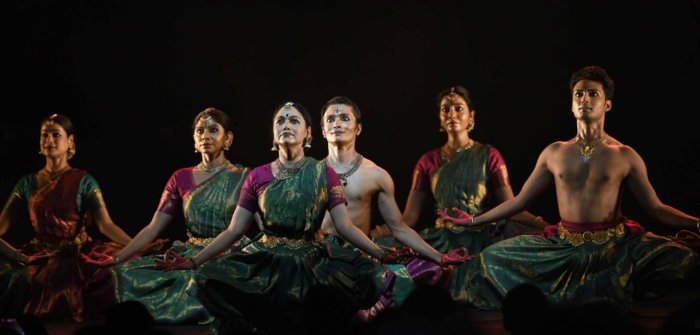 The surreal stage set-up with the backdrop of historic Golconda Fort had a staircase like prop, which unlike in many performances, had a pivotal role in the recital. The entire theme was conceived into five segments - Guru Sloka, Devi Stuthi, Swati Thirunal Krithi, Thyagaraja Krithi, Rasaleela. The foremost nritta item had Sannidhi Vaidyanathan on mridangam, Rajat Prasanna on flute and Rama Vaidyanathan herself on the nattuvangam, all seated on the stairs with five of her disciples draped in green-magenta combination costume, performing swara jathis. The gradual progression of expanding number of dancers on stage in twos and threes kept curiosity among the audience, totaling it to fifteen stalwarts. Their strong footwork in the segmented jathis unveiled their competence. Even the basic adavus, when represented with a novelty in execution, earned much appreciation. The catch of Rama's choreography is her adherence to the conventional outline with an adapted design in concept and dance composing, novel and invigorating. The succeeding Guru Sloka, paying obeisance to their revered Guru Saroja Vaidyanathan, had Rama's junior team led by Pritam Das, a senior disciple and an acclaimed dancer himself. This piece had 4 verses - "Gurur Brahma", "Akhanda mandalaakaram", "Agyana timiraandhasya" and "Sarva shakthi, Shirorathna", from Guru Stotram by Adi Shankaracharya with several repetitions of Thasmay Shri Guruve Namah. Each verse was enriched with differently paced jathis. The portrayal of Guru, atop the staircase and devoted disciples following the path enlightened by their Guru for the ultimate knowledge was well deciphered to reflect a moment of gratitude for the striving and sacrifice each guru makes for their disciples. This was evinced by a parallel sight of Rama and her disciples, which subtly reinforced the significance of Guru-Shishya tradition. 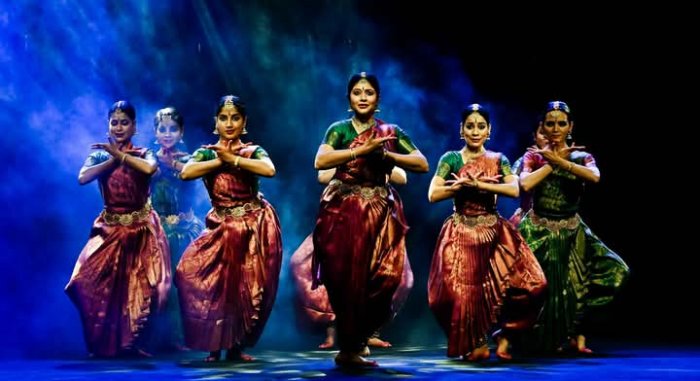 Kamakshi Stuthi led by Dakshina Vaidyanathan, eulogizing the feminine energy with a rare Muthuswami Dikshitar Krithi, "Sringaara Rasa Manjari Sri Kamakshi Gaurim Srita jana kalpa vallari chinthayeham" in the evocative Rasamanjari ragam painted many hues of the divine energy. Dakshina depicted the lotus like, fish like eyes of Kamakshi, with the dancers on the staircase with themed lights depicting lotuses blooming and floating in the river. The dancers' calm nuanced movements of the torso was done with utmost delicacy. Soulful rendition by Sudha Raghuraman was par excellence with her distinct sensitive style of singing. A virtual pilgrimage to Kashi was hosted by the ensemble with a Swati Thirunal Krithi, "Vishweshwara Darshanakara chala mana tum Kashi" in Sindhubhairavi ragam. The depiction of men entangled by their Karma and repeated cycles of life and death, trying to climb the stairs to reach up to Shiva at the top, for Moksha (salvation) had analogy of devotees' visit to Kashi, the sacred space where the soul consciousness and renunciation reach an elevated level. The representations of Karmic cycles, death and pyre was done as much relatable scenes on the ghats of Varanasi. The skillful delineation of Ganga aarti with dancers sitting in semi reclined positions with earthen lamps and the wavy movements visualized the drifting diyaas in the blissful waves of Ganga and with apt lighting of near darkness, it literally took everyone into Kashi to introspect upon their Karma, Bhakti, and Consciousness. 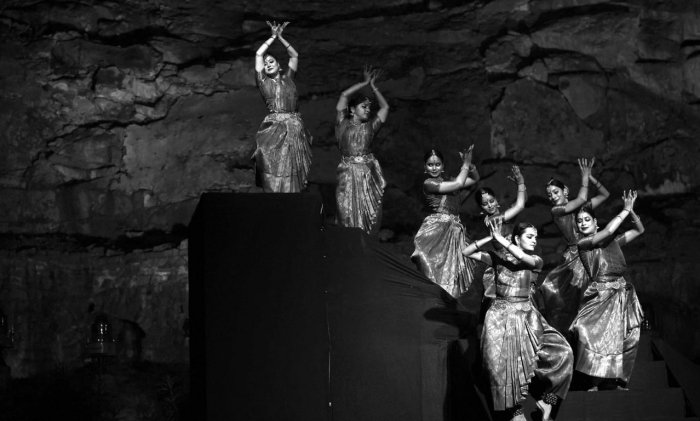 The exquisite Thyagaraja composition Samaja Vara Gamana with the majestic gait of Rama and her daughter Dakshina was absolutely a mind-blowing experience. The happiness in seeing such synchronized dancing of the mother-daughter duo was endearing and exceptional, that one could mark happiness of the audience from the non-verbal appreciative reactions midway of their exemplary posture pauses. The dancers who later joined created atypical patterns, with numerous unexpected foot works. The versatile K. Venkateshwaran's voice resonating in the fort was bliss. The varied ways of recitation of "Veda Shiromani...." explored the technical abilities of these well trained dancers like a saying goes in Malayalam - Pachilayum Kathrikayum (as tender leaves and scissors - so sharp and precise). The essence of Hindolam reciprocated with the swaras between charanam. The dance production concluded by Krishna's Rasaleela representing eternity and timelessness, symbolizing the continuous rhythm of the universe. In this, when Krishna dances with the gopis, the dancers gravitate in a circle, reiterating the ultimate truth of the continuity of life - of the soul and the cosmos. By surrendering their body and soul to Krishna, the gopis experience the aesthetic bliss of oneness with the Almighty. Commenced with slokas from the Bhagavatha Puranam and followed by a conclusion on Surdas Bhajan, "Murali naad sunayo, aaj Hari adbuth raas rachaayo" was an ethereal experience. A crescent moon, cool breeze of emerging spring, the majestic Golconda, what more than this illusive night a dance enthusiast could ask for? The Radha-Krishna duo and the gopis gyrating illustrated the cycle of birth-death, all culminating in the bliss of the unison with the Lord as Yogeeshwar. Pritam Das as Krishna nailed it with his mastery in technical and emotive virtues. The sketch of nature, cowherd all rejoicing in this universal union of the erstwhile devaganas as gopikas who have surrendered their body, mind and soul with the ultimate Brahman, evoked a spiritual exhilaration among the spectators as well as urged them to envision the rasleela beyond a romantic episode in Vrindavan to a much superior spiritual consciousness. 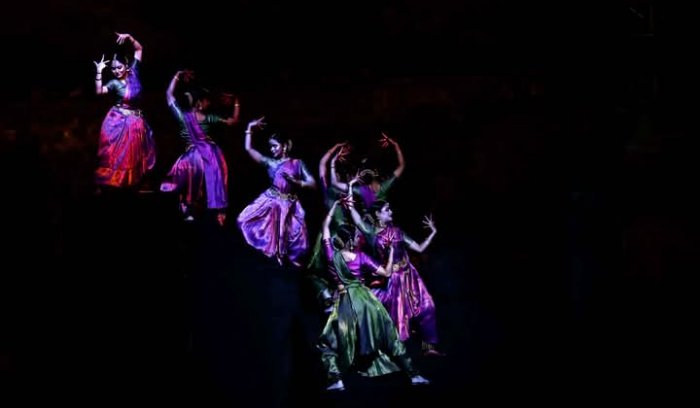 Each dancer of the ensemble was critical for the production and the male dancers Pritam Das and Nilava Sen warrant a special appreciation for their dexterity and non-effeminate approach in dancing, shattering the stereotypic notions. This magnificent performance was on pre-recorded music with a bunch of artistes in the long list. Infusing different instruments ranging from mridangam, tabla, ghatam, pakhawaj, and sitar in Bharatanatyam, added much diversity in terms of music. With over thousand spectators honoring the dancers with a standing ovation, it was perceptible how deeply the presentation got them immersed (Nimagna). Adopting global themes from the traditional compositions can be attributed to Rama's wider reach to audience. Moreover, the contentment was to see her proficient disciples ensuring a sanguine future for Bharatanatyam.  A M Hari Shankar, an art enthusiast, percussionist and a connoisseur of Indian Classical Arts is a Biologist-Educationist by profession, based in Delhi. Recipient of the Ministry of Culture Scholarship, his areas of interest include Life Science, Indian Arts and Spirituality. Some of his articles have been published in leading journals and newspapers. |
