
|     |
|
| |

 35th Pt Durgalal Festival and Anuttar - Vijay Shanker e-mail: vijaydance@gmail.com March 30, 2025 35th Pt Durgalal Festival - Tributes to the great mentor Photos: Suresh Muralidharan The 35th Pt Durgalal Festival was organised by Sam Ved Society of Performing Arts at Veda Kumba theatre auditorium in Andheri, Mumbai on 7th March with enthralling performances by Priyadarsini Govind in the Bharatanatyam style and Vidha Lal in the Kathak style. It was interesting to watch the contrasting distinction of two diverse classical dance styles, belonging to the south and northern part of India on the same platform, in the presence of a packed audience. Kathak exponent Uma Dogra is an ardent disciple of Pt Durgalal of the Jaipur Gharana, who was acknowledged as one of the best male exponents of the country. His passing away while he was in his early forties, was shocking for the entire cultural fraternity. Nevertheless, his legacy moves forward with devoted performers like Uma Dogra, who after migrating to Mumbai has been organising the Pt Durgalal Smruti Samaroh, for over thirty five years, by inviting established performers to perform and also as a tribute to the great maestro. 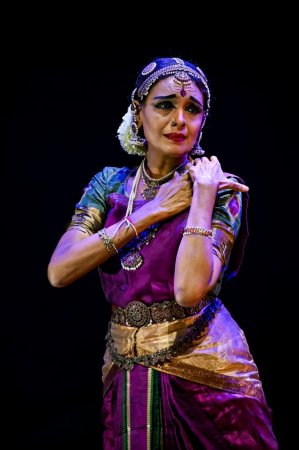 Priyadarsini Govind The program commenced with the intense abhinaya oriented performance by Priyadarsini Govind, with the interpretation of a Kshetragna padam "Ninnu Jugajininnu" exploring the plight of the Proshitabatruka nayika, who recollects the moments of union and happiness but suddenly realises that he is not around and is disappointed. The audience was elated to witness varied sancharis with subtle glances and bodily movements, that would convey the restlessness of the heroine. Choreographed by Guru Rajaratnam Pillai, this was a fine start to her evocative performance. The light hearted Javali reveals that the man who she is in love with is so handsome but does not care to look at her, so what's the use? In another verse from Amarushatakam, the dancer reveals the contrasting position of the lovers as they sit diagonally opposite to each other, failing to look at each other but after some time the eyes meet and the silence is broken. This was an innovative number in which the dancer in a seated position, interpreted the contrasting expressions with slight moves whenever necessary. Ultimately, it is the netra abhinaya with simultaneous bodily moves that interprets the emotional intensity of the contrasting lovers. Priyadarsini also performed the Purandaradasa composition "Jagadhodharana" incorporating the vatsalya of Yashoda, as she treats little Krishna as an ordinary child by scolding him for his naughtiness, in spite of realising that he is no ordinary child. Priya concluded her performance with a Ashtapadi "Kuru Yadunandana" as Swadinapatika nayika as she completely controls her lover. Priyadarsini Govind received a standing ovation for her elevating and expressive performance. 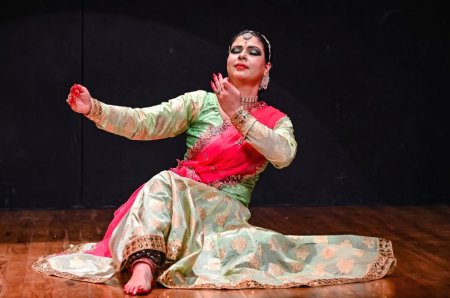 Vidha Lal The next performer of the evening was a complete contrast. Vidha Lal from New Delhi created a lasting impression with her vivacious and meticulous performance. Unlike most Kathak dancers, her 'pravesham' was quite different, as she appeared gliding on to the stage in a seated position, which was a surprise and unusual start to her performance. She commenced her performance with Dhrupad Vasant that incorporated the beauty of flora and fauna in Vrindavan as Radha and Krishna meet and dance in joy, celebrating the beauty of love and nature. This number was a fine combination of expressions and rhythmic charm in taal Dhamaar. After the varied and complex footwork pertaining to tatkaar, tukde, bandish etc, Vidha performed a beautiful and expressive number in which Muslim poet Ras Khan shares his devotion for Lord Krishna with "Saviyya" in which Radha is quite fascinated by the peacock feather of Lord Krishna and is jealous as she sees the flute as another woman who he is closely attached with. She feels deprived of the intimacy that she craves for. Vidha Lal is the disciple of Guru Gitanjali Lal and she concluded her brilliant performance with a fine jugalbandi with the tabla maestro. The competent musical team consisted of Hiren Sathe on the tabla, Ashish Gangani on pakhawaj, Manoj Desai on vocal and Alka Gujar on sitar. It was a fine tribute to a great maestro. Anuttar - Portraying bold social messages Photos: Innee Singh Anuttar was presented by Shovana Narayan along with the Asavari Repertory in collaboration with Pathways World Schools at the Kamani auditorium on 9th March. Anuttar was a thought provoking presentation dealing with stark realities that is misinterpreted, ignored and overlooked by the society in large. Shovana Narayan succeeded in drawing the attention to problems faced by the ostracised and marginalised section of the society, the victim girl child and her mother and the story of Gandhari who was forced to marry against adversity. Shovana and the Asavari Repertory received a standing ovation for having stirred the souls of the packed audience. Veteran writer Mulkraj Anand had once asked a classical dancer, "Can you dance the suffering of people, the pain, the agony, the poverty of the common man?" This statement was recollected after I witnessed Anuttar as it was so relevant and as to how classical dance can be used as a medium to reach out to people dealing with their problems and how the problems can be solved with a rational outlook for the betterment of life and the well being of the society with a larger and broader perspective. Furthermore, Bertrand Russell in The Value of Philosophy states, "Questions enlarge our conception of what is possible, enrich our intellectual imagination and diminish the dogmatic assurance which closes the mind against speculation". Anuttar - dance drama in three acts - is an analytical and introspective journey that opens the door to hidden facts and varied aspects of the characters. It draws awareness of the problems and challenges faced by women, the girl child and the marginalised section of the transgender sections of the society and attempts to understand the emotions and provocations from the perspectives of the characters themselves. 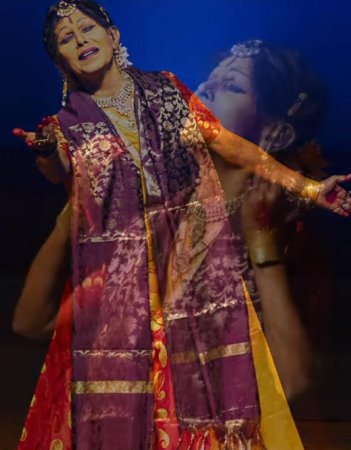 Aakhir Kyun Act One "Aakhir Kyun" commences with the scene of a wedding, where the transgender are intruders who attend the wedding. They are welcomed by the elders as they are aware that for any auspicious occasion, the blessings of the transgenders is considered vital and necessary for a happy and peaceful marriage but the youngsters ridicule the transgenders and they retort, "Is it our problem that we can born different?" Nevertheless, the writer of the script Shovana Narayan asks the pertinent question that when we worship Lord Shiva as "Ardha Nariswara" (Half man Half woman), why can't we accept the transgenders the way they are and provide them the concern and love they deserve like normal beings? In fact, in every person, the feminine and masculine aspect is there, although they may be biologically different. Male dancers were attired in sarees in order to distinguish the male and female aspect of every being. With expressions and simple body movements, Aakhir Kyun made a fine start to the thought provoking presentations. 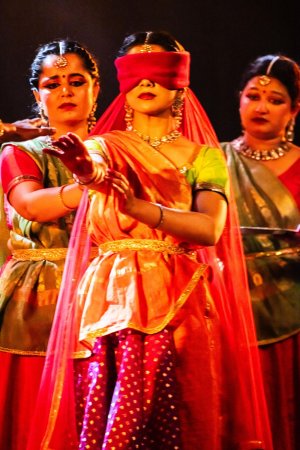
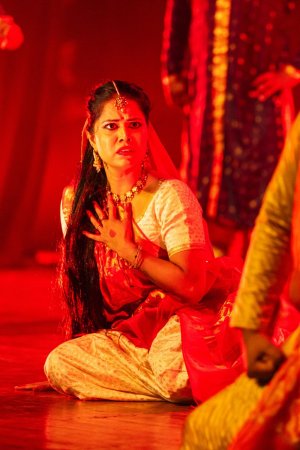
Act Two throws light on the suffering of the royal family of the Gandhar - dilemmas of Gandhari, the sister of Shakuni, who was used as a child bearing machine by the powerful Kuru dynasty. Her refusal to marry the blind Dhirtarashtra would have enhanced the violence and bloodshed where the abuse of women and children of the over powered and defeated Gandhar state was certain. Gandhari was helpless and hence married the blind Dhirtarashtra and accepted darkness in her life. Here again, it is the women who suffer the most and has to bear all the sacrifices for the pleasure of others, at the mercy of the powerful men. 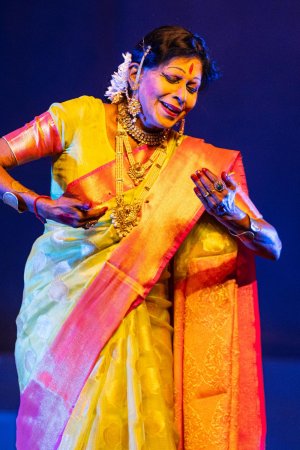 Shovana Narayan 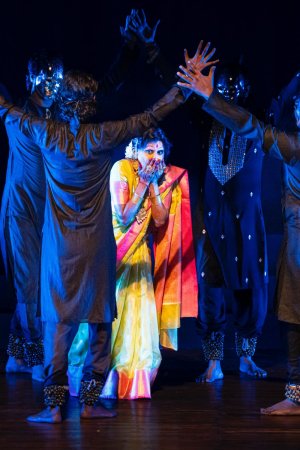 Toota Yeh Vishwas Kyun The last act again targets the young girl and her mother; the young girl is abused by her own father. "Toota Yeh Vishwas Kyun"? - How did the faith get distorted? The trauma faced by the victim and victim's mother are often not understood by the society at large. This was based on an actual incident in which the young girl commits suicide and the father get a clean chit. In all the three presentations, it was the characters and the theme that dominated the presentation. With Kathak as the foundation for expressions and movements and with suitable music, the three acts succeeded in drawing attention to bitter realities of life that are not attended with the human perspective, hence most people suffer and die before their actual death. Kudos to Shovana Narayan for such thought provoking subjects that is the need of the hour, in order to instruct, educate and enlighten the audience. Concept and direction by Shovana Narayan, music by Pt Madho Prasad. Asavari Repertory featured Shovana Narayan, Komal Biswal, Pallavi Lohani, Suparna Singh, Mahima Satsangi, Praveen Parihar, Asish Kathak, Vishal Chauhan, Mayank Gangani, Chanchal Prasad, Hitesh Gangani and Gaurav. The musicians were Ustad Shakeel Ahmed Khan (tabla), Pt Madho Prasad (vocal and keyboards), Pt Mahaveer Gangani (pakhawaj), Azhar Sakeel (violin) and Pt Ajay Prasanna (flute). Lights were by Nitin Jain.  Vijay Shankar is a Kuchipudi and Kathakali exponent, teacher, bilingual journalist, arts critic and actor. |
