
|     |
|
| |

 She-Shakti Rupena by Anurekha Ghosh and Company - Dr. Nita Vidyarthi e-mail: nitavidyarthi@gmail.com Photos: Anudeepa Majumder and Ranjit Das February 17, 2025 An evening sponsored by Infosys and Bharatiya Vidya Bhavan, was dedicated to social voice through dance and music titled 'She-Shakti Rupena' and was mounted by Kathak dancer Anurekha Ghosh (erstwhile from UK. trained under the virtuoso Nahid Siddiqui) and Company and her disciples of Natmandir. To ascertain the fact that Art, for that matter dance, is not just for entertainment but a medium for social and cultural awareness and education, acclaimed Kathak exponent Durga Arya from Germany and other seasoned dancers of different classical disciplines in the city joined Anurekha with their performances to support her endeavour at Gyan Manch, Kolkata. Recipient of the coveted "Dasha Bhuja Samman - Ami Nari Amio Pari" (I as a woman can also be an achiever) Award for Outstanding Cultural Dance Choreographer of the Year 2024 recently, her work exploring the power of women is not just limited to dance and dance-theatre but also to dance films like the recent Mata Kalika: The myth of the dark Goddess Kaali, a protest film "No Abuse" Seeking Justice: Women United Against Oppression, the choreography based on famous poet Subodh Sarkar's impactful poem, "Rater dakhol nik meyera" (Women should reclaim the night),"Ulongini nache ronorongey" (the title song of Tagore based on the fiery lyrics on Goddess Kali), and many others, successfully. With her extensive training, research on mythology, stressing the attributes of the Mother Goddess Durga and her dark counterpart Kali, she has embarked on their power and proved that Art can and does enlighten and enrich the society. Her work, especially the successful presentation 'Aloye Durga' last year, concentrating mostly on the "Dark Goddess Kaali" provide meaningful insights into looking at the power of women - Nari Shakti and Nari roop (beauty, dignity, identity of women). Her choreographic innovations imbued with different partial art forms, have sensitive, strong literary and mythological inputs penned by famous poets, personalities, musicians and lyricists of Bengal and have received critical acclaim from the connoisseurs, classified as well as the general audience leaving a long lasting impression. So, her offering 'She' was a premiere powerhouse of who the Mother Goddess is through dance, music and theatre. "She is an epitome of Shakti, between She is Multidimensional, She is calm and serene, She is the symbol of beauty, life and of death, She is fearlessly independent She is grace and dignity." And these lines occupy the colourful poster at the backdrop of the stage and feature in the production. The evening commenced with the stotra "Namastey Jagat Tarini" as a salutation to the Mother followed by a well-rehearsed group dance with bold steps, by nine members of Natmandir, set to the popular song "Jaago ma jaago Durga jaago dashaprohorohodharini" by Priyasmita Ghosh evoking the Goddess. Presentations by reputed dancers portraying "She" were garlanded one after the other weaving them gradually towards the main production 'Shakti Rupena' by Anurekha Ghosh and company evoking the Durga in every woman to raise voice against violence and injustice to them. 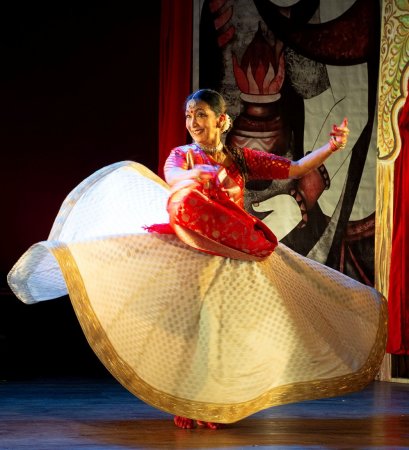 Durga Arya 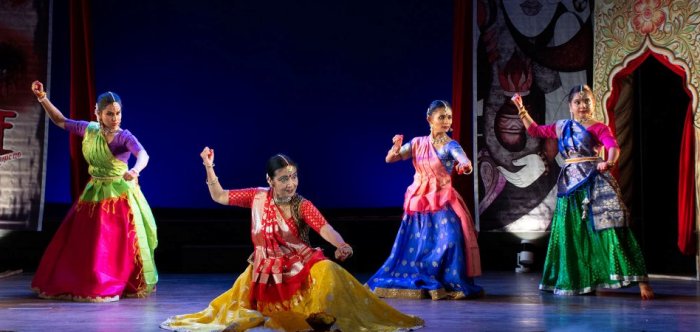 Durga Arya & group The consummate Kathak dancer Durga Arya began with the striking solo, "Matri bandana" after her salutation "Jaago ma", a snapping taatkar embellished tihai and then a nritta based "Vani udayani jaya jaya Durga jaya ma", an energetic and beautiful tukhra adorned with a series of perfect chakkars replete with a series of sargams. Definite toned body tension and crisp tala exactitude was tinged with articulate resourcefulness of the Lucknow gharana with its emphasis on aesthetics and grace. Her stress lay on the treasured recitals of tatkaar, (bhav nritta) her pure dance numbers and her depth of knowledge and creative wizardry of intricate rhythms. It was a real pleasure to watch this item sung by Deepabali Dutta. Durga Arya's final number was a soft joyous Sawal Jawab. Proficiency of her teaching skills was evident in a later group number together with her disciples who gave a good account of themselves in grasping the rhythms of the Durga Kavit (pure dance number) "Jaya Durgey ma Jagatatarini shankha chakra gada trishuladharini" composed by Guru Divyang Vakil. The bol paranth for this number was by Anurekha. 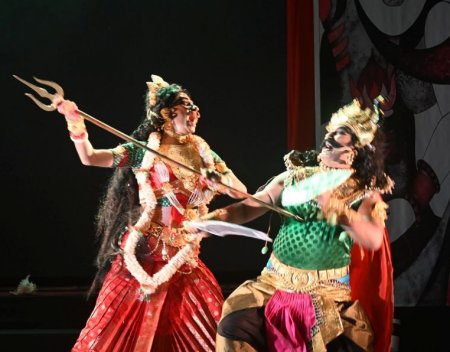 Arpan Sarkar as Mahisasuramardini A grand entry of the Bharatanatyam dancer Abir Arpan Sarkar as Mahisasuramardini in stree vesham saw him in the description of majesty and power of the beautiful Mother Goddess in his presentation "Parama Mahisasuramardini" as she arrives to banish the demon "Mahisasura". To the strapping dancer, "the prime power is not a symbol of male or female. It is not bound by gender - it is a supreme power. The gender crux is not between who is the superior, male or female. So irrespective of the gender and while discarding it, the attention should be given to the character and the qualities - the fight is between good and evil." He justifies himself to be in stree vesham! Set to the famous song "Jatajuta samayukta" from Sri Sri Chandi describing the Goddess, Arpan began from the rhythmic antara of the stotra "Nava yuvanasammpanna sarvabarna abhushita, Sucharu vasana". Replete with lasya movements, angularity and grace of the upper and lower torsos, fluid hand movements and beautiful hasta mudras and heavily bejewelled dazzling Arpan, clad in gorgeous costume showed not only his command over the dance form but stamped his tall, stately presence as the majestic Durga and a brilliant dancer. His dynamics as Mahisasuramardini while killing the demon showed strength and power. Dipanjan Ghosh as the raging Mahisasura did the needful and proved his presence in the final sequence. A stunning item indeed! 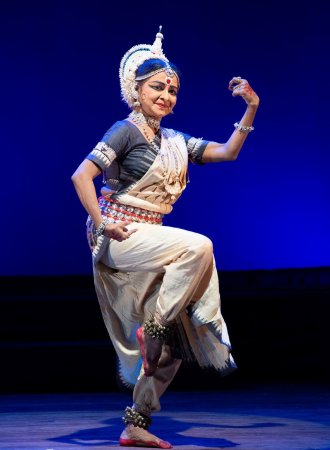 Rina Jana Odissi dancer Rina Jana's rendition with the lilting, melodious "Ke re kamini naba damini asuranashini" (Who are you, my pretty lady, slayer of asuras?) set to Hindustani ragapadhan - not Odissi music for a change - in madhyalaya, brought to the fore her rare distinction of quality, style and classicism. However her performance would have been better enjoyed if the singing could rise above mediocrity and match Rina Jana's vivacity of expression, grace befitting the grandeur of Goddess Durga as Mahisasuramardini and high standard of dancing embellished with bhramaris and chiselled movements Odissi. 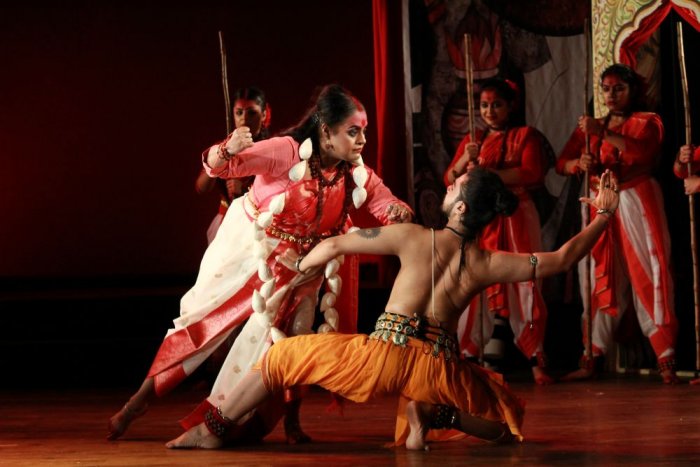 Anurekha Ghosh & Sumanjit Chakravarty Anurekha Ghosh's entry for the duet 'Purush-Prakriti' with Odissi dancer Sumanjit Chakravarty (who joined later) to introduce the concept of the evolution of Shakti, was a precursor to the presentation Shakti Rupena. While exploring a slower, more rounded vocabulary using less numerical complexities of tala, Anurekha, with very gently animated movements and narration (by her) concentrated on the interpretative side of the dance repertoire. She revealed through her narration and dancing, Adi Parashakti, which represent the cosmic power of the Universe, as eternal pure divine consciousness that is Shunya Bindu, the Zero Divine Energy, which is then expressed as Prakriti or as Universe Nature. Hence Adi Shakti is Param Prakriti. Adi Shakti is the ancient power of planet Earth, and Shakti representing the same power or true nature that metamorphosed from one to another, available on earth, all of these being supported by illustrations on the large screen behind and her narration. The different forms of Shakti were an indefinable stimulus which inflamed the fiery production 'Shakti Rupena'. The performance text also considered the "Samadhi and Nirguna" states of Lord Shiva (who is also Mahakaal) of the stotra whose effect Odissi dancer Sumanjit Chakravarty magnified with sharp, definite and clear movements with a mash on rhythm, followed by featuring the birth of Durga and her nine appellations (Nava Durga-Shailaputri, Chandraghanta, Kushmanda and others) considered in Hindu mythology to her nine stages during the nine-day war with Mahisasura who was killed on the tenth day. 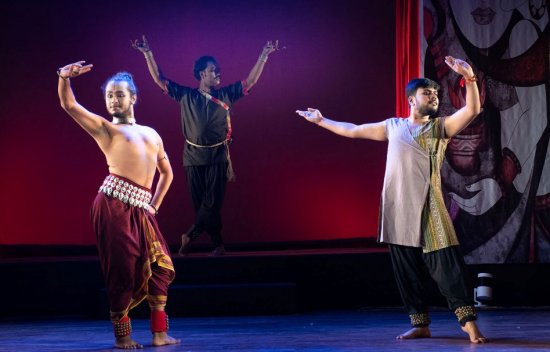 Soham Swar, Pritam Chakravarty & Arindam Roy The definable reality or duality of light and darkness, knowledge and ignorance, purity and impurity and finally the equilibrium between all opposites were represented by Anurekha as Prakriti and Sumanjit as Purush. Three strong male dancers, Arindam Roy (Kathak), Soham Swar (Odissi) and Pritam Chakravarty (Kalaripayattu) were featured in an energetic trio presentation in three different styles. However, their appearance at this point was not quite clear. The three appear later in turns to be banished by Durga one by one. And when Sumanjit as Shiva arrives on the platform with the backdrop of a brilliantly illuminated screen and the rising sun, Anurekha performs Surya namaskar and Surya puja as celebration of the source of cosmic energy or 'zero divine energy'. She welcomes him with open hands with the refrain of Tagore's famous Brahmasangeet "Prathama aadi tobo shakti, Aadi paramojjawal jyoti tomaari hey gagane gagane". The orange-yellow splashed screen described it all. The duet between Anurekha and Sumanjit in 'Shiva Shakti' was a visual treat for the fine dancing with an unhurried quality about it and coordination between the two. Odissi dancer Sumanjit's encircling the stage with open hands showed fine body control with admirable flexibility in stretched Odissi movements as Shiva. His freeze as Nataraja and Shiva in Dhyanamudra with chiselled hastas was a meld of intensity and grace and a captivating imagery of tranquility. 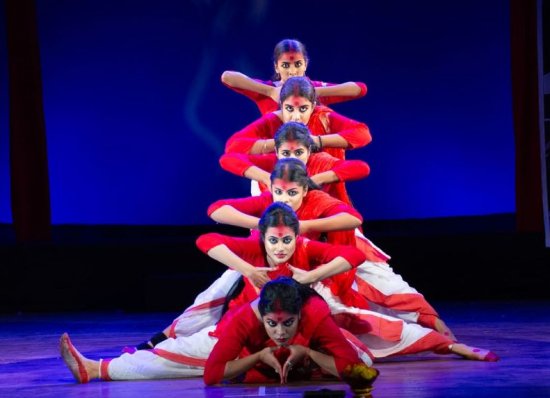 Dancers of Natmandir Aklanta Majumder surprised the audience with the shift from her role of the compere of the evening to a well-trained dancer on stage with a short and pleasing item set to the song "Ei sharadeyro jhanja banchey nisharo seshey roudra matey" (The rise of the sun spreads happiness and saves the turbulent autumn night) celebrating the destruction of the evil force on the tenth day. Two other choreographic presentations of celebrations by students of Natmandir were enjoyable. The production moved on towards 'Shakti Rupena' through the lens of Devi Durga, beginning with a vibrant group presentation of Bhairavi Vandana "Shivadyuti swarupena advaita ...Bhairavi namastutey" using lengths of bright red lengths of cloth. With strong movements, foreheads red, smeared with vermillion and energetic dancing, they displayed that she is the ultimate manifestation of the Divine Feminine, powerful and all fierce and compassionate at once. Two numbers ''Ya Chandi," and "Aiyi Giri Nandini" (dance by striking long sticks on the floor with the rhythm) were followed by a fighting sequence set to "Ya Devi Sarva Bhuteshu Shakti Rupena..." (and other attributes) with the appearance of Durga and Kali, who is the feminist icon we need today. 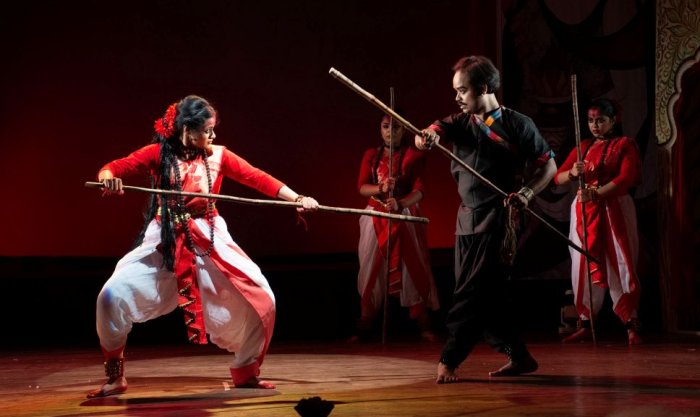 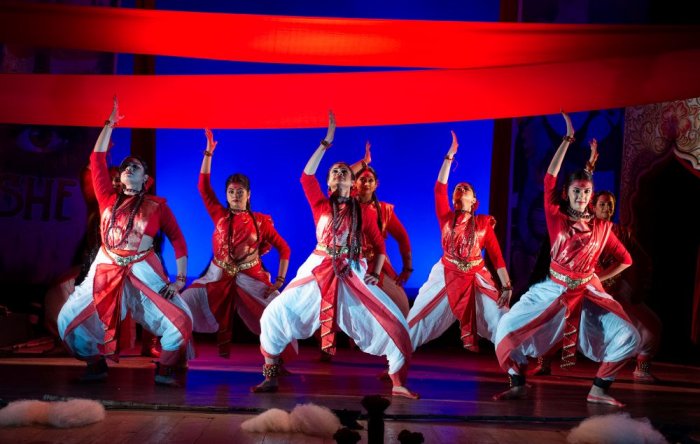 Shakti Rupena Anurekha with a human skull and kharga (sharp weapon with a convex head) in her hand, breaks into a violent dance with the Kavit "Tarata tara asura dalani jagatjanani jai bhavani" followed by "Mata Kalika" choosing Kali as an icon by women. The rhythmic joyous group number "Ulongini nachey rono rongey aamra nritya kori songey" penned by Tagore speaks of women dancing with the naked Goddess. Selected songs and strotras from the famous earlier recording of Mahalaya in All India Radio Kolkata, immortalised by legendary Birendra Krishna Bhadra in narration, Pankaj Mallick and Bani Kumar in music composition of the Golden Era of Bengali Music were weaved into the choreography with fine structural logic by Anurekha with inputs by Debojit Mukherjee. The final presentation 'Tilottama' was heart-wrenching with Anurekha and others breaking down with a loud cry "Kando Kolkata" (Cry Kolkata) on stage rekindling the demand for justice for violence and crime on women in the city once again. The dancers marched across the stage waving the red cloth with the recorded cult song "Pathe ebar namo sathi", a call composed by the legendary musician Salil Chowdhury during the IPTA days and the visual of a protest procession in Kolkata months before. The capacity audience stood up, some with closed fists and wet eyes raising their hands lending their voice to this number. The moving experience created a closeness between the performers and the audience emotionally as well as intellectually. Silence followed. Able support came from accomplished musicians Sunando Mukherjee on the sarod, Subir Thakur (tabla) Deepabali Dutta (vocals), light design by Uttiya Jana and concept, script, direction, narration and choreography by Anurekha Ghosh. The production "She" communicated the demand for justice for women to the highest level among all recent presentations in the city through dance.  Dr. Nita Vidyarthi is a veteran critic of performing arts and writes on dance, music and theatre in leading publications. |
