Response to Anita Ratnam’s A Million Sitas
Photos: Ari Ress
May 26, 2015
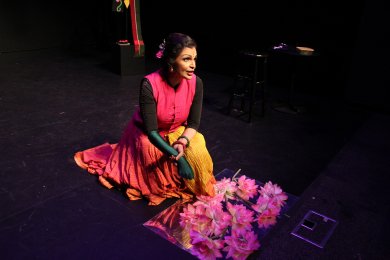
Storytelling in the Classroom, Spring 2015
Dr.
Anita Ratnam embodied the epic in her performance of The Ramayana at
the Provincetown Playhouse on Sunday, May 3. In a performance that lay
at the intersections of theater, dance, music and storytelling, Ratnam
and her two musicians explored the ways women have moved history forward
throughout the ages. She performed for a packed house full of community
members and students across ages and nationalities. The audience was
rapt withal, occasionally laughing at an aside or a particularly self
aware line about relationships between men and women, but mostly
silently taking in the story.
I came into the space with some knowledge of the content and with much
hype around Dr. Ratnam’s work. I knew there were questions around
whether her performance was traditional storytelling. I also entered
with my own desire to learn more about Indian mythology and culture.
From a visual standpoint, the show was breathtaking; the choreographed
movements, colorful fabrics, intricate masks brought the story to life.
Ratnam embodied many women in the story, as well as animals (she
portrayed a frog with a neat green glove and hand movements) and
elements. Interestingly, she did not portray men, and two masks for the
main men in the story flanked the stage and framed the action. The
moments Dr. Ratnam sang and danced were where she seemed most activated,
as if the story was flowing through her and she was merely a vessel for
the action. The moments Dr. Ratnam spoke added a layer of removal from
the story in a curious way, though I am still processing if that was
reflective of her performance or my own perception in the audience.
I struggled to follow the story, as there were many characters involved
and the plot jumped from backstory to current story. At the end of the
performance when Dr. Ratnam spoke more of her process, I was able to
understand better. In fact, I found the meta moments that commented on
the relationship between story and power to be the most impactful. For
example, at one point during the performance, Anita broke character and
turned to her musician and asked how many songs she knew about Rama
(Sita’s husband) and how many songs she knew about Sita. The discrepancy
(dozens for Rama and none for Sita) illuminated the ways that The
Ramayana has been filtered through a patriarchal lens to make Rama the
protagonist, not Sita.
Another powerful moment was when Dr. Ratnam entered the audience at the
end of the show and listed the names of “A Million Sitas,” women across
time and place and circumstance, as all being tied to this story, one of
destiny and agency. Her explanation of the role of the many women in
challenging and doing the work of fate clarified and made sense of what
had been a confusing performance for me. I also gained much from her
explanation of the way this story is (re)told in different ways in
India, with three main versions, and that her story was both a
descendent from those stories, and also distinctly her own.
In many ways, this performance fulfilled my understanding of
“classical,” “bardic” storytelling in its telling of universal truths
and moments of engaged sharing of myth with the audience. However, the
intentional feminist framing and blending of English with Hindi, and the
use of costume and prop and infusion of music and dance brought this
specific story to life in its particular beauty. Dr. Ratnam’s
performance proved the way we humans are, in the words of Erdoes &
Ortiz, “connected to the nurturing womb of mythology”, a mythology that
links religion, history and nature, a mythology that explains gender,
power and destiny, a mythology that makes sense of our world.
- Emily Schorr Lesnick
Seeing Anita Ratnam tell the story, A Million Sitas was a truly
captivating experience. Ratnam combined traditional text and classic
storytelling techniques with dance, music, and standard theatrical
conventions to bring the story of Sita to life.
Coming to the performance of A Million Sitas I was slightly hesitant.
This was going to be my first storytelling show and I was skeptical
about how the simple telling of a story can keep someone captivated for
the full performance. Luckily, I was pleasantly surprised that Ratnam
was able to do just that for the entire performance. I think multiple
aspects of the show allowed this captivation to occur, such as the
“nonconventional” storytelling Ratnam did as well as the audience
engagement and energy towards the piece.
Ratnam combined the story itself with dance, music, and more common
theatrical conventions to create a well-rounded performance. What I
loved about her doing this was that it showed different aspects of
Indian culture. I felt that I was able to learn so much more than just a
story from India, but I learned something about Indian music and Indian
dance as well as clothing and masks. I felt I was immersed in the
culture by the different aspects of performance that she brought in to
share. However, I seemed to have found myself questioning the
authenticity of traditional storytelling. With the use of sound effects,
costume changes, props, etc., I felt I was focusing on what was
happening to enhance the story rather than the story. In addition, parts
of the performance with these added theatrical conventions came off as
unrehearsed and slightly sloppy, which detracted from the performance
for me. I felt that the flow of the story was interrupted, just as if a
movie suddenly stopped playing and started again.
What was so interesting to me was the audience response during the
telling. First of all it was an audience comprised of primarily Indian
people and it was so fascinating to see everyone respond whether it be
verbally or physically to what Ratnam was sharing. I think it is
interesting to see how people react to their culture being displayed so
gracefully and respectfully even if it is not a common view just as the
story of Sita is in its relation to men of this culture. I felt that the
audience really completed the circuit of the performance and that we
were extremely valuable to the performance.
I realized storytelling performance can be extremely similar to Brechtian
theatre. For example, Ratnam told the story, reacted to the story
herself and also reacted to the story as a character but not at one time.
It seemed that her words were always as a storyteller and her body was a
character at times and then her body was herself at other times. In
Brechtian theatre, the performer shows themselves as the character, and
then steps out as performer and lets the audiences respond, and I feel
that was done here as well. It allowed me to react and make my own
opinions without being influenced, which I thoroughly enjoyed.
Ratnam’s version of storytelling seemed new and what storytelling could
be moving towards with the combination of different art forms and
theatrical conventions. However, I want to see true, traditional
storytelling, “campfire storytelling” if you will, and see what makes
classic storytelling so effective without anything extra to enhance it. I
think that would be a true, captivating, storytelling, experience that
would be great to be part of as an audience member.
- Kordell Draper
Anita’s Ratman’s telling of A Million Sitas was an engaging and
beautiful portrayal of women from Indian folklore. Anita brought the
stories of these women alive through costuming, dance, and
characterization. Her unique combination of traditional Indian dancing,
contextual explanations, and animated acting made for a powerful
portrayal that was accessible to all audiences.
My previous experiences with Indian storytelling have been through very
traditional dance and music. Past performances that I have seen have
been done completely in a native Indian language and all danced, with
each dance flowing seamlessly to the next. I appreciated that Anita kept
some of the traditional elements of this while breaking the dance and
songs to tell the story to an English speaking audience. Beyond the
actual story, Anita would also break to provide some cultural background
and explain how the gods are understood now in the Indian community.
There was enough narration and explanation in English for westerners to
enter into the Hindu epic, while also maintaining enough traditional
elements to appeal to Indian audience members as well.
Anita’s unique storytelling was characterized by her use of traditional
dance, suggestive costuming, and physical characterization of the women
she was representing. Since this epic follows four very distinct women,
Anita introduced each character with a unique dance and piece of
costuming that highlighted their personalities. After a verbal
description of the character, the dance and costuming allowed the
audience to really experience who these women were beyond words. The
dance set the mood for that portion of the story being told.
First, Mandodari, Ravana’s wife, was represented by a green glove
depicting her earlier life as a frog. Anita’s facial expressions and
movements through the dance were enticing and alluring. Then, Manthara
was contrasted with this character by wearing a tattered shawl to show
her status. She danced with a basket as a hunchback and made abrupt,
swift movements to show her desperation to remove Rama from power.
Later, Anita described Ahayla by her immense beauty. Anita used a simple
gray cloth to represent her elegant and majestic beauty. However, this
simple cloth was regally draped around her waist and shoulder as she
danced very gently and graciously to show Ahalya’s angelic
character. As Ahalya is cursed by her husband and becomes a stone,
the gray fabric is used to cover her and reveal the shame that traps
her. Next, Anita almost completely changes costumes to introduce
Surpanakha. Her dark flowing pants, witch like fingers, angered facial
expressions, and eerie movements help us to know that is a character not
to be trusted. Anita helped us to enter into the world of these women
through dance, clothing, and expressive movements.
The ending of the story helped the audience connect personally and tie
the stories of these women together. Anita ended the story about Sita by
handing audience members rose petals as she explained how we are all
Sita in the way that we share the struggles and adversity of women.
Handing us the rose petals helped us to think about how there is a bit
of Sita in our own lives. It was a way of connecting the stories of all
of this women and inviting us to remember our own as well. The
performance made me think of how women are depicted in religious stories
that I grew up with. Like Indian culture, women in the Bible are often
overshadowed by the dominating male characters. However, when you take
the time to really look at their stories, I see strong, very influential
women. It was very powerful for me to hold these petals in my hand
along with all the other women (and men) in the audience as I thought
about the remarkable story of these Indian folktales. The tangible
experience of the role petals also was a symbol of giving us the gift of
storytelling. It was a beautiful way to leave the audience at the end.
Although this was more performative than a lot of the work that we had
done in class, it did reflect a lot of what we had talked about and the
reading we studied. These stories were used as a way to pass on the
history of Indian culture, unite a community of women, and cause the
audience to reflect on their own life through the story.
- Megan Ibarra
It was a distinct pleasure to view the storytelling by Anita Ratnam at
Provincetown Playhouse. As a dancer who briefly studied
Bharatanatyam in my undergrad and in my years here in New York, I came
to this performance with a certain amount of understanding of the
inherent connection between storytelling and this specific dance form.
Remembering a wonderful storytelling my professor had shared while we
were in school - dynamically physicalizing his words with crisp and
expressive mudras (hand gestures) - I was curious to see how Anita would
blend this dance form with the traditional art of storytelling as we
studied it in our course this semester.
This was a very ambitious show incorporating props, recorded music, live
singers, jewelry and costume changes, talking, instruments, live music,
and dancing. The first element that I noticed was Anita’s choice to
work in a more upright (pedestrian) body position. Many of East Indian
styles incorporate deep bends of the legs, an angular triad of shifted
weight in the hips, torso, and head positions with Bharatanatyam being,
in my experience, especially grounded, rhythmic, and angular. I
found her more fluid style (going from extreme formalized movement,
through the natural body of the human storyteller - talking to the
audience and responding to them) allowed her to create a show that had
so much complexity, both in story and presentation. In researching
Anita a bit more through her website,
her approach to the performance became clearer. Blending several
movement styles and with this idea of striving for more freedom and
circular motion, she stated “I have learnt that the expressions of the
body are infinite and we need to unlearn some of our training in order
to open ourselves up to the entire vocabulary available to us as
dancers. In doing so we will not be unfaithful to our source for in
tradition is the basis of our cultural DNA and then we can begin to
become world citizens in the increasingly exciting world of art."
Some of the moments that resonated with me the most were the ones where
she took a single element (ex. green glove) and allowed that to identify
and transition her from one style of movement to the next. Having
the one prop that abstractly identified a character, allowed me as an
audience member to not only have access to follow her into the story,
but it let me fill in the gaps with my own story and imagination, while
carrying me to the essence of the story - the specific frame in the
storyboard. At times the multiple props became overwhelming - taking it
more into the theatrical element of “acting something out” versus
storytelling where I feel there is more space for the listener to be
part of the creation. In those moments, I felt like I was missing
details and was not given the same permission to trust what I was taking
from it. Another element that was very helpful in following the story
and the names that are less familiar to those of us in the audience who
do not know the language was her use of the masks of the two men - the
two characters who became the visual constants, while the women moved
around between and behind these men.
Her desire to incorporate her personal vocabularies and movement
knowledge, allowed her to uniquely present an epic story that has been
told, and retold, for centuries. Her focus on the female
characters was a refreshing way to view the story of Sita and Rama -
offering a through line. I realized again in listening to these stories,
that the storyteller’s cultural context still informs and embeds itself
into their focus and perspective - specifically in her choice to focus
on the women. Not understanding the role of women in that culture in an
experiential way, however, I believe that I missed some of the subtlety
that the East Indian audience members would have noticed. Often the
women were still making choices to place the men and their legacy above
themselves no matter what, and I would have appreciated a brief insight
(lecture demonstration, article or discussion) on what the traditional
role of the women is, and if/how the women in the story were going
towards or against that. Perhaps simply acknowledging their story
as a story worth telling is a big stance to take. For me to fully know
the meaning and purpose behind her choices as a performer - and her
artistic expression - I felt I needed a better understanding of her
social and cultural environment.
Overall, this was a thrilling experience and a story I was so happy to
have engaged with in this way. I look forward to following the
next storytelling series and can’t wait to engage these new approaches
into my classroom.
- Meggie Smith
A Million Sitas, Including Me
Anita Ratnam’s description as an “intersectionist” is an apt and
accurate characterization. She brings theatrical spectacle to
storytelling with the use of music, props, dance, and costume.
What strikes me as the most successful aspect of her performance, which I
have seen many one-man “shows” lack, is her easy integration of all of
the above. Her costume changes occur right on stage with little to
no disguising of them; she speaks frankly to the audience about her
purpose, giving life not only to the stories but to the audience as
well, and she even speaks to her assistants on stage (Ratnam) - no
fourth wall in sight.
Her use of props and gestures in dance particularly stand out. She
employs various fabrics throughout her storytelling, and she paints
such a vivid picture, she can turn those scarves into anything! In
particular, her use of a grey scarf to convey the sadness of Ahalya as
she turns into stone was haunting. In Ratnam’s dances her sharp
gestures do the storytelling for her, and this was especially clear to
me in her portrayal of Manthara the hunchback instructing the queen to
claim her two boons. I am certain there are many gaps I could not
fill when interpreting her dance. This type of storytelling reminds me
of Josephine Cho’s Korean storytelling in class - I could not tell what
exactly happened, but I understood the message of the value of honesty
quite clearly. Ratnam’s woman-centered themes were not lost on me,
however, even through dance.
Ratnam’s storytelling in another language besides English also created
gaps in the story for me. In listening to her singing and chanting
I was reminded of our collegial debate in class on the question of
“whose story is it?”. Being a non-South Asian and very unfamiliar
with The Ramayana, I noticed jokes or references at which South Asian
audiences chuckled or murmured, but were lost on me. I understood
that this storytelling was a feminist retelling of The Ramayana.
Ratnam explicitly shares as much with the audience, though she does so
briefly, moving on to making jokes on Rama’s behalf. At first
disappointed that there seemed to be a whole world of the story I was
missing, by the end of the storytelling, I found I was glad to have
heard this version first. After all in listening, “each person
creatively reconstructs the story being told through their own
imaginative response”. Even if I had heard or read The Ramayana
hundreds of times before, Ratnam’s retelling on May 3, 2015 would always
have been different to me than anyone else’s reception of it in that
audience.
My story, reconstructed in my mind out of hers, was confirmed when
Ratnam announces she is Sita and so are all of us. I understood
her story about Sita to be about the sidelining and silencing of women
both in India and around the world, both today and throughout
history. Whatever I might have “missed” on that stage did nothing
to hinder the impact of “A Million Sitas” for me, another testament to
the effects of storytelling.
- Melissa Sokolski
I was very pleased to have been able to make it to Anita Ratnam’s
performance this weekend. I was very eager to see the blending of
story and dance, particularly as I know many classical Indian dances are
based in story. While I am somewhat familiar with Indian dance, I
do not have much experience with Indian stories. However, after
hearing Anita, I realized that I have heard pieces of Sita and Rama’s
stories in other contexts (usually focused on Rama, as Anita pointed
out). In particular, the characters make an appearance in a story
in the 1990’s movie version of A Little Princess, which was a staple of
my adolescence.
I found it interesting to see how Anita opened her story with an
informal conversation about the character Sita, and her place in the
Indian folk canon. She came back to this informal voice several
times, which I found both informative and distracting, which I will come
back to. Anita’s presence on the stage is powerful and
captivating, and I appreciated her costume and set. I wish that I
could see the full show she normally puts on, because I believe that
what she did at Provincetown was very ambitious in terms of production,
and in some ways detracted from the telling of the story in that
particular setting.
As a performer, I am often hyper-aware of production elements which
don’t necessarily bother other people. In this particular
performance the complex costume changes took away from the flow and
grace of the storytelling. I appreciated Anita’s need to
differentiate the women in the story, because there were so many, and
each was unique and important. Which seems to be a main issue with
telling an epic: there are so many characters involved! I found
myself enthralled with each woman, story and sad that it was so short.
I was also struck with the huge cultural learning curve which hearing
this story requires. I do not believe that you have to know the
culture a story originates from in order to appreciate it (as we saw
during our class), but in the case of an epic like the Ramayana there
was a lot of literacy I felt distinctly lacking in. If I had grown
up in India, hearing little bits and tags of stories about Rama and
Sita, having their stories and lessons leak into all the pieces of my
own personal history, I would understand them that much better.
While I was pondering this I realized that I can use this paradox as a
tool in the classroom to help students understand each other
better. Just like a story, a person is complex, and if you are
unfamiliar with their context then you may not really understand
them. Especially in a classroom with students from many cultural
backgrounds, it would be so interesting to have each student come in
with an ‘epic’ that comes from their country. We can tell these
stories and then see the questions that we all have about them. A
student may never have considered that someone might not know why Rama
was blue (really, why is he blue?), and in explaining this we can
discuss how the story we tell on the outside is never the whole
story…there’s always so much more to learn.
I had mentioned Carmen Deedy and John McCutcheon in my last paper, and I
think that one of the reasons I connect with them both as storytellers
is that they tell personal stories. Personal stories are different
from epics or folk tales because they are teaching us about a
person, you don’t really have to know the person first. While
listening to Anita tell her epic story, I wished in some ways that it
had stayed centered on Sita, that she became Sita and told us ‘her’
story. Each time she stepped out of character to give us some
useful information I kind of lost the emotional thread of the
story. I loved the parts where I felt Anita become Sita, and the
beauty of connecting Sita’s beginning of being found in a furrow with
her ending of returning to the furrow was so powerful, that in a way, I
didn’t really even need the stories in the middle…and I certainly didn’t
need the men!
- Paige Horton
Anita Ratnam’s storytelling of A Million Sitas (on May 3, 2015)
began for me as soon as I walked into the theater space at The
Provincetown Playhouse just minutes before the scheduled start of the
show. I was seated in the first few rows towards the right side, but
easily could see Anita Ratnam as well as the two other performers that
were a part of her show to the left of me on the stage. All three of
them seemed to be already engaged with themselves, the energy of the
room, and readying themselves to engage our imaginations with their
story. They had steady poise and focus in their bodies and eyes that was
palpable to me. There was immediately a unique synergy that I could
feel in the air of the audience that I think is specific to a one-time
performance in a given locale. This clearly was not an extended run of a
Broadway or off-Broadway full-length play. While there was a
traditional theatre essence to it, being at New York University among
academics and students with ties to Greenwich Village, it very much had
its own unique quality of being a one-time storytelling that we truly
had to lend our ears to or risk missing all its glory and magic.
One of the highlights of the show for me was actually the beginning in
which Anita along with her performing partners guided us in a moment of
silence for people in Nepal in light of the recent Earthquake as well as
silence for people in Baltimore in light of police brutality affecting
the Black communities there. It was a very short moment of silence but
the fact that she took even that moment to encourage us to engage with
other parts of the country and the world I felt was very powerful and
naturally made her someone we truly wanted to listen to; learn from. Who
was this woman? What was her artistry that she wanted to show to us?
How might her storytelling in the present moment connect to or shed
light on Nepal? Baltimore? New York City? Ourselves? Our own histories,
past, present, and futures? In our class this semester we discussed
briefly how “stories” or “storytelling” has been such a buzzword as of
late for people to market, sell, or simply elicit empathy and personal
investment for certain campaigns, whether it be business-related
campaigns or campaigns for civic rights and social justice. Many
nonprofits I have been involved with have used “story” (i.e. “what is your
story?”) in connection to the nonprofit’s mission and goals as an
agenda strategy for fundraising. Usually companies and nonprofits
utilize real stories to get buy-in from real people, but as I sat there
thinking about Nepal and Baltimore and seeing the theatricality of
“Sita” come to life I couldn’t help but wonder what was Anita’s personal
story and what compelled her as an artist and as a person to tell this
re-imagined story of “Sita” in the way that she was doing. In other
words, why was this important to watch and listen?
I feel there is something to be said about a forged connection between
the new story of a contemporary culture and an older story that has been
told and retold and has evolved throughout many generations of history.
When she began her show and then immediately interrupted herself to
pause and directly ask someone in the audience to put their handheld
phones and recording devices away I felt that she was honoring the art
of live theatre and storytelling and doing the audience a service by
reminding us that storytelling should be told and received by people
coming into face to face contact; that its ephemeral and fleeting nature
is what renders it power and prominence throughout generations. And
while it is a hard concept for many people living through a social-media
dominated American society to accept, it is something we must accept or
risk losing that sacred experience forever. Ultimately, in a strange
way I felt more connected to Nepal and Baltimore and to the world when I
felt that everyone in the room was off their mobile devices and focused
on putting their energy into one place to share an experience, even if
it was a storytelling from a Hindu epic and not necessarily a newsworthy
“true story.”
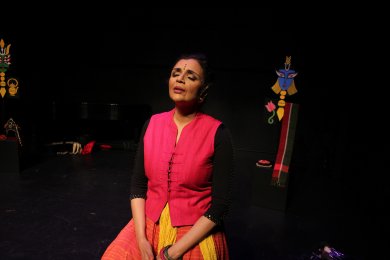
What was most captivating about her show was the graceful and enchanting
performance of her storytelling and I am not referring simply to her
voice or articulation of the story of “Sita” but what seemed to move me
the most was the fluidity and spirit of her movement, connected with
rhythm, and connected with the curiosity, allure, and taboo she weaves
around the story of the “Sitas” that seems to ultimately render Sita
someone beloved rather than scorned or unwanted. The rhythm of her
movement as she stomped and danced to the beat of the music and the way
she was in sync with her partners on stage situated me in the present to
actively listen and lean on the edge of my seat to continue listening,
as if sitting on the floor of my living room or around a campfire,
rather than stiff in a velvet-lined theater seat.
I believe there is something innate in human beings that we easily latch
onto the beauty of simple repetitive sounds and movements that are so
essential to our enjoyment of our own bodies in space and in
spectatorship of other bodies in space. There is something about
repetition that builds momentum and engages all as a community. It
seemed that once she transfixed me with the sounds and movements of her
dance-theatre I was then ready to hear her vocals and words and overall
verbal telling of “Sita”, which I saw as just another important aspect
of the telling of her story using a certain faculty of her body, rather
than the only aspect of storytelling worth recognizing or celebrating.
Often in many theatre mediums or traditional theatre settings performers
may place too much focus on their intellectual and vocal capacities (as
they analyze and critique scripts), easily forgetting the possibilities
of one’s body, mind, and soul when it is tied to not only words, but
song and dance and music and all that lies in between what may be part
of the full range of a human’s capacity for storytelling performance.
When Anita detailed how the name “Sita” is not often used as much as
other South Asian names it immediately made me feel as though Sita was
an outcast and someone waiting to be discovered or valued, which I feel
is a feeling that many young girls may identify with not only in America
but across the globe. The fact that Sita must constantly prove her
chastity shows her vulnerability as a woman tied to a man’s
jurisdiction. By the end of her performance we see that Sita is truly a
woman to be loved and respected for she has not led an easy life. And
although it is not a name that is used often for baby girls, perhaps
that is what makes a “Sita” special. And at the same time Anita ended
her performance by saying that we were all “Sitas”, echoing the
sentiment of the title of her piece that “a million Sitas” do exist.
I believe that there is this underlying and often unspoken universality
to human nature that lies within every individual that at one point or
another we have gone through difficult times in our lives or have felt
the pain of others in our hearts, and perhaps it is through these trying
experiences that we are all “Sita.” But does living through hardship
make one’s life not worth living? Does it make it any less than any
other person’s life? I believe that the fine line between the legacy of
what makes a blessed life and a life that is full of pain and suffering
is what makes Anita Ratnam’s story so fascinatingly complex and yet
accessible to all. This show fit with my expectations based on our class
in terms of varied storytelling elements that a performer might
utilize, but it also exceeded my expectations in the way it captivated
my imagination.
- Victoria Chau
|