 |
    |
|
|


PRISMVrindavani Vastra: In Britain, still carrying the heart of Assam- Anannya Mahanta Jugnaraine-mail: anannyamahantadance@gmail.com Image credit: © The Trustees of the British Museum November 20, 2026 (An encounter with Assam's centuries-old textile heritage through the eyes of a Sattriya dancer. Photographs accompanying this article document the author's visit to the British Museum Archaeological Research Collection on 28 October 2026, including the viewing of the Vrindavani Vastra.) On 28 October 2026, three Sattriya dancers, travelling from different parts of England, came together at the British Museum Archaeological Research Collection near Reading, England. We had gathered to witness the Vrindavani Vastra, a centuries-old Assamese silk textile depicting the divine narratives of Shri Krishna. For me, it was the fulfilment of a wish that had quietly stayed with me for many years. My journey with Sattriya began at the age of three, when my parents introduced me to the dance form. In those early years, I embraced it as part of my upbringing, something closely connected to my family and cultural identity. The deeper understanding of its philosophy, devotion and spiritual significance came much later, particularly around 2008, when I received my diploma in Sattriya. I began looking beyond the movements and compositions, developing a growing interest in the Vaishnavite traditions of Assam and the teachings of Mahapurush Srimanta Sankardev and Mahapurush Madhavdev. It was during this period that the name Vrindavani Vastra first caught my attention. Its association with Assam's Neo-Vaishnavite heritage fascinated me, but there was also a personal connection. My revered Adhyapak, Dr Bhabananda Barbayan, had undertaken a dance production inspired by the textile, which travelled to Europe and was presented at the British Museum in 2016. I was in Guwahati while he was based in Delhi, and hearing about his work sparked my curiosity. The thought of Krishna's stories, preserved through weaving and then interpreted through dance, stayed with me. I often wondered if I would ever see the textile myself. Years later, marriage brought me to the United Kingdom, and suddenly that possibility seemed closer. During one of my earliest visits to the British Museum in London, I went expecting to find the Vrindavani Vastra in its Asian galleries. To my disappointment, it was no longer on public display. I returned home without seeing it, but determined that I would try again. The opportunity eventually came through a senior friend associated with the Museum's Asian collections. During a visit to extend a dance invitation, I learnt about the textile's location at BM_ARC and the possibility of arranging a research viewing. With her guidance and after the necessary correspondence, I received official permission to visit. 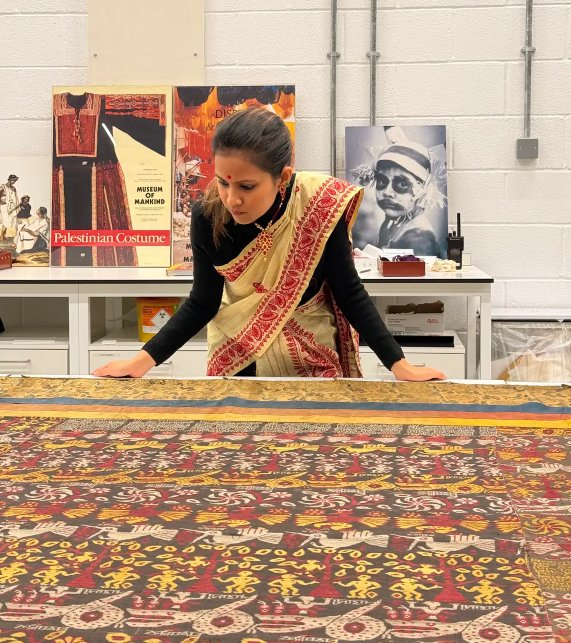 I was allowed to bring two guests, and I chose my fellow Sattriya practitioners, Bahana Saikia, a dancer and UK government civil servant based in Birmingham, and Oonmona Das, an artist-scholar based in Oxford. I travelled from Tonbridge in Kent. All three of us had spent more than two decades practising Sattriya, and it felt particularly meaningful to share this experience with artists who understood its significance. On reaching the research centre, we completed the required security procedures and were welcomed by the collections team. After being briefed about the viewing arrangements and conservation guidelines, we left our belongings in the lockers and were escorted into the study room. I still remember walking in and seeing the textile carefully laid out on a large table. Only a portion had been opened for viewing, while the remainder was rolled and protected with conservation materials. The team kindly offered to reveal more if we wished, but there was already so much to observe. For a moment, I simply stood there, taking it all in. The intricate figures, decorative motifs and Assamese inscriptions were far more striking in person than in any photograph I had seen. I felt goosebumps as I recognised the stories that have been part of my life as a Sattriya dancer. 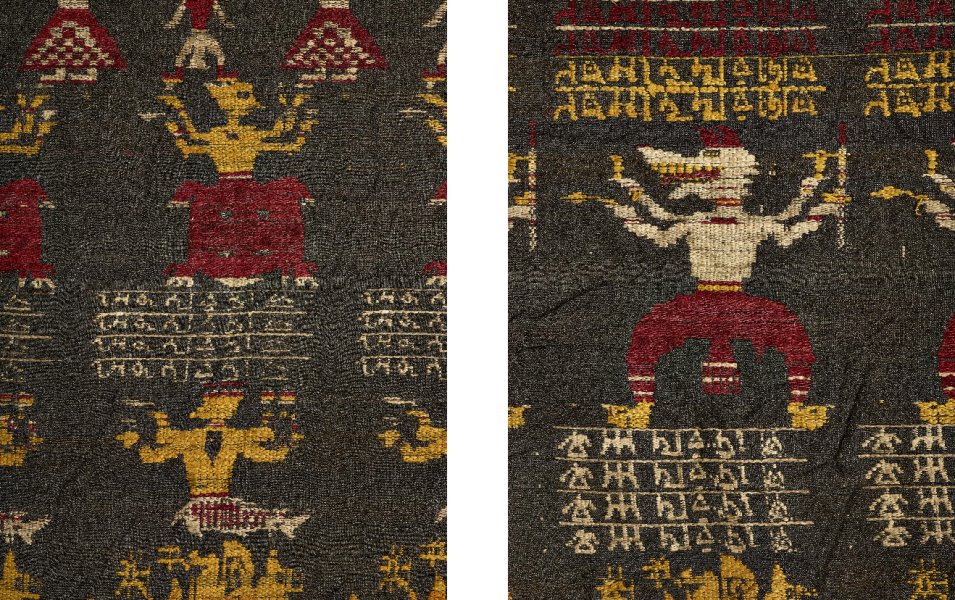 The Vrindavani Vastra, literally meaning the Cloth of Vrindavan, belongs to the devotional weaving tradition associated with the Neo-Vaishnavite movement of Assam. According to tradition, Srimanta Sankardev inspired the weaving of an elaborate cloth depicting episodes from Shri Krishna's life. The surviving textile at the British Museum is generally dated to the late seventeenth century, after Sankardev's lifetime, but it remains an important example of the artistic tradition associated with his teachings. Measuring approximately 9.37 metres in length and 2.31 metres in height, it consists of twelve panels of figured silk stitched together. The panels were created using lampas, a complex weaving technique in which images and inscriptions are formed directly through the interlacing of threads, rather than being painted or embroidered afterwards. What particularly fascinated me was the skill of the Assamese weavers who created such detailed compositions centuries ago. The textile depicts episodes from Krishna's life, including Bakasura Badha and Kaliya Damana, along with representations of Vishnu's incarnations such as Matsya, Kurma, Varaha, Narasimha, Vamana and Rama. Woven Assamese inscriptions accompany the images, bringing together literature, devotion and craftsmanship. As Sattriya dancers, we have grown up portraying these very narratives through abhinaya, gestures, expressions and movement. Standing before the Vastra, I found myself recognising the same characters and episodes that we have interpreted countless times on stage. What we communicate through dance, those weavers had expressed through silk. 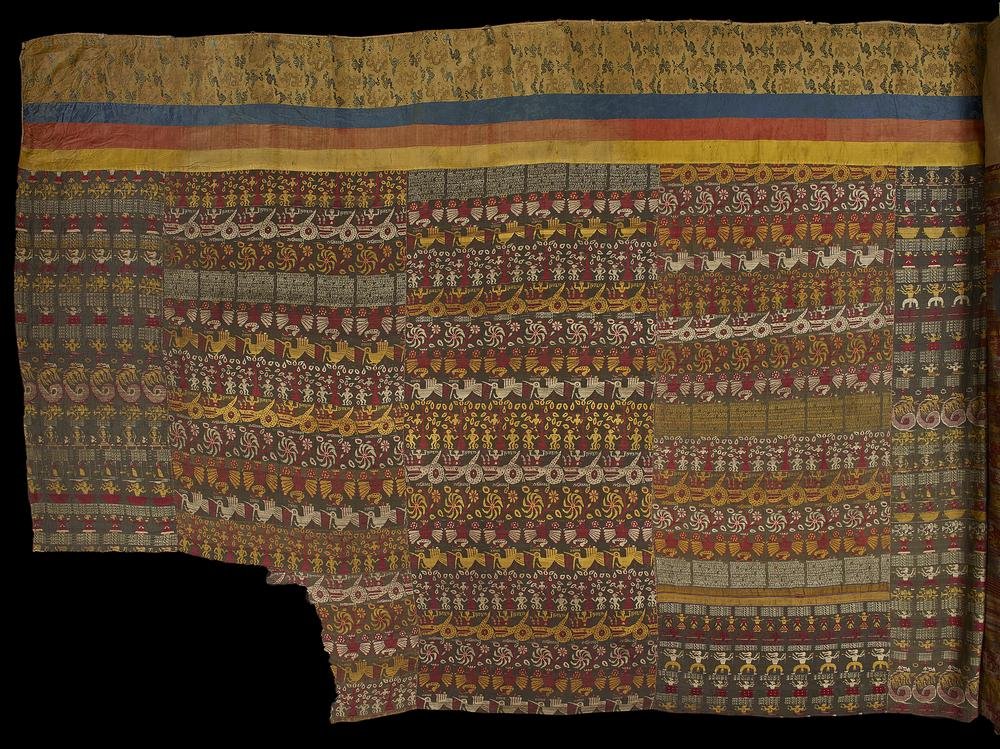 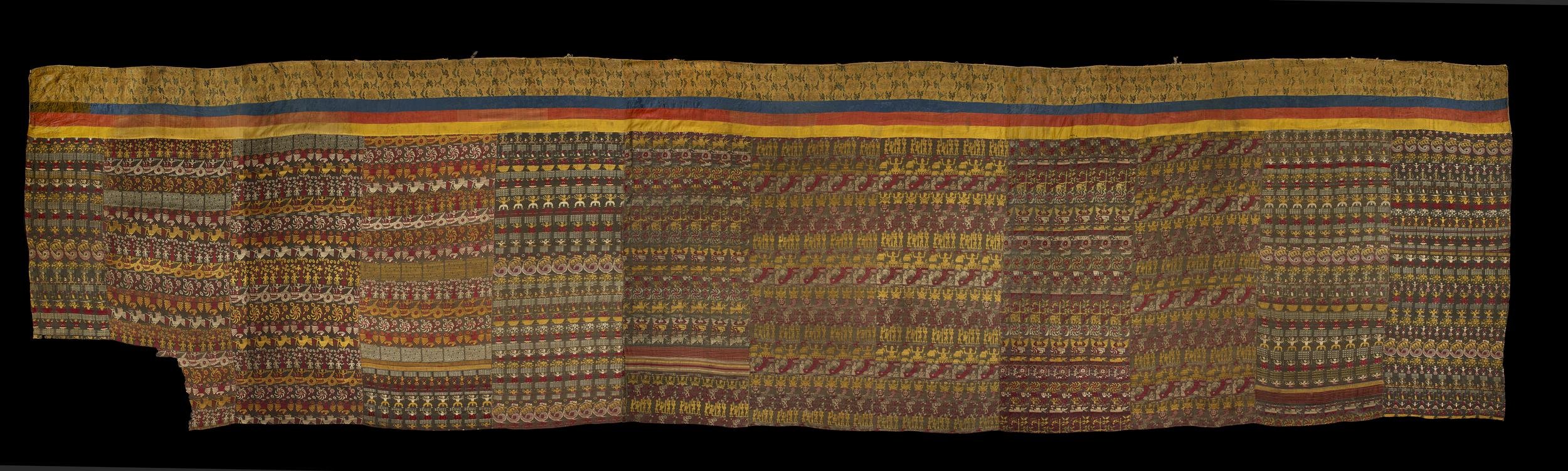 It was a beautiful reminder of how closely the artistic traditions of Assam are connected. Dance, music, theatre, literature and weaving have all contributed to keeping these stories alive, each in its own way. Equally fascinating is the textile's journey beyond Assam. The silk panels eventually reached Tibet, where they are believed to have been assembled into the large hanging preserved today. Along the upper section are three bands of Chinese silk damask in yellow, orange and blue, together with Chinese brocade depicting dragons among clouds, highlighted with gold thread. Metal suspension rings were also added, allowing the textile to be displayed in a monastery. These additions offer an interesting glimpse into its journey across different cultural settings. A cloth woven in Assam had travelled to Tibet, acquired new decorative elements, and eventually made its way to Britain. The textile was encountered at the Gobshi monastery near Gyantse during the British expedition to Tibet in 1903 - 04. It was subsequently acquired by the journalist Perceval Landon, who presented it to the British Museum in the early twentieth century. The precise circumstances of its acquisition remain uncertain. Initially identified as Tibetan, its Assamese origins were more fully recognised through later research. 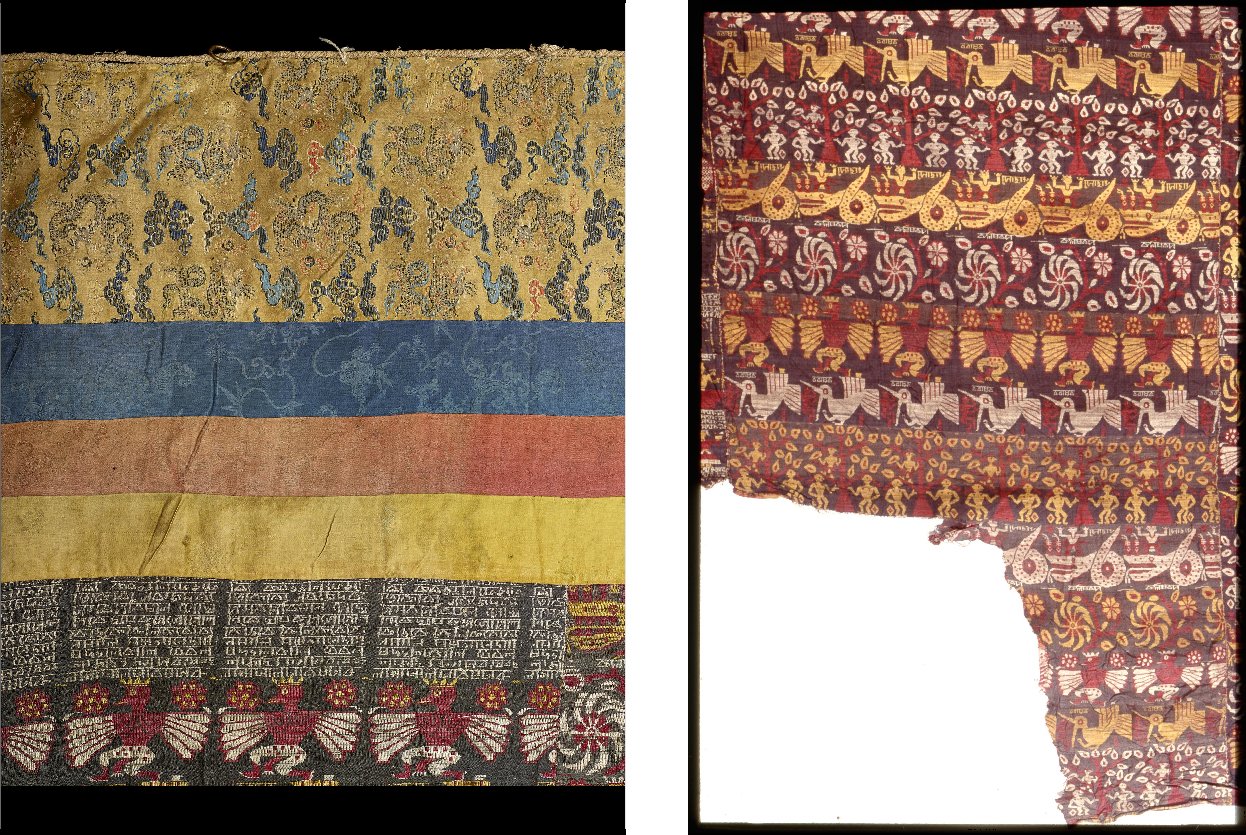 During our viewing, another detail caught our attention: a small portion of the textile appeared to be missing. When we enquired about it, the museum representative explained that the loss was longstanding and that the whereabouts of the missing section were unknown. We were naturally curious about when and how it might have disappeared, but no definite explanation was available. It was a reminder that even after years of research, certain parts of the Vastra's history remain unanswered. Given the age and delicate condition of the silk, we were instructed not to touch or handle it. I appreciated the care with which the collections team had arranged our viewing. Their professionalism, patience and hospitality made the entire visit smooth and memorable, and I remain sincerely grateful for the opportunity. 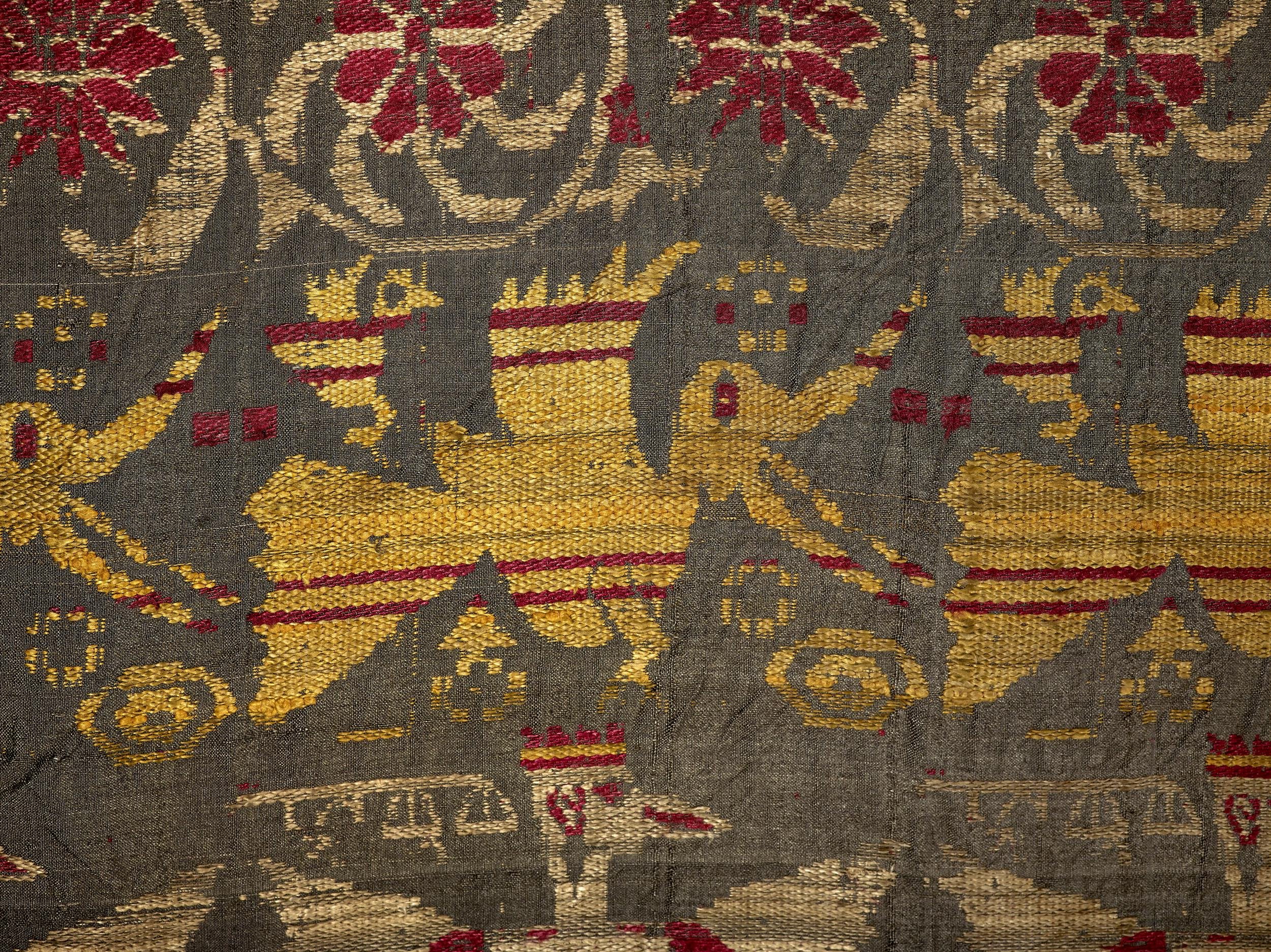 Our visit also came at an important time for the Vrindavani Vastra. Under the initiative of Assam's Chief Minister, Dr Himanta Biswa Sarma, an agreement has been reached with the British Museum towards bringing the textile to Assam on a temporary loan, with plans for an exhibition in 2027. A dedicated museum facility is being developed in Khanapara, Guwahati, to provide the specialised conditions required for its preservation and display. The final exhibition period remains subject to conservation requirements. For the people of Assam, this is a significant development. After generations of being physically distant from its place of origin, the Vastra may finally be seen by many who know it through history, literature and artistic practice. I particularly hope that young Sattriya dancers and traditional weavers will have the opportunity to study it firsthand. As our viewing drew to a close, I thought about how this journey had begun with my parents introducing me to Sattriya as a little girl, my Adhyapak's artistic exploration of the Vastra, and a curiosity that remained with me through the years. Sharing the experience with Bahana and Oonmona made it even more special. Three Sattriya dancers had travelled from different corners of England to witness something so closely connected to our Assamese roots. Living away from Assam has made me more conscious of the traditions I grew up with, and this visit gave me another reason to explore them more deeply. For anyone interested in the history of the textile, I would recommend Krishna in the Garden of Assam by T. Richard Blurton, which offers valuable insights into its craftsmanship, imagery and journey. I hope the anticipated exhibition in Assam allows many more people to experience what we did that October morning. Some may come to admire the weaving, others to learn about its history, and many to recognise the familiar stories of Shri Krishna. As for me, I will remember the quiet room, the carefully unfolded silk and the feeling of finally seeing something I had known through my art for so long. The Vrindavani Vastra has travelled from Assam to Tibet and Britain, but the stories woven into it have never lost their connection with the land where they began. Centuries later, those same stories continue to find expression in Sattriya, reminding us that while art may cross boundaries, its roots remain.  Anannya Mahanta is an acclaimed Sattriya dancer, cultural ambassador, and advocate of therapeutic movement currently based in London, UK. A gold medalist in Astrophysics and an aspiring writer and speaker, she explores the intersections of classical dance, breath, neuroscience, and somatic well-being. Her work bridges tradition and innovation, advancing accessibility, pedagogy, and global cultural dialogue. Anannya is a certified Performing Artist under Ministry of Culture, Govt. of India, a graded artist under Doordarshan Kendra, and an empanelled artist under SPICMACAY. She is currently serving as an artistic member of International Dance Council, UNESCO, Paris, OneDance UK and Women’s Resource Centre, United Kingdom. Post your comments Pl provide your name along with your comment. All appropriate comments posted with name in the blog will be featured in the site. |
