De-ritualisation and Re-contextualisation:
The shifting performance ecology of Bharatanatyam in the 21st century
- Dr. Amrita Sengupta Dutta
e-mail: dramritasenguptadutta@gmail.com
November 4, 2025
Abstract
Bharatanatyam, originally woven into the ritual and devotional life of
South Indian temple culture, has traversed a complex path of
transformation over the last century. From its deep association with
temple worship and the devadasi system to its redefinition during the
colonial and nationalist eras, and its subsequent digital and global
incarnations, Bharatanatyam continues to evolve amid changing social,
political, and technological landscapes. This essay investigates two
interconnected processes - de-ritualisation, referring to the dance's
gradual detachment from its sacred roots, and re-contextualisation,
which signifies its adaptation within modern cultural, ideological, and
digital environments. Employing a narrative research framework, the
study explores how globalisation, feminism, diasporic identity, and
social media cultures have reshaped Bharatanatyam's performance ecology,
creating an ongoing negotiation between tradition and innovation.
Introduction
The evolution of Bharatanatyam from the inner sanctums of South Indian
temples to international stages and digital platforms exemplifies one of
the most remarkable metamorphoses in Indian classical dance history.
Rooted in the Natya Shastra and once nurtured through the sacred
practices of the devadasis, Bharatanatyam traditionally functioned as an
act of seva - a spiritual offering rather than public entertainment.[1]
However, colonial ideologies, nationalist revivalism, and reformist
movements gradually severed the dance from its ritual foundations,
reimagining it as a symbol of India's cultural identity.
In the contemporary era, Bharatanatyam transcends institutional
boundaries, thriving in online spaces, short-form videos, and
international festivals. The process of de-ritualisation denotes its
movement away from temple-based sanctity, while re-contextualisation
marks its transformation into secular, pedagogical, and digital
frameworks. Together, they constitute a dynamic performance ecology - a
complex network of artists, audiences, platforms, and ideologies that
collectively redefine the meaning of Bharatanatyam today.
Historical Grounding: From Ritual to Revival
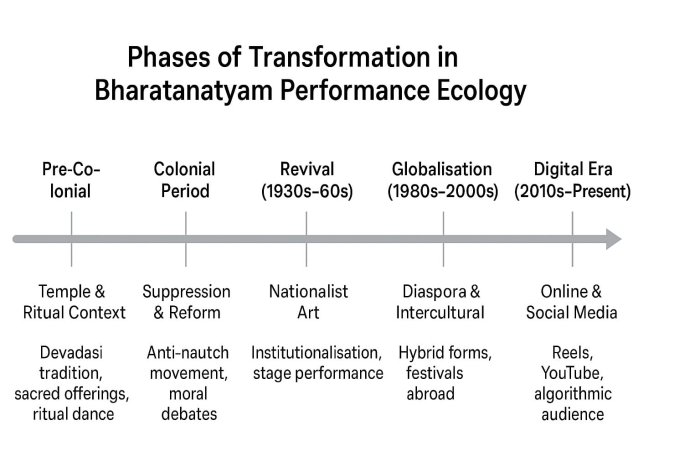
Bharatanatyam's sacred origins lie within the ritual and temple culture
of Tamil Nadu. The devadasis - women dedicated to temple deities - performed
the dance as part of sacred ceremonies. The Sadir repertoire,
comprising alarippu, jatiswaram, varnam, and padam, expressed both
spiritual devotion and aesthetic sophistication.[2] The abhinaya
(expressive storytelling) and nritta (pure dance) components were
harmoniously interwoven with music, poetry, and spirituality.
However, during the 19th century, British colonial moralities and social
reform movements began to stigmatise the devadasi system as "immoral."
Reformers like Dr. Muthulakshmi Reddy led campaigns against temple
dancing, culminating in the Madras Devadasis (Prevention of Dedication)
Act of 1947.[3] Paradoxically, even as the ritual practice was banned, a
simultaneous revival was initiated by figures such as Rukmini Devi
Arundale, E. Krishna Iyer, and T. Balasaraswati, who sought to preserve
the dance as cultural art.[4]
This period marks the first major de-ritualisation - dance was removed
from temples and redefined as a classical art form suitable for middle
class, nationalist, and educational contexts. Bharatanatyam became a
performance art that represented India's spiritual heritage but within
secular spaces such as auditoriums and academies.[5]
Re-contextualisation in the Modern Nation-State
After India's independence, Bharatanatyam underwent
institutionalisation. Institutions like Kalakshetra (1936), Sangeet
Natak Akademi (1953), and numerous university departments turned the
dance into a pedagogical discipline.[6] The guru-shishya parampara
was adapted into formal classrooms and degree-oriented programs.
This re-contextualisation aligned Bharatanatyam with nationalist ideals,
positioning it as a marker of India's ancient moral and cultural ethos.
Upper caste, educated women became its new custodians, distancing
themselves from the devadasi lineage.[7] Yet, this nationalist revival
contained a contradiction: while the rhetoric of spirituality persisted,
the ritual function disappeared. Margam performances became codified,
audiences secularised, and the focus shifted from divine service to
aesthetic presentation. Bharatanatyam thus emerged as a purified emblem
of cultural pride - sacred in rhetoric, but secular in essence.
Globalisation and Diasporic Re-contextualisations
By the late 20th century, Bharatanatyam had entered a new phase - its
globalisation. Indian diasporas in the United States, United Kingdom,
Singapore, and beyond began establishing dance schools, festivals, and
competitions. Here, Bharatanatyam served as a marker of cultural
identity, especially among second generation Indian youth.[8]
This diasporic re-contextualisation involved a delicate balance between
authenticity and adaptation. For many, learning Bharatanatyam became an
act of reconnecting with ancestral roots. However, global exposure also
led to creative hybridity - fusion with ballet, contemporary dance, and
multimedia performance. Artists like Anita Ratnam, Malavika Sarukkai,
and Aparna Ramaswamy have explored Bharatanatyam through feminist,
intercultural, and experimental lenses, expanding the language of the
form without losing its grammar.[9]
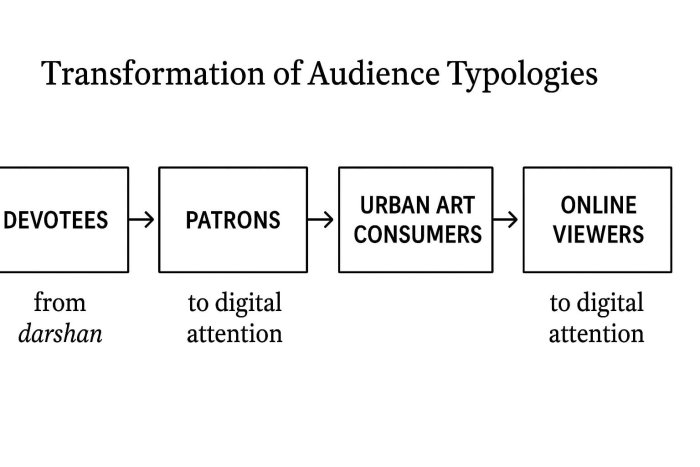
Globalisation thus redefined the performance ecology: audiences became
multicultural, narratives became political, and performance spaces
expanded from cultural halls to international biennales. Bharatanatyam
ceased to be a solely "Indian" art and became a transnational aesthetic
language.
Digital Turn and De-ritualisation 2.0
In the 21st century, digital technology has ushered in what can be
termed De-ritualisation 2.0. Social media platforms such as YouTube,
Instagram, and TikTok have democratised Bharatanatyam's reach, enabling
dancers to build global audiences without institutional gatekeepers.
Short-form videos, online classes, and cross-border collaborations have
redefined performance time, space, and spectatorship.[10]
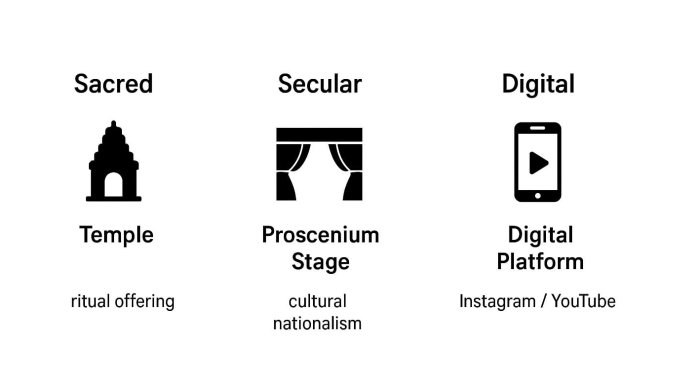
The temple sanctum and theatre stage have been replaced by the camera
frame; divine viewers have been substituted by algorithms and online
followers. While traditionalists lament the perceived loss of depth and
sanctity, digitalisation has simultaneously enhanced accessibility and
innovation. Online archives, virtual workshops, and interactive
platforms have extended Bharatanatyam's presence beyond geographical
limitations, transforming it from an elite art to a participatory global
practice.
Yet, this transformation also raises questions:
1. Does the digital aesthetic dilute the meditative core of Bharatanatyam?
2. Can algorithmic visibility substitute for aesthetic discipline?
3. What happens to rasa and bhava when mediated through screens?
These questions underline the tension between preservation and innovation - a central theme in the new ecology of performance.
Gender, Body, and Politics in Contemporary Context
Another major axis of re-contextualisation is gender. In recent decades,
Bharatanatyam has become a powerful medium for feminist and queer
narratives. Artists like Navtej Johar, Pavitra Sundar, and Ananya
Chatterjea have used the form to question patriarchal, caste-based, and
heteronormative hierarchies within the classical arts.[11]
The devadasi body, once erased through reformist modernity, is now being
reclaimed through research and performance. Choreographers revisit
archival texts, temple iconography, and oral histories to critique the
Brahminisation of Bharatanatyam.[12] This re-contextualisation is not
merely aesthetic but deeply political - it restores multiplicity to a form
long idealised as singular and pure.
In this light, the 21st-century Bharatanatyam dancer is not a passive
inheritor but an active negotiator of meanings, identities, and power
structures.
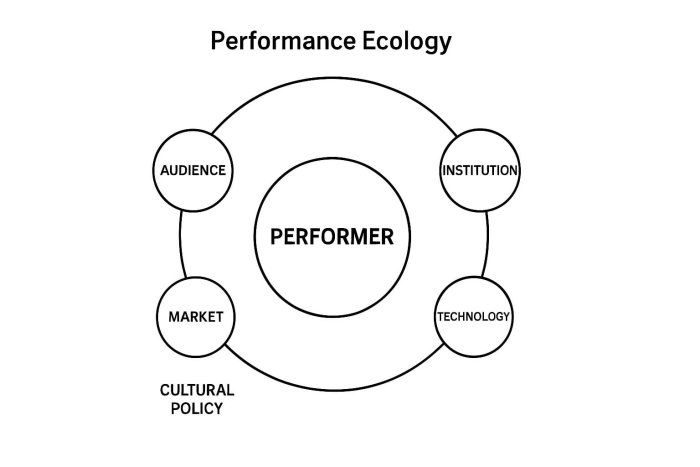
Performance Ecology: A Living Network
The term performance ecology aptly captures Bharatanatyam's current
condition - a dynamic network of spaces, technologies, ideologies, and
bodies. The ecology includes:
-
Institutional spaces: academies, universities, and cultural ministries.
-
Independent spaces: festivals, residencies, and experimental collectives.
-
Digital spaces: YouTube, Instagram, virtual workshops, archives.
-
Global networks: diaspora schools, international collaborations, cross-cultural projects.
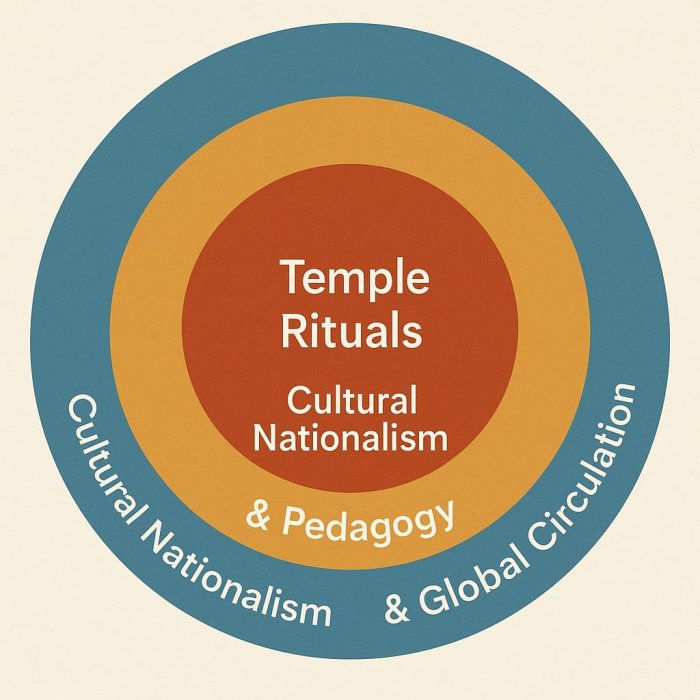
Within this ecology, Bharatanatyam survives not through static purity
but through adaptive vitality. Every new context - whether ritual,
national, feminist, or digital - adds another layer of meaning.
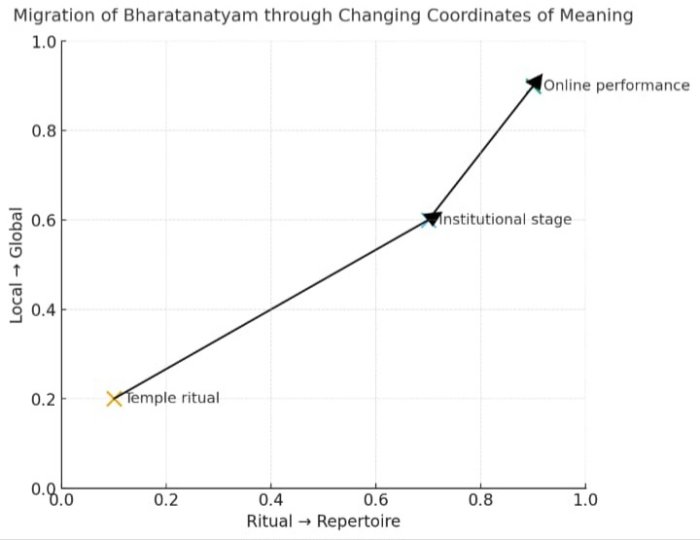
Thus, the de-ritualisation of Bharatanatyam is not a loss but a
transformation. The sacred has not vanished; it has migrated into new
forms of devotion - devotion to art, identity, and self-expression.
Conclusion
The trajectory of Bharatanatyam reflects a continuous dialogue between
the sacred and the secular, the traditional and the modern, the local
and the global. De-ritualisation did not strip the dance of its essence;
it released it into a wider field of cultural negotiation.
Re-contextualisation, meanwhile, ensured its survival in new ecological
systems - from temple courtyards to digital reels.
In the 21st century, Bharatanatyam stands as both archive and
innovation. It carries the memories of ritual while embracing the
immediacy of contemporary media. Its ecology thrives on
contradiction - discipline and improvisation, devotion and expression,
heritage and futurity.
Ultimately, Bharatanatyam's power lies not in its static preservation
but in its ability to evolve without erasing its soul. The dance that
once embodied divine dialogue now performs the pulse of a globalised,
connected humanity - a living testimony to the resilience of art across
time and transformation.
References (for footnote sources)
1. Meduri, A. (1996). Nation, Woman, Representation: The Sutured History
of the Devadasi and Her Dance. In J. Desmond (Ed.), Meaning in Motion:
New Cultural Studies of Dance (pp. 270-297). Duke University Press.
2. Kersenboom, S. (1987). Nityasumangali: Devadasi Tradition in South India. Motilal Banarsidass.
3. Soneji, D. (2012). Unfinished Gestures: Devadasis, Memory, and Modernity in South India. University of Chicago Press.
4. Ibid.
5. Meduri, A. (2008). Bharatanatyam as a Global Dance: Some Issues in
Research, Teaching, and Practice. Dance Research Journal, 40(2), 29-49.
6. O'Shea, J. (2007). At Home in the World: Bharatanatyam on the Global Stage. Wesleyan University Press.
7. Meduri, A. (1996), op. cit.
8. Srivastava, A. (2018). Performing Identity: Diasporic Negotiations
through Bharatanatyam in the U.S. South Asian Popular Culture, 16(3),
251-263.
9. Ratnam, A. (2010). Transmuting Tradition: Contemporary Expressions in Bharatanatyam. Nartanam, 10(4), 12-18.
10. Rangarajan, S. (2022). Dancing with the Algorithm: The Digital
Mediation of Classical Indian Dance. Asian Theatre Journal, 39(1),
92-112.
11. Chatterjea, A. (2004). Butting Out: Reading Resistive Choreographies
through Works by Jawole Willa Jo Zollar and Chandralekha. Wesleyan
University Press.
12. Johar, N. (2015). Dancing the Other: The Politics of Gender and
Caste in Indian Dance. Performance Research Journal, 20(6), 45-54.
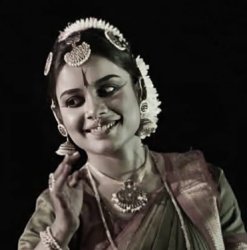
Dr. Amrita Sengupta Dutta is a scholar, performer, and Guest Faculty
in the Department of Dance at Rabindra Bharati University, Kolkata. A
Ph.D. holder and UGC-NET-qualified academic, she has served as a Senior
Research Fellow at RBU. A recipient of the National Scholarship from the
Ministry of Culture and a B-graded artist of Kolkata Doordarshan, Dr.
Sengupta Dutta has authored three books and numerous research papers on
Indian dance and culture. She is currently engaged in a research project
funded by the Ministry of Culture, contributing significantly to the
preservation and evolution of Indian performing arts.
Post your comments
Pl provide your name along with your comment. All
appropriate comments posted with name in the blog will be
featured in the site.
|