 |
    |
|
|


 Dance education in schools- Bharat Sharmae-mail: bhasha.dance@gmail.com From Narendra Sharma Archive August 28, 2025 During a major international dance seminar held in November 2024 in Delhi organized by Sangeet Natak Akademi (SNA), in one session focused on Indian Dance in Diaspora, an Indian Council for Cultural Relations (ICCR) student from Bangladesh, on a plush scholarship for advanced learning of Bharatanatyam in India, informed the august gathering - teaching of Bharatanatyam and Kathak has been made compulsory in Bangladesh till 10th standard! While several stalwarts gasped that why this was not done in India till now, I was a bit perplexed. Why this was happening in the ancestral land of the likes of Rabindranath Tagore, Ritwik Ghatak and Ustad Allauddin Khan? However, in the arena of cultural exchange, ICCR has been appointing teachers of Kathak in its various cultural centers all over the world since the 60s. I grew up with several dancers in Delhi, who had gone on lucrative assignments to spread the word of India's culture abroad in formative years of the Republic. Inversely, ICCR scholarships for students to study in India have been substantial and often become envy of local students who get far less. It has now become a good business for gurus and institutions to host ICCR students in classical dance, which reflects on the current state of Dance Education, cultural economy and institutional eco-system. I was reminded of yet another event in the year 1989, in Bangalore, just at the cusp when the city was becoming the hub for Information & Technology (IT) Industry. This was a major dance seminar-cum-festival organized by Protima Bedi, as a pre-cursor to setting up Nrityagram in outskirts of the metropolis. After the seminar, Protima drove me to the location where construction work had begun. This was a stupendous task she had undertaken - to set up a village of gurukulams having a dedicated space for each dance style. She showed me the architectural plans - each gurukulam as a rounded structure in stone, where students and gurus were to live together, in absolute proximity, for living and learning. She did mention that she was finding it hard to raise funds, and the corporates had little interest in 'guru-shishya parampara'. Problems were also emerging from another end - top-notch gurus were reluctant to move to Bangalore, leaving their homes and schools to live in the proposed village. Some gurus had state supported institutions backing them up. Protima, nevertheless, pursued her dream relentlessly...although it ended with focusing on her passion, Odissi! In the seminar-cum-festival, there was a series of performances in the presence of doyens. Mulk Raj Anand, editor of Marg magazine who had not given up writing yet, inaugurated the festival, in august gathering of the son-of-soil Ram Gopal - who had come to visit his city of birth. There were martial arts and classical dance performances in the evenings. And the venue Ravindra Kalakshetra, on each day was full of fun and celebration. 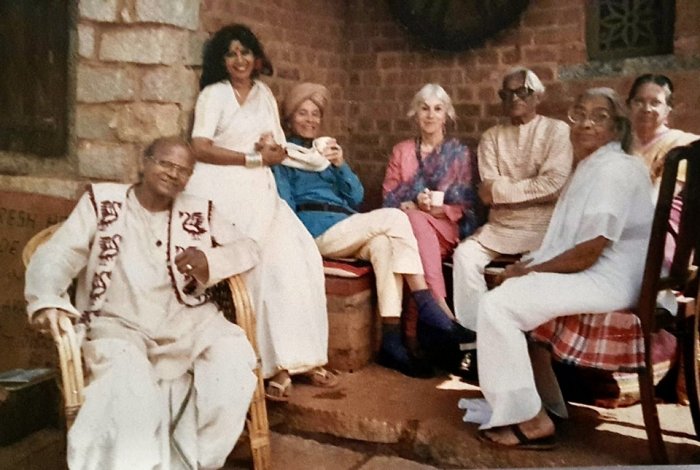 From left: Guru Kelucharan Mohapatra, Protima Bedi, Ram Gopal, a friend, Prof. US Krishna Rao, Chandrabhaga Devi and writer Maheshwata Devi seated on chair. Photo courtesy: Dr. Sunil Kothari But yet another facet of this festival was a seminar which was held in the mornings. Protima, through Dr. Sunil Kothari, had roped in NCERT to deliberate on Dance Education in Schools during the event. In the mornings, Prof. U S Krishna Rao, Chandrabhaga Devi, Chandra Jain, Tripura Kashyap and myself were asked to prepare a framework of guidelines to be submitted to NCERT that could be adopted for Dance Education in Schools. After a series of congenial and fruitful discussions, a basic framework was adopted which clearly stated that, till primary school levels, children should be provided innovative and creative dance as a subject. Interestingly, even Prof. U S Krishna Rao and Chandrabhaga Devi agreed upon this premise, that guru-shishya-parampara and dance education in schools are two separate areas to be looked into. I presented a paper on the basis of my experience in Delhi, working for my father and at Bhoomika. Baba had worked for 3 decades in Modern School, making almost 300 short and long dances for children of all age groups. His contributions went a long way in creating a congenial atmosphere for dance in Delhi schools from the time he began work in 1954. Today Delhi has the highest density of well-paid teachers in entire India. Many dancers from other states have migrated to Delhi to seek lucrative jobs. Besides, Bhoomika was involved in Dance-Theatre for Children from its inception in 1972. This was incorporated in society's preamble when the organization was formed. Bhoomika's interventions preceded many initiatives thereafter, including SPIC MACAY and NSD's Sanskar Rang Toli. There were several efforts within NCERT to develop dance curriculum for schools, which never made any headway. Bhoomika's efforts were a roaring success in 70s, but got sidelined in 80s when critics and connoisseurs started panning Bhoomika's choreography as 'bacchon ka kaam' - childish work. Nevertheless, there was yet another incident that took place about a decade back when I happened to meet the Director of NCERT, who was my senior classmate in Modern School. She shared with me a printed booklet which gave guidelines for arts education in schools. As I glanced through the pages, it was a revelation. Visual Arts and Theatre Education were well articulated. For music, it was mostly focused on Bhatkhande system of Hindustani music, not even Carnatic music, pretty much same as articulated in UGC guidelines for Higher Education. For dance, there was not much except schools should teach 7 classical dance styles to children, and aspects of Natyashastra! I reminded the Director of the seminar which Protima Bedi had organized in 1989 in Bangalore, and told her that a framework was evolved and submitted to NCERT. And whether it was ever considered? She looked straight into my eyes and said, 'Don't ask me uncomfortable questions, Bharat!' I left the matter to rest... Now that National Education Policy (NEP) is still debating on Dance Education in Schools, I am tempted to share what I had written then... in 1989! Paper read at a workshop held in Bangalore (July 28 to 30, 1989) by NCERT to prepare guidelines for dance education in schools to be incorporated into the National Education Policy. Contemporary Dance Education in Schools To begin with, I will read out a few passages from a booklet I recently read - 'Foundation of Living' by Marjorie Sykes. She quotes T.S. Eliot - '...to know what we want in education we must know what we want in general...' She adds - 'To know what we want in general we must have some answer to the old question. What is man?' For this she quotes Rabindranath Tagore - 'A man is a part of the stream of generations, enriching its flow; he is also an individual with a beginning and an end, and needs to reach completeness within those limits. He is part of both the movement of the finite and the fulfillment of the infinite... Man is degraded by being looked upon merely as the protector of his country or the producer of its wealth. India has looked on man as greater than any purpose he could serve... society is not the ultimate end - though collective endeavor is the best road to liberation. The aim must be to liberate the human soul by linking both work and enjoyment to the supreme'. To this Marjorie Sykes adds - 'Are we too prone in India to regard education merely as a powerful tool' for re-fashioning society? The truth is that growth of a free, vigorous, healthy society will be a by-product of our success in developing free, vigorous, healthy human beings as ends in themselves'. With these quotes as parameters for a basis for education, I would now draw the parameters of Contemporary Dance. Contemporary Dance recognizes the body and its elements as the basic source material for expression. The elements consist of each body part, both physical and meta-physical, as separate entities independent in themselves as much as parts of the entire being. The exploration and expression through this medium in Time and Space and in relation to its environment is known as dance. Contemporary Dance relates the within to the without and takes images from the immediate to stimulate the Self. It is concerned with life and existence. Existence, for us, is relationships. Contemporary Dance is related to another major area of study - the art of movement. This refers to all human movements as source material for creation that is used by man in his work, living, and leisure. Taking the art of movement as central to human existence, it becomes imperative to study the wider significance of human behavior and its motional qualities. Contemporary Dance strives to discover the motivations behind human movement. These hidden sources of energy are then managed to create a harmonious balance with other faculties of mind and matter. One of the fundamental differences between the codified traditional techniques all over the world and the contemporary dance movement is that in the traditional forms the technique determines the creativity while in contemporary dance the creativity determines the technique. Each individual or a group of individuals apply principles according to their perceptions and thus, create their own unique styles. When we are talking of a school in this workshop, we are not talking of a school that trains professional dancers, but a school that prepares children for living. The methods employed in this 'preparation for living' is known as education. And education, in essence and as propounded by all our great contemporaries in India, is to 'draw out'. This approach pre-supposes that a child has latent qualities and a process has to be initiated by a teacher to help the child discover these hidden qualities. The purpose is to prepare integrated human beings who, as they grow up, go and submerge themselves into the millions as dynamic elements. A complex organization is needed for democratization of education because today, scale matters. The good in education has to be made available to large numbers. A major problem today is to keep the essence of education, that is to 'draw out', intact. Thus, it is all the more essential that in mass organization of education, at a conceptual level, the methods evolved which are to be introduced in schools, should be to infuse creativity in children. This is important because by nature, mass organization tends to 'straighten out' rather than draw out. Art education is absolutely critical in this and I consider dance as the basic art because it is this body of ours that carries us from birth to death. What are the principles that should form the basis for teaching contemporary dance in schools? I would now like to list a few of them. The teaching process has to be a collaborative effort between the students and the teachers. The creativity of the child should determine the technique. One aspect of technique is basically the permutation and combination of the source material. Children can bring their own movement material and simple combinations can be achieved to create phrases of dance. They can be simplistic at the primary level and could get complex through years. At the secondary level students should be encouraged to create their own dances. In this collaborative effort between the children and the teachers, the teacher will have to push the idea of movement exploration. He has to make the student think through his/her body and to be aware of the movement potential. It is imperative for the teacher to create an atmosphere whereby he/she is seen as a guide and not as a master. The teaching process has to be investigative, analytical and yet, very improvisational in nature. There has to be a major element of playfulness in the teaching methods. Universal principles like space, time, weight, shape, motion, emotion, the senses etc can be explained in simple ways. These terms are not to be taught to young children by naming them but to be explained through class games, situations and simple movements. For example, I find 'Langdi-Tang' (the one-legged game) an ideal way to introduce to children the concept of weight and the transfer of weight. A class can start with a game of 'langdi-tang'. In the next stage the entire class can participate in a one-legged race. Gradually, as the class tires out on one leg, they can be told to switch legs whenever they feel like. Thus, the concept of transfer of weight is introduced. At this stage, movements can be fitted into simple rhythmic cycles. To further develop it a child can take turns between transfer of weight. Add claps to it and perhaps a simple dance is in the making. At an advanced level the entire Mayurbhanj Chhau technique can be explained in terms of transfer of weight from one leg to the other. Of course, there are other relative elements attached to it but this can be one way of an analytical approach to movement exploration and movement construction. Similarly, 'aankh-mincholi' (the game of the mock-blind) can be a basis to create movement games to cultivate and strengthen the 'act of seeing' and introduce the child to the power of the eyes, perception, observation and imagination. The natural behavior of children and human beings, the motional qualities of animals and inanimate things can be dynamic elements of movement material. For example, walks, kinds of walks, postures of sitting and sleeping, postures of rest and motion in animals. The movement of trains, buses, cranes, trees etc can become source material for techniques to be built up. This way the child can directly relate to its environment and bring the material in class for expression. The co-operative and the collective principle should be central in all teaching methods. It is not to belittle the individual against the collective but the faith that the individual has to emerge through the collective. I may go a bit farther and emphasize that no technique centralized on the 'single body individual concept' should be taught in the schools. Let it be left for the professional dance schools to practice. Thus, a lot of emphasis would have to be put on group work, collective endeavor, creation through cooperation, community and social dancing. We have to create forms by a collective of dynamic Individuals rather than forms of fattened Individuals who love to live within their own shirts. A lot of emphasis should be put on teaching the 'art of movement' to children. At a basic level, dance and movement is body in motion. A conscious observation and coordination of inner motivations of bodily actions can help a better management of our effort actions in our living. Child has a very natural habit of observing his elders at work - that is the way children learn. Like the act of cleaning, the act of wearing clothes, the act of walking, the act of sitting in different postures. This keen sense of observation has to be developed into a wider awareness of the effort actions of its body in relation to man's work in industry, in technical and occupational exertions, in working habits, in movement in streets and public places. It is all the more essential today when machines are making more infiltration into the working process of man and his daily mundane life. Technology has created a myth that machines create leisure - there are more health problems and immobile bodies than ever. In agrarian societies, the exertions in their daily work itself is a major scope for the body to determine its healthy physical space. Computers definitely reduce pressures on railway ticketing but it reduces completely the scope of human movement and effort for those men and women working behind them. And soon there would be more computers. Thus, movement and dance have to create an area where man, overburdened by technology, gets a creative space for his bodily exertions. We have to cultivate a love for human labor and its manifestations. This is not to propound yet another myth of man against the machine but a plea for a more harmonious relationship between the human body, its labor and the machines. By preparing children in these directions, we would be helping them to handle their lives more vigorously and intelligently. Sixthly, it is a common fact recognized by educators that the unbound and restless energies of the young take an ugly turn when they are not given a proper direction. For this there is no better medium than dance. Energy is meant to be spent/burnt, and for the young it only happens through bodily actions. These actions have to come in waves, in massive doses, not by subjecting the children to use their fingers to write essays. Sports are useful but dance is a step ahead because it imbibes both the emotional and physical faculties of a child. At this stage, the focus should shift to a more inter-disciplinary approach to instruction. Relationship with other branches of knowledge would have to be established and perhaps, other subjects could be taught through the medium of dance. The intellect can be developed through effort actions of the body and this has been confirmed by the great traditions as well as most advanced theories in education. I have been able to teach basic concepts in Geometry, Mathematics, and Design to students through dance. In many ways those very experiments are helping me in my professional work. Seventhly, there has to be a two-pronged approach to making guidelines for dance where a set of universal principles should be evolved at a national level which could be interpreted at the levels of states, regions, groups and communities with specific and local materials. All classical styles and traditional forms should be seen from a point of view of the heritage of body rather than a heritage of a region or communal sentiments. In context of the heritage of body, I am talking in reverence for the heritage which is existent and also the heritage that has to be created. The general guidelines at the national level have to be very broad based and should be evolved through consensus so that there is room for every idea and form to flourish. For example, there is an absolute opposition, ethnically or otherwise, in the basic stance of Bharatanatyam while it is 'bucked in' in Manipuri. It would be defying the nature, physical structure and genetics of a region if a Manipuri is asked to work in a Bharatanatyam stance and vice versa. In this case, a guideline could be made as 'stance as a base for movement construction'. This imbibes all the stances of traditional techniques and yet leaves room for individuals to create other stances and build their own vocabulary. One part of the guidelines should be exclusively linked with the dance-world in general. Dance helps in developing the aesthetic sensibility and personality of the child. On another plane they should be trained as enlightened audiences for the dance world. Regular performances should be organized and the magic and mechanics of dance-theatre should be explained. Children should be encouraged to make their own dances to have them feel the creative process in making productions. Schools can become an ideal recruitment ground for the professional training schools of different dance techniques. Lastly, along with the process of evolving guidelines for dance education in schools, I would draw the attention of NCERT to a vital issue that should be considered urgently. That is to prepare competent teachers of dance for the schools. Till now, most of the dance teachers in schools are people who could not find a place in professional dance circuits. Most of the professional schools of the classical styles and traditional forms train students in set repertories of dances; there is already a consensus that these highly stylized forms should not be taught at the primary school level. There is no school of contemporary dance despite the fact that it has been flourishing for more than fifty years in India. There is no B.Ed. course anywhere having the subject of dance as even an optional subject. Thus, the contradictions and the problems of the professional dance world are imposed on school education. Dancers do away their teaching jobs by teaching 'items' of dance. In the absence of recognized institutes for training teachers, spurious degrees in dance are available in the market for a price for getting jobs in schools. In case of Delhi, there is a consistent demand for dancers coming out of the contemporary dance groups in schools because of their ability to handle large groups and mount innovative productions. But in the absence of a training institute that legitimizes their training in the eyes of the authorities, these dancers are left with doing petty jobs in parts and pieces. Most of them leave dancing altogether once they are past their prime dancing career. From another angle it is heartening to know that there is some emphasis on the cultural component in education policy by making it mandatory till the 10th standard. For all this, we need competent teachers who are specially trained to teach children. It is not sufficient to catch hold of performers who would tone down their rigid techniques to make children move in a particular way. We need teachers who can help children to be creative with their bodies in work and play to create a new dance tradition. 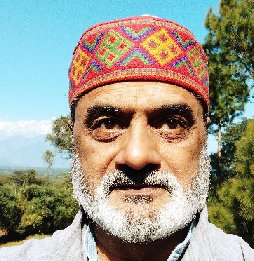 Bharat Sharma's career in dance spanning over five decades is marked by diversity of experiences as performer, choreographer, teacher, writer, composer, film-maker and arts administrator. He currently leads Bhoomika, New Delhi. Post your comments Pl provide your name and email id along with your comment. All appropriate comments posted with name and email id in the blog will be featured in the site. |
