
|
    |
|
|
|

INTERVIEWBharatanatyam dancer Vinay Tiwari on choreographing 'Magadh' in Kathak- Shveta Arorae-mail: arorashveta1806@gmail.com Photos: Anoop Arora September 13, 2026 I recently watched 'Magadh: The Whispers of Lost Glory', the 2026 annual student showcase of the Gauri Diwakar Sanskriti Foundation (GDSF) - Sarvatra Nrityam. Everyone who watches Kathak knows the name Gauri Diwakar. But what I watched at the function was Gauri's calibre as a guru, which was obvious in even the littlest ones trying to remember their steps. I also got new perspective on another dancer whom I have seen much less than his peers - Bharatanatyam dancer Vinay Tiwari. Vinay started learning Bharatanatyam at Bhatkhande University in Lucknow after he finished school, and realized his dream of learning from Guru Saroja Vaidyanathan after she visited the university. He continued his learning under Guru Rama Vaidyanathan in Delhi and has been associated with Ganesa Natyalaya ever since. Vinay had been learning yoga long before he started learning Bharatanatyam, and he is also trained in classical music, besides being a dance photographer. Despite all this, what he seems to be known for best is that he is a social media star in the classical dance community! Seeing how little interest the classical arts inspire in people outside these circles, that is an achievement worth recognizing - he is very funny and his reels are great fun. But it doesn't do justice to how good a dancer he has become, how hard he works or how he is evolving. I was a bit late to the party and really began looking at Vinay in his Shivaarghya appearances over the past few years at Ganesa Natyalaya's annual Shivaratri showcase of male dancers. He is a very good dancer, with a unique presentation style combining muscular strength and extraordinary flexibility with some lasya, having trained his body through years of yoga. Vinay has the technique, the training and all the razzle-dazzle he needs to be recognized as a soloist, and he is getting that recognition, especially as he has presented his first solo choreographic work, 'Abhadra', to critical appreciation. But choreographing an annual function in Kathak was a risky move for both Vinay, making his mark in Bharatanatyam, and for Gauri, making her mark as a guru in Kathak. Having pulled it off, and very well too, shows the mettle and strength of conviction Gauri has always had in her individual work. For Vinay, it shows another dimension of this young artist's capabilities. He choreographed pieces for younger dancers, in a very different form, and honoured and utilized the uniqueness of that form, all while also beautifully presenting a region not represented in the classical arts. His presentation honoured Bihari culture and history through four well-conceptualized and intricately choreographed pieces performed by Gauri's Kathak students. At the end, he performed a solo depicting the cat, the vahana of Chhathi Maiya, as usual impressing viewers with what a classical dancer can do with his body. He also choreographed a surprise duet with Gauri as Chhathi Maiya in Kathak, and him as the cat vahana in Bharatanatyam, to conclude the function. I spoke to Vinay at length about his repeated presentation of Bihar in his choreographies, about 'Magadh' and working with Gauri in Kathak and the process of conceptualizing each piece in the function. I also spoke to Gauri about choosing Vinay as this year's guest choreographer and about how he fared in her estimation. When Gauri invited you, a Bharatanatyam dancer, to choreograph for her Kathak showcase, how confident were you - firstly, about choreographing the disciples of another guru and then, of a different stream of dance altogether? The idea of such a collaboration had been in my mind for a long time. I had been in Lucknow for 7-8 years - my exposure to classical dance, I would say, consisted more of Kathak than Bharatanatyam. I was a student at Bhatkhande University, and Bharatanatyam in Lucknow was either those people who were in my class or those who were related to that class. But Kathak was more widely present in the form of performance or presentation. So just my constant observation of Kathak spans 12 years to 13 years. I also had some opportunities to play characters in Kathak dance productions by Surabhi Singh Tandon ji. So it was that I understood the body language of Kathak. I have many friends in Kathak and much exposure to it. Whenever I used to watch Kathak, I watched Lucknow gharana. One thing that I noticed, which is my personal view, is that I felt that the abhinaya of most classical dances is very similar, especially Kathak and Bharatanatyam. So, I told Gauri didi that I will need help in the nritta part and because I had some exposure, I knew what aamad is, what paran is, toda, the various gat, gat nikas, palta etc. I had a pretty good idea of the Kathak structure, but what I was also noticing was that a lot of the time, young Kathak dancers were hiding behind nritta. It was becoming more of how many chakkars one can perform. So, I told Gauri didi I wanted to do something that was heavy in abhinaya. I was not fazed by this choreography in Kathak. I took it up as another project and because I am so comfortable with Kathak vocabulary - also, as a photographer, I watch a lot, I document a lot of Kathak - I found it very natural. And I told Gauri didi that I would need her help in the technical aspect and she was of course very accommodating. I can tell you that this is looking good (in Kathak), but I cannot tell you whether it is technically right. In Bharatanatyam, for instance, we do Rupak in 6 mantras, in Kathak it is 7 mantras. There are some things which are technically different. So of course, she came to save me, helped me with those things. I created a structure that I want this, then I want this much nritta, then I want like this. This is how it was done. Overall, it was like meeting like my second friend (Kathak) in the world of classical dance. There is a lot of difference in the hastas especially - Kathak hastas are not as sharp as they are in Bharatanatyam. Yes. So, when I worked with the students, I told them the first or second day that as I am a Bharatanatyam dancer, let's use mudras. Kathak uses fewer mudras, it uses more lokadharmi abhinaya, and the students also come focused on the nritta. And not many mudras are used in nritta. There is a lot of flow, a lot of chakkars, a lot of focus on footwork. I sat with all the students, we did a few classes on the mudras and I tried to make them do more mudras, but I also tried not to make it look like Bharatanatyam. My attempt was to create a production in their vocabulary with my understanding. I gave them as much as I could, but I did not want to make it look like I wanted them to do Bharatanatyam. As I said, I had a fair understanding of Kathak, I have done a few productions, I have worked with Kathak dancers previously, so I had some idea about which mudras they use. For example, for ghunghat, they will use kapit instead of katakamukha. There is a mudra between katakamukha and kapit that is often used to show lightning - kartri. So, I told them, kartri is not rain, it's lightning, so when you are doing kartri, don't show water, show thunder. There were a few discussions like that - also with my training in Vinyoga and everything - but I did not want to force too many mudras because then I would be taking away the essence of Kathak, and each classical dance is extremely graceful in itself. I deliberately avoided too much harshness (precision of hastas), but I also included a few mudras, so it can be incorporated without being forced. How did the idea of Bihar as a theme come to you? First of all, I want to clear the misconception that I am from Bihar. I am not from Bihar. I am from Bihar border - the Bihar border is 2 or 3 km from my house in my village. But I am culturally Bihari, technically a UPite, and a South Indian in my soul! It's a combination of three reasons (for a production about Bihar in Bharatanatyam). Culturally I am from Bihar, and this urge to talk about Bihar, about Bhojpuri, it comes very naturally to me. I did not want to talk about the problems of Bihar, which I have already done in my own work 'Abhadra', like the migration issue. For this, I thought I'd rather talk about the glory of Bihar. That's why I called it 'Magadh: The Whispers of Forgotten Glory'. That was a state that was advanced in art, literature and science, that is the land of Lakshmi - Sita was born in Magadh, she was from Mithila. I was determined to speak about Bihar, but not about the usual associations like poverty. I wanted to remind everyone of the glory of its history. Remember the past and work on your future. The present is what you have received; you don't have to be stuck with it. Because of this, all these kids - some of them Punjabis, some from Bihar or Jharkhand, one Telugu - they all learn about the rich culture of Bihar. A lot of people learn what is Chhath Puja. I presented the important parts of the height of Bihari glory, the spiritual part of it, all these aspects of Bihar. The minute I told Gauri didi I want to do something on Bihar, she was so happy. We had discussions and she came up with the name 'Magadh'. I suggested 'Bihar: The Whispers of Forgotten Glory' and she agreed. So, she came up with the name, I came up with the tagline. When I am talking to the world, it might not make an impact. But now that these children have worked on it in childhood, their associations with Bihar are very different. They don't associate Bihar with just the problems or the poverty, not just the migration. Their association with Bihar is Goddess Sita, Nalanda University and the knowledge of Magadh. Their understanding is Chhath Puja, a powerful goddess. They come from that perspective, that Bihar was so enriched with knowledge. So, for these 50-60 kids, plus the audience, Bihar has a different meaning now. Maybe, in some form, they will talk about this knowledge, about Mahavir and Guru Nanak. People don't even know that Guru Nanak Dev is from Bihar - Patna Sahib. Bihar is the seat of Shakti. This was important for the kids; they will have a good impression of Bihar, not what we see in social media, in memes - roads being stolen, bridges collapsing, that Bihar is not for beginners. All that is the present, but it has been a glorious state too. That was the reason to choose Bihar. You began with the Ganesh Vandana for the youngest children. Yes, the first was Ganesh Vandana with the younger kids. I had to consider that this was not a personal project. At the end of the day, it's an annual function. I felt that the parents who are coming must see something that accommodates all the students. Ganesha was right for the first piece because we referred to the fact that any pooja in the world will start with Ganesh vandana, so we just followed our norms of how we present dance in India - first was Ganesh Pooja for the youngest kids. 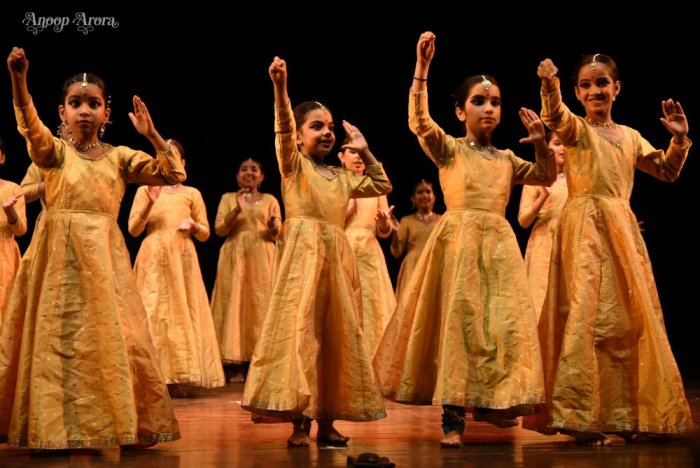 Ganesh Vandana Then there was Devi - the first group were the youngest children and the second group were professionals. The narrative was that there was knowledge and there was power also. The importance of that was in the context of what we see today, the condition of women in that society. I just wanted to remind everyone that it's not only the land of poverty and problems. There is a Shaktipeeth, a culture of worshipping the power of the goddess. I chose the senior batch and 'Bhavani Dayani' for this. And again, I told them the same thing - girls, you have to do a lot of abhinaya. I don't want you to just do some chakkar, chakkar, chakkar, ghungroo, ghungroo, ghungroo, and move on. I want you to show the wrath and the strength of the goddess. A lot of time, we just do the nritta and then we move to a nice thumri or something. So, I felt, let them do something like Jwalamukhi, Chandi. I kept in my mind what the students are getting, what they can use later. And honestly, there was not much of an age gap - I would be perhaps 4-5 years older than the senior students, or maybe the same age as some of them. But if I am in that room as a coach or a trainer or a choreographer, what makes me different? So we worked on the abhinaya, we discussed how you build that character... You have to go through this process. Stop thinking dance is all about looking pretty. When we see Kathak abhinaya, there are very few strong pieces. It's mostly thumri, dadra, chhed-chhad, Krishna-gopi. I deliberately chose this strong piece because they were the most senior group and I felt I could push them a bit - it had strong nritta plus strong abhinaya, where you are not thinking about how graceful you are. I chose 'Bhavani Dayani' for the contrast; it would include both sides of the portrayal - grace on one side and wrath on the other. Let's proceed to the third piece, Sita. When I started the Sita concept, first of all, I wanted it to be in Bhojpuri. And second, I was looking for a context which talks about Sita's wedding. Also, I was catering to a classroom. You know how when we are young, there is always like, oh, I got the main part. I did not want that. I wanted this group of students to all be represented; there were three boys also. And at a point, I saw that the boys were a little bit confused about whether they should do this or not. The piece was called 'Sita' and was full of lasya. So, the question for me as a choreographer was how I'm going to cater to that. I had a long talk with the boys to explain - it's Kathak. One of the most popular gurus is Maharaj ji. Remember how he used to do female characters? Here, you are not even doing a female character, you are depicting something about Sita. Then I went looking for the text. I could not find anything that really appealed to me. Whatever I got, it was very filmy, or from TV serials, or by some popular singers. So I started wondering what I could do and concluded that I would write it myself. I chose a sohar, which is a traditional birth song. But I had to write the lyrics because there was no sohar written for the wedding of Sita, which I could find in that moment. 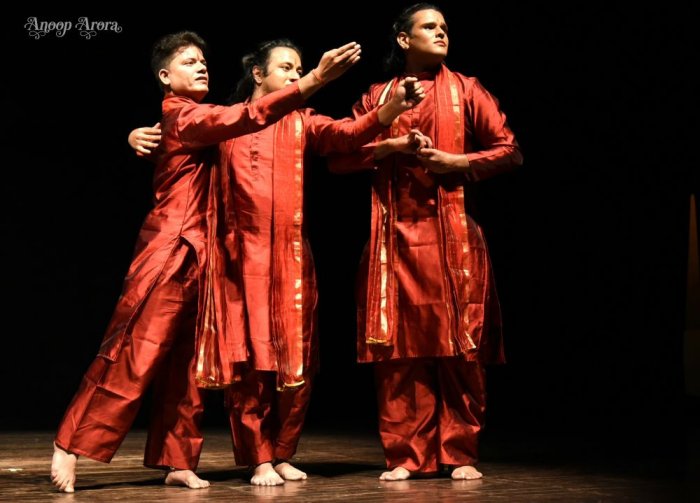 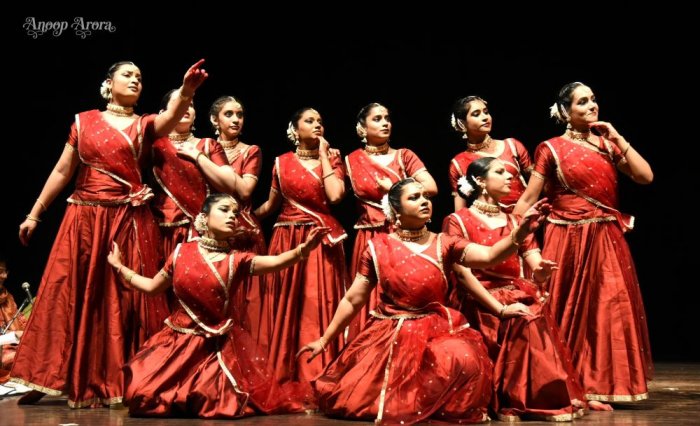 Sita This particular piece was more special to me because first of all, it was completely lasya. I told all the girls, please remember, I am not going to hide you behind nritta or taal. You have to do abhinaya, you have to experience the grace of Kathak in this particular piece. It was the same for the boys. Then I sat and I wrote the lyrics of it. And it came out so well; even I did not know that it would turn out like that. But it was received well. I learnt later that all the senior girls asked, why are we not doing this? I liked it because they also enjoyed it a lot. In this piece, I took a lot of reference from the way we do abhinaya in Bharatanatyam because I felt that there is a lot of scope for mudras, like looking in the mirror and others. I started by describing how Sita's friends are decorating Mithila because it's the day of the swayamvar. And the piece ends with the narration that Sita is leaving Mithila, but with the concern that it was not just Sita who left Mithila that day, but also the identity of prosperity. And that it is time for Bihar to reclaim that identity of Goddess Lakshmi, because Sita is considered a form of Lakshmi. It is important for a culture to remember that the goddess of prosperity belonged to their state, whereas today everyone calls it a poor state - it is considered a bimaru rajya or a sick state. And it is ironic that people call Biharis jaahil, ganwaar (uncouth and illiterate), but Nalanda was there. Buddha got knowledge at Bodh Gaya, they say that there is no culture or sanskar, but Mahavir came from there and after Mahavir, Guru Nanak Dev is from Patna. It is the irony of the state that we have forgotten that culture and that was the whole reason for 'Magadh'. Because the state was so flush with money and everything, the rajya was so well to do, the women were so empowered, why? Because they had the best university in the world at the time, which was Nalanda. There was prosperity and they spent it on their knowledge, on their studies - that is how the fourth item came in sequence. The Sita piece was more like a reclaiming of the history of Goddess Lakshmi, to say that Ram has come to Ayodhya; Mithila, please claim Sita now. Say that Lakshmi was born on our land, remind people of that. With that we came to the fourth piece, which was 'Nalanda'. I did not want to make 'Nalanda' a very complex piece, I just wanted to show the three stages of any culture, any society. The first was knowledge. In the vishwa vidyalaya (global university), we have shown that they are given the knowledge of shaastra, which is our books, Vedas, Upanishads; then after shaastra, music is also taught, in that they are learning to play instruments, some are dancing; and after that, shastra (weapons) were also taught, some are doing malkhamb, some are learning archery. Not only that, they were also studying agriculture. I feel that when any society has food, its next step is wanting a house, money and this and that. Prosperity works on various levels - when you don't have food, how will you think about studies? So agriculture was there and they are also shown doing yoga in the choreography. Then there was a pivot in the narration - when a society is well-read, well-fed and well-educated, they naturally move towards art and culture. In this I took, of course, the reference of Mithila painting, the small elements that make up the painting. My inspiration was the fish, because in Mithila painting, fish is prominent. Then there are paintings that depict birds, especially the parrot, which is dear to Bihar - parrots and mynahs. The third popular depiction is a deer sitting under a tree, and we showed it in padhant. Because I have been a dedicated observer of Kathak for many years now, I knew how to use toda, tukra etc. as nritta. Hence, we showed that through nritta. For each piece, actually, I had to return to the basic idea of how dance and acting should be incorporated, because I did not want to make it only abhinaya heavy or only nritta heavy. Then there was the third part of the piece - Gauri didi suggested that we do something on Amrapali, which is such an empowering concept, that there used to be a rajnartaki in a state like Bihar. I tried to find some literature and I did not get much, that is why we did not take the Vaishali character, Amrapali. From there, we went to the idea that when any culture evolves a lot in education and art, it eventually comes to intellectual liberation, which means people go to spirituality. I chose the Sanskrit shloka 'Bhavati tam trigudh rahitam satgurum tam namami', because in that land, Mahatma Buddha was in Bodh Gaya, Mahavir was there, and then after Mahavir, Guru Nanak was there, and so was the Shaktipeeth. I felt that all these religious scriptures and traditions, the spiritual knowledge produced in one state, happened because people were educated artistically and also in shaastras, and this is how that piece ended. 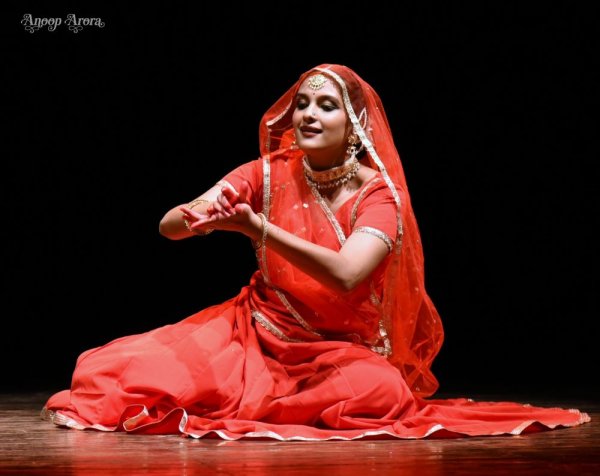 Chhath pooja Now we move to the last piece, on Chhath Pooja. Kathak has its own tradition, and respecting it is my responsibility as a choreographer. The thing that makes Kathak special is that the performer comes forward and recites the padhant, that interaction with the audience. Bihar was once a part of Bengal - in Bengali they say Shashthi Devi, and in Bhojpuri and Maithili, we say Chhathi Maiya. For this piece, I told Gauri didi that I need the boost of her intervention here. I can give a storyline, but because it is pure, traditional Kathak, how the padhant will be done - one girl will come, she will narrate, and the other girl will enact it. Padhant is a nuanced element of Kathak, for which I can provide the story, the elements, but from a technical perspective, Gauri didi did most of the choreography in that final piece. Then we came to the end, and she asked me to do a piece. This is her institute, she always does one small piece at the annual function, and I was just waiting for her to ask me before I said, let's do something together. I said, now that Chhathi Mata's pooja has been done, let's show who Shashthi Devi is, how she appears. The kids have depicted the prakriya (process) and the pooja, we will show who she is. Actually, I wasn't in the city, and so I said Gauri didi, we'll demarcate the pieces, and you do it. She said, no, you will teach, that's why you are a choreographer here. I was so happy. I did a piece that was from my first solo production, 'Abhadra' - the opening piece. It was a choreographic piece based on a cat. That vahana (vehicle) of Chhathi Maiya is actually not a lion (but a male cat), but sometimes it's mistaken for one because cat and lion belong to the same family. 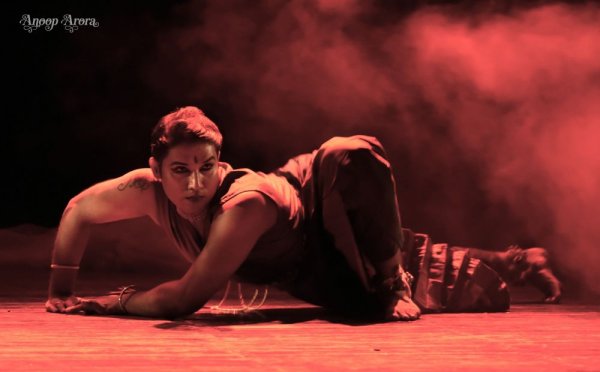 Cat solo The reason behind that cat piece was my mother. Actually, 2-3 years ago, Bharatanatyam exponent Dr. Himanshu Srivastava (a senior disciple of Saroja Vaidyanathan) asked me, “You are from Purvanchal, who is Shashti Devi's vehicle?” I've never thought about it. Then I started researching it and that one question changed a lot for me, in life and in general. I asked my mom, what is the vahana of Shashthi Devi, and she was amused at my question, even though, all my life, I have seen my mother perform the Chhath Pooja. I decided to ask a few more people I knew, and they had no idea either. That led me to create a work that would educate everyone about this goddess. And I was very scared when I was doing it. When you are a young artist, you question everything you do - how will the critics receive this, how will the audience take it? The audience is often your friend, and acquaintances will praise you, but when I performed this for the first time, the love I got from the audience as well as critics was beyond... Leela mami (Leela Venkataraman) was there in the audience, and she told me only one thing - I had never thought in all these years that this is possible. When I did my first Bhojpuri work, I was very scared, because I had never seen anyone dancing to Bhojpuri, I had never heard of anyone doing it, especially in Bharatanatyam. But then I decided - either it will be so bad that no one in the world will ever do it, or it will be so good that people will remember it and there will be more work on it. That was the only intention behind my piece. That piece I took from 'Abhadra', thinking that this is a big audience, these people should also know who this goddess is, what is her sanskar, what is her kripa, what is her shakti. So, Gauri didi and I did a duet, and the audience's reaction was very positive. This was the whole journey of 'Magadh: The Whispers of Forgotten Glory'. 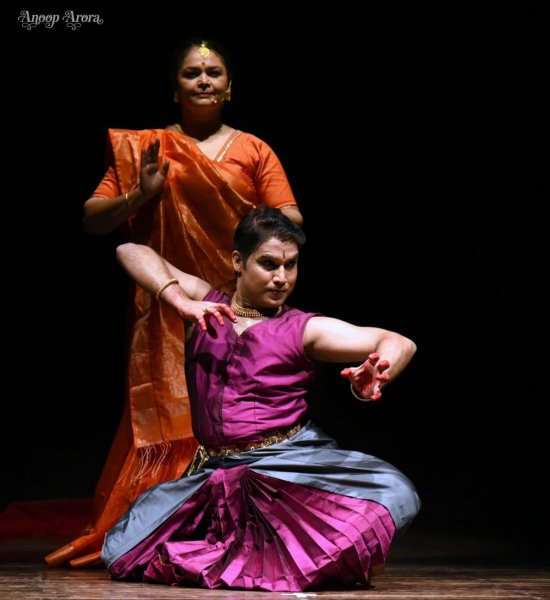 Gauri Diwakar and Vinay Tiwari It was very impressive work and I hope you can carry this further. There are so many young girls and boys in the art world, so many kids from Bihar... If I had not done work in Bhojpuri, someone or the other would have done it - it is not that no one would have done it - but maybe it was in my destiny to do it, maybe I had good fortune and such gurus - I saw work in so many languages, in Awadhi, in Marathi, so I also felt, if it is happening in all languages, then why not in Bhojpuri? Rama Vaidyanathan ma'am did the Mayur Alarippu, so I felt why can't I do the cat? I think that the classroom leaves its mark; maybe I won't look like a copy paste of my guru, and maybe I will look like a copy paste, but if I am under their tutelage, who else would I look like if not them? Saroja guruji choreographed so many Hindi compositions, or Awadhi ones, or Meera bhajans, so I also felt that I should work on Bhojpuri compositions too if I am from the Bhojpuri belt. I was apprehensive that it might be disastrous and critics will say this greenhorn artist, what is he saying, he is ruining our traditional margam, but it was the opposite - everyone gave such a positive response. It made me realize that sometimes you just need to say what you want to. Don't think so much about good and bad, just keep doing and keep learning. The sooner you make mistakes, the sooner you learn. That is the urge behind telling any story. I choose anything that comes my way like that, which might be a little contrary, and of course it is very scary - very, very scary - but you have to do it. Vinay is a good dancer, of course, and he also thinks very intelligently: Gauri Diwakar For the children, I always choreograph the annual function myself one year and invite a young artist as choreographer the next year. The reason for that is that the children learn from me all year; I want them to have a new perspective on thinking about dance, on watching dance. They need to learn how other teachers think and choreograph, instead of a one-man show in which they learn from me and I also choreograph everything they dance. My intention is to somehow or the other call a choreographer every other year - I can't afford to do this each year. As for the name and the poster etc., most of it was Vinay because it was his concept and as a Bihari myself, I liked it very much. His initial title was 'Patliputra' but I liked 'Magadh' better than 'Patliputra'; I suggested it and he accepted. The design of the invitation was done by my students - Avinash Mishra made the invitation, and the captions on social media are handled by Khushboo (Kukreja). The intention was to stay within Bihar - when we had chosen that as the concept, everything should be related to that. As for choreography by someone from another form, I have been highly inspired by Bharatanatyam right from the beginning in my own work as well, so I thought, why not try? Of course, I contributed - you cannot expect a Bharatanatyam dancer to choreograph with complete technical correctness in Kathak, but I had asked Vinay to give me the completed work by 20 April, and before that I joined in as well. I had started my part in January-February. When Vinay conceptualized something, he imagined it in his own way choreographically, but I had to re-check whether that was technically and grammatically correct for Kathak, and after consultations with him, I did change some things. You must trust and you must take risks - that was the thought when I called Vinay. And he is very creative, very intelligent and very well-read. So I thought, why not? If he is asking for something, then why not? My confidence stems from the thought if I take a risk, then at the most I will fail. Even if I fail, how does it matter? I really don't care that about. Taken together, the nature of these things (art, the dance world, making something new, teaching children) makes it essential to take risks. Many times people say, it's a children's show, but I don't take a children's show lightly. You have seen our shows - we do it like any other professional show. There are challenges, of course... The other thing I emphasized to Vinay was that it is not your show or mine, it is the children's show, their annual showcase, we must not forget that more than us, it is the children who must perform, must dance as much as possible. And Vinay did the Ganesh and Kartik piece with the little kids extremely well, including the Shiv and Parvati family in the concept. That was very beautiful - as I said earlier, he is a very intelligent boy. He is a very good dancer, of course, but he also thinks very intelligently. I was confident that he could do it. There was scope for technical lapses, but those I checked and corrected at my end  Shveta Arora is a dance-mad writer who chronicles classical dance events in Delhi (and also those online). In 2009, she started the blog Kala Upasana at delhiculturecomment.blogspot.com, where she began posting her own writing along with photographs clicked by Anoop Arora, her husband. She's been dancing all her life as a devotee, but resumed her formal training in Kathak in her 50s and has passed her fifth year Kathak exams. Post your comments Please provide your name when you use the Anonymous / blog profiles to post a comment. All appropriate comments posted with name in the blog will be featured in the site. |
