|
    |
|
|
|

INTERVIEWWe worship Bharata Muni in Thailand: Bharatanatyam dancer Awassada Kilnsukhon- Shyamhari Chakrae-mail: shyamhari@yahoo.com Photos Courtesy: Awassada Kilnsukhon September 4, 2026 She was in her mid-20's when she represented her country in the historic international conclave on Indian dance hosted by the Ministry of Culture and Sangeet Natak Akademi in New Delhi two years ago. The youngest delegate in the meet, she was one of the panelists to speak in the important and interesting session on Indian dance diaspora. She is Bharatanatyam dancer Awassada Kilnsukhon from Thailand who was in India for two years and recently returned to her country upon completion of her masters in Bharatanatyam from Banaras Hindu University. 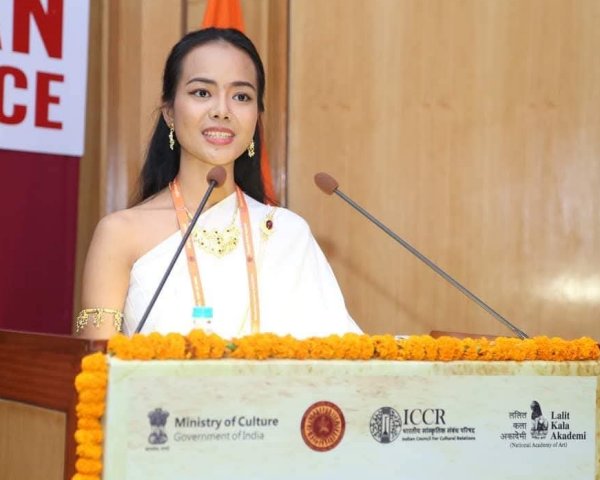 Awassada addressing seminar on Indian dance diaspora in Delhi Excerpts from the interview: How did you get interested in dance? I was born into a family of Thai classical musicians. Therefore, I grew up surrounded by the arts traditions of ancient Thailand. As a kid, I was quite fond of dancing. I began learning classical Thai dance as part of my school's dance curriculum from kindergarten when I was just four years old. I started studying Thai dance at the age of 13. During the same year, I formed a group with friends who loved Indian dance. We discussed and practiced dance moves using television, YouTube and films, as it was difficult to find teachers at that time. Later, when I was about 16, I studied at the Swami Vivekananda Cultural Centre. After that, I studied with many other teachers as opportunities arose. From my undergraduate studies onwards, I studied with teachers more regularly, as the Thai dance teachers in the faculty were also graduates Master of Bharatanatyam in India. I enrolled myself in The College of Dramatic Arts to study classical Thai dance. I graduated in Thai dance in 2023, received scholarship from ICCR and then completed my Masters from the Department of Performing Arts of Banaras Hindu University in India. 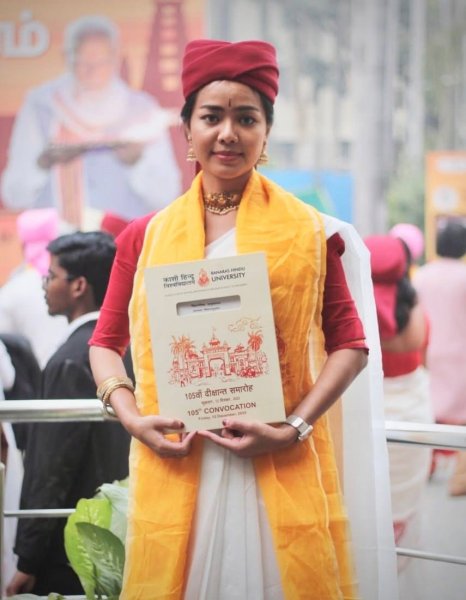 Master's Degree from BHU Thailand has so many beautiful dance forms and you graduated with Thai dance as well. But why did you choose this Indian dance style of Bharatanatyam as your profession? Born into a family that practices classical Thai music, I was well exposed to Indian arts and culture. The roots of Thai culture, religion, and beliefs are derived from India. As a child, I learned about Hindu deities such as Bharata Muni, Ganesha, Shiva and others through the rituals and ceremonies. My father's explanations about these rituals and ceremonies also helped me further to understand the roots and the traditions during my growing up years. as a child. I enjoyed reading history, religion, and social studies books and as a child, I loved watching Indian films about gods which often featured ancient dances. All these exposures inspired me to think further about Thai dance having its roots in Indian dance. And I focused on Bharatanatyam because it is a South Indian dance form based on Bharata Muni's Natyashastra. You would be happy to know that every year during the Thai New Year in April (Songkran), all family members gather to worship Bharata Muni. We were taught to respect him as if he was the most revered elder in the family. How old is the India-Thailand cultural bond? In south-east Asia, our culture originated from the migration of ancient Indian Brahmins during the Chola-Pallava dynasty. In southern Thailand, statues of Vishnu in the Pallava style have been unearthed. Therefore, the cultural roots of Thailand and South India are very strong. It can be said that we have an Indian father and a Thai mother as far as our culture is concerned. This is why I asked my family's permission to study Thai classical dance to explore more about our roots. I believed that to truly understand something, I must master our own arts form. 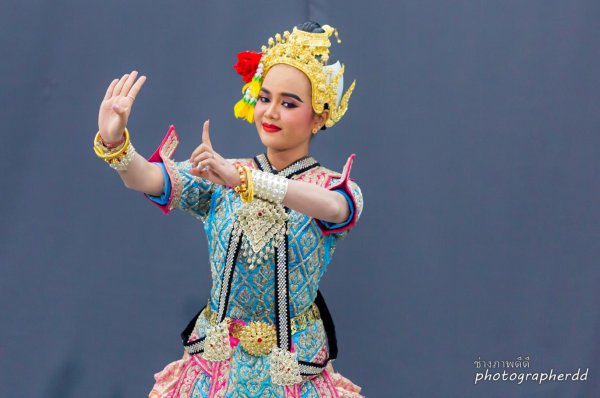 Awassada performing Lakhon Nok Thai folk dance Bharatanatyam uses Tamil, Telugu and Sanskrit literature. How could you follow these south Indian languages? I am fortunate to have received kindness from several Sanskrit and Tamil language teachers. I also have some Thai friends who appreciate South Indian culture and are very skilled at translating these languages. Therefore, I can often ask them for help with translations whenever I am learning new songs. You once said that Padma Subrahmanyam and Harinie Jeevitha were your inspiration. How did they inspire you? When I started learning Bharatanatyam at the age of 13, I diligently searched the internet every day until I found a video of Harinie dancing. The first time I saw her, I was amazed by her talent. She could perform difficult Karanas, and her dance was captivating. She completely charmed this young Thai girl and became a strong inspiration to me, fueling my dream of studying Bharatanatyam in India. I have never met her, but I wish I get the chance to meet her at least once to thank her for being my inspiration that motivated me to practice diligently until I received a scholarship from the Indian government to pursue higher studies in Bharatanatyam. I learnt about legendary Padma Subrahmanyam from an older Thai friend who loved Kuchipudi dance and told me that she performed Karana gracefully. During my high school years, I briefly compared Thai dance movements with Karana movements on my personal Facebook page. Later, I had the opportunity to present on the stories of Indian and Thai dance through hosting a seminar and demonstrating dance movements. That presentation garnered significant interest from academics in Thailand. Since then, I was keen to meet the legendary dancer and scholar. My dream came true after I landed in India. I had the opportunity to meet her in Chennai and Delhi and discussed various matters concerning Bharatanatyam. She is a very compassionate teacher. Since I knew her, I have studied her work with utmost interest. I must also mention two more names who have been very inspiring to me. The person who inspired me about abhinaya performance is legendary Balasaraswati. I heard her name and story from a teacher who had the opportunity to study Bharatanatyam in India. I also have Aniruddha Knight as another great inspiration for the profound depth of this dance form. I met this brilliant dancer when he performed at Chulalongkorn University in Bangkok in 2022. I was very impressed by the magical storytelling techniques of his style. 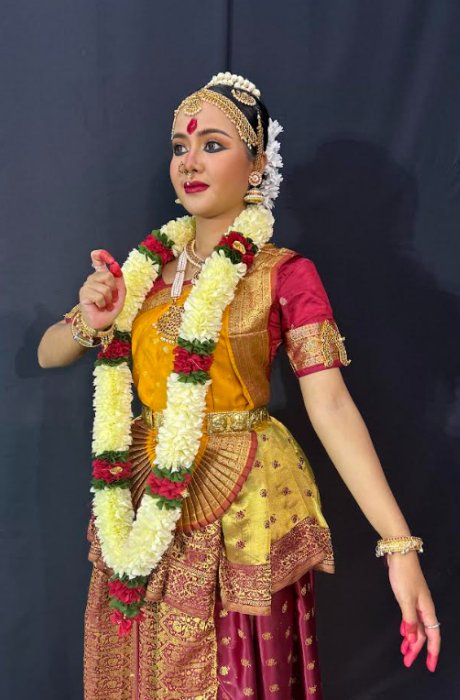 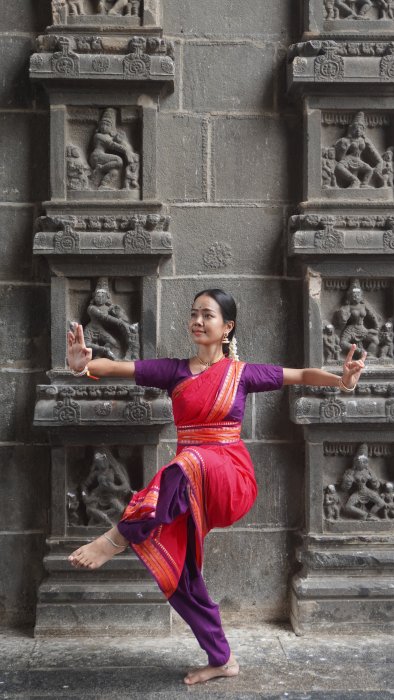 Awassada in Bharatanatyam You have got good exposure to dance and cultural traditions of Thailand and India. What have been your findings so far? From my studies, I discovered many connections between India and Thailand, such as the worship of Brahmanical deities, performing arts traditions, ritual practices, and many more that are undeniably traces of the influence of Indian culture and Natyashastra, evident in Thai dance over the course of centuries. As the co-researcher of academic articles "Ram Phat Cha", I have studied the trace of Indian dance in the Siamese Royal Elephant Sacred Ceremony. As the Indian dance demonstrator in comparing the influence of Indian dance and Thai dance on the TV shows "Oh my God!", I have made a significant presentation. Further, my comparative study resulted in being moderator of a seminar titled "Influence of Indian Dramatic Arts on Thai Dramatic Arts" while I was an intern at Thai-Bharat Cultural Lodge, Thailand. My latest study has been on Assam's Sattriya dance tradition. I found the Thai arm gestures are very similar to the Sattriya arm gestures. So, it may be one of the most beautiful heritage elements we have received. And there are many more beautiful things that we are interested in studying. How is the Indian classical dance scene in Thailand? Indian dance is now much more well-known than it was 20 years ago when it was recognized only in international dance courses at various educational institutions. Nowadays, it's more widely known through various social media channels, largely due to the popularity and reverence for South Indian gods, as I have already mentioned. International travel has also become easier and many Indian dancers travel to Thailand to perform. Therefore, access to Indian dance is much easier than when I was a child. Indian dance forms present in Thailand today include Bharatanatyam, Kathak, Kuchipudi, Mohiniattam, Odissi and Kathakali. Of all the Indian dance styles, Bharatanatyam has the largest proportion in Thai society. The teacher who laid the foundation of Indian dance in Thailand is Chaturong Montrishastra. He was the first Thai to travel to Kerala Kalamandalam to study Indian classical dances of Kathakali and Mohiniattam. He was also the first to lay the foundation of Indian dance in the Thai dance education system. With his dedication, he had produced many works and many young people are following his footsteps. Many young Thais are interested in South Indian culture and have great faith in Gods. They know that dancing is one of the Ṣhodasopachara Puja (Sixteenfold Ritual Worship), so they learn Bharatanatyam as an offering to God. In the international dance courses included in various Thai universities, teachers ask students to create their performances by applying knowledge from Bharatanatyam. 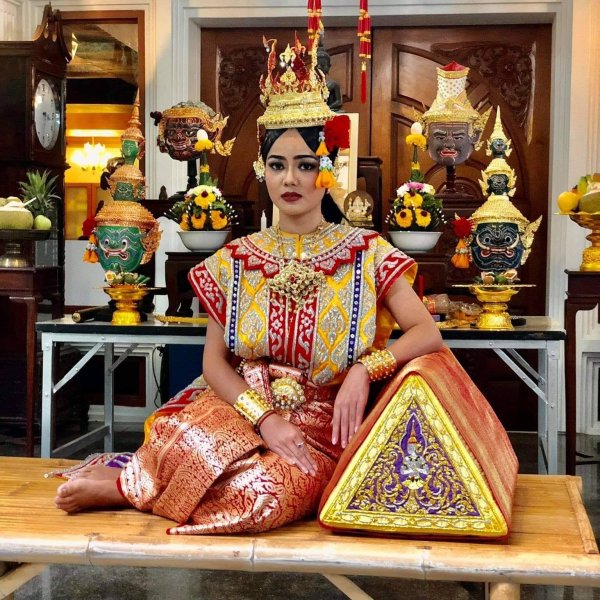 Awassada performing Khon dance What is your future career plan? Currently, I work as a Bharatanatyam teacher at the Swami Vivekananda Cultural Centre under the Embassy of India in Bangkok. I plan to set up a small private studio offering instruction in both Thai and Indian dance. I might also include Sanskrit lessons if possible. Is it possible for a Thai dancer to survive economically as an Indian classical dancer in Thailand? I believe it is possible. Renowned and successful dancers are invited to teach at various educational institutions. Most of them work in Thai educational institutions as international dance instructors. Furthermore, a number of Thais are currently very interested in South Indian culture including their reverence for South Indian deities. They possess excellent knowledge of Ṣhodasopachara Puja and therefore understand that offering dance to the deities is essential. I myself have been frequently invited to perform dances for the gods. In addition, we also work behind the scenes for various performances, concerts, film sets, and much more. Did you find anyone in India interested in learning any dance form of Thailand? Actually, I have never met anyone who was seriously interested in study of Thai dance. Most of them just had a normal level of interest and admiration. Bangkok to Banaras and now back home in Bangkok. How has this journey to India been as an artiste? I am blessed for Kashi's philosophical and spiritual awakening. It was here that I gained a profound understanding of the philosophy embedded in the lyrics of Bharatanatyam dance. Furthermore, Kashi is an ancient city, rich in traces of civilization and traditions that provide me with inspiration for my artistic endeavors. Kashi is a magical place where I encountered every aspect of Indian culture from across the country. My two years in Kashi were truly transformative and magical. It was amazing! The other cities that I visited across India included Khajuraho, where I viewed the bas-reliefs for inspiration; Shillong, which has a landscape and the food very similar to Thailand; Chidambaram, a sacred temple that every dancer should make a pilgrimage to at least once in their lifetime, where I witnessed the Karanas; Brihadeeshwara Temple, the origin of Bharatanatyam, showing traces of the existence of the nattuvanar and devaradiyar; Mahabalipuram - Srirangam, to see the origins of the bas-reliefs, paintings, and architecture of the Pallava dynasty, which evolved into the art and architecture of the Suvarnabhumi region and became modern Thai art; and Kanchipuram, the place where Balasaraswati, a legendary figure, had her arangetram.  A former journalist and arts critic with Indian Express and The Hindu for over 20 years, Shyamhari Chakra is a New Delhi based writer covering dance. Post your comments Please provide your name when you use the Anonymous / blog profiles to post a comment. All appropriate comments posted with name in the blog will be featured in the site. |
