
|
    |
|
|
|

INTERVIEWSandhya Raman and Suma Suresh on the layers of art forms that brought interdisciplinary 'Kintsugi' to life- Shveta Arorae-mail: arorashveta1806@gmail.com Photos: Anoop Arora June 12, 2026 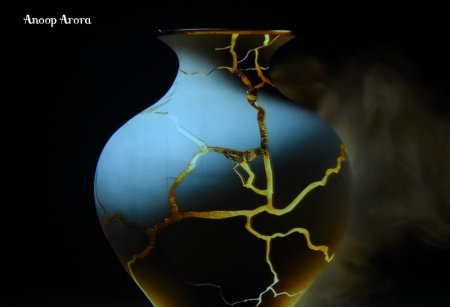 The AV showed a pot breaking and coming together with golden seams to depict kintsugi Starting late 2025 and continuing well into 2026, Lata Pada's Canada-based Sampradaya Dance Creations toured with the production 'Kintsugi'. Kintsugi is a Japanese art that honours broken pottery by mending it with gold lacquer, highlighting the breaks rather than hiding them and 'embracing embellished brokenness'. The concept of the production was that kintsugi is 'where rupture meets renewal and radiance', 'what we lose, what we mend and what endures'. It was applied to the Mahabharata, reimagining volatile and unresolved ruptures in relationships as points of transformation or healing. It was a rich amalgamation of Kathak, Bharatanatyam and contemporary dance, which was very well woven into the music and the rhythm. Plus, there was a natya element in enacting the stories - Eklavya and Drona, Draupadi and Yudhishthir, Kunti, Arjuna and Karna, Gandhari and her daughter Dushala. 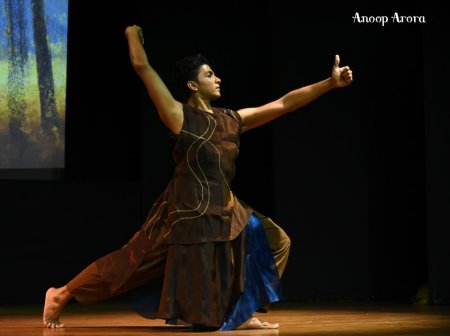 Arun Sreekumar as Eklavya 'Kintsugi' was conceived by Lata Pada and co-choreographed with Sampradaya's artistic director Suma Suresh. It features an original score blending classical Indian music by the ensemble Trayam, featuring Praveen D. Rao, B.C. Manjunath and Grammy-nominated singer Varijashree Venugopal. It was performed by dancers Atri Nundy, Purawai Vyas, Rachana Joshi, Harikishan S. Nair, Arun Sreekumar and Tanveer Alam. Light design was by Bharat Vyas, projections by Tara Rose Morris and costumes by Delhi-based designer and curator Sandhya Raman. 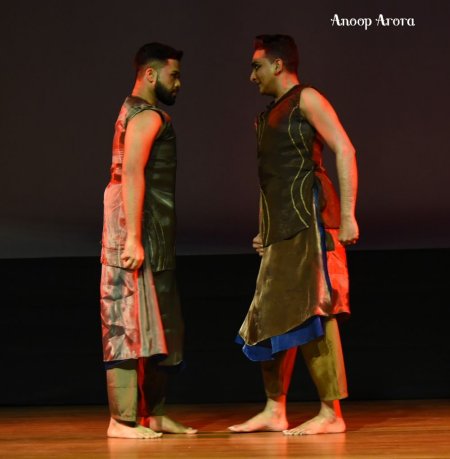 Tanveer Alam and Harikishan S. Nair as Arjuna and Karna; the costumes appeared brown, brass or gold based on the light In Delhi, 'Kintsugi' was presented by Sandhya Raman's Desmania Foundation. The dancers wore black costumes with hues of blue and brown interspersed with rills and wisps of gold to show themselves as the vessels that break and mend. The costumes were flowy, unstructured and seemed to change hues as the lighting shifted, brilliantly reflecting the layered and complex concept of the production in its aharyam. I spoke to Sandhya and to Suma Suresh, the co-choreographer of 'Kintsugi', about the intriguing presentation. Sandhya Raman 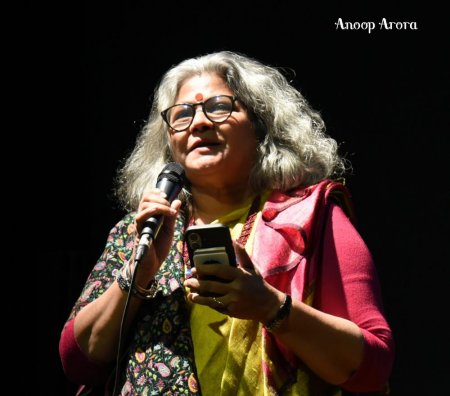 Sandhya Raman Sandhya Raman is a Delhi-based, internationally known costume designer, curator and textile activist. For over three decades, she has been not only designing for dance, but also curating fabrics and productions, reviving textiles and contributing to design in various ways. It is only Sandhya who could have given not just words but also mouths to the costumes. She makes them sing, speak and dance with the wearer; she makes each warp and weft talk to you. The costuming for the event was admirable. Q: I want to know your take on the whole production. A: My take is that (in modern society), we think of the entire vessel as broken. Can we have a different method, a different perspective of repairing it? Can we question stereotypes? There is always scope to rethink and rebuild. In a fragmented society, how do we see the layers and bring out the beauty within that? How do we put them back together and resurrect them? (We took episodes of unresolved ruptures from the Mahabharata) Each episode was revisited - how do we nurture these relationships again? The rethinking is the kintsugi part of it. The golden cloth was the repair and rethink, and a symbol that everything broken can be mended. Q: Tell us more about the costume design. A: There is shimmer in the cloth and the colours are that of Japanese vessels. There is the influence of Japanese work and the silhouettes are Japanese. Though we are taking stories from the Mahabharata, the influence is of Japanese culture. You are marrying the art forms through the production. The silhouettes were loose and flowing with layers, and on top of those was the kintsugi work, the lacing between the layers, and from each layer you see the colours that come out and brighten up. 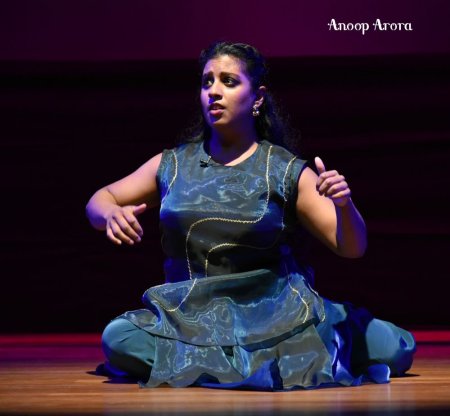 Atri Nundy; the costumes featured snaking rills of gold that caught the light and glinted as the dancers moved to show the golden lacquer in kintsugi Q: The colours took on different hues as the light changed. A: That is to show the different personalities and different perspectives that you are going through. There are so many differences and different possibilities, so many variations that we are going through - it cannot all be shown with a monotonous colour scheme. Each layer comes out as if dust is being removed and a pop of colour emerging, showing that there is a spark, a meaning to whatever you do. Suma Suresh 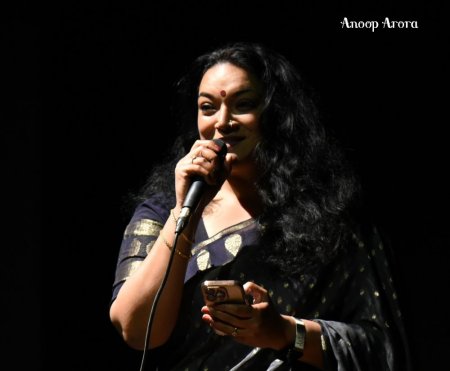 Suma Suresh Suma Suresh is a Bharatanatyam and contemporary dancer, and the artistic director of Sampradaya Dance Creations in Mississauga, Canada. She holds a Master of Fine Arts in Dance Choreography from York University and won the 2019 MARTY Award for Dance. "This was a unique and special production, since this was the first time we were venturing into the theatrical space, and we made it interdisciplinary in many ways. It wasn't easy, but my dancers were also a bag of surprises. They have the skill. We had recently done a smaller work called "The Children of Air India" with the three female dancers (in "Kintsugi") enacting poetry - bringing poetry to life through spoken word and movement. So we had seen a bit of skill there and we thought, let's tap into this and create a work that's not pure dance, go into experimenting with theatre as well. I am a theatre actor myself, so I could contribute. We also called in a voice coach who could help the dancers with voice modulation, intonations and the cadence of speaking." "These are familiar characters and episodes from the Mahabharata, so it was devised together. It was a collaborative process since we had brought the dancers in very early on to workshop movements. In fact, we began the process with a kintsugi workshop in which we broke pottery and mended it with gold. It was like a team-building exercise; everybody - cast and crew - sat together to get the essence of it, and then we moved into the studio and understood what cracks in a body mean, what fractures in movement mean, we built phrases and distilled it all into a whole box of phrases. Not everything made it to the final cut, of course." "And then Lata Pada and I worked on the text. Then we had the dancers exercise these, use their voices and deliver their lines, and if something didn't make sense, if it sounded too lofty or too light, we tweaked it. The text was being refined till just before we left for the tour! But the dancers have all been such sports." 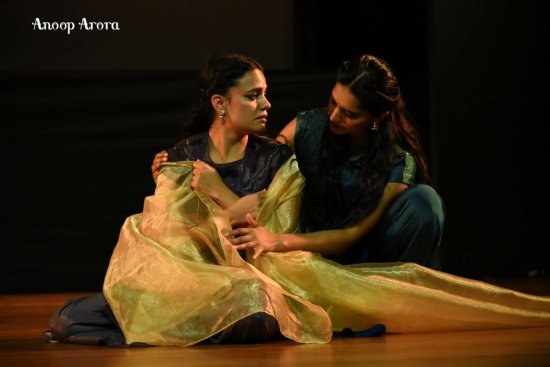 Purawai Vyas and Rachana Joshi as Dushala and Gandhari; the golden cloth tied all four episodes together and also depicted healing, as in the theme of repaired pottery "We did not directly use the scriptures, but we used all the research we have done, our readings of the various versions of the Mahabharata, our research online, plus we reimagined the incidents. This is not how they occur in the Mahabharata. It was not Dushala who unravelled her mother's blindfold, Dronacharya did not have that reaction for Eklavya when he cut his thumb. We were experimenting and were taking a risk because we did not know if it would land well. But here we are - the cities we've performed so far, everyone seems to like it." "It was important for us to show healing, hope and the acceptance of where we are. And not everything may be healed fully - healing is also a process, it's not linear. That is how we ended with a lullaby, because there is nothing more healing than a mother's voice. That was actually down to our music composer, Praveen D. Rao, who is a genius. In fact, he also came into the process early, so his contributions have also helped navigate our narrative through the hour-long work. We are celebrating collaboration also through this process, from the lighting design to the visual projection, sound, light, acting, dancing - that's why it's special for us. It's not one person sitting there and devising the entire thing - it's everybody's contribution, and their talent and skill is on display."  Shveta Arora is a dance-mad writer who chronicles classical dance events in Delhi (and also those online). In 2009, she started the blog Kala Upasana at delhiculturecomment.blogspot.com, where she began posting her own writing along with photographs clicked by Anoop Arora, her husband. She's been dancing all her life as a devotee, but resumed her formal training in Kathak in her 50s and has passed her fifth year Kathak exams. Post your comments Please provide your name when you use the Anonymous / blog profiles to post a comment. All appropriate comments posted with name in the blog will be featured in the site. |
